How to Use AI to Get More From Your Agency
TL;DR
- 88% of organisations now use AI in at least one business function. If your agency isn’t using it, they’re already behind. If you’re not using it, so are you.
- Better-prepared clients get better results. AI helps you create sharper briefs, give more useful feedback, and have strategic conversations instead of administrative ones.
- This post includes copy-paste prompts for five high-value use cases: brief creation, deliverable review, report analysis, brainstorming, and pressure-testing recommendations.
- We’ve included an AI comparison table so you know which tool to use for what.
- We want clients who want to win. AI restrictions cap outcomes. We’d rather be upfront about that than waste everyone’s time.
We don’t want average clients.
It’s not arrogance. It’s alignment. Our whole model is built around delivering results that actually move businesses forward. Long-term partnerships. Work we’re proud of. Outcomes worth talking about.
That only works if both sides are pulling in the same direction.
Which brings us to an uncomfortable conversation we’ve had more than once. What happens when a client actively ties our hands?
The Reality of AI Restrictions
We’ve had clients specifically request that we don’t use AI on their account.
We get it. There’s anxiety around AI. Headlines about hallucinations. Concerns about quality. Fair enough.
But the reality is this: asking your agency not to use AI in 2025 is like asking them not to use Google in 2005. You’re not protecting quality. You’re capping it.
According to McKinsey’s State of AI 2025 report, 88% of organisations now use AI in at least one business function. That’s up from 78% just a year ago. The high performers aren’t just adopting AI. They’re three times more likely than their peers to be scaling it across multiple functions.
The gap between AI-enabled businesses and everyone else is already visible. And it’s widening fast.
Why This Matters to Us
Our ethos has always been clear. We focus on conversions, not vanity metrics. We don’t do lock-in contracts because we’d rather keep clients through results than paperwork. We’ve been doing this since 2008. Through the shift from Yellow Pages to Google. From desktop to mobile. And now into whatever this next era becomes.
Every one of those shifts rewarded the businesses who leaned in and punished the ones who held back.
This one’s no different.
When a client insists on restrictions that limit what’s possible, something has to give. Whether that’s refusing to update a broken website, ignoring data, or mandating we don’t use the tools that make exceptional work possible.
Either the results suffer, or the relationship does.
We’d rather be upfront. If you want standard outcomes, we’re not your agency. There are plenty of shops who’ll happily bill hours and deliver average. That’s not what we’re building here.
The Flip Side: AI Makes You a Better Client
The same AI that’s changing how agencies work can change how you work with your agency.
Better-prepared clients get better results. The conversation shifts from hours to outcomes. Everyone levels up.
So instead of just telling you what we won’t accept, here’s how to use AI to get more from any agency you work with. Including us. We’ve included copy-paste prompts you can use today.
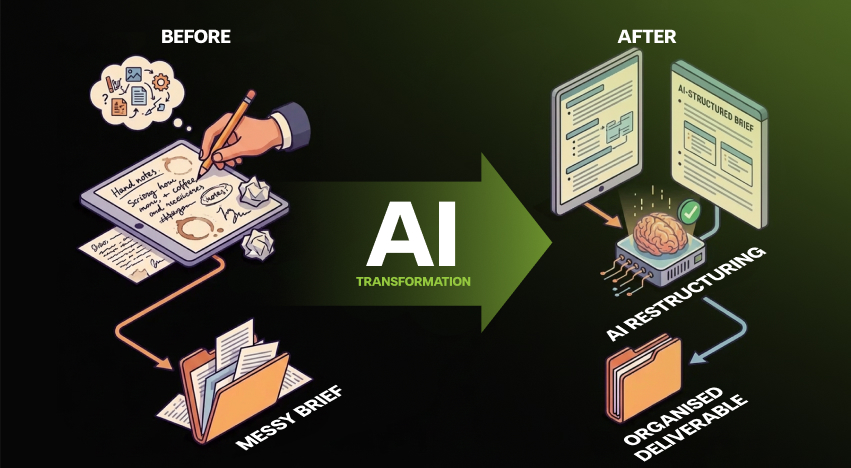
1. Create a Brief That Actually Gets You What You Want
The single highest-leverage thing you can do before engaging any agency: use AI to build your brief.
Not “we need more leads.” Not “make it pop.”
A proper brief. One with what you’ve already tried. Competitor examples. Tone references. The actual business problem. And constraints worth knowing.
Here’s how. Dump your messy notes, internal emails, and half-formed thoughts into Claude or ChatGPT. Ask it to structure a marketing brief. Refine it. Argue with it. Then send that to your agency.
You’ll skip two discovery meetings and get straight to strategy.
Prompt Template: Brief Creation
I need to brief a digital marketing agency on [PROJECT TYPE, e.g., “a Google Ads campaign for our new product launch”].
Here’s what I know so far:
[PASTE YOUR MESSY NOTES, EMAILS, OR THOUGHTS HERE]
Please structure this into a professional marketing brief that includes:
1. Business objective and success metrics
2. Target audience description
3. What we’ve tried before and what worked or didn’t
4. Competitor examples we like (and why)
5. Tone and messaging direction
6. Budget and timeline constraints
7. Any internal approvals or stakeholders to considerAsk me clarifying questions if anything is missing.
The agencies who receive briefs like this immediately know you’re serious. The engagement starts differently. The work is better from day one.
2. Review Deliverables Before the Feedback Call
Your agency sends you a draft campaign. A landing page. A set of ad creatives.
You sit on it for three days. You arrive at the meeting with “I’m not sure about it” or “can we try something else?”
That’s not feedback. That’s a feeling without language.
Instead, upload the creative to AI. Ask what’s working, what’s unclear, what questions you should be asking. Come to the call with specifics.
“The headline feels off because it doesn’t address the timeline objection we discussed in the brief.” That’s useful.
“I don’t love it.” That’s a revision cycle that helps nobody.
Prompt Template: Deliverable Review
My agency has sent me this [AD COPY / LANDING PAGE / CREATIVE CONCEPT]:
[PASTE THE DELIVERABLE HERE]
Our original brief objectives were:
[PASTE KEY POINTS FROM YOUR BRIEF]
Please help me review this by:
1. Identifying what’s working well
2. Flagging anything that doesn’t align with the brief
3. Noting any unclear messaging or missing elements
4. Suggesting specific questions I should ask the agency
5. Recommending 2-3 specific improvements I could requestGive me language I can use in the feedback call.
You don’t need to be a copywriter or designer to give precise feedback. You just need five minutes with AI before the call.
3. Actually Understand Your Reports
CPC. ROAS. Core Web Vitals. Impression share. Quality Score.
If your eyes glaze over during monthly reviews, you’re not getting value from them. And you can’t hold your agency accountable for outcomes you don’t understand.
Before your next catch-up, paste the report into AI. Ask it to explain what each metric actually means for your business. Get it to highlight what’s improved and what’s declined. Ask it to suggest questions you should be asking.
You’ll know within five minutes whether you’re actually winning or just being managed with green charts and optimistic language.
Prompt Template: Report Analysis
Here’s my monthly [PPC / SEO / PAID SOCIAL] report from my agency:
[PASTE REPORT DATA OR KEY METRICS]
I’m a business owner, not a marketer. Please:
1. Explain what each metric means in plain English
2. Tell me what’s improved vs. last month and what’s declined
3. Flag anything that looks unusual or concerning
4. Give me 5 specific questions I should ask my agency
5. Tell me honestly: does this report show we’re winning or just treading water?Be direct. I’d rather know the truth than feel good.
This isn’t about catching your agency out. It’s about having a real conversation instead of a presentation.
4. Brainstorm Before You Brief
Don’t arrive with a problem. Arrive with hypotheses.
Bad: “We need more leads.”
Better: “We’ve been thinking about targeting renovators specifically with messaging around timeline guarantees. What’s your take on that versus our current broad approach?”
The second version is a strategic conversation. The first is a blank canvas that’ll cost you two weeks of back-and-forth.
AI makes brainstorming free. Before your next agency conversation, spend 20 minutes exploring angles you haven’t tried.
Prompt Template: Pre-Meeting Brainstorm
I’m meeting with my digital marketing agency next week to discuss [TOPIC, e.g., “improving our lead generation”].
About my business:
– Industry: [YOUR INDUSTRY]
– Target customer: [WHO YOU SELL TO]
– Current approach: [WHAT YOU’RE DOING NOW]
– Main challenge: [WHAT’S NOT WORKING]Help me prepare by:
1. Suggesting 5 angles or approaches we might not have considered
2. Identifying what competitors in similar industries are doing
3. Listing the key questions I should be asking
4. Helping me articulate 2-3 hypotheses to testI want to show up with ideas, not just problems.
You don’t need the right answers. You need better questions.
5. Pressure-Test Agency Recommendations
Your agency recommends a new platform, a creative direction, a budget shift.
Instead of just nodding or pushing back based on gut feel, use AI to stress-test it.
This isn’t about second-guessing your agency. It’s about being an informed partner in the decision. The best agencies will welcome the scrutiny. It means you’re engaged.
Prompt Template: Recommendation Stress-Test
My agency has recommended the following:
[DESCRIBE THE RECOMMENDATION]
Their reasoning is:
[THEIR JUSTIFICATION]
Help me evaluate this by:
1. What are the potential risks or downsides of this approach?
2. What would need to be true for this to succeed?
3. What alternatives exist and why might they be better or worse?
4. What questions should I ask to validate this recommendation?
5. What benchmarks or data should I request to measure success?I trust my agency but want to be an informed decision-maker.
Which AI Should You Use?
Not all AI tools are created equal. Here’s a quick comparison to help you choose the right one for each task:
| Use Case | Best Choice | Why |
|---|---|---|
| Writing and Editing | Claude | Best at capturing tone, refining prose, and longer-form content. Fewer hallucinations on detailed work. |
| Brief Creation | Claude or ChatGPT | Both excel at structuring messy information. Claude for nuance, ChatGPT for speed. |
| Report Analysis | Claude | Handles large documents well with minimal errors. Good at plain-English explanations. |
| Brainstorming Ideas | ChatGPT | More creative and wide-ranging suggestions. Good at “what if” scenarios. |
| Research and Fact-Finding | Perplexity | Built for search. Cites sources directly. Best for checking claims and finding current data. |
| Working with Google Docs | Gemini | Native integration with Google Workspace. Good for summarising docs you already have. |
| Image Generation | ChatGPT (DALL-E) | Best text rendering and instruction-following for marketing visuals. |
| Coding and Technical Tasks | Claude | Strongest performance on complex code and debugging. Good at explaining what it’s doing. |
Our recommendation: Start with Claude for most business tasks. Use Perplexity when you need to verify facts or find current information. Add ChatGPT for brainstorming and creative work.
All of these have free tiers. There’s no excuse not to experiment.
The Two Paths
We’ve seen both sides now.
- Clients who embrace AI as a collaboration tool get more from us. The briefs are sharper. The feedback is specific. The conversations are strategic instead of administrative. The results compound.
- Clients who treat AI as something to be avoided? The engagement drags. Revision cycles multiply. We spend hours on alignment that could’ve been solved with a better brief. Nobody’s happy. Not them, not us.
So here’s where we’ve landed:
We want clients who want to win.
AI isn’t the point. Exceptional outcomes are. But right now, AI is the difference between good and exceptional. In speed. In precision. In what’s even possible.
We’re not going to win awards delivering handicapped work. We’re not going to build long-term relationships where both sides are frustrated. And we’re not going to tank our efficiency because a client read a scary headline about chatbots.
Clients who get that? We’ll go to war for them. We’ll find angles nobody else is finding. We’ll move faster, test more, and compound results over years.
Clients who want to pretend it’s still 2019? We wish them well. But we’re not the right fit. And we’d rather say that upfront than waste everyone’s time.
What This Means for You
If you’re reading this and nodding, we should talk.
Not because you need to be an AI expert. You don’t. But because you’re the kind of client who wants to get better, not stay comfortable.
Use the prompts in this post. Build better briefs. Come to meetings with sharper questions. Treat AI as a tool that makes both of us better.
That’s the partnership we want.
And if you’re reading this and bristling? If the whole thing feels like we’re being difficult or precious? That’s okay too. There are plenty of agencies who’ll work the way you want to work. We’re just not one of them anymore.
We’ve picked a lane. Exceptional outcomes, or nothing.
If that sounds like your kind of agency, get in touch with our team to discuss how we can help you move forward.
Do I need to be an AI expert to work with a modern digital agency?
No. You don’t need to know how AI works. You just need to be willing to use it as a collaboration tool. The prompts in this post are copy-paste ready. If you can use Google, you can use AI to prepare better briefs, give clearer feedback, and have more strategic conversations with your agency.
Which AI tool should I start with?
Start with Claude for most business tasks like writing briefs, reviewing deliverables, and analysing reports. Use Perplexity when you need to research or verify facts. Add ChatGPT for brainstorming and creative ideation. All have free tiers, so you can experiment without commitment.
Will my agency be offended if I use AI to review their work?
Good agencies will welcome it. Using AI to prepare specific, actionable feedback shows you’re engaged and serious about outcomes. It’s the vague “I’m not sure about it” feedback that frustrates agencies. Not informed questions. If your agency is threatened by you being more prepared, that tells you something.
How do I know if my agency is actually using AI effectively?
Ask them. A good agency should be able to explain how they’re using AI to improve efficiency, quality, or outcomes on your account. If they’re evasive or dismissive, that’s a red flag. The best agencies are transparent about their tools and processes. Including AI.
What if I’m concerned about AI quality or hallucinations?
Valid concern. But it applies to using AI without human oversight, not to using it as a collaboration tool. AI is best used to accelerate human work, not replace it. Your agency should still have experienced humans reviewing, refining, and taking responsibility for deliverables. AI handles the drafting and analysis. Humans handle the judgment.
Is Click Click Media saying they won’t work with clients who don’t use AI?
We’re saying we want clients who want to win. And right now, that means being open to the tools that make exceptional outcomes possible. We’re not interested in delivering handicapped work because of arbitrary restrictions. If you want standard outcomes, there are agencies for that. We’re not one of them.