Is Your Digital Marketing Agency the Right Fit?

Most brands don’t wake up one morning and decide their agency isn’t the right fit.
There’s a specific kind of anxiety that comes with suspecting your agency isn’t working out. You’re not sure if the results are actually bad or just feel bad. You wonder if switching would fix things or just reset the clock on a different set of problems. And somewhere in the back of your mind, you’re calculating whether raising concerns will make the relationship worse.
We see this moment often. And the data supports it.
A 2024 Setup Survey found that 40% of brands are considering switching their primary agency within six months. Nearly half the market is quietly questioning whether their current setup is actually serving the business, while still attending polite status meetings and approving monthly invoices.
The challenge is not deciding whether to switch. It’s deciding whether switching would materially improve outcomes, or simply reset the clock.
The Real Cost of Getting It Wrong
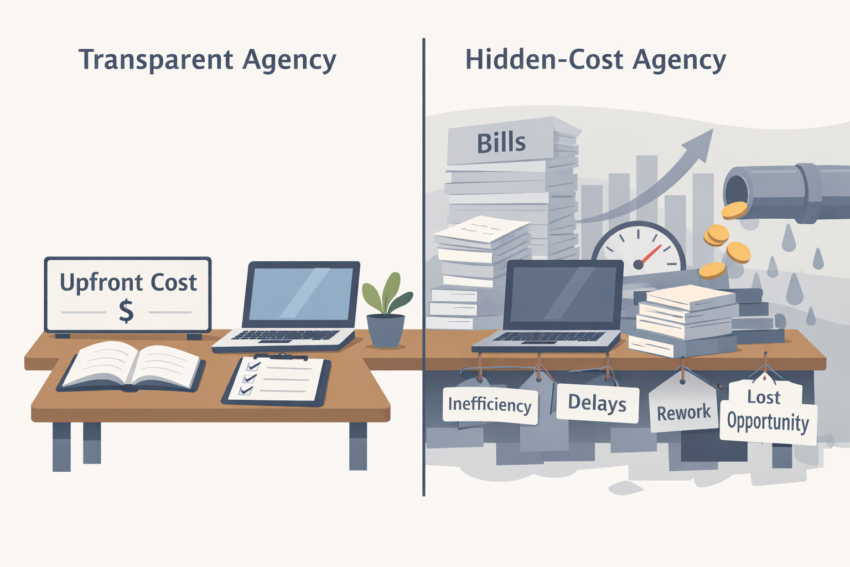
Changing agencies is expensive.
Research from the ANA and 4As estimates the average cost of a formal agency pitch at approximately $408,500, once you factor in internal time, consultants, onboarding, and performance disruption during handover.
That figure alone is enough to keep many brands stuck in underperforming relationships.
But there’s a second cost that rarely gets calculated: the compounding loss of staying put.
We worked with a retail brand that had spent eighteen months with their previous agency. On the surface, nothing looked broken. Budgets were stable. Reports were delivered. Meetings happened.
But when we audited the account, the Google Ads change history told a different story. For six months straight, almost nothing had changed. Same keywords. Same bids. Same ads. No testing. No iteration.
The real cost wasn’t the agency fee. It was eighteen months of lost momentum while competitors kept moving.
The goal is not to avoid switching at all costs. The goal is to assess, clearly and honestly, whether staying is doing more harm than leaving.
The Signals That Something Isn’t Working
Some warning signs are obvious. Others only become clear when you zoom out and look for patterns.
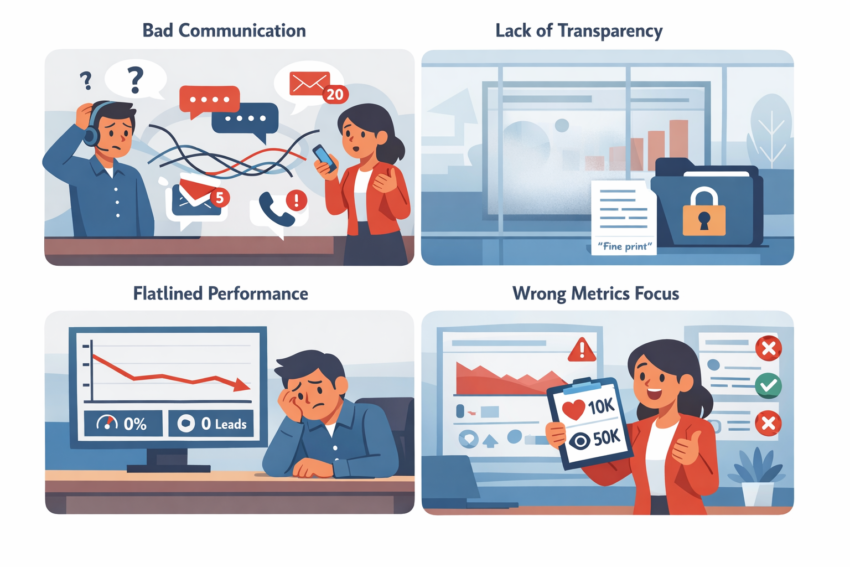
Communication That Looks Fine, But Isn’t
Slow responses, frequent account manager changes, and defensive answers are easy to spot.
The more dangerous version is subtler: an agency that is reactive, but never proactive.
They reply when you email. They attend scheduled meetings. But they never surface ideas, risks, or opportunities unprompted. No early warnings. No “we’ve noticed a shift.” No forward-looking thinking.
When meetings consist of reading metrics you can already access, you’re not paying for strategy. You’re paying for reporting.
In our experience, communication issues rarely fix themselves. They usually point to one of three problems: capacity constraints, internal turnover, or low client priority. None improve without intervention.
Transparency Gaps That Shouldn’t Exist
There are baseline standards that should never be negotiable.
You should have admin access to every platform spending your money. Google Ads, Meta Business Suite, Analytics, Search Console – all of it. Not viewer access. Not “we’ll send you screenshots.” Full admin access from day one. If an agency hesitates here, the question isn’t whether to push back. It’s why they don’t want you seeing what they’re doing.
You should understand what work was done last month, not just what metrics moved. An agency hiding something will deflect to “strategy” and “optimisation” without specifics. We’ve audited accounts where the change history showed three minor bid adjustments across an entire quarter. That’s not management. That’s neglect with a monthly invoice attached.
You should own your digital assets, not discover later that they’re locked inside proprietary systems. Your agency should manage your digital assets, not own them. We’ve seen businesses discover their domain was registered in their agency’s name, their Google Ads account was a sub-account of the agency’s MCC with no transfer rights, and their website was built on proprietary systems requiring complete rebuilds to leave. This isn’t accidental. It’s leverage. If you discovered tomorrow that your agency relationship was ending, could you walk away with everything you’ve paid for? Check this now, not when you’re already trying to leave.
We regularly audit accounts where “optimisation” turns out to be three minor changes across an entire quarter. That’s not management. That’s inertia with an invoice attached.
If an agency is hesitant to show change history, itemise work, or grant access, the issue isn’t process. It’s trust.
Performance That Has Flatlined
Early gains followed by long plateaus are one of the most common failure patterns we see.
External factors do exist. Markets change. Algorithms shift. Competition increases. The question is whether your agency responds with adaptation or excuses.
A useful diagnostic is simple: What has been tested and learned in the last 90 days? Not what’s running.
What hypotheses were formed, tested, and validated or rejected?
If the answer is “nothing meaningful,” you’re no longer paying for growth. You’re paying for maintenance.
Optimising the Wrong Metrics
We once inherited an ecommerce account where the previous agency proudly reported a 40% reduction in cost per click.
Revenue was down 25%.
They had achieved efficiency by shifting spend toward broad, low-intent keywords that looked good in reports but attracted browsers, not buyers.
This is what happens when agencies optimise what’s visible in their dashboards rather than what matters in the business.
Good agencies understand enough about your commercial model to occasionally push back on requests. Vendors execute. Partners advise, even when it’s uncomfortable.

The Structural Issues That Hold Results Back
The Siloed Agency Problem
“We specialise purely in SEO” or “we only do PPC” Sounds disciplined. Sounds focused.
In practice, it often means you’ll spend a significant portion of your retainer listening to your agency point fingers at your developers, your web team, or your other vendors, without fix.
Modern SEO and paid media are inseparable from development and design. Site speed, structured data, JavaScript rendering, landing page experience, and mobile performance directly affect outcomes.
We’ve inherited accounts where the previous agency’s monthly reports consistently blamed “slow site speed” or “poor mobile experience” for underwhelming results, the same issues flagged month after month, never resolved, because the agency couldn’t implement the fixes they were recommending. The client paid for diagnosis repeatedly but never got treatment.
There’s also a strategic cost. Agencies that can’t build often don’t think about what could be built. They optimise within existing constraints rather than questioning whether those constraints should exist. The landing page you have becomes the landing page you’re stuck with, even when the data clearly indicates it’s the bottleneck.
Specialisation has value. But when an agency’s specialisation creates blind spots in areas directly affecting their deliverables, that’s not discipline, it’s a structural limitation dressed up as philosophy.
That isn’t strategy. It’s diagnosis without treatment.
Guarantees That Sound Reassuring, But Aren’t
Any agency guaranteeing specific rankings, instant results, or outcomes they can’t control is either lying or doesn’t understand how digital marketing works. Google’s algorithm isn’t something agencies control. Market conditions aren’t predictable. Competitor behaviour isn’t known in advance.
Explicit ranking guarantees: “We’ll get you to position one for [keyword].” This is the most obvious form, and any experienced marketer knows to run from it. But we still see businesses fall for it, usually because the agency pairs the guarantee with a convincing explanation of their “proprietary methodology” or “special relationship with Google.” There is no special relationship. There is no methodology that guarantees rankings. Anyone claiming otherwise is either lying or planning to use tactics that will eventually get you penalised.
Implied timeline promises: “Most of our clients see results within 8-12 weeks.” This is softer, but still problematic when presented without context. Results depend on your starting position, competitive landscape, budget, and a dozen other factors. An agency that quotes timelines without first understanding your situation is selling, not advising.
Outcome guarantees with escape clauses: “We guarantee ROI or you don’t pay – as long as you implement all our recommendations within the specified timeframes and maintain minimum budget levels and don’t make any changes we haven’t approved.” By the time you’ve read the conditions, the guarantee is meaningless. It exists for the sales process, not for your protection.
Credible agencies talk about process, track record, and constraints. They don’t need guarantees because they can show you how results are earned, not promised.
Lock-In Contracts That Protect the Agency, Not You
Agencies that require 12 or 24-month commitments with punitive exit clauses are telling you something about their confidence. If you knew your work would consistently deliver results clients wanted to pay for, why would you need a contract preventing them from leaving?
If results were consistently strong, retention would come from performance, not penalties.
When we removed lock-in contracts, retention improved. Clients raised issues earlier. Accountability increased. Relationships strengthened.
If your agency requires a long lock-in, ask yourself: are they confident enough in their work to keep you through results alone?
Questions to Ask before Deciding
If you’re in evaluation mode, these questions can clarify your thinking:
Performance reality check:
- What KPIs are we tracking, and how do they connect to business objectives?
- How do our results compare to industry benchmarks for our spend level?
- What’s the trend over the past 12 months, genuinely improving, flat, or declining?
- What’s worked well and what hasn’t? What optimisations have been made in the last 90 days, and what did you learn from them?
Transparency test:
- Can I get admin access to all accounts immediately?
- Who owns our domain and digital assets if we part ways?
- Can you itemise the invoice and explain each line?
- How is time allocated across our account monthly?
- Can I see the change history in our advertising accounts?
Strategic depth check:
- What’s your strategy for next quarter and why?
- How are you staying current with platform and industry changes?
- What new opportunities have you identified that we haven’t pursued yet?
- If our budget increased 30%, what would you recommend?
- If it decreased 30%, what would you protect?
Capability assessment:
- What certifications and partnerships does your team hold?
- How do you approach channels or tactics outside your core expertise?
- What’s your process for identifying and addressing underperformance?
- Do you have development and design capability in-house, or do all technical recommendations require external implementation?
Document the answers. Compare them to what you’d expect from an agency you were enthusiastic about. The gap between expectations and reality tells you something important.
What a Good Fit Actually Looks Like
Healthy agency relationships share common traits:
- Proactive communication, not reactive reporting
- Deep understanding of your business, not just your channels
- Capabilities aligned to your needs, including implementation
- Mutual accountability, with clear expectations on both sides
- Willingness to challenge, not blind execution
- Cultural alignment, so progress doesn’t feel like friction
When these elements are present, conversations are clearer, decisions are faster, and results compound.
When Switching Is the Right Call
Switching makes sense when issues are structural rather than situational:
- Your needs have outgrown their capabilities
- Trust has eroded to the point of constant second-guessing
- Performance hasn’t improved despite clear feedback and time
- Turnover or growth has diluted focus on your account
At that point, staying becomes avoidance rather than prudence.
Making the Transition Less Painful
If you do decide to switch, a few practices reduce the disruption:
- Secure your assets first. Ensure you have admin access to all accounts, own your domain, and have copies of all creative assets. Do this before announcing the transition.
- Plan for overlap. Budget for 4-6 weeks where both agencies are involved. The outgoing agency handles handover documentation while the incoming agency onboards.
- Document everything. What’s worked, what hasn’t, what’s been tested, what the current strategy is and why. The more context your new agency inherits, the faster they’ll reach full effectiveness.
- Set realistic expectations. New agencies typically take 3-6 months to hit their stride, sometimes longer for complex accounts. Anyone promising immediate improvement is probably overpromising.
- Address what went wrong. Be honest with yourself about what contributed to the previous relationship failing.
The Question Beneath the Question
Sometimes, the discomfort isn’t really about the agency.
It’s about unclear success metrics, misaligned stakeholders, or objectives that don’t match budget reality. No agency can fix those upstream issues.
Before deciding the agency is the problem, make sure the strategy is sound.
Either way, the discomfort is useful.
It’s signalling that something needs to be addressed.
Whether that means changing agencies or changing expectations is the decision worth making deliberately, not quietly.
Ready for a Change?
If you’re questioning whether your current agency setup is truly working, a second perspective can bring clarity fast. At Click Click Media, we help brands cut through reporting noise, pressure-test performance, and identify exactly where growth is being constrained. Whether that confirms your current direction or highlights a better path forward, the goal is the same: confident, informed decisions. If you’d like an honest assessment of where things stand, get in touch with Click Click Media and start the conversation.