From Fragmented to Focused: LiteracyPlanet’s Search Performance Reset
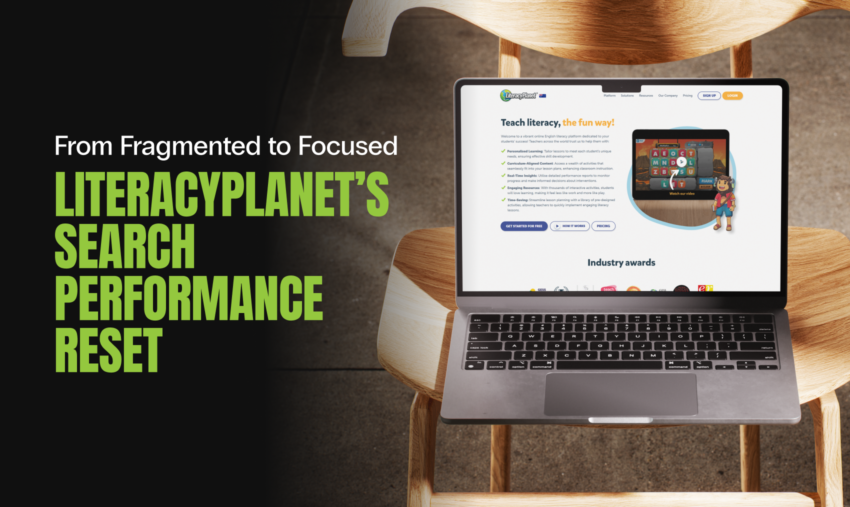
LiteracyPlanet is one of Australia’s most recognised online literacy platforms, used by students, parents, and teachers right across the country. The product is strong. The audience is engaged. But the digital marketing hadn’t kept pace with either of those things.
Campaigns were structured around geography rather than performance. The SEO content was spread across multiple markets instead of built around the audience most likely to convert. There was a real opportunity sitting in the data. It just wasn’t being captured.
When LiteracyPlanet partnered with Click Click Media, the brief wasn’t to start over. It was to make what already existed actually work by fixing the structure, sharpening the focus, and directing both channels toward the same goal.
TL;DR
- Restructuring Google Ads campaigns by service rather than geography doubled clicks and cut average CPC by 50%.
- Localising SEO content to the Australian curriculum created clear organic growth in high-intent keyword categories.
- Google Ads conversions grew 20.4% while total spend barely moved.
- Focus keywords, including digraph, NAPLAN, and phonics, are gaining traction on page one of Australian search.
- When paid and organic channels share the same strategic brief, performance in both improves.
Big Reach, Mixed Signals
There’s a version of Google Ads management that looks functional on the surface. Ad spend is going out, impressions are ticking over, and the dashboard shows activity. The problem doesn’t show up until you look at what the structure is doing underneath.
LiteracyPlanet’s account had been built around geography, with one campaign per country, across multiple markets. It sounds organised. In practice, it fragments data, complicates bid management, and limits the ability to maintain a clearer, purpose-built Google Ads structure that supports meaningful optimisation signals.
The SEO had a similar issue. The content was trying to serve too many markets at once, which meant it wasn’t doing justice to any of them. For Australian sign-ups, the most commercially valuable segment, the content simply wasn’t speaking their language.
The Australian curriculum has its own terminology, its own search behaviour, and its own intent signals. None of that was being reflected. Traffic was arriving. The right traffic wasn’t.
The Fix: Focus Before Scale
The instinct when campaigns aren’t performing is usually to do more: more budget, more keywords, more content. That wasn’t the answer here. The answer was to do less, but do it properly.
On the Google Ads side, country-level campaigns were consolidated into a service-based structure: one campaign per subject across Sight Words, Spelling, Phonics, Reading, and Grammar. That’s a cleaner architecture, and clean architecture matters because it gives Google a consistent signal to learn from. Fragmented campaigns produce fragmented data.
For SEO, the shift was about depth over breadth. Instead of trying to rank across multiple markets, the focus moved to Australia, specifically the language and intent of the Australian curriculum. An SEO approach grounded in how Australians actually search and the queries that carry genuine commercial intent.
Parents searching for phonics help, teachers looking for NAPLAN prep, students working through national literacy exercises. That’s the audience LiteracyPlanet is built for, and the content needed to reflect it.
From Audit to Execution
On the paid side, the restructure was the foundation. Service-based campaigns replaced the country-level setup, geo-targeting was tightened to focus spend where it was most likely to convert, and bid optimisation was applied across all five campaigns once the new structure was in place.
For SEO, nothing went live until the technical foundations were checked. A site with crawl or indexing problems is one where content has a ceiling. Once those were confirmed, the on-page work began. The approach was methodical:
- Page localisation: aligning key pages with the Australian curriculum language and search intent
- Meta titles, descriptions, and header tags updated across all priority pages
- Blog content developed to target focus keywords and build organic authority over time
- Backlink activity focused on quality and relevance link-building strategies rather than volume
- Monthly keyword mapping and performance reviews to keep the strategy responsive to live data
Two Channels, One Direction
What made this engagement different was that Google Ads and SEO weren’t running as separate workstreams. They were pointed at the same target from the start.
The paid restructure freed up budget that had been going to low-intent segments and put it to work where conversion was most likely. The SEO work built an organic presence around those same high-intent terms. The result was a unified digital marketing strategy that reduces noise across channels and strengthens the signals each system relies on.
Paid search captures the demand that exists right now. Organic builds the asset that keeps working without spending behind it. When both are aligned, they make each other more efficient.
The Numbers: More Clicks, Less Spend
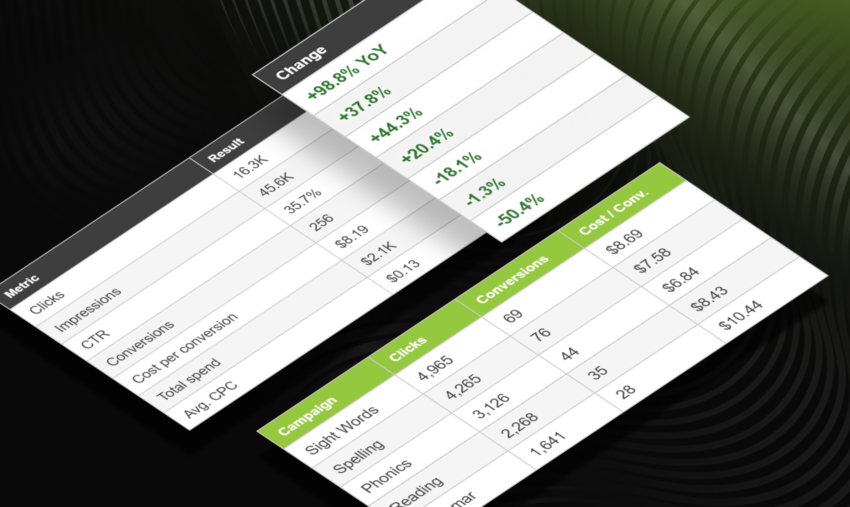
The February 2026 Google Ads data shows what happens when a properly structured account has had time to learn. Nearly double the clicks. Half the cost per click. More conversions, on almost identical total spend.
|
Metric |
Result |
Change |
|
Clicks |
16.3K |
+98.8% YoY |
|
Impressions |
45.6K |
+37.8% |
|
CTR |
35.7% |
+44.3% |
|
Conversions |
256 |
+20.4% |
|
Cost per conversion |
$8.19 |
-18.1% |
|
Total spend |
$2.1K |
-1.3% |
|
Avg. CPC |
$0.13 |
-50.4% |
Every one of the five campaigns contributed. Spelling led on conversions, Sight Words drove the most clicks, and Phonics produced the lowest cost per conversion across the group.
|
Campaign |
Clicks |
Conversions |
Cost / Conv. |
|
Sight Words |
4,965 |
69 |
$8.69 |
|
Spelling |
4,265 |
76 |
$7.58 |
|
Phonics |
3,126 |
44 |
$6.84 |
|
Reading |
2,268 |
35 |
$8.43 |
|
Grammar |
1,641 |
28 |
$10.44 |
What the Organic Data Shows
The organic picture tells a story of strong category ownership. Across 16 months, the site generated 531K clicks from 6.53M impressions at an average CTR of 8.1%, a figure that reflects genuine relevance, not just volume.
The brand terms are dominant. LiteracyPlanet holds position 1.0 with 131,903 clicks and a 54% CTR. LiteracyPlanet login sits at 1.1 with a 67.2% CTR, reflecting high-intent traffic from users who know exactly what they’re looking for and are coming back for it.
Branded traffic has grown to 19K, up 168.94% in the tracked period. Five core keywords are holding position 1, with consistent growth since 2022 and SERP feature appearances accelerating through 2023 and 2024.
Focus Keywords: Where the SEO Strategy Is Taking Hold
Non-branded SEO results build slowly, particularly in competitive educational categories. But three keyword clusters are already showing meaningful movement, and each one began gaining traction after the content strategy shifted to focus on the Australian curriculum.
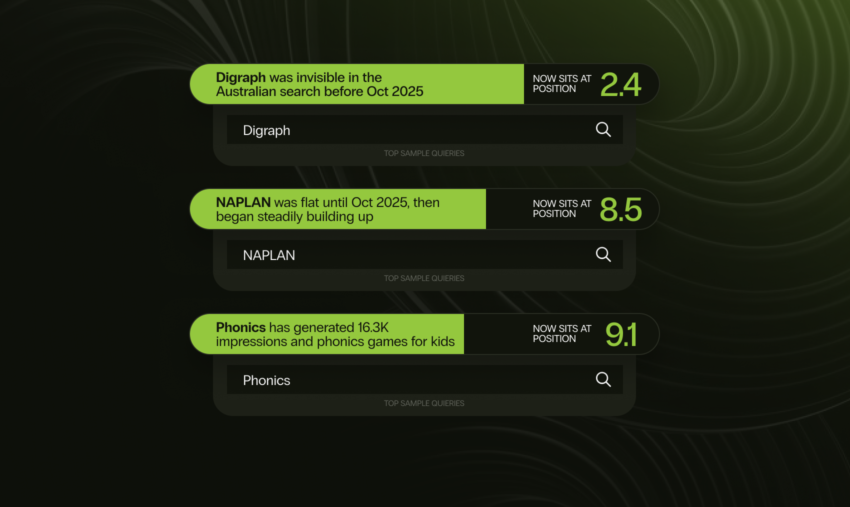
Digraph was invisible in the Australian search before October 2025. Then impressions climbed sharply and held. Diagraph’s meaning now sits at position 2.4. For a curriculum-specific term that wasn’t being targeted six months ago, that’s a strong early result.
NAPLAN was similarly flat until October 2025, then began steadily building up. NAPLAN is now at position 8.5, with consistent upward movement in both impressions and rank. It’s a term with real commercial relevance for an Australian audience, and it is responding.
Phonics is the most competitive cluster and will take longer to develop. But 16.3K impressions have been generated, and phonics games for kids are approaching page one at position 9.1. The trajectory is clear.
A Note on Non-Branded Traffic
Non-branded organic traffic sits at 2.3K, down 80.2% in the tracked period, and that is worth addressing directly. The majority of that movement reflects a deliberate strategic shift: away from broad multi-market content and toward a concentrated Australian curriculum approach.
Branded traffic growing 168.94% to 19K shows the brand is winning the category it has chosen to compete in. The digraph, NAPLAN, and phonics data show that non-branded growth is beginning. That’s what the next phase of the strategy is built to accelerate.
What This Project Demonstrates
This wasn’t about spending more. Total spend barely changed. What moved the needle was the structure underneath the activity. A cleaner campaign architecture gave Google better signals, and a localised SEO strategy gave organic search a clear brief. After the noise was removed, both channels began to perform the way they should.
That is usually the pattern. When a business knows its service is strong, but visibility is weak, the issue is rarely the offer. It relies on the structure behind the marketing and the clarity of the foundations. Once those foundations are set, performance becomes predictable rather than reactive.
Finding Clarity In Your Own Marketing
For organisations facing similar challenges, this type of clarity is often the difference between activity that feels busy and activity that genuinely drives growth. Click Click Media helps Australian businesses build clarity across Google Ads and SEO through strategy, clean execution, and content that is designed to convert.
If you want to see what a cleaner structure could unlock for your marketing, reach out to Click Click Media, and we will show you what is possible.