
Long-Tail vs Short-Tail Keywords in Google Ads
Choosing keywords for Google Ads often seems straightforward, yet the decision becomes more complex when you look at how Google actually treats different keyword lengths. Many marketers assume that long-tail keywords offer stronger intent and better quality leads, while short-tail keywords are dismissed as too broad or too competitive.
These ideas make sense in an SEO environment, but Google Ads behaves differently. Keyword length affects how often a keyword appears in real searches and whether it can generate the signals needed for optimisation. A keyword can look perfect on paper but contribute nothing if it never becomes eligible or enters the auction.
This is where a grounded understanding of Google Ads becomes essential, because performance depends on how keywords behave within the system, not simply on how targeted they appear.
TL;DR
- Most long-tail keywords never run because Google marks them as low search volume.
- Short-tail and mid-tail keywords support stronger learning and optimisation.
- Long-tail intent is still valuable, but best captured through match types and search terms.
- The most reliable Google Ads keywords usually fall between two and four words.
What Keyword Length Really Means for Performance-Based Ads
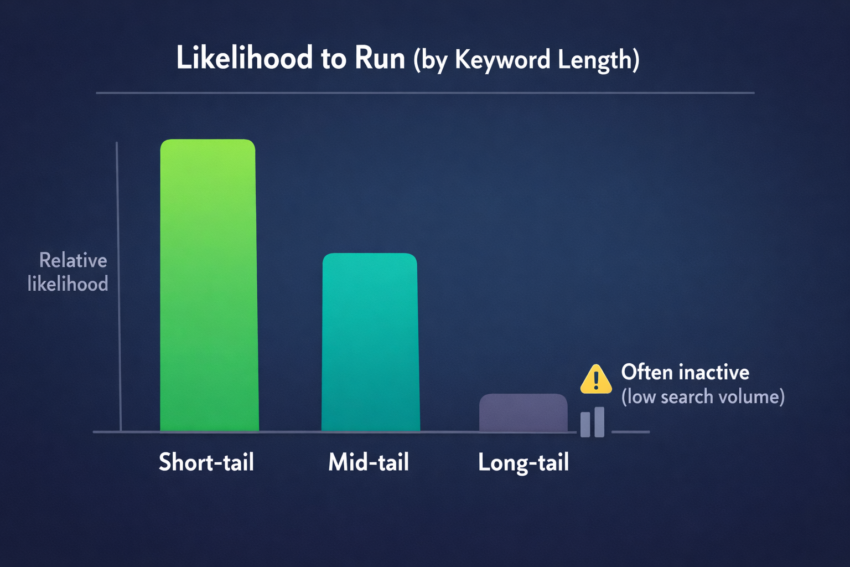
One of the most important distinctions in Google Ads is that a keyword only matters if Google is willing to show it. Google explains that keywords with minimal search activity are categorised as low search volume and remain inactive until search frequency increases.
This is often the case for extended long-tail keywords, even when they reflect strong commercial intent, and it becomes clearer when viewed through a grounded Google Ads perspective rather than traditional SEO thinking.
These limitations are less about the relevance of the keyword and more about how Google interprets real search patterns. When a phrase does not appear frequently enough in live searches, Google has no basis to serve the ad or support optimisation. This means keyword length directly affects eligibility, data generation, and the consistency needed for campaigns to learn effectively.
How Search Behaviour Limits Long-Tail Performance
The effect becomes more noticeable in local and service-based campaigns, where search behaviour can fragment quickly. Users often add qualifiers such as suburbs or descriptive terms, and each variation divides search volume into smaller segments. As a result, long-tail keywords struggle to reach the eligibility threshold required to run.
Mobile behaviour adds another layer. Google’s reporting shows that mobile users rely on shorter phrasing and autocomplete suggestions, which reduces the frequency of extended long-tail searches. Quick, abbreviated queries dominate real-world behaviour far more than fully articulated long phrases.
The challenge is rarely the intent behind long-tail keywords, but whether they occur often enough for Google to recognise and use them. In practical terms, keyword choices determine whether a campaign gathers enough signals to optimise without wasted spend or stalled learning.
Short-Tail, Mid-Tail and Long-Tail Keywords: How They Look Inside Google Ads
Keyword length shapes how Google interprets intent, matches ads to searches, and gathers data for optimisation. This influences how each keyword length behaves inside a campaign and why some keywords participate more reliably than others.
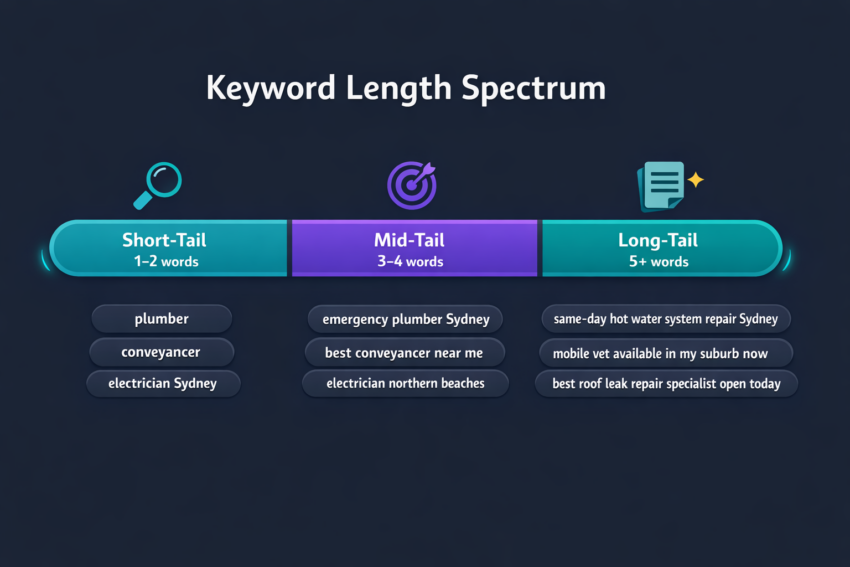
Short-Tail Keywords (1 to 2 words)
Short-tail keywords reflect broad, common searches. They appear frequently and help campaigns gather the activity needed for early optimisation. Although they can attract a wide range of intent, their consistency gives Google enough data to recognise patterns and stabilise performance.
Examples often include:
- plumber
- electrician Sydney
- conveyancer
Short-tail keywords can introduce the campaign to a wider audience and support stronger learning, though they may also attract more competition and different motivations.
Mid-Tail Keywords (3 to 4 words)
Mid-tail keywords offer a strong balance between specificity and reach. They mirror the way users refine searches once they have a clearer idea of what they need. Because they reflect everyday phrasing, mid-tail keywords are often the most dependable performers across service-based and local campaigns.
Common examples include:
- emergency plumber Sydney
- best conveyancer near me
- electrician northern beaches
Long-Tail Keywords (5 or more words)
Long-tail keywords describe highly specific searches. They reflect strong intent but appear far less often in real-world behaviour. Many of these phrases are marked as low search volume, meaning they remain inactive until enough users search for them. This makes them difficult to rely on for consistent visibility or optimisation.
Typical examples may include:
- same-day hot water system repair Sydney
- mobile vet available in my suburb now
- best roof leak repair specialist open today
Long-tail phrases can still be valuable for understanding how people search later in their decision journey, but the limited traffic makes them less effective as core keywords. Google’s matching systems help bridge this gap by showing ads on queries with similar meaning, even when the phrasing differs.
What the Data Shows About Keyword Length and Google Ads Results
Campaigns built around frequently appearing keywords optimise more efficiently. Observations from ongoing PPC management highlight distinct patterns in how keyword length influences the speed and stability of optimisation.
Google’s data shows that most searches contain only a few words, making extended long-tail phrases less reliable as primary performance drivers. Short-tail and mid-tail keywords generate enough impressions for Google’s systems to recognise patterns, refine bids and direct spend toward the conditions that produce conversions.
Longer search terms, however, often show strong click-through rates when they appear, but their low frequency limits their impact. They provide insight, not scale. From a commercial perspective, this limits efficiency and slows campaign progression. A keyword cannot shape conversions or optimisation if it rarely enters the auction.
How to Build a Google Ads Keyword Strategy That Actually Scales
A scalable keyword strategy relies on understanding how users search and how Google evaluates relevance. Rather than focusing on the longest or most granular terms, effective strategies prioritise the keywords that activate consistently and provide enough data for optimisation to take shape.
Start with intent, then choose keywords that can meaningfully participate in the auction
Intent remains the foundation of keyword selection, but it has to be matched with terms that reflect real search behaviour. Google’s research shows that shorter phrasing dominates, particularly on mobile devices, where users expect speed and rely heavily on autocomplete. This is why short-tail and mid-tail keywords tend to support learning more reliably than extended long-tail phrases.
This perspective often reframes strategy. Instead of choosing the most descriptive or technically accurate keywords, advertisers focus on those that gather campaign momentum. That learning becomes the basis for campaign scale and how SEO and paid search will interact as complementary channels.
Use match types and search terms to uncover long-tail intent without relying on standalone long-tail keywords
Google confirms that broad and phrase match can surface queries with similar meaning, even when phrased differently. This allows long-tail intent to appear naturally, without relying on keywords that may never meet Google’s eligibility threshold.
This approach helps identify refinements such as:
- how searches evolve as users move closer to conversion
- which modifiers consistently appear across qualified traffic
- where intent shifts between early and late-funnel behaviour
By treating match types and search terms as discovery tools rather than afterthoughts, advertisers build a structure that reflects real search behaviour, strengthens optimisation, and supports long-term growth.
How CCM Optimises Keyword Length for Google Ads
CCM builds campaigns through a combination of clarity, consistency and ongoing refinement. Early stage focus on short-tail and mid-tail keywords that reliably generate impressions. These keywords ensure the campaign has enough activity to learn and reduce the volatility that often appears in the early stages of optimisation.
Once the campaign generates enough data, CCM uses search terms to identify meaningful long-tail patterns. These insights help refine keyword targeting and ensure the strategy reflects real behaviour rather than theoretical intent.
This approach avoids oversaturation of long-tail keywords that never run. While there is no harm in adding more keywords, it becomes clear which ones influence performance and which ones remain inactive.
How Long Should Your Google Ads Keywords Really Be
Across most industries, keywords within the two to four word range provide the most dependable performance. They support meaningful intent without sacrificing search volume and avoid the inactivity issues associated with extended long-tail phrases. They also align with the way users search, particularly on mobile devices, where shorter queries are more common.
Longer phrases still offer value when they appear frequently in search terms. They can guide refinements and help shape messaging, landing pages and campaign structure. However, they rarely function as foundational keywords unless they appear consistently in live search data.
The most effective keyword length is the one that participates regularly, supports learning and aligns with the campaign purpose. Decisions made with these factors in mind create Google Ads structures that are easier to optimise and support bigger growth.
For organisations seeking deeper clarity on how keyword behaviour shapes performance, the next step is to speak with our team to explore the opportunities available within a structured and commercially aligned Google Ads strategy.