Migrating an established eCommerce business is never just a platform switch. It is a structural rebuild, one that has to preserve years of product data, complex business logic, SEO equity, and customer experience, while laying a foundation for faster growth.
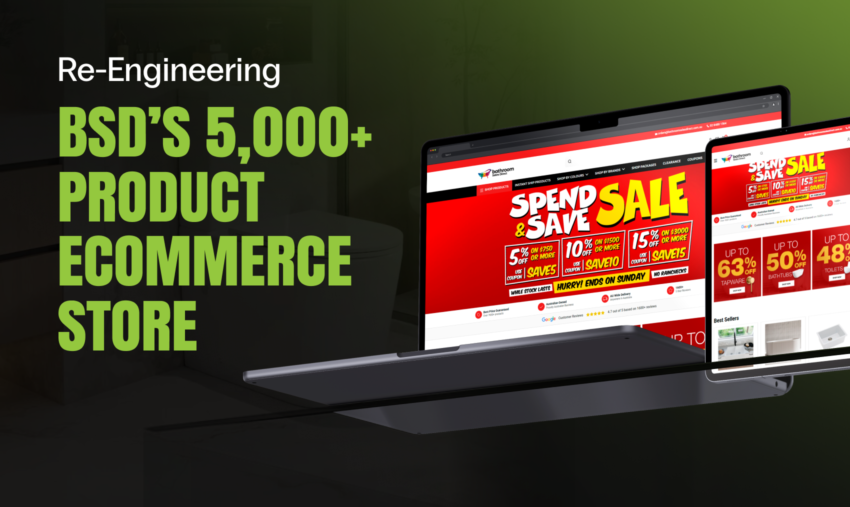
That was the challenge presented by Bathroom Sales Direct, one of Australia’s most established bathroom retailers, when they engaged Click Click Media to move their large-scale WordPress and WooCommerce site onto Shopify.
This case study focuses almost entirely on development, architecture, and technical decision-making. The goal was not just to “get onto Shopify”, but to rebuild the business in a way that improved maintainability, performance, and long-term scalability without compromising the highly customised functionality that had grown organically on WordPress over many years.
The Starting Point: An Over-Engineered WordPress Build at Scale
Bathroom Sales Direct had been operating on WordPress and WooCommerce for a long time, and it showed.
The site housed more than 5,000 products, many of which were deeply customised through Advanced Custom Fields (ACF), bespoke attribute logic, category hierarchies, and shipping rules layered through plugins and custom PHP. Over time, this created a powerful but fragile ecosystem, where even small changes carried risk.
From a development perspective, the platform presented several limitations:
- Performance bottlenecks caused by plugin overlap and database complexity
- Increasing difficulty maintaining custom logic as WooCommerce updates evolved
- Shipping rules that were highly tailored, but hard to visualise or extend
- Product data structures that were flexible, but inconsistent at scale
The decision to move to Shopify was driven by long-term stability, performance, and operational efficiency. But Shopify’s stricter data models meant the migration would not be a straight import.
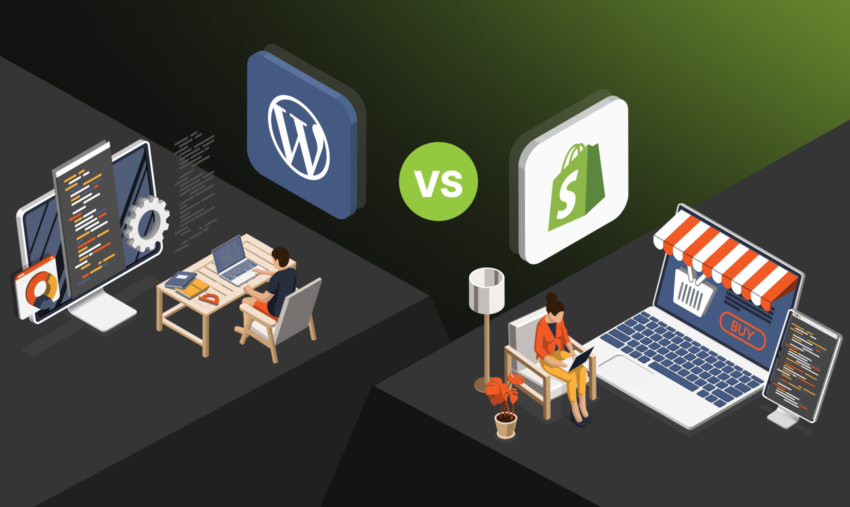
The Core Challenge: Shopify’s Structure vs WordPress Flexibility
WordPress allows near-limitless flexibility. Shopify demands discipline.
The biggest challenge was not volume, it was translation. Every concept in WooCommerce had to be mapped intentionally into Shopify’s ecosystem:
- ACF fields into metafields
- Attributes into metaobjects
- Categories into collections, and in some cases tags
- Shipping rules into Shopify’s advanced shipping logic
- Custom front-end logic into apps, APIs, or theme-level solutions
There was no off-the-shelf solution that could handle this automatically.
In several areas, we were forced to experiment with untested or undocumented migration approaches, particularly around complex product relationships and conditional data. The product migration alone became a project within the project.
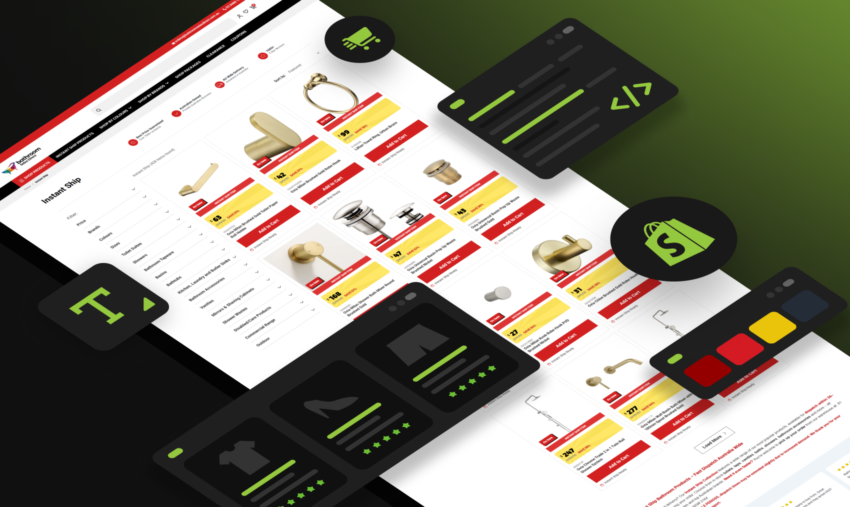
Product Migration at Scale: Beyond a Standard Import
Moving 5,000+ products is one thing. Moving them correctly is another.
Using Matrixify, we engineered a multi-stage migration process that allowed us to:
- Preserve SKU integrity and product relationships
- Map WooCommerce ACF fields into Shopify metafields
- Convert attributes into structured metaobjects for future scalability
- Rebuild category logic into Shopify collections
- Apply selective tagging where Shopify collections were not appropriate
This process required repeated dry runs, validation scripts, and manual reconciliation for edge cases. Some product types simply did not fit Shopify’s default assumptions and had to be re-architected.
The result was a clean, scalable product catalogue that remained flexible for future merchandising and filtering.
The Hidden Complexity: Incomplete and Inconsistent Product Data
One of the least visible, but most time-intensive challenges in this migration was the state of the existing product data itself.
With a catalogue of over 5,000 products built up over many years, the data was not uniform. Products had been added by different team members, at different points in time, under different assumptions about what fields were required or optional. As a result, we were dealing with:
- Products missing critical attributes
- Inconsistent use of ACF fields across similar product types
- Attributes entered as free text instead of structured data
- Conflicting values between attributes, categories, and descriptions
- Products that technically existed, but were not fully “sellable” in a structured system
In WordPress and WooCommerce, this inconsistency was largely hidden. The platform’s flexibility allowed products to render even if underlying data was incomplete or incorrect. Shopify, by contrast, is far less forgiving. Its reliance on structured data means gaps and inconsistencies surface immediately.
This created a dual challenge. We were not just migrating data, we were auditing, correcting, and normalising it at scale.
Rather than attempting a risky “clean everything first” approach, we built migration logic that could handle imperfect inputs gracefully.
This meant designing fallback rules during the migration process. Where data was missing, we mapped defaults. Where attributes were inconsistent, we standardised them into controlled metaobjects. Where categories were ambiguous or misused, we made deliberate decisions about whether they belonged as Shopify collections or simple tags.
In several cases, products that appeared similar on the front end were structurally very different in the database. These edge cases required manual intervention, testing, and iteration to ensure they behaved correctly once imported into Shopify.
This process significantly extended the development effort, but it was unavoidable. Ignoring data quality issues would have resulted in broken filters, incorrect pricing logic, unreliable shipping calculations, and a poor customer experience.
Rebuilding Custom Shipping Logic from the Ground Up
Shipping was one of the most complex parts of the original WordPress site.
Bathroom Sales Direct had accumulated years of shipping rules based on:
- Postcode zones
- Order weight thresholds
- Cart value tiers
- Local delivery eligibility
- Product-specific exclusions
Shopify does not natively support this level of complexity out of the box.
To solve this, we designed and implemented a custom Shopify app, internally referred to as the BSD Shipping Filter, which allowed fine-grained control over shipping methods at checkout. This app works alongside Shopify’s advanced shipping rules to dynamically determine which options should be shown to the customer.
The outcome was a shipping system that matched existing business logic, but was far more maintainable and transparent for future updates.
The Semi-Custom Vanity Builder: Preserving a Key Revenue Feature
One of the most commercially important features on the site was the ability for customers to build semi-custom bathroom vanities.
Rather than recreating this logic from scratch, we integrated Infinite Options to replicate and improve the builder experience. This allowed customers to:
- Select sizes, finishes, and configurations
- Combine multiple options into a single product flow
- See pricing update dynamically
- Maintain compatibility with Shopify’s cart and checkout
The challenge here was not the app itself, but ensuring the underlying product data and metafields were structured in a way that could support complex combinations without breaking inventory or pricing logic.
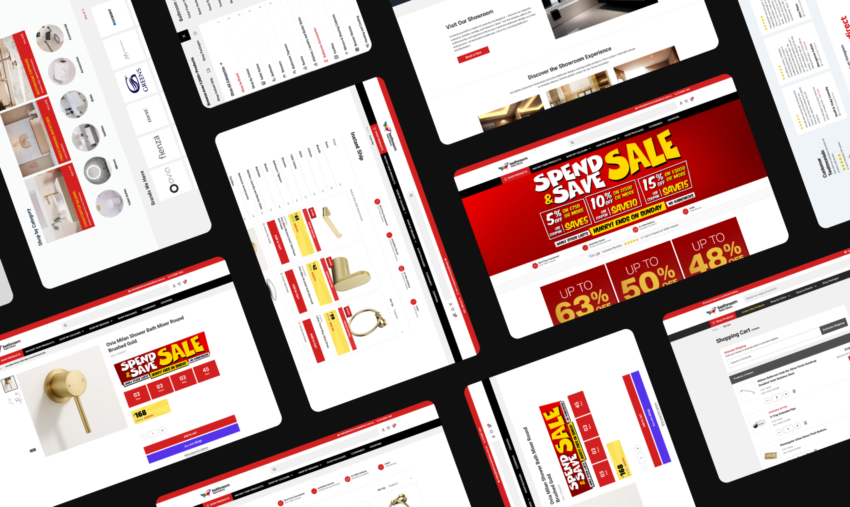
Merging Two Worlds: Shopify Theme Meets WordPress Design
Rather than discarding the existing visual identity, Bathroom Sales Direct wanted continuity.
We approached this by merging a Shopify theme with the existing WordPress design language, recreating layouts, typography, and UI patterns while modernising performance and responsiveness. This hybrid approach ensured returning customers felt immediately familiar with the new site, while benefiting from Shopify’s speed and stability.
To support flexible content management, we deployed Shogun Landing Page Builder, enabling the internal team to create and iterate on landing pages without developer involvement.
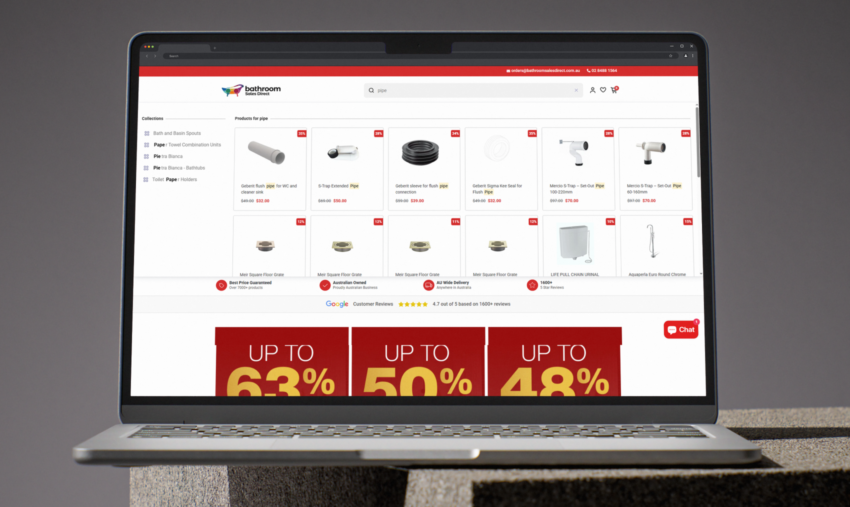
Search, Discovery, and UX Enhancements
With a catalogue this large, search performance is critical.
We implemented Algolia AI Search & Discovery to deliver fast, relevant, and typo-tolerant search results, paired with Shopify’s native Search & Discovery tools for merchandising and filtering.
Additional UX functionality was layered in through apps such as SWishlist and Corner Free Gift & Cart Upsell, all carefully tested to ensure they did not conflict with custom logic or checkout behaviour.
Data, Feeds, and Analytics Continuity
Maintaining data continuity was critical during the transition.
We rebuilt product feeds using DataFeedWatch, ensuring Google Shopping and paid media campaigns could continue without disruption. For analytics, Analyzify was deployed to ensure GA4, Google Ads, and ecommerce tracking remained accurate post-migration.
This was particularly important given the structural changes between WooCommerce and Shopify’s event models.
The Outcome: A Platform Built for the Next Phase of Growth
The final Shopify build delivered:
- A clean, scalable product architecture
- Custom shipping logic that mirrors real-world operations
- Preserved and improved custom vanity functionality
- Faster performance and improved stability
- A development foundation that is easier to extend and maintain
Most importantly, Bathroom Sales Direct now operates on a platform designed for growth, not patchwork maintenance.
This project was not about shortcuts. It was about engineering solutions where none existed, and making Shopify bend just enough to support a highly specialised retail operation without compromising its strengths.
For Click Click Media, it stands as a benchmark example of what a true development-led migration looks like when done properly.
Ready to Rebuild Without Cutting Corners?
Platform migrations are rarely straightforward, especially when years of custom logic, imperfect data, and operational complexity are involved. At Click Click Media, we approach these projects with a development-first mindset, engineering solutions that respect how your business actually operates, not how a platform expects it to.
If you are considering a move to Shopify, planning a large-scale rebuild, or struggling with a site that has outgrown its foundations, our team can help you architect a solution that scales cleanly, performs reliably, and is built for what comes next. Get in touch now.