Your Attention Is Being Sold. Here’s How the Auction Works.
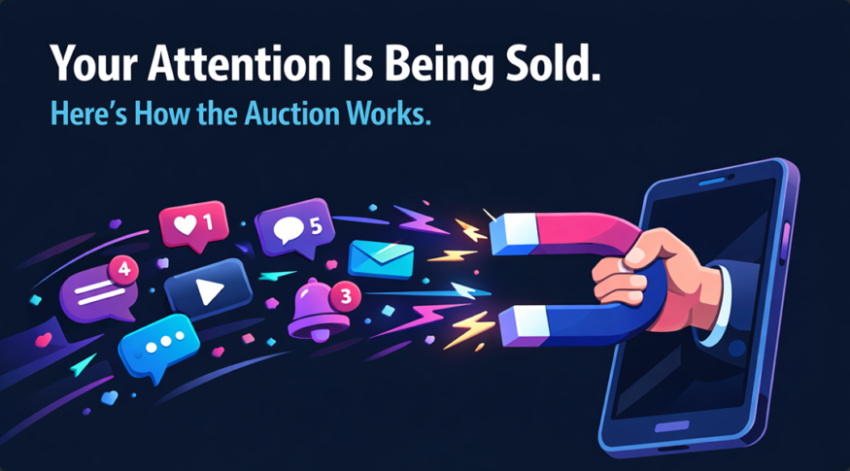
Every time you open Instagram, an auction runs.
It takes milliseconds. Dozens of advertisers (big brands, scrappy eCommerce operators, local businesses) are bidding against each other for the right to put something in front of you. Before you’ve finished loading your feed, the winner has been decided.
You didn’t know. You didn’t consent. You didn’t get a cut.
That’s the attention economy. And most people, including plenty of businesses spending serious money inside it, don’t actually understand how it works.

You’re Not the Customer. You’re the Product.
It’s a line that gets thrown around a lot. But let’s make it concrete.
Social platforms don’t sell you anything. They sell access to you, to every brand willing to pay for it. The currency is CPM: cost per thousand impressions. That’s what advertisers bid. And that number shifts dramatically depending on who you are, where you live, what you’re interested in, and critically, what you’re about to do.
Two people, same city, same platform, same time of day. One commands a CPM of $50. The other gets $9. The gap isn’t random. It’s the result of a very deliberate scoring system that’s been built, refined, and monetised over 20 years.
You’re being priced in real time. The question is: what’s driving that price?
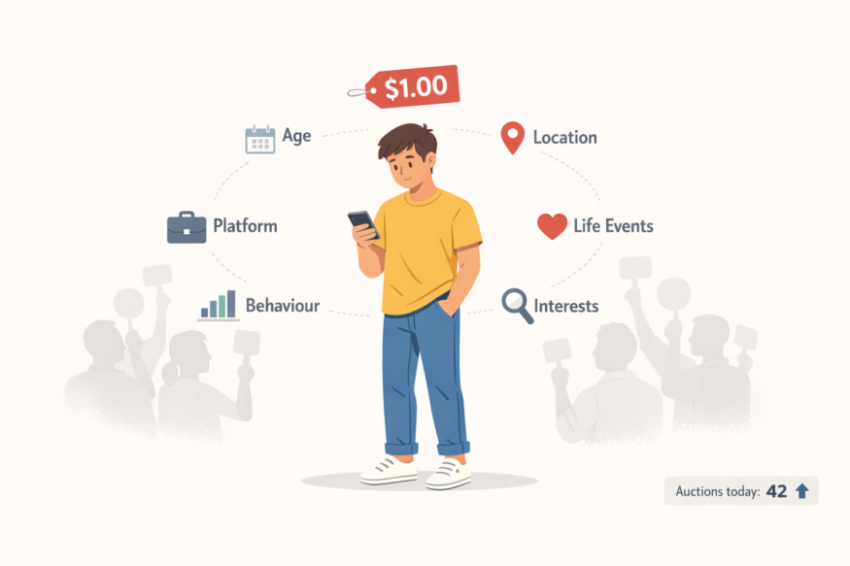
The Signals That Set Your Value
Age
Advertisers sort humans into buckets. 25–34 is the prime one. That’s peak earning, peak spending, peak decision-making power. The trifecta for most consumer brands. If you’re in it, you’re in demand. Bids are higher. Inventory is more competitive. If you’ve aged out, the rates drop. Not because you’re less valuable as a person, but because advertisers have made actuarial bets about your spending behaviour. You’re a data point in a model.
Location
Your postcode alone can shift your ad value by up to 52%. Same person, same income, same interests. Move them from Parramatta to Mosman and watch the CPM climb. Advertisers pay a premium to reach people in high-income areas because proximity to money is treated as a signal of money. It’s a blunt instrument, but it works often enough that everyone uses it.
Platform
Not all attention is priced equally. LinkedIn CPMs are the highest of any social platform, sometimes north of $50, because the audience skews toward professionals with purchasing authority. A dollar of attention on LinkedIn is worth more to a B2B software company than the same dollar on TikTok. But TikTok’s CPMs are climbing fast, and its engagement rates are doing things that Instagram did five years ago.
Every platform is its own auction with its own pricing logic. When you’re active on multiple platforms, you’re running multiple auctions simultaneously. More platforms, more auctions, more ads. This is exactly why paid social strategy can’t be treated as a single-channel decision. Each platform rewards fundamentally different behaviour.
Time Spent
Every extra hour you spend scrolling adds roughly 14 more ads to your day. That’s 14 more auctions run in your name. Each one a brand winning or losing the right to show you something. The platforms have a direct commercial incentive to keep you on as long as possible. Not because they care about your experience, but because your time is what they’re selling.
Life Events
This is the one that surprises most people.
Getting married? Having a baby? Buying a car? Moving house? You’ve just become significantly more valuable to advertisers. People in transition spend more, decide faster, and are more emotionally open to new brands. Advertisers know this. They pay up to three times the normal rate to reach people mid-transition.
The platforms know about these events because you told them. The engagement post. The profile update. The sudden interest in pram reviews and mortgage calculators. The signal is everywhere and it’s priced accordingly.
This is one of the most powerful levers in Meta advertising. Life event targeting lets brands reach people at exactly the moment their habits are up for grabs. Done well, it’s one of the highest-ROI moves in the paid social playbook.
Interests and Intent
Not all interests attract the same ad dollars. Property investment, finance, luxury goods, automotive. These are high-CPM territory. The brands chasing these audiences have high customer lifetime values, which means they can afford to pay more per impression.
Interests like gaming, food, and general entertainment sit at the lower end. Not because they’re niche (these audiences are massive) but because the conversion economics for advertisers in these spaces are tighter.
This is why two creators with the same follower count can earn completely different amounts from the same platform. The finance creator is pulling higher CPMs. The gaming creator isn’t. Same reach, different value.
Behaviour
Here’s where it gets precise.
Platforms don’t just know what you’re interested in. They know how you behave around ads. Do you buy things you see advertised? Do you skip immediately or watch through? Do you google products you see on social before buying? Do you click through or scroll past?
This behavioural data is layered on top of everything else. An audience of property investors is valuable. An audience of property investors who have previously clicked on property ads, visited developer websites, and have a history of purchase behaviour? That’s a different auction entirely.
Advertisers can target by intent signals, not just interests. Someone who has been researching home loans for three weeks is worth more than someone who casually browsed a real estate article once. The platforms can tell the difference and they charge accordingly.
What This Means for Advertisers
If you’re running paid social campaigns, you’re inside this machine. Every campaign you launch is a bid for specific humans. The targeting options (age, location, interests, life events, behaviour) are the levers you use to narrow who you’re bidding for and how much you’re willing to pay.
Get the targeting wrong and you’re paying premium rates for people who’ll never buy from you. Get it right and your cost per acquisition drops sharply.
This is why we’ve always argued that paid social is a strategy problem before it’s a creative problem. The best ad in the world, served to the wrong person at the wrong moment, does nothing. A decent ad, served to exactly the right person when they’re in market and ready to move? That converts.
The brands winning on paid social aren’t just producing better creative. They’re making smarter decisions about which humans to chase and what signals to use to find them. They understand that a 42-year-old male in the Inner West who recently searched for ‘investment property Sydney’ and has previously clicked on mortgage ads is not the same audience as ’35–55, interested in property’. One costs more and converts better. The other burns budget.
Knowing the mechanics of the auction, who gets priced where and why, is what separates campaigns that compound from campaigns that flatline. You can see some of what that looks like in practice across our paid social case studies.

The Platform Is Not Your Partner
One more thing worth saying directly.
The platforms are not neutral tools. They have a commercial interest in getting you to spend more, not in helping you spend better. Higher ad spend flowing through their auction means more revenue for them, regardless of whether your campaigns are actually working.
This is why self-serve advertising dashboards are designed to make spending easy. The frictions are all on the exit side. Increasing budgets takes two clicks. Understanding whether that budget is actually delivering is a different problem entirely.
We’ve audited hundreds of accounts over 17 years. It’s common to find 20–40% of budget going to audiences that were never going to convert. Not because the business didn’t care, but because the platform defaults tend toward broad, and broad tends toward waste. This applies equally to Meta Ads and Google Ads, where default settings are almost always optimised for platform revenue, not advertiser ROI.
The auction rewards precision. Precision requires understanding what you’re actually bidding for.
See It From the Other Side
We put together an attention value calculator that shows you what your attention is worth from the advertiser’s perspective. It walks through the same signals we’ve covered here: age, location, platforms, interests, life events, behaviour. Plug in your own details and it’ll estimate your CPM value, show you what’s driving it up or down, and give you a sense of how many ad auctions are running for you every day.
It’s worth doing, especially if you’re running ads yourself. Understanding the buyer’s experience is one of the fastest ways to make better decisions about targeting.
If You’re Running Paid Social, Let’s Talk Strategy
Understanding the mechanics is one thing. Applying them to your specific business, budget, and growth targets is another.
We’ve managed over $115 million in ad spend for Australian businesses since 2008. We’re a Google Premier Partner and our paid social team runs campaigns across Meta, TikTok, and LinkedIn for growth-focused businesses that need results, not just reach. We’re direct enough to tell you when your targeting is costing you money. Get in touch today.