TL;DR
- Platform architecture determines your SEO ceiling, not just how easy configuration is.
- Shopify offers a strong technical baseline, but structural constraints limit its scalability.
- WooCommerce provides the most SEO flexibility, but requires ongoing technical management.
- Magento suits enterprise catalogues with dedicated development and SEO resources.
- The right platform is the one your strategy can actually execute on.
Most retailers choose their eCommerce platform based on cost, a developer’s recommendation or simple familiarity. SEO rarely enters that conversation early, even though the platform quietly determines how search engines interact with the site for years to come.
The platform you build on shapes what SEO is possible, not just how easy it is to set up.
Many SEO capabilities are configuration choices that cannot be adjusted later. They are structural characteristics of the platform itself. Once a store is live and a catalogue is built around it, those constraints become part of the foundation and are far harder to change.
This makes the question relevant not only for retailers choosing a platform for the first time, but also for businesses already operating online who are beginning to wonder whether their current setup may be quietly limiting organic growth.
Why Platform Choice Is an SEO Decision, Not Just a Tech One
Platform architecture controls several SEO variables that are either difficult or impossible to alter after the launch. These settings cannot be changed later via an app or plugin. They form part of the platform’s technical framework and often define the ceiling of what optimisation can achieve.
Some of the most consequential structural SEO factors include:
- URL structure and path conventions
- Canonical tag behaviour across large catalogues
- Crawl efficiency and sitemap generation
- Duplicate content exposure from filters and variants
- Baseline page speed performance
Retailers can still execute strong keyword targeting and content strategies on any platform. What the platform determines is how efficiently search engines interpret that work, and how scalable optimisation becomes as the catalogue grows. Organic search compounds gradually, and structural limitations do the same.
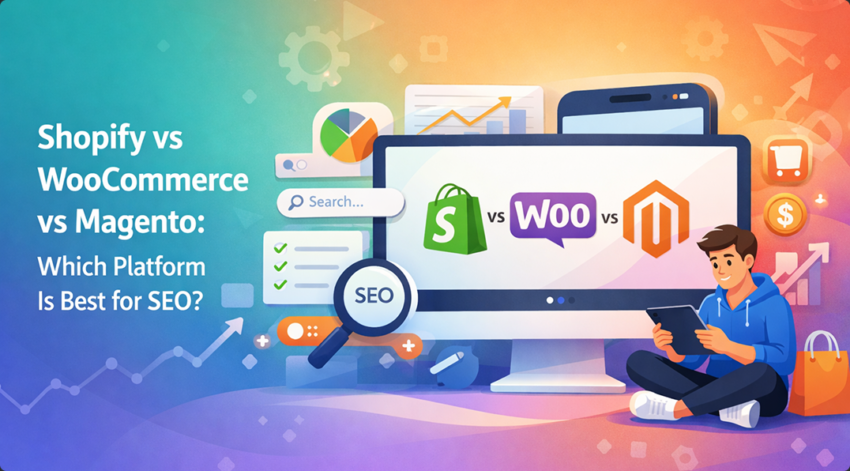
With that context in place, here is how Shopify, WooCommerce and Magento actually perform when you put them under an SEO lens.
What Makes eCommerce SEO Different From Regular SEO
eCommerce sites operate at a scale and complexity that standard business websites do not encounter. Catalogues can run into thousands of pages. Filters, variants, and pagination generate URLs automatically, often creating near-duplicate pages that were never planned for.
Category structures also carry a dual burden. They need to help customers navigate the catalogue while giving search engines a clear hierarchy that explains how products relate to one another. On most platforms, satisfying both at once requires deliberate architectural decisions.
Platform Controls vs Merchant Controls
One of the most useful ways to understand eCommerce SEO complexity is to separate what the platform controls from what the merchant controls.
The platform manages the structural layer:
- URL architecture and path conventions
- Canonical tag logic and sitemap generation
- Performance infrastructure and page speed baseline
The merchant controls the optimisation layer: content quality, internal linking, keyword targeting, and structured data implementation. Knowing which layer a problem belongs to often determines whether it can be solved quickly or whether deeper platform constraints are involved.
What Google Actually Evaluates on an eCommerce Site
Google evaluates eCommerce sites across a consistent set of signals. Core Web Vitals measure page experience and influence rankings. Whilst product schema allows pricing, availability and reviews to appear directly in search results. Internal linking depth determines how efficiently the full catalogue gets crawled.
These signals interact directly with platform architecture. A platform with limited canonical control pushes duplicate content management onto the merchant, while a slower site performance foundation often requires developer work to recover lost ground.
The goal is not to identify a single “best” platform. It is to understand how each site has a different technical starting point, and how those differences affect what becomes easy or difficult to optimise over time.

Shopify for SEO: A Strong Start With Structural Trade-Offs
Shopify provides one of the strongest default technical foundations among eCommerce platforms. Because it operates as a hosted system, several important SEO elements are handled automatically, without configuration or developer involvement.
These include CDN delivery, automatic SSL certificates and XML sitemap generation, which significantly reduce the technical effort required to establish a stable SEO environment. This creates a strong starting point, particularly when the underlying theme structure and integrations are implemented through considered Shopify development rather than a reliance on multiple apps.
Where Shopify Performs Well
Several factors make Shopify an attractive starting point from an SEO perspective:
- Strong default hosting performance
- Automatic management of core technical infrastructure
- Built-in canonical handling for product pages
- A large ecosystem of SEO apps
On a clean theme, Core Web Vitals performance typically competes with other hosted platforms. The app ecosystem also covers most standard requirements, allowing tasks such as meta field editing, redirect management and schema markup to be handled without touching code.
Where Limitations Begin to Appear
As catalogues grow, some structural limitations become more noticeable. Shopify uses fixed URL prefixes such as /products/ and /collections/, which cannot be customised. For smaller catalogues, this rarely matters, but stores targeting competitive category keywords sometimes find the structure restrictive.
Another limitation appears in Shopify’s blogging system, which is relatively basic compared with a full CMS like WordPress. Retailers running content-led SEO strategies often encounter constraints around taxonomy structure and editorial flexibility.
Best suited to:
Retailers who want a fast, reliable launch, have a manageable catalogue, and do not require deeply customised URL architecture or a content-heavy organic growth strategy.
WooCommerce for SEO: Flexible by Design, Demanding by Nature
WooCommerce takes a different approach because it operates on WordPress. Rather than providing a fixed hosted environment, it gives retailers full control over site structure, which often creates a higher SEO ceiling for businesses that rely heavily on content marketing and complex category structures.
Where WooCommerce Offers Advantages
The structural flexibility is genuine and meaningful. WooCommerce provides capabilities that are difficult to achieve on hosted platforms:
- Fully customisable URL structures with no enforced path prefixes
- Advanced SEO plugin ecosystems
- Seamless integration between content pages and product catalogue
- Granular control over metadata, canonical tags and schema
Plugins such as Yoast SEO and Rank Math allow merchants to configure canonical tags, metadata and schema with considerable precision, enabling retailers to shape catalogue structures around keyword targeting strategies.
That control allows a retailer to structure URLs to match their keyword strategy precisely. With WooCommerce development support, blog posts, buyer’s guides, and product pages all operate within the same URL structure and internal linking framework, a structural advantage that hosted platforms cannot replicate.
The Trade-Off: Technical Responsibility
This flexibility also introduces operational responsibilities. WooCommerce is self-hosted, which means server performance, caching, security, and uptime sit under the merchant’s control. When hosting and caching are not managed properly, performance can lag behind a standard Shopify installation.
Plugin management also requires ongoing oversight: updates, compatibility conflicts, and gradual performance bloat can accumulate as additional functionality is added over time.
Best suited to:
Retailers with access to WordPress development support, a content-led organic growth strategy, or site architecture requirements that a hosted platform cannot accommodate.

Magento for SEO: Enterprise Capability That Requires Enterprise Investment
Magento is designed for organisations managing large and complex product catalogues. Its architecture supports thousands of SKUs, deep category hierarchies, multiple variants, and multi-store environments across regions or brands.
Where Magento’s Architecture Adds SEO Value
From an SEO perspective, Magento offers extensive control over URL structures, canonical directives, and faceted navigation behaviour. These capabilities become particularly important for enterprise retailers where crawl budget and duplicate content issues become operational challenges.
Multi-region and multi-language setups are also handled natively, with proper hreflang support that would require significant custom development on other platforms.
The Reality of Implementation
Magento’s SEO strength depends heavily on implementation quality. The platform provides powerful tools, but results depend entirely on how the site is built and maintained. Default installations often require significant optimisation work, and without careful development, Magento sites can perform more slowly than Shopify or WooCommerce.
For organisations without complex catalogue requirements or dedicated development resources, the operational overhead can significantly outweigh the SEO benefit.
Best suited to:
Enterprise retailers with large, complex catalogues, multi-region or multi-brand requirements, and dedicated development and SEO resources in place.
How Shopify, WooCommerce and Magento Compare for SEO
The table below summarises how each platform typically performs across the key SEO factors. Each rating reflects the platform’s default starting point, not its theoretical limits.
|
SEO Factor |
Shopify |
WooCommerce |
Magento |
|---|---|---|---|
|
URL structure control |
Limited |
Full control |
Full control |
|
Duplicate content risk |
Medium |
Low |
Low (if configured) |
|
Core Web Vitals baseline |
Strong |
Depends on hosting |
Requires optimisation |
|
Canonical tag management |
Automatic |
Plugin-managed |
Developer-managed |
|
Structured data/schema |
Via apps |
Via plugins |
Highly configurable |
|
Content and blogging |
Basic |
Excellent |
Moderate |
|
Crawl budget management |
Limited |
Full control |
Full control |
|
Technical SEO flexibility |
Low |
High |
Very high |
|
Best fit |
SME / fast launch |
Growth-stage / content-led |
Enterprise / complex catalogue |
A limited rating does not mean a platform cannot rank well. It simply means certain SEO elements cannot be configured beyond the platform’s structural boundaries.
What Actually Drives eCommerce SEO Performance on Any Platform
Platform choice establishes the technical foundation. Long-term organic performance depends on how the catalogue is structured, maintained, and supported by content. These are the areas where eCommerce SEO is consistently won or lost, regardless of the underlying system.
Catalogue Architecture and Internal Linking
The relationship between category pages, product pages and supporting content plays a major role in how search engines interpret an eCommerce site. A clear hierarchy helps search engines understand product relationships and crawl the catalogue efficiently.
Product Page Quality
Unique product descriptions, natural keyword usage and structured data highlighting pricing, availability and reviews all contribute to stronger search visibility, while duplicated manufacturer descriptions rarely perform well in organic search.
Technical Maintenance
As catalogues evolve, issues such as broken links, redirect chains, and discontinued products inevitably appear. Without regular monitoring, these problems accumulate and gradually reduce search visibility. Retailers who provide consistent technical audits and publish supporting content such as buying guides or comparisons tend to build stronger topical authority over time.
How CCM Approaches eCommerce SEO Across Platforms
Click Click Media’s approach to eCommerce SEO starts with understanding the platform’s structural position before making any optimisation decisions. Working across Shopify, WooCommerce, and Magento gives a clear view of how platform decisions influence organic growth over time.
Platform discussions rarely begin with recommending a specific system. Instead, it is important to understand the retailer’s growth strategy and recognise whether the current setup supports or limits it.
During audits, we often see retailers who chose a platform based on cost or familiarity. As their catalogue grows or their content strategy evolves, structural SEO limitations begin surfacing that were not obvious at launch.
Rather than applying a fixed approach, CCM identifies where the platform supports organic growth cleanly and where it creates friction, then builds the strategy around what is actually achievable within that structure.
Choosing the Right Platform for Your SEO Strategy
The right platform is rarely the one that ranks best in search results. Instead, the decision usually depends on how well the platform aligns with the retailer’s growth and internal resources.
As catalogues expand and content strategies mature, WooCommerce’s flexibility around content volume, category depth, and URL architecture can become increasingly valuable. But if growth depends more on simplicity and stability in the early stages, Shopify allows retailers to focus on a large product feed and marketing, rather than infrastructure management.
Magento typically becomes relevant once catalogue complexity reaches enterprise scale and the business has the development resources required to support it.
Ultimately, the most effective platform is the one that allows the retailer’s SEO strategy to execute cleanly, with the team and resources available to support it. That is a different question from which platform has the highest theoretical ceiling. For retailers seeking clearer direction on how platform architecture influences organic search performance, speak with our team about identifying the setup that best supports long-term eCommerce growth.