Why We Launch Shopify Stores on a Quiet Tuesday

Most Shopify launches are planned around the marketing calendar. The campaign is booked, the email is scheduled, and the store goes live because a date was promised. Then something small breaks at 4pm on a Friday and nobody who built the store is at their desk.
Our Shopify development team in Sydney plans it the other way round. We pick the launch day around the people who can fix problems and the traffic that will expose them. For most stores, that means a quiet Tuesday.
TLDR
- The launch day matters as much as the build. Staging cannot test real customers, real cards and real traffic.
- We launch midweek, on a quiet Tuesday, so the people who can fix problems are at their desks and traffic is ordinary.
- We never launch into a sale. The store should prove itself for at least a week before any campaign.
- Five checks come first: redirects, payments and shipping, tracking, a speed baseline and a rollback plan.
What Can Go Wrong in the First 48 Hours
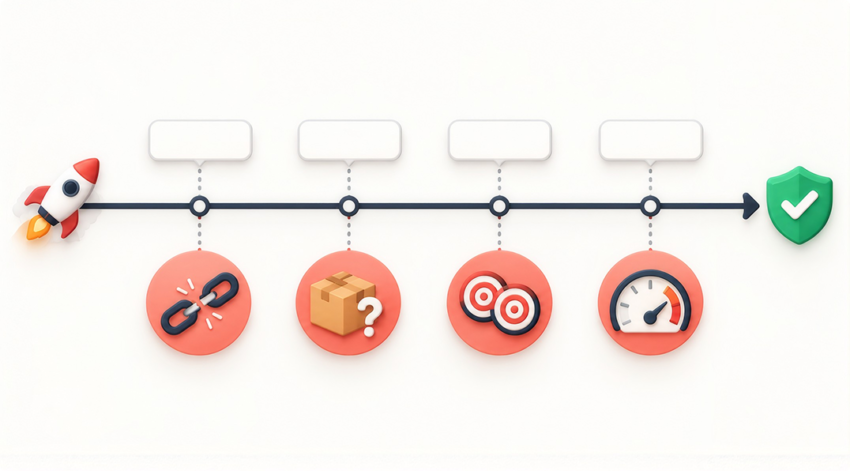
A new store is untested in one way that staging cannot cover: real customers, on real devices, using real payment cards. Staging shows you that the build works. Launch shows you what it does under pressure.
The usual first-week problems are small and expensive:
- A redirect that points at the wrong collection, so an old product URL lands on a 404.
- A shipping rule that quotes the wrong rate for one postcode range.
- A tracking tag that fires twice, or not at all, so paid media reports the wrong numbers.
- An app that behaves differently with live traffic and slows the product page.
None of these is hard to fix. They are only hard to fix when the team is offline, or when the store is already carrying peak traffic.
Why Tuesday

| Day | Launch verdict |
| Mon | Weekend backlog, split attention |
| Tue | Full week either side of go-live |
| Wed | Fine, shorter runway |
| Thu | Fine, weekend close |
| Fri | Faults sit until Monday |
Monday carries the weekend’s backlog. Customers return, emails pile up and the store owner’s attention is split. Wednesday and Thursday are fine, but they leave a shorter runway before the weekend. Friday is the day we avoid, because a problem found on Friday afternoon is a problem that sits until Monday.
Tuesday gives the whole team a full working week on either side of go-live. We cut the store over early in the morning, so the developers, the project lead and the store owner are all online when the first real orders arrive. A named developer stays on call, and the team keeps a close watch on the store for the first week.
It also helps that midweek traffic is usually steadier than a weekend or a payday peak, although the pattern varies by business. Check your own analytics before you choose the day. Lower traffic means any fault touches fewer customers while we find it.
Never Launch into a Sale

A sale is the worst possible launch day, and it happens constantly. The store is rebuilt to be ready for the big promotion, so the launch lands directly on it. Every untested edge case now meets peak traffic.
Our rule: launch at least a week before any planned campaign. That week is not padding. It is when the store proves itself on ordinary traffic, so the campaign runs on a platform that has already been tested.
What We Check Before the Switch

A quiet launch day only helps if the work before it is done. Our launch checks cover five areas:
- Redirects. Every old URL that earns traffic or links is mapped, tested and signed off. This matters most on a migration, where URL preservation and 301 mapping protect existing rankings. Our Shopify migration work treats this as a launch blocker.
- Payments and shipping. Test orders through each payment method, and across the shipping zones the store actually sells to.
- Tracking. Analytics, ad pixels and conversion events checked against a real test purchase, so reporting is trustworthy from the first order.
- Speed. A baseline recorded before launch. It is the number the store is measured against afterwards, and the subject of our Shopify speed self-audit.
- A rollback plan. Someone knows exactly what gets reverted, and in what order, if the store needs to step back.
The First Week After Launch
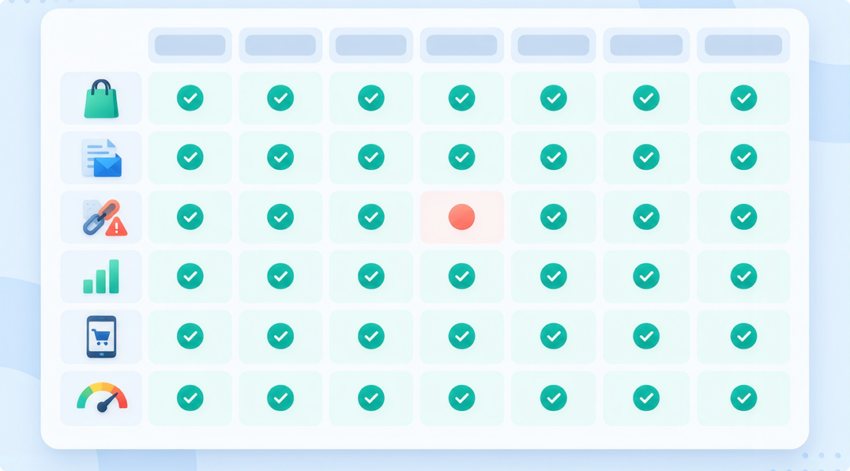
Go-live is the start of the watch, not the end of the project. For the first week we run the same checks every day:
- Orders and payments. Real orders are completing, payments are settling and order confirmation emails are reaching customers.
- Forms. The contact form, enquiry forms and newsletter sign-up are submitted as a test, and the notification arrives in the right inbox.
- Errors and redirects. New 404s are reviewed in Google Search Console and fixed with a redirect where an old URL still earns traffic or links.
- Tracking. Analytics and ad conversions match the orders Shopify records, and no tag is firing twice.
- Mobile checkout. A full purchase is completed on a phone, because most first-week problems appear there.
- Speed. The three key pages are re-tested against the day-one baseline.
Anything unusual is easier to spot when you are looking at a short, quiet week of data than at a month of it.
That is also why we record speed on day one. A store that launches fast can drift slowly, and the drift is much harder to explain without a starting point. Our case study on how Zebra Home held its speed after launch shows what that looks like in practice.
Should You Launch On a Tuesday?
For most stores, yes. If your business has a genuine reason to go live elsewhere in the week, such as a fixed product release or a trading pattern that peaks on a Tuesday, plan around that and protect the same three things: a full team on call, ordinary traffic, and no sale on the horizon.
If you are weighing up a new build or a migration, the launch plan is a useful thing to ask any agency about. A clear answer usually reflects how carefully the rest of the project is run.
FAQs
What is the best day to launch a Shopify store?
For most stores, a quiet midweek day such as Tuesday. It gives the whole team a full working week on either side of go-live, avoids the Monday backlog and keeps launch clear of the weekend, when problems sit unfixed until Monday.
Why avoid launching a Shopify store on a Friday?
A fault found on Friday afternoon often sits until Monday, because the team that built the store is offline. New stores have the most unknowns in the first 48 hours, so the people who can fix problems need to be at their desks.
Should I launch a new Shopify store before a sale?
Launch at least a week before any planned campaign. That week lets the store prove itself on ordinary traffic, so the sale runs on a platform that has already been tested instead of exposing every untested edge case at peak volume.
What should be checked before a Shopify store goes live?
Redirects for every old URL that earns traffic or links, test orders through each payment method and shipping zone, analytics and ad tracking against a real test purchase, a recorded speed baseline, and a rollback plan that names what gets reverted and in what order.
Why record a speed baseline at launch?
A store that launches fast can drift slowly as apps and tags are added. Without a day-one baseline, the drift is hard to prove and harder to assign to anyone. The baseline is the number every later change is measured against.
Planning a Shopify Build or Migration?
Our Shopify development services in Sydney include the launch plan as part of every build.