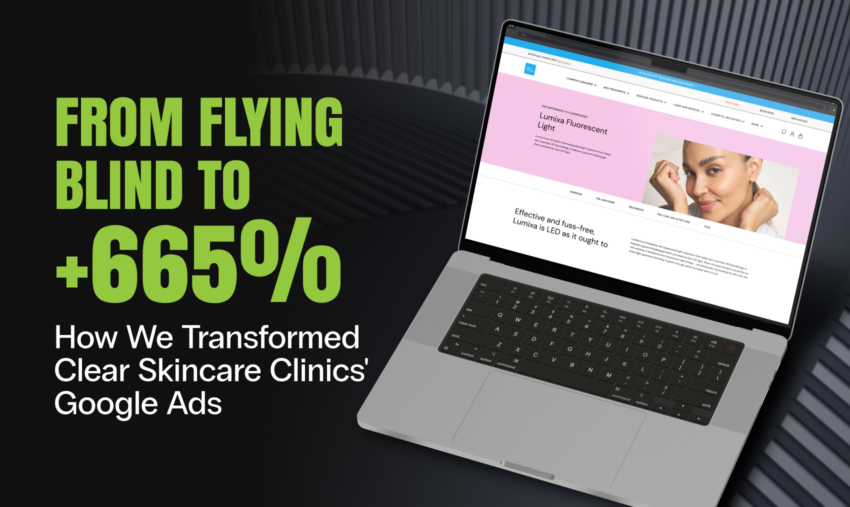
From Flying Blind to +665%: How We Transformed Clear Skincare Clinics’ Google Ads
Some brands talk about making a difference. Clear Skincare Clinics has been doing it since 1999. With 40+ clinics across Australia, Clear Skincare has spent over two decades making advanced clinical skin treatments genuinely accessible, not just for the few who can afford a Pitt Street dermatologist, but for anyone who wants real, results-driven skincare. And behind that mission, a significant corporate story has been quietly unfolding.
Clear Skincare’s journey into the Wesfarmers orbit began in March 2022, when Wesfarmers, the $70+ billion conglomerate behind Bunnings, Kmart, Officeworks, and Target, completed its $764 million acquisition of Australian Pharmaceutical Industries (API), the pharmacy and health retail group that already owned Clear Skincare. In July 2023, API announced a $180 million acquisition of SILK Laser Australia after seeing off a rival bid from Hong Kong-based EC Healthcare. The deal completed on 29 November 2023, bringing SILK Laser Clinics, Australian Skin Clinics, and Eden Laser Clinics under the same roof as Clear Skincare. Wesfarmers’ stated ambition was explicit: to build a leading medical aesthetics operator across Australia and New Zealand. The result was a rapidly consolidating aesthetics empire, with Clear Skincare sitting at its centre.
High Stakes, High Expectations
What the Wesfarmers era brought to Clear Skincare wasn’t just capital and scale, it brought scrutiny. When you’re part of an ASX-listed conglomerate with institutional shareholders, reporting obligations, and a publicly stated transformation program called ‘Accelerate’, every business unit has to demonstrate its worth in clear commercial terms.
Wesfarmers’ own full-year results had already flagged that Clear Skincare’s sales faced pressure from cost-of-living headwinds, with some customers trading down to cheaper alternatives, and that 17 underperforming clinics had been closed as part of the rationalisation process. The message from the top was unmistakable: the era of operating without rigorous performance accountability was over. Digital channels needed to show up in the numbers.
It’s against this backdrop that Clear Skincare’s Google Ads account became a priority, and what made what Click Click Media found when we took it over so concerning, and so urgent to fix.
The Problem: Spending Money Without Really Knowing Why
Here’s the uncomfortable truth that confronts a lot of brands operating at scale: just because you’re running Google Ads doesn’t mean Google actually knows what success looks like for your business.
When Click Click Media took over Clear Skincare’s account, the campaigns were live and spending, but the foundations were shaky. The account structure was broad, with campaigns not tightly aligned to individual services or the specific states where Clear Skincare operates. But the deeper, more damaging problem was invisible to anyone who didn’t know where to look: the conversion tracking wasn’t capturing what actually mattered.
Clear Skincare runs its appointment booking system through Zenoti, a sophisticated clinic management platform widely used across the beauty and wellness industry. Online sales were already being tracked, but the critical gap was online booking conversions and the revenue that came with them. When a customer clicked an ad and completed a booking through Zenoti, that appointment and its associated value weren’t being reported back to Google Ads. The platform could see some activity, but it was missing the data that actually mattered most to the business.
Think about what that means in practice. Google’s Smart Bidding strategies, the machine learning algorithms that determine which users to bid higher for, which keywords to prioritise, and how to allocate budget across thousands of micro-decisions every day, had no visibility over booking revenue. The system knew about product sales, but was flying blind on appointments, which for a clinic network are the primary commercial outcome. It was optimising for an incomplete picture of the business.
This is a more common problem than most brands realise, and it compounds quietly over time. The longer an account runs without proper conversion data, the more entrenched the wrong patterns become. The algorithm learns the wrong lessons, the budget flows to the wrong places, and performance plateaus, or quietly drifts backwards, while the reports continue to look plausible. Our Google Ads audit process is specifically designed to catch exactly these kinds of hidden structural problems before they become expensive habits.
For a brand now sitting inside one of Australia’s most analytically rigorous corporations, this wasn’t good enough. It was time to fix it properly.
What We Did
Fix #1: Zenoti Conversion Tracking — The Game Changer
The single most impactful change we made was implementing proper conversion tracking through Zenoti. That’s not a glamorous sentence. It doesn’t sound like the kind of thing that produces +665% growth. But in paid search, measurement is everything, it’s the difference between an educated campaign and an expensive guess.
Getting Zenoti bookings firing accurately as conversion events into Google Ads required careful technical work. Zenoti’s booking journeys often span multiple steps, subdomains, and embedded iframes, and a misplaced tag or a poorly configured trigger can result in conversions being missed, double-counted, or attributed to the wrong source. Our team traced the full booking funnel across multiple service types and clinic locations, configured the tracking to fire reliably at the right moment, when a booking was confirmed, not just started, and QA-tested exhaustively before switching anything on.
Once live, the effect was immediate and profound. For the first time, Google’s algorithms could see actual appointment bookings and the revenue attached to them. They could see which keywords triggered bookings, which audiences converted, which times of day were most valuable, and which devices produced the best results. All of that rich signal flowed back into the bidding system and began reshaping how the campaigns operated, automatically, continuously, and with compounding effect over time.
Clean data is the foundation everything else is built on. Without it, even the most creative campaign structure is just rearranging deck chairs.
Fix #2: A Complete Campaign Rebuild — One Service, One State
With the tracking fixed, we turned our attention to the account architecture and rebuilt it from scratch.
The previous structure didn’t reflect the reality of Clear Skincare’s business: a multi-service brand, operating across multiple Australian states, where a HydraFacial® in Queensland and a Cosmelan® Evo treatment in Victoria are fundamentally different commercial propositions. Collapsing everything into a handful of broad campaigns forces compromises that quietly hurt performance across the board, and, critically for a brand now subject to Wesfarmers-level reporting, makes it nearly impossible to answer the most basic strategic questions about where the money is actually going and what it’s returning.
Our approach was to build a dedicated campaign for every service, in every state. This kind of granular structure, sometimes called a Single Service, Single State approach, isn’t always the right answer, but for a brand of Clear Skincare’s complexity, it unlocks several compounding advantages:
Budget flows where it should. When a high-volume Laser Hair Removal campaign shares a budget with a more niche skin treatment, the high-volume service will almost always dominate spend. Separating them means each service gets the investment it needs, and nothing gets quietly starved of budget because a bigger sibling is hogging the same campaign.
Bidding becomes precise. A Signature Clear Skincare Facial and a Cosmelan® Evo treatment have different price points, different consideration periods, and different conversion rates. Bidding strategies need to reflect those differences, and they can only do that when each service has its own campaign with its own data and its own targets.
Quality Score improves. Tight campaign themes lead to tighter ad groups, more relevant keywords, more specific ad copy, and more closely matched landing pages. All of that pushes Quality Scores up, which means better ad positions at lower cost-per-click, a genuine competitive advantage in a category where national and local brands are all bidding on the same terms.
Reporting tells a real story. Which services are outperforming? Which states have untapped potential? Where should next quarter’s budget increase go? These questions can’t be answered from a consolidated campaign structure, but they become straightforward when the account is built to reflect the business. For a brand inside the Wesfarmers reporting machine, that clarity is non-negotiable.
This kind of strategic rebuild is core to how we approach PPC management at Click Click Media, and it’s why account structure is always the first conversation we have, long before anyone writes a single line of ad copy.
Fix #3: Ad Copy and Landing Page Alignment
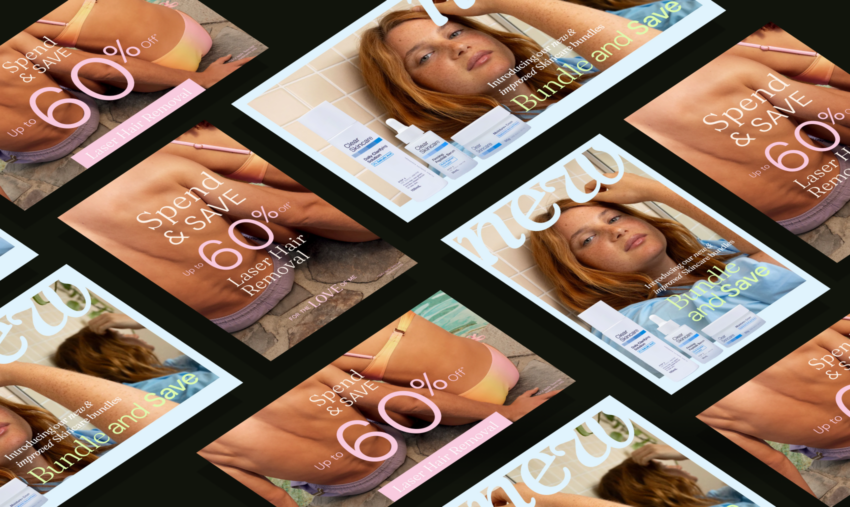
Structural improvements only go so far if the ads themselves aren’t doing their job. Alongside the rebuild, we reviewed and rewrote ad copy across every campaign, ensuring each service’s messaging reflected its actual value proposition, clinical expertise, affordability, over 20 years of in-clinic refinement, tailored for the specific treatment being advertised.
Responsive Search Ads were built with tightly matched headlines for each service category, drawing on Clear Skincare’s genuine strengths: accessibility, clinical credibility, and a treatment range covering everything from everyday skin concerns to more advanced aesthetic goals.
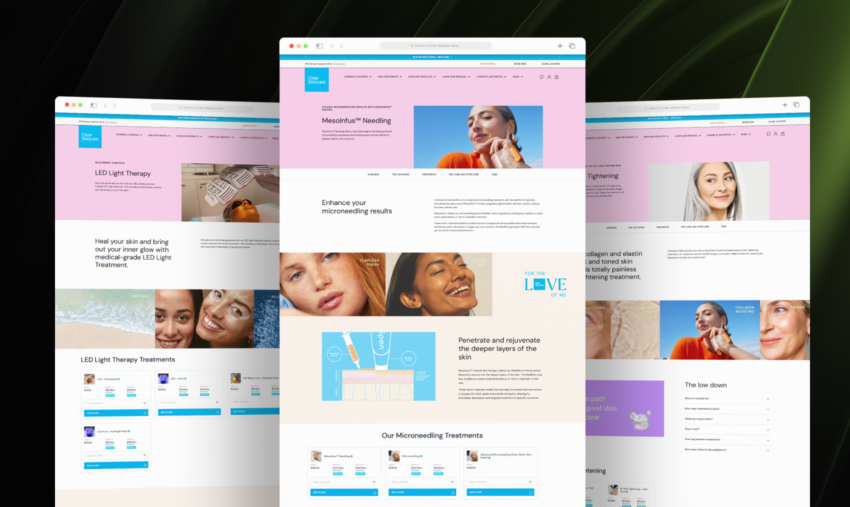
Equally important was landing page alignment. Every campaign was paired with the most relevant page on the Clear Skincare website, a dedicated service page rather than a generic homepage or broad category page. A user searching for “laser hair removal Brisbane” doesn’t want to land on a homepage and hunt for what they’re looking for. They want to land directly on the laser hair removal page for Queensland. Reducing that friction at the bottom of the funnel is one of the highest-leverage improvements available in paid search, and it contributed meaningfully to the conversion rate improvement we saw across the account.
The Results: What a Year of Proper Google Ads Management Looks Like
Comparing November 2023–24 against November 2022–23, the numbers speak for themselves.
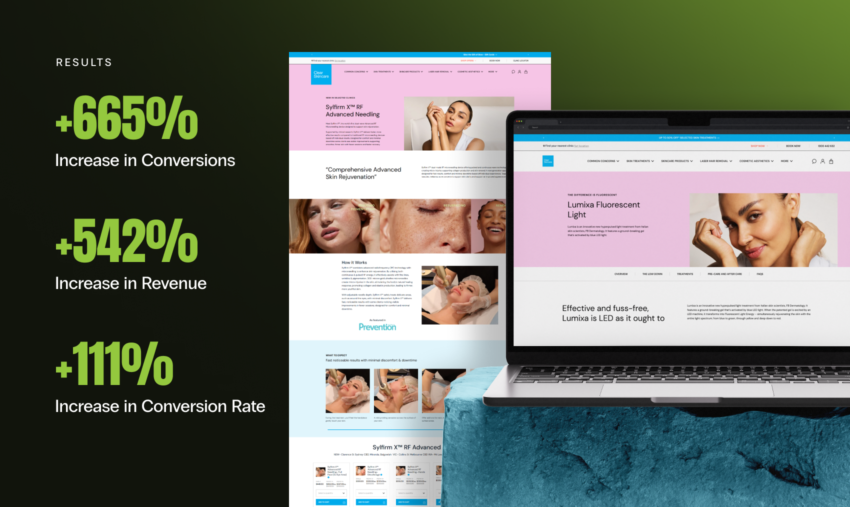
+665% Increase in Conversions
This is the headline. Total conversions grew by 665% year-on-year, a figure that reflects both the immediate impact of fixing conversion tracking, surfacing bookings that were previously invisible to the platform, and genuine growth in appointment volume driven by better-structured, better-optimised campaigns. In practice, it’s the combination of both: accurate measurement and improved performance reinforcing each other.
+542% Increase in Revenue
Revenue attributed to Google Ads grew by 542% over the same period. For the first time, Clear Skincare had a credible, real-time picture of what paid search was actually delivering commercially, not just clicks and impressions, but confirmed bookings with real dollar values attached. In the context of Wesfarmers Health reporting to the ASX on the performance of its aesthetics division, that kind of clear attribution matters enormously.
+111% Increase in Conversion Rate
Of all three numbers, this one might be the most telling. Conversion rate is independent of budget, it measures the percentage of clicks that result in a completed booking. Doubling the conversion rate means every dollar spent on Google Ads is working twice as hard as it was twelve months earlier. That’s the signature of structural improvement: better targeting, sharper ad copy, tighter landing page alignment, and smarter bidding working in concert. It also means that as Wesfarmers invests further in growing Clear Skincare’s digital footprint, that investment goes further.
Why This Matters at a Wesfarmers Scale
These results land at a genuinely pivotal moment for Clear Skincare’s place within the Wesfarmers Health division. The group’s ‘Accelerate’ transformation program is explicitly focused on improving the financial performance of its aesthetics portfolio, integrating the SILK Laser, Australian Skin Clinics, and Clear Skincare brands, and identifying where investment will drive the best returns. Wesfarmers Health’s revenue grew 5.5% to $5.93 billion in its most recent full-year result, with the MediAesthetics division a key growth priority, but also one under pressure to demonstrate that its digital marketing activity is commercially productive.
That’s a very different conversation to the one most marketing teams are used to having. When your parent company reports to the ASX every six months, “we ran some campaigns and traffic was up” isn’t an answer. Clear Skincare needs to show appointment volume, booking revenue, and cost-per-acquisition, all tied back to specific channels and campaigns. The infrastructure Click Click Media has put in place makes that possible.
The Zenoti tracking integration gives Clear Skincare a reliable, real-time line of sight from ad spend to confirmed bookings and revenue. The service-and-state campaign architecture means budget can be shifted with confidence in response to new clinic openings, seasonal demand shifts, or the promotional priorities Wesfarmers sets from above. And as the MediAesthetics division continues to consolidate its brands and expand its clinic network, the Google Ads account is now built to scale with it, not just in terms of spend, but in terms of insight and accountability.
What was a channel operating well below its potential is now one of Clear Skincare’s most measurable and high-performing digital acquisition tools. In the Wesfarmers era, that’s exactly what it needs to be.
What Every Multi-Location Service Business Should Take From This
Clear Skincare’s story isn’t unique, it’s just unusually well-documented. Across the beauty, wellness, and health sectors, we regularly see brands spending meaningfully on Google Ads while their booking platforms quietly fail to communicate results back to the platform. The spend continues. The budget feels like it’s doing something. But the algorithm is starved of the signal it needs to optimise properly.
If your business runs on a third-party booking system, whether it’s Zenoti, Mindbody, Fresha, or anything else, the first question worth asking is: are those bookings actually being tracked as conversions in your Google Ads account? If you’re not certain, the answer is almost certainly no, or not reliably. A Google Ads audit will tell you exactly what’s being captured and what’s slipping through.
The second question: does your campaign structure reflect your business? For multi-location, multi-service brands especially, consolidation feels simpler, but it costs you the precision and reporting clarity that makes paid search genuinely manageable at scale. Granularity isn’t complexity for its own sake, it’s the architecture that lets you make confident decisions about where to grow.
Get those two things right, and the numbers tend to follow.
Want to know what your Google Ads account could really be doing? Book a free Google Ads audit with Click Click Media — we’ll show you exactly where performance is leaking and what it would take to fix it. Get in touch with our team to talk through your goals.