
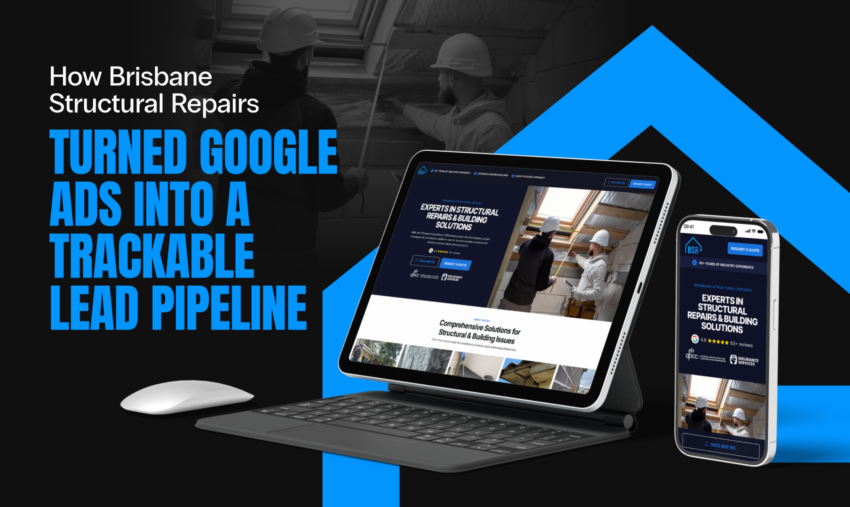
How Brisbane Structural Repairs Turned Google Ads into a Trackable Lead Pipeline
TL;DR
- Rebuilding the Google Ads account around core services created clearer visibility and stronger budget control.
- End-to-end conversion tracking turned an unmeasurable account into one that could be optimised with confidence.
- A dedicated landing page, purpose-built for paid traffic, is converting at an 18% all-time rate well above the industry benchmark of 5–15%.
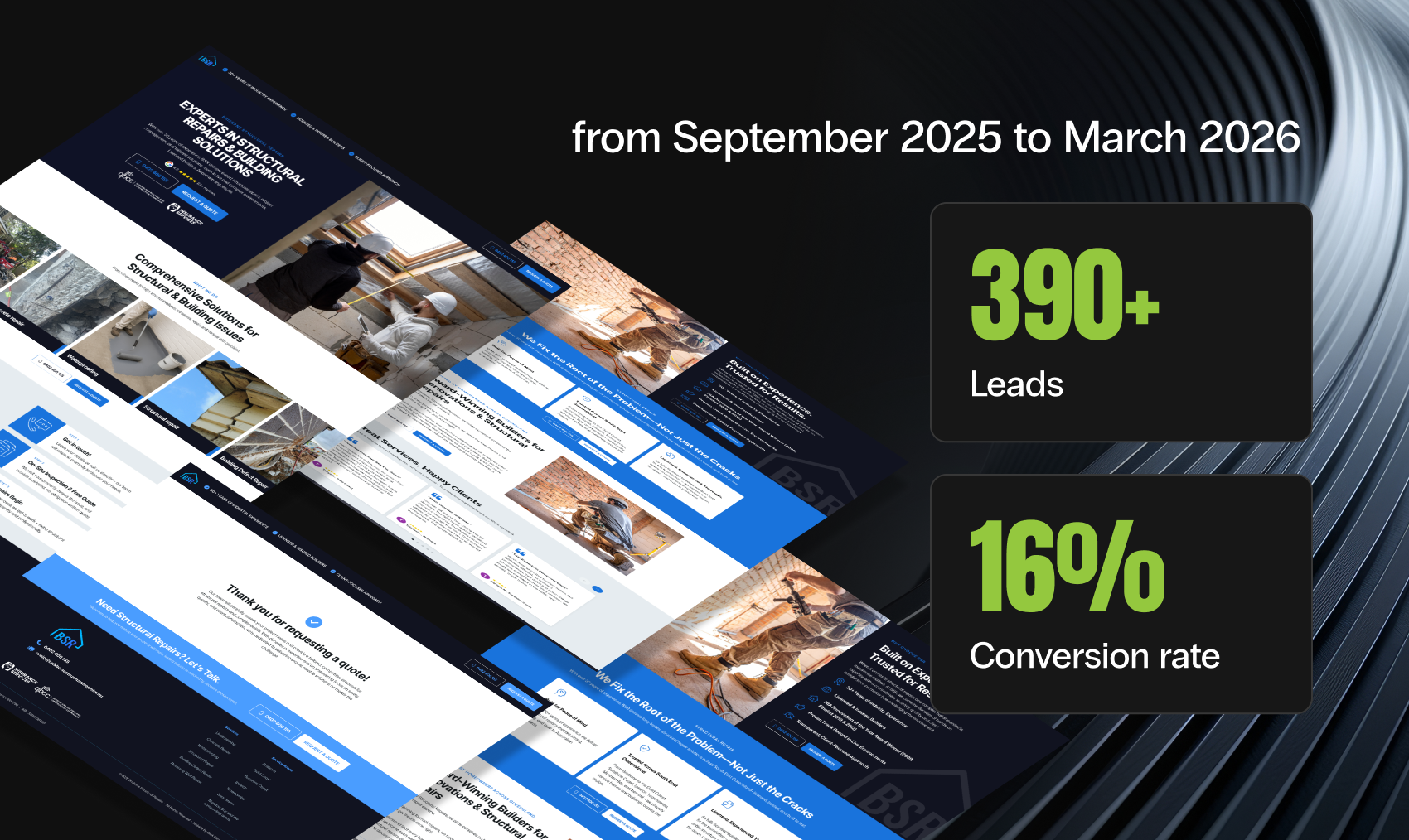
- Across six months, the campaigns generated 393 leads at a 16% average conversion rate.
- For a structural repairs business where a single job can be worth hundreds of thousands of dollars, that level of lead efficiency is a strong commercial result.
The Client
Brisbane Structural Repairs (BSR) is one of South East Queensland’s most experienced structural repair companies. With over 30 years of hands-on industry experience, a 5.0 Google rating, and an HIA Renovation of the Year Award to their name, BSR has spent decades building a reputation for solving structural problems at the root cause, not just the surface symptoms.
Their services span underpinning, concrete repair, waterproofing, structural repairs, retaining wall repairs, and building defect remediation, with clients ranging from homeowners across Brisbane to commercial operators stretching from the Gold Coast to Toowoomba.
The expertise was never in question. The problem was digital. Despite a strong track record and genuine demand for their services, BSR was running Google Ads without the infrastructure to understand what was actually working. There was no reliable conversion tracking, no campaign structure built around their services, and no dedicated landing page to receive paid traffic and turn it into booked jobs.
That’s where Click Click Media came in.
The Problem: Activity Without Accountability
There’s a version of Google Ads that looks functional on the surface. Budget is going out, impressions are ticking over, and the dashboard shows plenty of activity. The problem doesn’t show up until you try to answer a basic question: where are the leads coming from?
For Brisbane Structural Repairs, that question had no clear answer.
Without end-to-end conversion tracking, there was no dependable way to attribute enquiries back to specific campaigns or keywords. Campaigns weren’t structured around the services the business actually delivered. Underpinning and waterproofing were grouped together despite having completely different search intent, job values, and conversion behaviour. Running them as a single campaign meant budget decisions were being made without any service-level visibility.
And when visitors did arrive via Google Ads, they were landing on a general page with no purpose-built destination to meet them where they were. There was no clear path to action. No trust signals positioned for a cold audience. No frictionless way to submit an enquiry.
The business had the right offer. It lacked the infrastructure to convert it.
The Solution: A Full Rebuild From the Ground Up
Fixing this properly meant addressing both sides of the problem: the campaigns that were generating the clicks, and the destination those clicks were landing on. The two had to work together.
Rebuilding the Google Ads Account Around Real Services
The account needed a rebuild, not a patch-up. Working with BSR’s team on their paid search setup, campaigns were restructured and segmented by service:
- Underpinning
That structure created immediate clarity. Each campaign could now be isolated, measured, and optimised independently. Budget decisions could be based on what the data was actually showing for each service, rather than a blended view that made it impossible to see what was performing and what wasn’t.
Ad relevance also improved. When a campaign is tightly focused on a single service and its matching search terms, Google has cleaner signals to learn from. A homeowner researching underpinning support is a completely different prospect to someone with an urgent waterproofing issue. Treating them the same way inside the account meant neither was being served properly, and the platform’s own machine learning systems were being fed noisy, conflicting data as a result.
Conversion tracking was then implemented end-to-end, so every lead could be traced back to the specific campaign and keyword that generated it. For the first time, the account had a proper framework for optimisation. The business moved from making gut-feel decisions to making evidence-based ones.
Building a Landing Page That Converts
Running Google Ads without a purpose-built landing page is like turning on a tap with no bucket underneath. Even well-structured campaigns producing strong, high-intent traffic will underperform if the destination doesn’t match the expectation of the person who clicked.
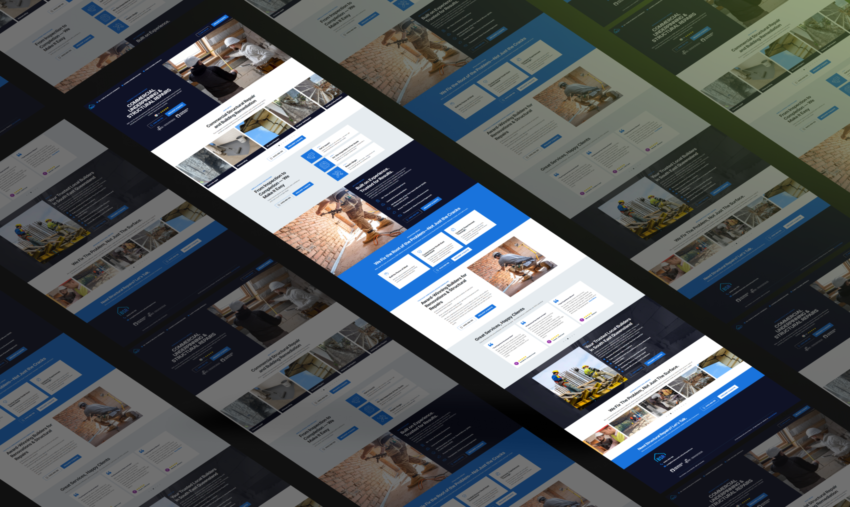
Rather than sending visitors to a general page on the BSR website, Click Click Media designed and built a dedicated landing page from scratch, built to receive the specific kind of visitor that paid search delivers: someone with a problem, actively searching for a solution, and ready to act.
Every design decision was made in service of that goal.
The hero section was built to establish authority immediately. The headline “Experts in Structural Repairs & Building Solutions” is direct and category-defining. Three trust indicators (30+ Years of Industry Experience, Licensed & Insured Builders, Client-Focused Approach) sit in the very first thing a visitor sees, not buried at the bottom. BSR’s 5.0 Google star rating, their QBCC Builders Licence badge, and their HIA membership logo all appear upfront. These are credibility signals that matter significantly to Queensland homeowners evaluating a licensed builder for serious structural work.
Two CTAs appear in the hero, a phone number and a “Request a Quote” button, so regardless of where a visitor is in their decision-making, the next step is always immediately visible.
The services section uses a horizontally scrolling image carousel pairing real project photography with each service name. Visitors can self-identify quickly, which reduces friction and keeps the page engaging without overwhelming them with text. If someone arrived because of concrete cracks in their slab, they can see Concrete Repair right in front of them and know immediately that BSR handles exactly their situation.
The process section tackles one of the most common barriers in the trades: prospective clients don’t know what happens after they make contact. A clean three-step breakdown (Get in Touch, On-Site Inspection & Free Quote, Repairs Begin) uses deliberately reassuring language to remove the psychological uncertainty that stops people from acting.
A mid-page trust section on a dark background lays out BSR’s credentials in full: 30+ years of experience, their licensed and insured status, the HIA Renovation of the Year Award (2009, finalist 2010 and 2012), and their track record working in live and occupied environments. This section is positioned after the visitor has been introduced to services and process, but before the final conversion push. It’s doing the job of converting someone who is on the fence.
The testimonials section features long-form, attributed client reviews from across BSR’s service region. These aren’t generic praise. They speak specifically to the communication, transparency, and technical competence that define working with BSR, the kinds of details that resonate with someone weighing up whether to call.
The quote form includes file and photo upload functionality, so clients can submit images of their damage directly. For structural repairs, a photo is worth a thousand words, and allowing clients to attach images upfront accelerates BSR’s qualification and quoting process from the very first enquiry.
Throughout the page, a sticky navigation bar maintains both CTAs at all times. A visitor who becomes ready to act at any point can do so immediately, without scrolling back to the top.
The Results
Six-Month Campaign Performance (September 2025 – March 2026)
| Metric | Result |
| Total conversions | 393 leads |
| Average conversion rate | 16.01% |
These results came from a cleaner structure, not from increased spend. Total budget across the six months remained consistent with what BSR had been running before. What moved the needle was the account architecture underneath the activity.
Peak Performance (October 2025 – January 2026)
| Period | Conversions | Conversion Rate |
| November 2025 | 90 | 21% |
The October to January period delivered especially strong lead efficiency, with November 2025 standing out as the strongest individual month. That level of consistency across four months is significant. The account wasn’t riding a one-off spike. A properly structured account with clean tracking and relevant campaigns tends to look like this when everything is pointing in the same direction.
Q1 2026 Performance
| Period | Conversion Rate |
| Q1 2026 | 15.54% |
Q1 2026 saw some movement in costs, which is common in competitive paid search categories as seasonal patterns and auction dynamics shift. But the conversion rate held strong. A rising cost-per-acquisition alongside a healthy conversion rate points to increased competition in the auction, not to something breaking down in the campaign or on the landing page. The offer and the user experience were still doing their job.
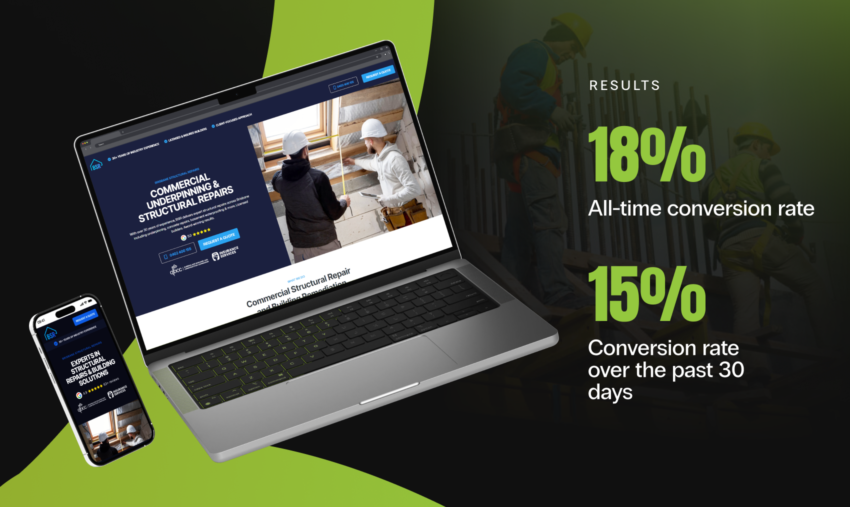
Landing Page Performance
The landing page has achieved an 18% all-time conversion rate, with a 15% conversion rate over the past 30 days. For context, landing pages across the digital marketing industry typically convert somewhere between 2% and 5%. A well-optimised page in a competitive trade services niche might push toward 10–15% with strong copy and design. An 18% all-time rate places BSR’s page well into the top tier of performance for any industry, let alone one as competitive as structural repairs in South East Queensland.
What Those Numbers Actually Mean for the Business
Context matters when evaluating lead generation performance, and the context here is significant.
For Brisbane Structural Repairs, a single job can range from a few thousand dollars to as much as half a million. Residential underpinning, commercial waterproofing, and large retaining wall projects carry substantial value. Someone searching for underpinning support isn’t casually browsing. They have a genuine, often urgent problem. These campaigns were designed to attract exactly those prospects: high-intent residential and commercial clients actively searching for structural repair solutions.
The real outcome wasn’t improved ad metrics. It was a trackable, scalable pipeline of qualified enquiries that the business can now understand, report on, and continue to build from. Decisions can be made based on evidence rather than assumptions.
What Made This Work
Several principles underpinned the success of this project, and they’re worth naming directly.
Campaign architecture and the landing page were built together, not separately. Google Ads and the landing page weren’t treated as independent workstreams. The page was built to receive the specific visitor that paid search delivers. That alignment between ad messaging and landing page experience is a core reason conversion rates are this high. When the two are misaligned, even slightly, efficiency bleeds away at the handoff point.
Conversion tracking is non-negotiable. Without it, paid search is just money going out with no reliable way to understand what’s coming back. Once tracking was in place, every subsequent decision became better, because it was grounded in actual data.
Campaign segmentation matters because different services carry different intent. Underpinning and waterproofing aren’t the same product, the same customer, or the same search behaviour. Treating them as one campaign produces average results across the board. Separating them produces optimised results for each.
Trust was the primary design goal of the landing page, not aesthetics. Every visual decision was made in service of credibility. The QBCC badge, the HIA logo, the Google rating, the award history. These aren’t decorative. They’re conversion elements designed for an audience that needs to trust who they’re handing their property to.
CTAs were treated as a navigation system. Rather than placing a single call to action at the top and bottom, the page features CTAs at every natural pause point in the scroll journey. A visitor who decides they’re ready after reading the process steps doesn’t have to hunt for the next action. It’s already in front of them.
Finding This Kind of Clarity in Your Own Campaigns
When a business knows its service is strong but results are inconsistent, the problem is rarely the offer. It tends to be the structure behind the marketing. Fix the structure, and efficiency tends to follow.
For businesses dealing with inconsistent lead flow, unclear reporting, or campaigns that seem active but don’t produce results structural clarity is often the most important change to make. When conversion tracking, campaign architecture, and landing page experience are working together, it becomes much easier to understand what’s driving results and what to do next.
Click Click Media helps Australian businesses build that kind of clarity through strategy, measurement, and grounded execution. If you want to understand what a cleaner structure could do for your campaigns, reach out to our team and we’ll talk you through what’s possible for your business.