
Creative Wins Meta Auctions: Platform Work Decides How Often It Gets the Chance

Most advertisers think of the Meta auction as something decided by bid: whoever pays the most wins the placement, and everything else is a formality. That “everything else” is doing more work than it looks like.
You are not entering a contest judged on spend alone. Meta scores every ad on bid, estimated action rate, and ad quality together, and a weak quality score doesn’t just raise costs. It can shut an ad out of the strongest placements entirely, no matter how aggressive the bid behind it.
That’s why two advertisers can spend the same budget targeting the same audience and land in completely different auctions. One is competing for every high-value impression. The other is fighting over what’s left.
Most teams respond to rising costs by raising bids. That treats the symptom, not the cause.
TLDR
- Meta’s auction is decided by bid, estimated action rate, and ad quality together, not bid alone.
- Weak creative doesn’t just raise cost per result. It lowers how often an ad is offered a chance to compete.
- Ad quality is measured through Quality Ranking, Engagement Rate Ranking, and Conversion Rate Ranking, compared against ads targeting the same audience.
- Frequency and engagement decay over time, meaning a winning creative has a shelf life, not a permanent status.
- Consistent creative testing and refresh cycles are what keep an account competitive in the auction long-term.
What Actually Decides Who Gets Shown

Meta’s own guidance on the ad auction is clear. When ads compete for the same impression, Meta chooses the one with the highest total value, not the highest bid. That total value comes from three things combined: the advertiser’s bid, the estimated action rate, and ad quality. Meta measures that last piece through what it calls ad relevance diagnostics, not a single relevance score.
A $5 bid paired with strong creative can beat a $15 bid paired with weak creative in Meta ad campaigns, because quality carries real weight in that calculation. It isn’t a tiebreaker Meta reaches for occasionally. It’s built into every single auction. Meta built it this way because irrelevant, low-quality ads hurt the platform more than any high bid is worth.
Why Weak Creative Loses the Auction

Ad quality isn’t a grade Meta assigns once and forgets. It’s a live prediction of how a specific user will respond, rebuilt continuously from engagement, negative feedback, and what happens after the click to the landing page.
Meta breaks that prediction into three diagnostics, each measured against other ads chasing the same audience. Quality Ranking compares the ad’s perceived quality with other ads targeting the same people. Engagement Rate Ranking compares how often people interact with it relative to similar ads chasing the same audience. Conversion Rate Ranking compares its conversion rate once objective and audience are accounted for.
Meta’s own documentation on quality ranking shows exactly what a low score does. An ad ranked in the bottom 20% isn’t just more expensive. It’s being out-competed by at least four in five ads targeting the same audience, and delivery drops to match.
Below a certain threshold, that stops being a pricing problem. It’s an eligibility problem, and no bid increase fixes it. Two advertisers can spend identical budgets targeting the same audience and land in entirely different auctions, one competing broadly, the other confined to costlier, leftover inventory.
The Shelf Life of a Winning Creative
A creative’s position in the auction isn’t fixed. It moves through a predictable cycle, from a fresh advantage at launch to a gradual decline that has nothing to do with how it was built. That early advantage comes from no frequency history and a fresh quality signal, since Meta has not seen the creative before, and neither has most of the audience.
Why That Advantage Fades
That advantage erodes on its own. The same people see the ad again and again, engagement softens, and frequency climbs even when nothing about the targeting has changed. Frequency is simply the average number of times a single person has seen the ad. This is normal creative fatigue, not a sign anything was set up wrong.
Frequency climbing while engagement or conversion rate falls is usually the clearest early signal a creative needs replacing, not a targeting adjustment. It moves before cost per result does, so it’s worth watching on its own.
Chasing volume isn’t the fix, either. A colour swap or a tweaked headline doesn’t meaningfully refresh the signal Meta is reading, because the audience’s reaction hasn’t changed. Refresh has to mean genuinely different creative, not more output dressed up as new.
Signs Your Creative Has Started to Decay

Some of this is easier to spot in hindsight than while it’s happening. A handful of patterns, all visible in Meta Ads Manager, tend to show up consistently once a creative starts losing ground in the auction, often before cost per result visibly climbs.
- Frequency climbing steadily while click-through rate holds flat or drops
- Quality Ranking sliding from Above Average toward Average or Below Average
- Cost per result creeping up with no change to targeting or budget
- Engagement thinning out on a creative that used to perform well
- A widening gap between reach and results, even as spend stays constant
None of these signs is decisive on their own, since performance naturally fluctuates. Together, especially alongside a rising frequency number, they’re usually enough to confirm a creative has run its course.
A single bad day isn’t enough to act on. Confirm the pattern across several days, then swap the creative once Quality Ranking or engagement has genuinely slipped.
What Each Diagnostic Tells You to Fix
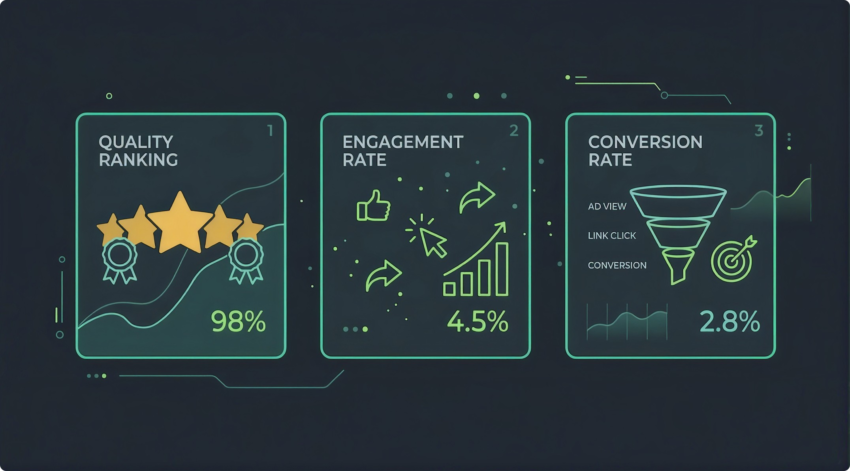
Knowing a diagnostic has slipped is only useful if it points to the right fix. Each one is telling you something different about where the problem sits.
| Diagnostic | What a Drop Usually Means | What Actually Fixes It |
| Quality Ranking | The creative itself isn’t resonating with this audience | New creative, not a copy tweak |
| Engagement Rate Ranking | People are seeing the ad but scrolling past it | A different hook or format, not a colour change |
| Conversion Rate Ranking | The ad is fine, but something after the click isn’t | Check the landing page before touching the ad |
Treating all three the same way, usually by pausing the ad and hoping the next one performs better, is how accounts end up guessing instead of fixing the problem.
When It Isn’t the Creative
A low Quality Ranking doesn’t always mean the ad is at fault. The real issue can be the landing page, or a mismatch between what the ad promises and what the page delivers.
Most of the time, though, a below-average ranking traces back to the creative itself, which only new creative actually resets. Checking the landing page first saves a testing cycle when the fix was never the ad to begin with.
The Discipline Most Accounts Skip

CCM treats creative as a live input to ad delivery optimisation, not a production task finished before a campaign launches. Performance data from one week shapes what gets tested next, rather than treating creative and reporting as separate steps.
Within our Meta ads service, that means reviewing quality rankings and frequency data in Meta Ads Manager on a set schedule, not waiting for CPMs to climb before anyone looks. A creative flagged as fatigued gets replaced before it drags the whole ad set down, not after.
The same discipline carries across every paid channel we manage, not just Meta. A creative losing ground in a Meta auction often shows the same fatigue pattern in Google Ads campaigns running alongside it, so creative review sits inside account management, not bolted onto one platform.
Testing New Concepts Properly
Testing follows the same logic as the auction itself. We judge a new concept against quality signals and estimated action rate from day one. Early cost per result does not get the same weight, not before Meta has enough data to read it properly. This is not about producing more assets for volume. It is about knowing which creative is losing ground and acting on that before the account feels it.
Keeping Creative Ahead of Decay
Accounts that catch decay early do one thing differently: they feed engagement and frequency data back into what gets tested next, rather than letting it sit in an unread report. A creative feedback loop makes this concrete: which metrics to check weekly, and when a dip is normal variance rather than genuine fatigue. It also covers how to have a new concept ready before the current one is needed.
That usually means testing a different hook, format, or angle rather than a new version of the same idea. A UGC-style video reads differently to a static image ad even when the offer is identical, and that variation produces a fresh read from the audience. None of this requires more budget, just treating creative review as a recurring part of account management rather than a one-off task revisited only when something breaks.
The Real Lever Is Creative, Not Bid
Bid is the lever every advertiser reaches for first, but it’s the one with the least room to move once quality and estimated action rate are already working against you. Fix the creative, and the bid does less work to compensate for it. That’s what Meta is describing every time it recalculates total value: the strongest combination wins, not the biggest bid.
Paid social and paid search increasingly get judged inside a digital marketing strategy on the same combination of signals and spend, not spend alone.
CCM runs Meta Ads accounts as a Google Premier Partner, a status held continuously since 2014, with no lock-in contracts on any campaign.
FAQs
Does a Higher Bid Guarantee an Ad Wins the Meta Auction?
A higher bid improves an ad’s chances, but Meta’s auction weighs bid alongside estimated action rate and ad quality, and either of those can outweigh it. An ad with weak creative can lose to a lower bid backed by stronger quality signals.
What Is Meta’s Ad Quality Score Based On?
Meta’s ad quality score is measured through what it calls ad relevance diagnostics: how people engage with or hide the ad, and what happens after they click through to the landing page. These signals are compared against other ads competing for the same audience, not scored in isolation.
How Often Should Meta Ad Creative Be Refreshed?
There’s no fixed schedule, since decay depends on audience size and frequency rather than a set number of days. A more reliable signal is watching frequency climb alongside softening engagement, which usually means it’s time for genuinely new creative rather than a variation of the old one.
Why Do Two Advertisers With Similar Budgets Get Different Results on Meta?
Budget is only one input into Meta’s auction, and quality and estimated action rate can outweigh it entirely. An advertiser with stronger creative can end up competing across premium placements, while a similar budget with weaker creative gets pushed into costlier, lower-value inventory.
What Is a Creative Feedback Loop and Why Does It Matter for Meta Ads?
A creative feedback loop is the habit of letting last week’s engagement and frequency numbers decide what gets tested next, instead of treating creative output and performance reporting as two unrelated jobs. It’s what allows an account to catch decay early, before cost per result climbs and a campaign needs rescuing rather than refreshing.
Where to Look Before You Raise Your Bids
For accounts where CPMs keep climbing despite steady targeting, this is usually the first place worth looking before adjusting bids further. That “everything else” decides whether your bids even get the chance to work. The next step is to speak with our team about reviewing your current creative against what’s actually driving your auction costs. No lock-in contracts.