
Premier Partner Since 2014: What the Badge Does and Does Not Mean
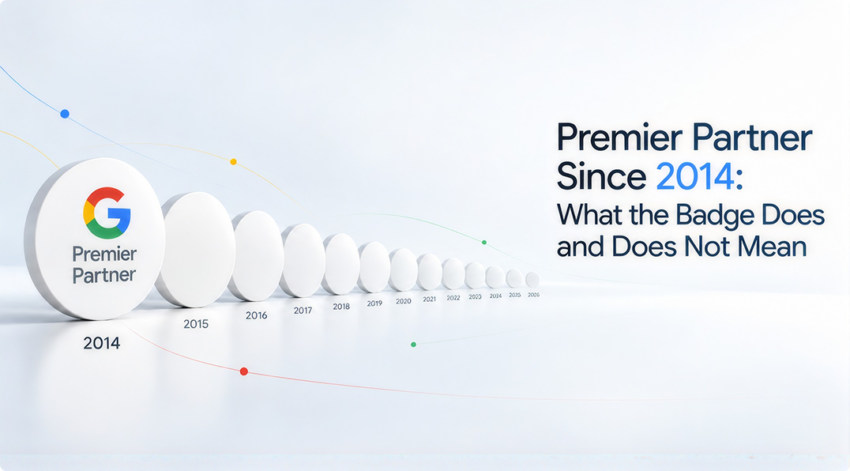
Some treat the Google Premier Partner badge as marketing fluff, a logo agencies put on a website and forget about. Others treat it as a guarantee, proof an agency will get results before a single campaign runs. Neither is right.
Google measures three specific things to award the badge, and none of them is quite what most people assume. What it verifies is narrower than the badge implies. What it does not verify matters just as much, and ten continuous years of renewal says more than the badge alone ever could.
TLDR
- Premier Partner status is awarded on performance, spend, and certification data, not paid for or self-declared.
- It verifies account performance and platform expertise, not strategic fit, communication style, or industry experience.
- Status is re-evaluated every year, so a decade of renewal says more than the badge alone.
- Premier Partner status is capped at the top 3% of agencies in a country, not a fixed pass mark.
- The badge is one input for evaluating an agency, not a replacement for asking about process and results.
What Google Actually Measures
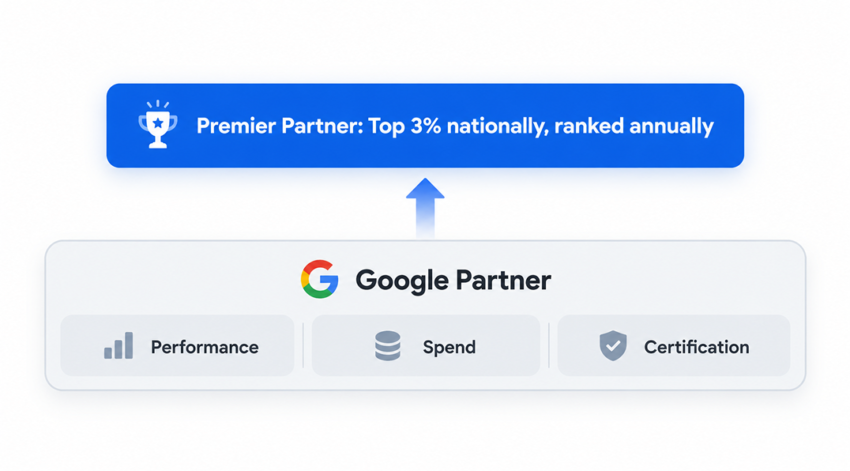
Google’s own Partner Program documentation lays out the requirements directly, and they come down to three categories, checked daily against an agency’s actual account data:
- Performance: a minimum optimisation score of 70% across the agency’s managed accounts
- Spend: at least $10,000 USD in ad spend managed across clients every 90 days
- Certification: at least half the team certified in Google Ads, with coverage across every product area they work in
Meeting those three earns an agency the standard Partner badge and makes it a genuinely certified Google Ads agency. Premier Partner status is a second, harder bar. The agency must also sit in the top 3% of companies in its country, a ranking Google recalculates yearly based on client growth, retention, and spend beyond Search.
Nobody applies for that ranking; Google assigns it based on where an agency lands against every other agency in its country. An agency can check where it currently stands against all three thresholds any time, through the Partners program dashboard, which shows live numbers rather than a once-a-year self-report.
Google publishes both sets of thresholds, and they’re worth seeing side by side, since the jump from one tier to the next is bigger than a single extra requirement:
| Category | Google Partner | Google Premier Partner |
| Performance | 70% minimum optimisation score | Same score, plus top-3% client growth and retention |
| Spend | $10,000 USD managed spend per 90 days | Same threshold, plus annual spend growth ranking |
| Certification | 50% of strategists certified, one per product area | Same requirement, evaluated alongside product diversification |
| How it’s decided | Checked daily against account data | Ranked annually against every other agency in the country |
The Premier Partner requirements never replace the base three. They stack a country-wide ranking on top of the same Partner Program tiers. That’s why if enough competitors perform better in the same market that year, an agency can meet every Partner threshold and still miss Premier status entirely.
An agency sitting at 69% one quarter and 71% the next isn’t failing. It’s operating right at the edge of a fixed threshold, with a score that shifts with every account it manages. That’s why daily-checked Partner requirements and the annually ranked Premier requirements measure different things at different speeds.
What the Premier Partner Badge Verifies
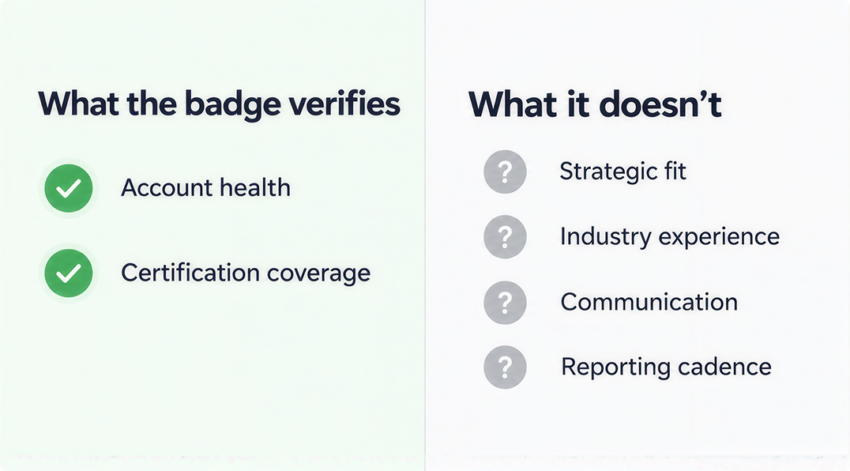
Passing those checks confirms something real, just not the whole picture agencies imply when they put the badge on a homepage.
Platform Performance and Account Health
A 70% optimisation score means Google’s system rates the account setup as sound. That is a genuine signal, not a vanity number. A campaign missing ad extensions, running an outdated bid strategy, or leaving keyword gaps drags that score down fast. One well-built account can’t prop up a score for neglected ones sitting alongside it.
Certification Depth Across the Team
Certification works differently. It checks whether staff have passed Google Ads exams, with coverage across every product area the agency claims to work in. A team running Google Shopping campaigns needs that certification in place, since coverage does not carry over between product areas, no matter how strong an agency’s Search credentials look.
Those exams run through Skillshop and link directly to the agency’s Google Ads account. This lets Google see the real numbers rather than whatever an agency claims on its website.
What the Badge Does Not Verify
The gaps matter more than they get credit for, since this is where a badge and a working relationship start to diverge. Google’s checks stay silent on two things in particular:
- Strategic fit: whether an agency understands a specific industry, a specific market, or the commercial reality behind a client’s goals
- Communication and process: response times, reporting cadence, and how decisions get made and explained
A Premier Partner managing eCommerce accounts and a Premier Partner generating leads for law firms clear the same bar, even though their marketing strategies barely overlap. A retail account lives on ad spend ROI during sales peaks, while a local services account lives on cost per lead spread all year. The badge cannot tell the two apart.
An agency can hold Premier Partner status and still send a monthly PDF with no context attached, or go quiet for a week when a campaign underperforms. It can just as easily stay vague about why a budget shifted throughout a month. None of that is what the badge is measuring.
Why Ten Years of Renewal Matters
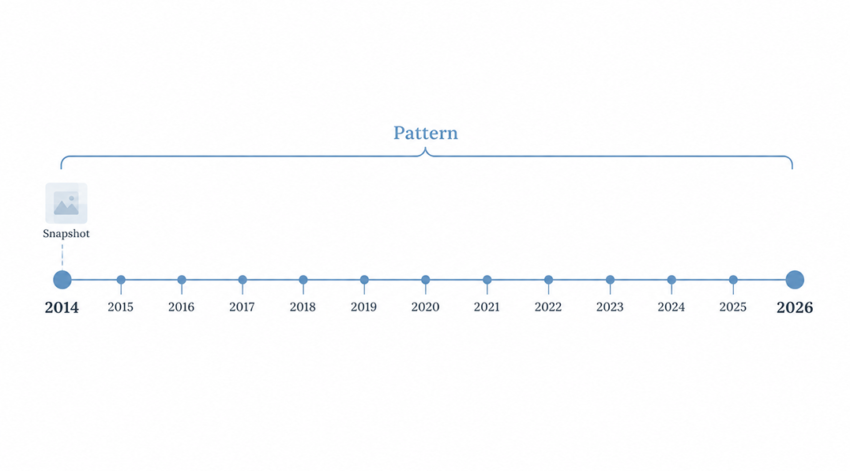
Premier Partner status resets every year. Google re-evaluates it against five factors: existing client growth, new client growth, retention, product diversification, and ad spend. A single year only proves an agency cleared the bar once.
Ten consecutive years build a track record. Our Premier Partner history runs unbroken back to 2014, across changes to Google’s own requirements, algorithm updates, and a decade of client work along the way.
A badge earned once is a snapshot. A badge held continuously since 2014 is a pattern, and patterns are harder to fake than a single good year.
How CCM Uses Premier Partner Status
Status alone does not explain what changes day to day inside an account. What matters more is a habit: the same senior people staying on an account long enough to know it well, rather than a badge sitting on a page while junior staff rotate through the work.
That habit shows up inside our senior PPC team as fewer handoffs and more institutional memory. The same strategist who set up a client’s account eighteen months ago is often still the one adjusting it now.
So a shift in cost per lead gets read against what changed in the account, not guessed at from a fresh dashboard. Google does not measure that kind of continuity. It is what has kept the badge current for a decade, rather than reflecting just one good year.
One Input, Not the Whole Decision
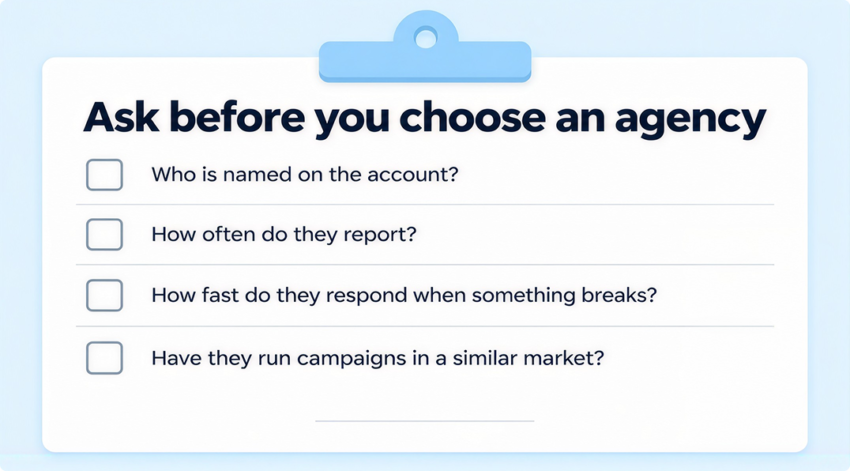
A badge is a fast way to filter out agencies that do not meet a baseline. It was never designed to replace harder questions, like whether the strategist has run a campaign in a similar market, or whether reporting cadence matches how fast the business needs to decide.
Asking how senior teams handle an account, not just what badge sits on their homepage, surfaces answers that predict a working relationship better than certification data ever will. Businesses that ask these questions upfront end up with an agency that fits how they work, not just one with the right certificate on the wall.
FAQs
Can an Agency Buy or Apply for Premier Partner Status?
Premier Partner status cannot be bought or applied for directly, since Google calculates it from account performance, spend, and certification data rather than an application form. An agency can apply to join the base Partner program, but Google assigns Premier Partner status based on how an agency ranks against others in its country.
What Is the Difference Between Partner and Premier Partner?
Google Partner status requires meeting baseline thresholds for performance, spend, and certification, checked daily against an agency’s account data. A Google Premier Partner agency must also meet those same thresholds and rank in the top 3% of participating agencies in a given country, a bar Google recalculates every year.
Does Premier Partner Status Guarantee Good Campaign Results?
Premier Partner status confirms an agency’s accounts meet Google’s performance, spend, and certification thresholds, not that a specific strategy will work for a specific business. Results still depend on the strategy, the market, and the account priorities an agency sets, none of which the badge measures.
How Often Is Premier Partner Status Re-Evaluated?
Google re-evaluates Premier Partner status annually, based on the previous year’s performance, spend, and client growth data. Meeting the bar one year doesn’t guarantee an agency meets it the next, so continuous renewal over multiple years carries more weight than the badge alone.
What Should a Business Ask Beyond Whether They Hold the Badge?
Questions about who manages the account, how often they report, and how quickly they respond when something breaks tend to reveal more than the badge does. How long an agency has held that badge, rather than whether they currently hold it, is the better predictor of what the working relationship looks like.
A Few Questions Before You Decide
Neither the sceptics nor the ones treating it as a guarantee had the full picture. A badge earns an agency a place on the shortlist; it doesn’t finish the decision.
Before choosing an agency on the strength of a badge alone, ask who is named on the account and how quickly they act when something needs attention. As a Google Premier Partner with no lock-in contracts, the next step is to speak with our team about what is happening inside your Google Ads account, badge or no badge.