
What Smart Bidding Actually Optimises For (And When to Overrule It)
TL;DR
Smart Bidding optimises for the signal you give it, not your actual business objective.
The most common reason it underperforms is bad or insufficient conversion data, not a bidding strategy problem.
There are five specific situations where human judgment should override the algorithm.
Overruling does not always mean switching to Manual CPC. There are more targeted options.
Smart Bidding is the default recommendation for every Google Ads account. And in the right conditions, it works. The machine learning is sophisticated, the auction-time signal processing is beyond what any human can replicate manually, and the results in well-configured accounts are hard to argue with.
The problem is that “well-configured” is doing a lot of work in that sentence.
Smart Bidding optimises for what you measure, not what you want. If your conversion tracking is misconfigured, it optimises confidently toward the wrong thing. If your data volume is insufficient, it guesses. If you are feeding it the wrong conversion events, it maximises the wrong outcomes. The algorithm does not know your business. It only knows the signals you give it. Understanding that distinction is the difference between treating Smart Bidding as a performance lever and treating it as a replacement for strategy.
What Smart Bidding Is Actually Doing
When you select a bid strategy, you are not handing control to a system that understands your business objectives. You are giving the algorithm a target and a dataset, and asking it to optimise toward that target using that data.
At auction time, Smart Bidding pulls from hundreds of real-time contextual signals:
- Historical conversion patterns for similar users and query types
- Device type, location, and time of day
- The specific search query, not just the keyword match type
- Browser, operating system, and connection type
- Audience membership, remarketing lists, and in-market segments
- Landing page content and historical quality signals
- Competitor auction behaviour and dynamics
That signal processing is where Smart Bidding outperforms manual bidding. A human cannot evaluate that many variables per auction at scale. The machine can.
But all of that processing is in service of a target you set. And if the target is wrong, the output is wrong. The algorithm is not checking whether your leads are converting to customers downstream. It does not read your CRM. It knows what you tracked.
What Each Strategy Actually Optimises For
Target CPA
Target CPA asks the algorithm to get as many conversions as possible at or below your nominated cost per acquisition. It will bid aggressively in auctions it predicts will convert and pull back on auctions it considers lower-probability.
What it misses: whether those conversions are actually valuable. If all your conversion events carry the same weight, which is the default, a test-drive booking enquiry and a $90,000 vehicle purchase enquiry look identical to the algorithm. It maximises volume, not quality.
Target ROAS
Target ROAS asks the algorithm to maximise conversion value relative to spend. It will favour auctions likely to produce higher-value outcomes.
What it requires: accurate conversion values. If you are passing flat values or guessing at lead values, Target ROAS is using fabricated numbers as its north star. It will optimise toward those numbers with complete confidence, and the output will be meaningless. This is not a bidding strategy problem. It is a data quality problem.
Maximise Conversions and Maximise Conversion Value
These are unconstrained versions of the above. No efficiency target, just an instruction to spend the budget in the direction you point it.
Maximise Conversions is often the right starting point for new campaigns: it gathers data without the constraint of a CPA target that may be miscalibrated. Without a maximum CPA cap applied, it will spend to budget regardless of efficiency. Maximise Conversion Value has similar dynamics and carries the same dependency on accurate conversion values.
The Three Conditions Smart Bidding Needs to Work
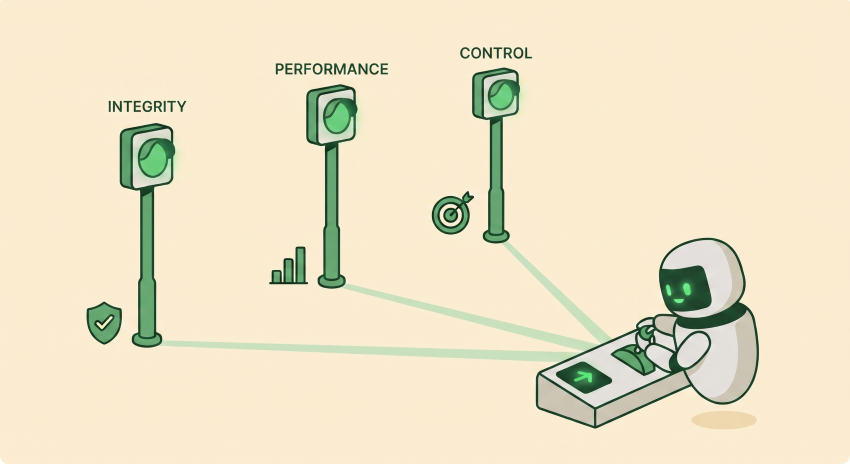
Smart Bidding performs consistently when all three of these are in place:
This is a thirty-second fix. It should be done at setup and checked quarterly.
| Condition | What it means in practice | Status if missing |
| Clean conversion data | The events you track represent the outcomes you actually want. Tags fire correctly. No duplicate events. No missing conversions on key pages. | Algorithm optimises toward incorrect signal |
| Sufficient conversion volume | Google recommends 30+ conversions per 30-day window for Target CPA, 50+ for Target ROAS, per campaign. | Algorithm fills data gaps with guesswork |
| A calibrated target | Your CPA or ROAS target reflects what is actually achievable based on historical performance, not a default suggestion or a wishlist figure. | Algorithm either over-spends or under-delivers |
When to Overrule It

Your conversion data is unreliable
If your GA4 revenue figures do not reconcile with your actual revenue, your Smart Bidding is optimising toward incorrect data. This is the most common issue that surfaces in a GA4 and GTM audit: duplicate purchase events, payment gateway sessions resetting attribution, and misconfigured datalayers all feed bad signals into the algorithm.
The fix is not to change your bidding strategy. The fix is to fix the tracking. Until that is done, Smart Bidding is not a performance lever. It is an amplifier for errors.
Your conversion volume is too low
TIf a campaign generates fewer than 30 conversions per month, Target CPA is guessing. In this situation, the options are Manual CPC or Maximise Clicks while you accumulate data, or a portfolio bid strategy that pools data across campaigns so no single campaign is flying blind. The data threshold is not a soft recommendation. It is the point below which the algorithm’s predictions are statistically unreliable.
You have context the algorithm does not
The algorithm knows auctions. It does not know that you have a warehouse issue and cannot fulfil orders this week, that a competitor’s site went offline and you should push harder right now, or that leads from a specific campaign are converting at 40% in the CRM despite looking identical to lower-quality leads on the surface.
These situations call for seasonality adjustments, temporary strategy changes, or manual overrides that account for business context no algorithm can access.
Brand campaigns
Brand terms often perform better on Target Impression Share or Manual CPC. Someone searching your brand name is not a prospect you need to win in an open, competitive auction. Letting Smart Bidding aggressively optimise bids on brand terms can inflate CPCs unnecessarily and spend budget that would convert regardless of bid level.
After major account changes or new launches
Smart Bidding has a learning period, typically 7 to 14 days, during which performance can be erratic as the algorithm builds a new model. If you are launching a new campaign or restructuring an existing account, consider starting on Maximise Clicks to gather baseline data before introducing CPA or ROAS targets. Resetting the learning period repeatedly by making frequent structural changes is one of the most common reasons Smart Bidding never reaches optimal performance in an account.
What Overruling Actually Looks Like

Overruling Smart Bidding is not always switching to Manual CPC. Sometimes that is the right call, particularly during a diagnostic period or when tracking is too broken to rely on. But there are more targeted options.
| Method | When to use it |
| Seasonality adjustments | Signal to Smart Bidding that conversion rates will be abnormally high or low for a defined short window. The algorithm adjusts temporarily without discarding historical learning. |
| Target adjustments | If Smart Bidding is chasing volume at the expense of efficiency, tighten the CPA target or raise the ROAS target to rein it in without removing automation entirely. |
| Bid adjustment layers | Device, location, audience, and ad schedule adjustments on top of Smart Bidding targets. Use selectively. Too many layers send conflicting signals. |
| Portfolio bid strategies | Pool conversion data across multiple campaigns under one bidding rule. Useful when individual campaigns do not hit the conversion volume thresholds on their own. |
| Manual CPC (diagnostic) | Temporarily switch to Manual CPC to see what bids the algorithm was setting and whether they reflect the actual value of the auctions you were entering. |
The Part That Does Not Get Said Enough
Smart Bidding is not a fire-and-forget setting. It requires conversion tracking that reflects your actual business outcomes, enough data volume to give the algorithm something real to learn from, targets grounded in unit economics rather than Google’s suggested defaults, and ongoing oversight to catch the moments when business reality diverges from what the algorithm knows.
When accounts arrive after Smart Bidding has underperformed, our Sydney Google Ads agency team asks the same question first: what was it actually optimising for? The answer is almost always the same. The wrong thing, because the data it was given was incomplete or inaccurate
This is why the account structure guide matters before the bidding strategy is set. How you organise conversion data across campaigns determines whether Smart Bidding has a clean signal or a noisy one. The algorithm can only work with what you build for it.
CCM manages over $115M in Google Ads spend for Australian businesses. As a Google Premier Partner, our team works with Smart Bidding every day across accounts ranging from local service businesses to national eCommerce brands. No lock-in contracts.
FAQs
What does Smart Bidding actually optimise for?
Smart Bidding optimises for the conversion signal you give it. Each strategy uses a different target: Target CPA optimises for conversion volume at a nominated cost, Target ROAS optimises for conversion value relative to spend, and Maximise Conversions optimises for volume within budget. None of these strategies knows your actual business objectives. They optimise toward whatever events and values you have set up in conversion tracking.
How much conversion data does Smart Bidding need?
Google recommends a minimum of 30 conversions per 30-day window for Target CPA, and 50 or more for Target ROAS. Below these thresholds, the algorithm lacks enough data to make reliable predictions and will fill gaps with guesswork. For lower-volume accounts, portfolio bid strategies that pool data across campaigns can help reach effective thresholds.
What is the difference between Target CPA and Target ROAS?
Target CPA asks the algorithm to maximise conversion volume at or below a nominated cost per conversion. It treats all conversions as equally valuable. Target ROAS asks the algorithm to maximise conversion value relative to spend, which means it needs accurate conversion values to work correctly. If you are passing flat or estimated values to GA4, Target ROAS will optimise toward those figures rather than real revenue.
When should I use Manual CPC instead of Smart Bidding?
Manual CPC is worth considering when your conversion data is unreliable, when you are in a diagnostic phase and want to understand what bids the algorithm was setting, or when your campaign lacks the conversion volume Smart Bidding needs. It is also useful as a temporary measure during major account restructures to avoid repeatedly resetting learning periods.
Does Smart Bidding work for small Google Ads budgets?
Smart Bidding can work on small budgets, but conversion volume is the limiting factor. If a campaign generates fewer than 30 conversions per month, Target CPA is guessing. Portfolio bid strategies that pool data across campaigns can help smaller accounts meet effective data thresholds without requiring each campaign to reach the minimum independently.
What are seasonality adjustments in Google Ads?
Seasonality adjustments let you signal to Smart Bidding that conversion rates will be abnormally high or low for a defined short window, such as a sale period or product launch. The algorithm temporarily adjusts its predictions without discarding its historical learning. They are designed for short windows of 1 to 7 days and should not be used as a substitute for a correctly calibrated bidding strategy.
Can I use bid adjustments with Smart Bidding?
Yes, device, location, audience, and ad schedule bid adjustments can be applied on top of Smart Bidding targets. However, stacking too many adjustment layers sends conflicting signals and can undermine the algorithm. The more constraints you apply, the less Smart Bidding can adapt to real auction dynamics. Use them selectively and with a clear rationale for each one.
How do I know if Smart Bidding is making poor decisions?
The clearest signal is a gap between what Google Ads reports and what your business actually generates. If reported conversions do not match your CRM, if GA4 revenue does not reconcile with actual revenue, or if conversion costs look efficient in the platform but leads are not converting downstream, Smart Bidding may be optimising toward incomplete or inaccurate data. A GA4 and GTM audit is usually the right first step.
Is Your Smart Bidding Working From the Right Data?
A free Google Ads audit from Click Click Media checks your conversion tracking, bid strategy configuration, and campaign structure before you let the algorithm run any further on incomplete signals. Google Premier Partner. In business since 2008. No lock-in contracts. Book at clickclickmedia.com.au/contact-us/.