
How Google’s AI Overviews Choose Who to Quote: Cost Bands, Process Steps and the Blocks That Get Cited
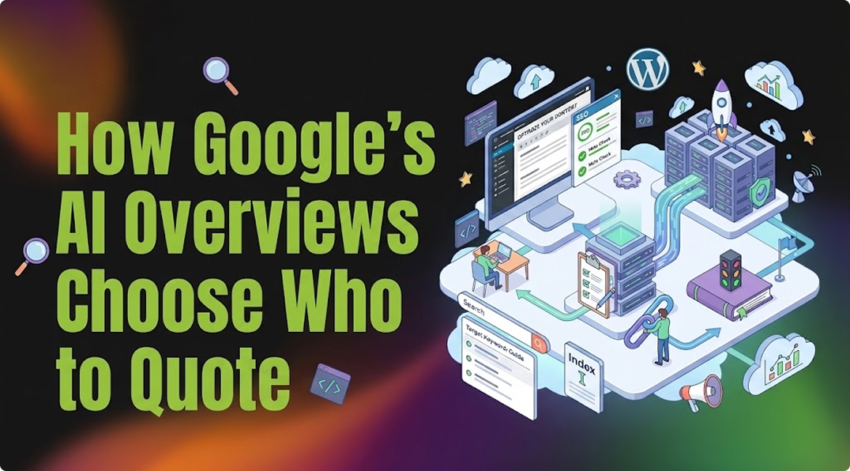
Every business asking about AI Overviews eventually lands on the same question: why is Google citing someone else and not us? The answer is not random. AI Overview citation follows patterns that can be understood, diagnosed, and improved. This resource covers three frameworks: the query cost bands that predict how difficult citation will be for a given term, the five-step process for auditing and improving AI visibility, and the six content block types that consistently earn citations across industries.
The frameworks here are based on tracking AI Overview citations across CCM’s own domain and multiple client accounts using SEMrush Position Tracking, with the Lt: aio field as the definitive citation signal.
Query Type Determines Your Starting Point
Before diagnosing why a page is not cited, the more useful question is: what type of query are we dealing with? AI Overview behaviour differs by search intent, and that intent shapes how often an AI box appears and how accessible citations are.
Four intent types produce different citation patterns:
- Pure informational (“how does microneedling work”, “what is smart bidding”) — AI Overviews appear on almost every query of this type. Citation is most accessible because Google is looking for the clearest, most accurate explanation.
- Research and comparison (“best local SEO agency”, “google ads vs facebook ads”) — AI Overviews appear frequently. Citation favours pages that address the comparison directly, not just describe a service.
- Local and consideration (“google ads sydney”, “local seo sydney”) — AI Overviews appear regularly. Citation depends on both content quality and organic ranking, with entity signals (GBP, local authority) playing a larger role.
- High commercial intent (“hire an SEO agency”, “google ads management pricing”) — AI Overviews appear less consistently and may favour aggregator pages. Citation for a provider’s own page is harder here but achievable.
Knowing which category your target queries fall into tells you which cost band applies and how much work citation will realistically require.
The Three Cost Bands
Citation “cost” refers to the combination of content quality, organic ranking position, and entity authority required to earn and maintain an AI Overview citation for a given query. It is not a financial cost — it is a measure of competitive investment.
| Band | Query type | CPC guide | AIO frequency | What earns citation | Example |
| Achievable | Niche or specific informational queries, low competition | Under $8 | Very high | Well-structured, accurate page that directly answers the query. Position one not required. | “mesoinfus needling” — Clear Skincare cited at #1, every day |
| Moderate | Local service queries and consideration-stage searches | $8–$20 | High | Content depth plus top-5 ranking. Entity authority (GBP, citations, reviews) contributes meaningfully. | “local seo sydney” — CCM cited at #4, 3 of 7 days |
| Competitive | High commercial intent head terms | $20+ | Moderate to high | Top 1–3 ranking, strong entity authority, and content depth well beyond a service description. | “google ads sydney” — CCM cited at #1, 6 of 7 days |
Where to start: If you have not earned any AI Overview citations yet, begin with the achievable band. Identify your most niche, specific service queries — the ones with low competition and clear informational intent. Build citation there first, then work toward the moderate band as your content and authority develop.
CPC is a useful proxy for cost band because it correlates with commercial intent and competition. A $3 CPC query has low advertiser and organic competition, and AI Overviews that are easier to enter with well-structured content. A $35 CPC query is heavily contested, and the AI Overview citation is correspondingly harder to earn.
The Five-Step Citation Audit
Step 1. Map which tracked keywords have AI Overview boxes
Run all tracked keywords through position tracking filtered for SERP feature aio. This tells you the scope: how many of your target queries are in play for AI visibility. For most businesses in competitive service categories, this number is higher than expected, often 50 to 70% of tracked terms show AI boxes on their SERPs.
Step 2. Confirm citation status versus organic co-occurrence
An AI box on the SERP is not the same as being cited inside it. Check the link type field (Lt) for each keyword. Lt: aio means your content is cited inside the AI answer. Lt: org means you appear organically below the box. Most businesses, when they first check, find they are in the second category for the majority of their AI Overview keywords.
Step 3. Reverse-engineer the currently cited pages
For each query where you are not cited, identify which page Google is using. Read it. What does the opening 200 words do that yours does not? What questions does it answer directly? What is its structure? You are looking for the gap between what Google judges sufficient and what you are currently publishing.
Step 4. Diagnose the gap across four dimensions
Compare your page against the cited page on: query specificity (does your page address the exact search, or a broader topic?), structural clarity (are key answers in the first 300 words?), factual authority (does the page include specific, verifiable claims and examples?), and entity signals (are your business details consistent across the page and your broader web presence?).
Step 5. Build, track and iterate
Implement the identified improvements. Then track the Lt field daily. Citation status can change quickly when a page’s position improves or content quality changes. The goal is moving from Lt: org to Lt: aio for each target query. Monitor for at least four weeks before drawing conclusions.
The Six Content Blocks That Get Cited
AI Overviews draw from specific content formats more than others. These patterns are observed across dozens of cited pages tracked against the Lt: aio signal. Building these blocks into your service pages is the most direct way to give Google material to work with.
| 1. The definition block A clear, accurate definition of what the service or topic is, written in plain language without marketing claims. Sits in the first 100 words. AI Overviews pull heavily from definition blocks when answering “what is X” and “how does X work” queries. Accuracy matters more than persuasion here. | 2. The process or mechanism block Explaining how a service works step by step — the mechanism, not the marketing outcome. “Microneedling creates controlled micro-injuries that stimulate collagen production” is more citable than “microneedling gives you younger-looking skin.” The AI needs something it can relay as an explanation. |
| 3. The “what to expect” section One of the most consistently cited patterns in health, professional services, and trades. This directly answers research queries people search before booking: how long does it take, what happens during and after, what does follow-up look like. High-intent informational queries that AI Overviews frequently address. | 4. Structured FAQs with FAQPage schema FAQ sections mirror the “People Also Ask” box, which shares query signals with AI Overviews. Questions written in natural search language — the way a real customer would type the query — give Google a structured format to draw from. FAQPage schema reduces the parsing work required. |
| 5. The local context block For local service queries, a section addressing geographic specifics: suburbs or areas served, how a local appointment or consultation works. This adds a geographic relevance signal that supports citation for location-modified queries. Consistent GBP details reinforce this signal. | 6. Data and statistics with attribution Specific, attributed statistics increase a page’s authority signal for research and comparison queries. A page citing a percentage with a named source is more credible to the AI than one making unqualified claims. Australian sources and recent data are particularly strong where local context matters. |
Not every block belongs on every page. Match the blocks to the intent. A niche informational page needs a strong definition block and a process explanation. A local service page needs the local context block and entity consistency. A consideration-stage page needs FAQs and a “what to expect” section.
Seeing This in Practice
For a worked example of what this looks like when it produces consistent AI citations, the Clear Skincare Clinics case study covers how treatment pages earning daily AI Overview citations were built, which content signals CCM put in place, and why some treatment pages earn consistent citations while others on the same domain do not.
CCM’s own tracked terms, covered in our AI Overview citation data, show the same dynamics: pages with high specificity and structured answers earn citations at positions four and five. Pages that rank number one but are written as general service overviews earn citations inconsistently, if at all.
If you want to understand where a specific business sits and what the path to better AI visibility looks like, our AI SEO team can run the five-step audit against your current tracked keywords.
FAQs
Do you need to rank number one to be cited in an AI Overview?
No. Position one increases the likelihood of citation but does not guarantee it. A page can hold position four or five and still be cited inside the AI Overview if its content directly answers the query in a structured way. Conversely, a page at position one may not be cited if the AI finds a more specific or accurate answer elsewhere. Pages that fall significantly in ranking do tend to lose citation status quickly.
What is the difference between an AI Overview on a SERP and a page being cited inside one?
An AI Overview appearing on a search results page means Google generated an AI answer for that query. A page being cited inside that AI Overview means Google used that specific page as a source. These are two different things. You can rank organically below an AI Overview without your content contributing to the AI answer at all. Tracking citation requires checking the Lt field in position tracking tools, not just noting that an AI box appeared.
How quickly can AI Overview citation status change?
AI Overview citations can change daily. A page cited on Monday may not be cited on Tuesday, particularly in the moderate and competitive cost bands where multiple strong pages compete. The most stable citations tend to be in the achievable band, where specific queries have few competing pages of equivalent depth.
Does schema markup help earn AI Overview citations?
FAQPage schema makes FAQ content readable in a format that aligns with how AI Overviews answer question-type queries. It does not directly trigger citation but reduces the parsing work Google needs to do. Other schema types (Article, Service, LocalBusiness) contribute to entity clarity, which is a supporting signal. Schema helps; it does not override weak content.
Can a page earn AI Overview citations without a top ranking?
Yes, particularly in the achievable cost band. A page ranking in positions three to seven on a niche query can earn consistent AI citations if its content is more structured and directly responsive to the query than the pages ranked above it. As query competition increases, the correlation between organic ranking and AI citation becomes stronger.
What content investment does the competitive cost band require?
In a competitive service category, citation typically requires strong organic ranking (positions one to three), high content depth, consistent entity signals across the web, and established domain authority. The content needs to go beyond describing the service to explaining the methodology, expected outcomes, and what distinguishes the offering. That specificity is what gives the AI material to draw from rather than defaulting to a competitor or directory.
Find Out Where Your Pages Stand
A free SEO audit from Click Click Media includes AI visibility analysis: which of your target queries show AI Overview boxes, and whether your pages are the source Google draws from. Google Premier Partner. In business since 2008. No lock-in contracts.
