
Google’s AI Overviews Cite Us on 8 Tracked Terms. Here Is Exactly What They Quote.
- 199 / 295 tracked keywords now show an AI Overview on their SERP (67% of our target terms, Sydney desktop)
- 8 of those keywords cite our content inside the AI Overview itself, confirmed via SEMrush’s Lt: aio field
- 6 / 7 days cited for “google ads sydney” and “google ads management sydney”, both holding position one
Most agencies talk about AI Overviews in terms of how they might affect organic traffic. We wanted to know something more specific: are our own pages actually being cited inside them, for which terms, and what does Google pull from those pages when it does?
So we checked, using our own domain as the test case. This post walks through what we found by tracking 295 of our own target keywords.
How We Track AI Overview Citations
Every number in this post comes down to one distinction, so it is worth being precise about it before anything else. We pulled this data from SEMrush Position Tracking (Sydney desktop) for clickclickmedia.com.au, which tracks two separate fields on every keyword.
Sf (SERP features) confirms that an AI Overview box is showing on the page. Lt (link type) confirms something more specific: whether our own domain is the one Google is actually citing inside that box. Most tracking setups only report the first. This analysis is built entirely on the second.
A value of Lt: aio means Google is pulling from our content to build its AI answer for that query. A value of Lt: org means we appear organically below the AI box instead, which is a very different outcome. Many keywords show both at once, but only Lt: aio confirms an actual citation, and that is the one number every figure in this post is built on.
How Many of Our Tracked Keywords Actually Show an AI Overview
Starting with the most basic question: how often does an AI Overview show up at all for the terms we care about? Of the 295 keywords tracked in the Sydney desktop campaign, 199 show an AI Overview box on their search results page. That is 67% of the commercial search terms we target.
For a digital marketing agency competing in Sydney, that proportion reflects the broader trend: AI Overviews have moved from an occasional feature into a consistent part of competitive agency search results.
67% of the commercial search terms we track now show an AI Overview box. For most of those 199 keywords, that AI box sits above our organic ranking, regardless of where we appear on the page.
The 96 keywords without AI boxes tend to be either highly localised suburb-specific queries (where Google defaults to the local pack) or lower-volume navigational terms.
For broad commercial queries, the AI box is simply the norm now. That raises the real question: how often does that AI box actually pull from us?
The 8 Terms Where We Are Cited Inside the AI Answer
The answer, out of those 199 keywords, is that our content is cited inside the AI Overview for 8 of them over the last seven days. Here is the breakdown, including which page is cited and how consistently the citation holds.
| Keyword | Monthly searches | Position | Days cited (of 7) | Page cited |
|---|---|---|---|---|
| google ads sydney | 1,300 | #1 | 6 / 7 | /ppc-agency/google-ads/ |
| google ads management sydney | 880 | #1 | 6 / 7 | /ppc-agency/google-ads/ |
| adwords agency | 480 | #1–4 | 4 / 7 | /ppc-agency/google-ads/ |
| local seo sydney | 1,300 | #4 | 3 / 7 | /seo-agency/local-se |
| website maintenance | 720 | #1–15 | 3 / 7 | /web-development/website-maintenance/ |
| ppc agency | 1,000 | #1–5 | 2 / 7 | /ppc-agency/ |
| seo sydney | 3,600 | #4–55 | 1 / 7 | /seo-agency/ |
| sydney seo | 1,000 | #1 | 1 / 7 | /seo-agency/ |
The Google Ads management page covers campaign management in concrete terms: what we do inside an account, how we approach campaign structure, what conversion tracking looks like in practice, and what distinguishes active management from passive engagement.
The SEO agency page earns citations intermittently, reflecting the position volatility on those terms over the tracking window. A small handful of pages account for almost all of our citations, which says something specific about what actually earns one.
What Google Is Actually Quoting, and Why
AI Overviews do not reproduce page content verbatim. Google constructs its own summary and uses the cited page as a source. But the pages earning citations share a few clear traits.
The Google Ads page
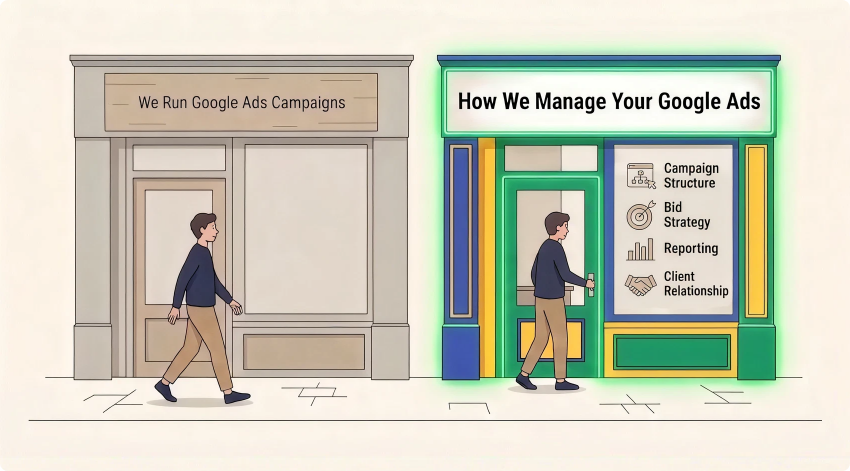
The Google Ads management page covers campaign management in concrete terms: what we do inside an account, how we approach campaign structure, what conversion tracking looks like in practice, and what distinguishes active management from passive engagement.
It answers the questions someone would ask when evaluating whether to hire a Google Ads agency: what will you actually do, and how will I know it is working?
That level of detail is what gives Google something to draw from. A generic we run Google Ads campaigns page does not give the AI enough to construct a useful answer. A page that explains campaign structure, bid strategy, reporting, and the client relationship gives the AI a source it can actually cite.
The local SEO page
The local SEO citation is notable because we hold position four for local seo sydney, not position one. Yet on three of the last seven days, Google chose our content to construct its AI answer despite the pages ranked above us.
The page covers local SEO methodology specifically: Google Business Profile, citation building, review management, and how local ranking signals differ from standard organic SEO. The depth on a clearly defined topic appears to be the factor, not the position.
The website maintenance page
This is the most position-volatile citation in the data. The website maintenance page fluctuated between position one and position fifteen during the tracking window, with AI citations appearing on the days it ranked closer to the top.
It is a reminder that citations are not fixed. A page that drops significantly in position can lose its citation status, and regain it as the ranking recovers.
Taken together, these three pages tell a consistent story. Citations follow depth and relevance to the specific query, not just ranking position or overall site authority.
The Gap Between Having an AI Box and Being In It
Depth and relevance explain which pages get cited, but they do not change the overall odds.
199 keywords. 8 citations. That ratio is the most honest number in this analysis. For every 25 keywords where an AI Overview is sitting above our organic results, we are cited inside that AI box for one of them.
The terms where we are not cited cover everything from seo agency and digital marketing agency (where we do not currently rank high enough to be a citation candidate) to ppc management and Google Ads specialist (where we rank organically but the AI is drawing from other sources).
In some cases, the AI Overview appears to favour pages with stronger entity authority or more structured content on that specific query. In others, the content depth on our pages is not detailed enough yet for the query being asked.
Plenty of other businesses see the same pattern. Right now, most target queries have AI boxes, and only a small share of those show your content cited inside the box. Closing that gap is exactly what AI search optimisation is designed to address.
What This Tells Us About Earning AI Visibility
Three patterns emerge from this data that match what we observe across client accounts.
Ranking matters, but it is not the whole story. Most AI Overview citations come from pages that rank well organically for the same query. Ranking at position one makes citation significantly more likely. But local seo sydney at position four earning citations on three days shows that position alone is neither sufficient nor necessary. Content depth and authority on the exact topic of the query also play a role independent of ranking.
Consistency correlates with content depth. The two terms with six-day citation rates both cite a single page with significant detail about Google Ads management as a service. Terms with one- or two-day citation rates cite pages that are either positionally unstable or less specific to the query. The more targeted a page’s content relative to the query, the more consistent the citation.
AI visibility is determined at the page level, not the site level. We have 295 tracked keywords. The citations cluster around four pages. A site’s overall authority matters, but AI citation depends on whether an individual page directly and usefully answers the query the AI Overview is responding to.
For a closer look at the signals Google uses to decide which pages to cite inside AI Overviews, read how AI Overviews choose who to quote.
Frequently Asked Questions
How do you track AI Overview citations in SEMrush?
SEMrush Position Tracking includes a link type field on each keyword, and a value of "aio" means that domain’s content is actively cited inside the AI Overview box for that query. This is different from "org" (appearing organically below the box) or the SERP feature indicator, which only confirms a box exists on the page.
Why do some keywords show an AI Overview but not cite our site?
An AI Overview appearing on a search results page does not mean the highest-ranking site is the one cited inside it. Google constructs the AI answer from whatever sources it judges most relevant, which can include pages ranked lower in the organic results or on an entirely different site altogether.
What makes a service page citable in an AI Overview?
The pages earning AI citations in this analysis are detailed, clearly structured service pages that directly answer what the service is, how it works, who it is for, and what outcomes it produces, rather than generic overview pages. A page that explains methodology, process, and the client experience will almost always earn more citations than one that simply lists service names.
Does ranking position one guarantee an AI Overview citation?
Position one increases the likelihood of citation, but it does not guarantee one, and pages that fall significantly in position can lose their citation status just as easily. Seo sydney (3,600 searches) produced a citation on one day when we ranked at position four, which shows relevance to the specific query matters more than position alone.
Can other businesses achieve AI Overview citations in competitive categories?
Other businesses can achieve this too, even in categories where AI boxes already favour competitors, starting with understanding which target queries show AI boxes and whether your content is currently cited inside them. From there, the work involves building detailed, well-structured service pages, not just informational content, that give Google something to cite.
What is the difference between AI Overviews and other AI search platforms?
Google’s AI Overviews appear directly in standard Google Search results, embedded in the search interface Australian users already visit every day for commercial research, unlike ChatGPT Search, Google Gemini, or Perplexity. That makes them particularly high-value for service businesses targeting local search queries, which is why tracking these citations is a priority for most Australian SEO campaigns right now.
Are Your Pages Cited Inside Google’s AI Answers?
Most businesses track their search rankings. Very few track whether their content is being cited inside the AI boxes sitting above those rankings.
A free SEO audit from Click Click Media includes AI visibility analysis: which of your target queries show AI boxes, and whether your pages are the source Google draws from. We have been doing this as a Google Premier Partner since 2008, with no lock-in contracts attached.