
Google E-E-A-T: What It Is and Why It Affects Your Rankings
Google E-E-A-T is the framework that determines whether Google considers your content credible enough to rank. It stands for Experience, Expertise, Authoritativeness, and Trustworthiness. Google added the first E, Experience, in December 2022. The framework is not a score you earn or a checkbox you tick. It is a quality signal that Google’s human reviewers assess across millions of pages, and it influences rankings for every category of website, from local tradespeople to national eCommerce brands.
What E-E-A-T Actually Stands For
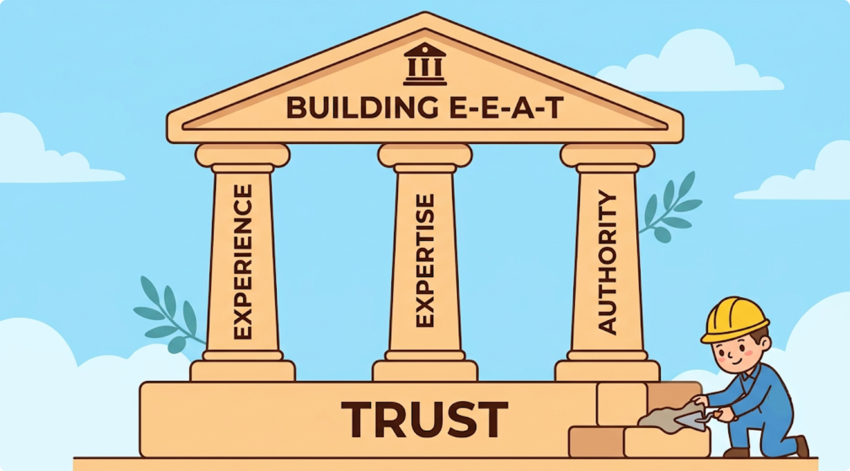
Each pillar means something distinct, and they are not equally weighted. Trustworthiness is the foundation. The other three pillars contribute to it.
The relationship between the four pillars matters. Experience, expertise, and authority all feed into trust. A site can demonstrate all three and still be rated low E-E-A-T if its content is inaccurate, its contact details are hidden, or its review profile raises questions.
How Google Uses E-E-A-T (and What It Is Not)
Scaling before your account is ready is the most common mistake businesses make with Google Ads. More spend amplifies This is where most E-E-A-T guides get it wrong. E-E-A-T is not a direct ranking factor with a score Google assigns to your site. There is no E-E-A-T number in Google Search Console, no dashboard to check, and no metric to optimise against directly.
What E-E-A-T actually is: a framework that Google’s Search Quality Raters use when evaluating pages. These are human contractors Google employs to assess whether its search results are actually useful. Their feedback trains and refines the algorithms over time. Strong E-E-A-T signals correlate strongly with better rankings. They are just not the direct cause in a simple, measurable way.
John Mueller, Google Search Central Live NYC, April 2025: “Sometimes SEOs come to us and mention that they’ve added E-E-A-T to their web pages. That’s not how it works. You cannot sprinkle some experience on your web pages. That doesn’t make any sense.” Source: Search Engine Journal. The point being: E-E-A-T is earned through consistent, credible content and real-world reputation, not through technical workarounds.
The practical implication is important. Improving your E-E-A-T means actually building credibility: publishing accurate content, naming qualified authors, earning backlinks from reputable sources, and maintaining a trustworthy brand presence. There are no shortcuts that fool the system long-term.
Why E-E-A-T Matters More in 2026

Three things have raised the stakes significantly over the past twelve months.
First, AI-generated content has flooded the web. When low-effort, experience-free content is everywhere, genuine expertise becomes harder to fake and more valuable to Google. The sites that demonstrate real authority through specific examples, verifiable credentials, and original data are the ones pulling away from the pack.
Second, Google’s December 2025 core update raised quality standards across every category. E-E-A-T is no longer primarily a concern for medical and financial sites. It now applies to eCommerce product pages, SaaS review content, trade service websites, and local business listings. Any site where inaccurate or unhelpful content could send a user in the wrong direction is now evaluated through an E-E-A-T lens.
Third, Google expanded the YMYL category in September 2025 to explicitly include government information, elections, and civic trust content. The bar for Trustworthiness in these areas is now materially higher. But even if your business has nothing to do with health or finance, the same quality trajectory applies.
For businesses investing in long-term organic search growth, E-E-A-T is no longer optional context. It is the standard.
What E-E-A-T Looks Like for Australian Businesses
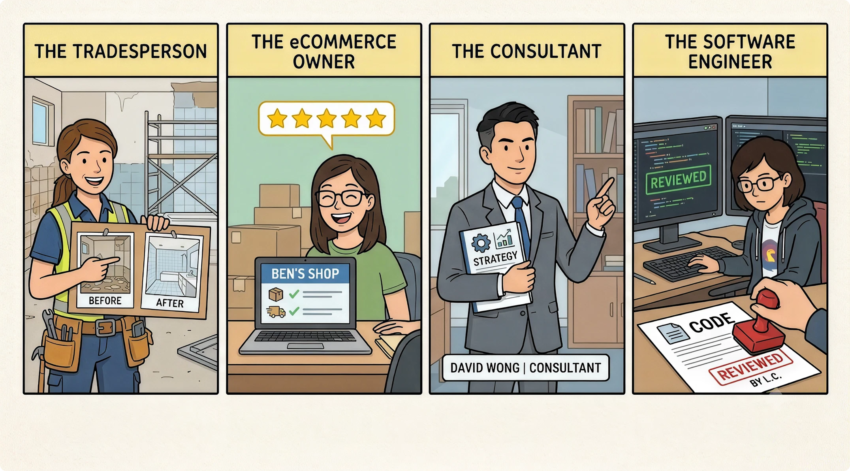
Most E-E-A-T guides use a medical clinic or a finance website as their example. That is unhelpful for the majority of Australian businesses. Here is what E-E-A-T looks like across four common categories.
| Business type | Strong E-E-A-T looks like | Common gap | One quick fix |
| Trades / Local | Named bio with licence, before-and-after photos, 50+ verified reviews, consistent NAP across directories | Generic copy that could describe any plumber. No author, photos, or reviews referenced on the site | Add team page with real headshots, licence numbers, and years of experience. Link to GBP listing |
| eCommerce | Product descriptions from someone who has used the product, user reviews with photos, transparent returns policy, real contact page | Manufacturer copy across all pages. No reviews. Contact page with only a form and no address | Add verified purchase reviews with photos. Rewrite top product descriptions to include real-use context: who it is for, when to use it |
| Professional Services | Named authors on all content, certifications referenced in context, case studies with real outcomes | Blog posts under a generic company name with no author credit. Case studies with vague percentage claims | Add an author to every piece of content. Name them, link to bio, include one verifiable credential |
| SaaS / Tech | Technical content written or reviewed by practitioners, G2/Capterra reviews referenced, integration documentation that shows product depth | Feature content written at a generic level. No external review platform presence | Add a ‘Reviewed by’ field to technical content with a named product manager or engineer |
Seven Ways to Improve Your E-E-A-T Signals
These are practical, confirmed E-E-A-T signals. None of them are shortcuts. All of them compound over time.
1. Add named author bios with real credentials
Every piece of content should have a named author. Link to a bio page that includes their role, relevant experience, and any professional credentials. For a blog post on tax planning, that means a named accountant. For a post on local SEO, a named SEO practitioner with a verifiable track record.
2. Cite verifiable Australian sources and data
Generic claims do not build trust. Reference real data: ABS statistics, ACCC guidance, industry association reports, or your own client research. Citing authoritative sources tells both readers and Google that your content is grounded in evidence rather than assertion.
3. Build quality backlinks from relevant publications
Building quality backlinks from Australian industry publications is one of the strongest Authoritativeness signals available. An editorial mention in SmartCompany or a guest contribution to an industry association website carries far more weight than directory submissions. See how we approach link building and digital PR for more on the sustainable approach.
4. Collect and display genuine Google Reviews
Reviews are a Trust signal Google’s Quality Raters actively check. A business with 150 reviews averaging 4.8 stars is easier to trust than one with 12. Actively asking satisfied customers to leave a review, and responding professionally to every review including negative ones, builds a review profile that works for your E-E-A-T in ways you cannot manufacture artificially.
5. Add structured data for authors, organisation, and content type
Schema markup does not directly improve E-E-A-T, but it helps Google’s systems understand your site clearly. Person schema on author pages, Organisation schema with verified contact details, and Article schema on blog content all give Google structured signals about who you are and what you produce.
6. Keep content accurate, dated, and regularly reviewed
Outdated content is a trust signal problem. A blog post from 2021 that references superseded statistics signals to both users and Google that the content may not be reliable. Add a “last reviewed” date to key pages, update statistics annually, and archive content that is no longer relevant rather than leaving it to decay.
7. Build a consistent brand presence across the web
Google builds a picture of your brand through signals from across the web. Consistent mentions on LinkedIn, consistent NAP in directories, an accurate and active Google Business Profile, and a presence on industry platforms all reinforce that you are a real, legitimate entity. Inconsistency across these signals creates doubt.
A note on AI-generated content: Google does not penalise AI-generated content as a category. What Google penalises is unhelpful, low-quality, experience-free content regardless of how it was produced. AI content reviewed by a subject matter expert, enriched with genuine insight, and attributed to a named author can meet E-E-A-T standards. The question Google asks is who created the content, how it was produced, and why.
What This Means for Your SEO Strategy
E-E-A-T is not a separate project you run alongside your SEO. It is what good SEO looks like in practice. Content produced by knowledgeable people, cited accurately, and maintained over time naturally builds the signals Google rewards.
Click Click Media has been building E-E-A-T signals into client content since before the framework had a name. As a Google Premier Partner and SEO agency with Australian search experience since 2008, we have seen every iteration of how Google evaluates quality, from the original E-A-T guidelines through to the 2025 updates. The principles have not fundamentally changed. Genuine expertise, real experience, verifiable authority, and consistent trustworthiness have always been what separates content that compounds in value from content that gets filtered out.
If you are concerned about how your site’s content stacks up against the E-E-A-T framework, a free SEO audit will show you exactly where the gaps are. For businesses focused on building local search presence in particular, E-E-A-T signals like verified reviews and consistent NAP data often represent the fastest path to meaningful ranking improvement.
The connection between E-E-A-T and AI search visibility is also worth noting. The same signals that build trust with Google’s Quality Raters also make your pages more likely to be cited in AI-generated answers. Our guide to generative engine optimisation covers the overlap in detail.
FAQs
What does E-E-A-T stand for in SEO?
E-E-A-T stands for Experience, Expertise, Authoritativeness, and Trustworthiness. It is the framework Google’s Search Quality Raters use when evaluating whether content is helpful and credible. The first E, Experience, was added in December 2022. Before that, the framework was known as E-A-T.
Is E-E-A-T a direct Google ranking factor?
No. E-E-A-T is not a direct ranking factor with a measurable score. As John Mueller has confirmed, you cannot add E-E-A-T to a page. It is a quality evaluation framework used by human Search Quality Raters. Their assessments inform how Google trains its algorithms over time.
What is the difference between E-A-T and E-E-A-T?
E-A-T stood for Expertise, Authoritativeness, and Trustworthiness. In December 2022, Google added Experience, creating E-E-A-T. The addition reflects that first-hand, real-world experience with a topic adds credibility beyond formal credentials alone.
How does Google measure E-E-A-T?
Google does not measure E-E-A-T with a single score. Search Quality Raters assess pages against the guidelines in Google’s QRG. Signals include author credentials, backlink profiles, review counts, schema markup, content accuracy, and trust indicators such as HTTPS and transparent contact information.
What are YMYL pages and why do they have higher E-E-A-T requirements?
YMYL stands for Your Money or Your Life. These are pages that could significantly affect health, finances, safety, or wellbeing. Bad advice in these areas can cause real harm, so Quality Raters apply stricter standards. In September 2025, Google expanded YMYL to include government and civic trust content.
Does E-E-A-T apply to small businesses and local services?
Yes. Google’s December 2025 core update raised quality standards site-wide. Local tradespeople, eCommerce stores, and professional services all benefit from demonstrating experience, expertise, and trust signals, not just health and finance websites.
How do I improve my website’s E-E-A-T?
Add named author bios with real credentials, cite verifiable Australian sources, earn quality backlinks from industry publications, collect genuine Google Reviews, add Person and Organisation schema, keep content accurate and date-stamped, and build a consistent brand presence across the web.
Does AI-generated content hurt E-E-A-T?
Google does not penalise AI-generated content as a category. What Google penalises is unhelpful, low-quality, experience-free content regardless of how it was produced. AI content reviewed by a subject matter expert and attributed to a named author can satisfy E-E-A-T requirements.
How important are backlinks for E-E-A-T?
Backlinks are one of the strongest signals for Authoritativeness. Links from reputable, relevant Australian publications tell Google that others in your field consider you credible. Quality matters significantly more than quantity.
How long does it take to improve E-E-A-T?
Some fixes, like adding author bios and schema markup, can be done in days. Building Authoritativeness through backlinks takes months of consistent effort. Trust, the most important pillar, compounds over time as Google observes your site’s consistency and accuracy.
Not Sure How Your Content Measures Up?
A free SEO audit from Click Click Media identifies where your E-E-A-T signals are weak, what is costing you rankings, and what to prioritise first. No lock-in contracts.