
Ranking Screenshots vs Revenue: How We Report SEO to Business Owners
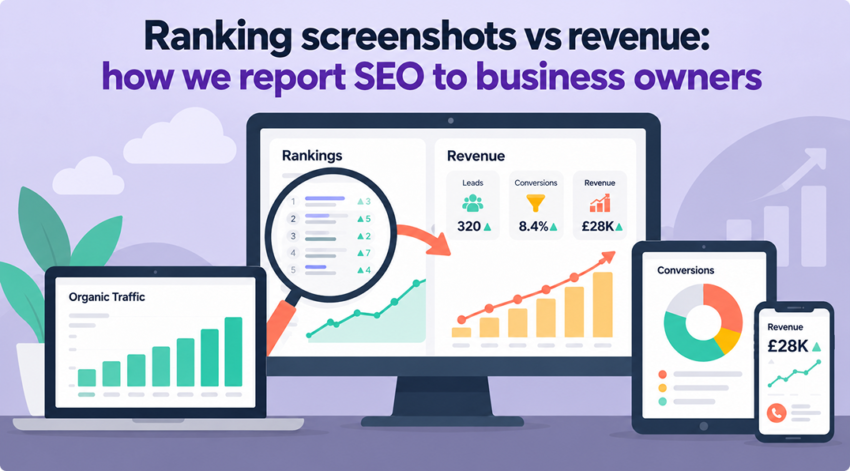
The typical SEO report arrives on the last Friday of the month. It is twelve pages long. It has graphs, it has keyword position tables, it has screenshots of terms that have moved up two or three places. And if you are a business owner who has been receiving one for the past six months, there is a good chance you have no idea whether your SEO is actually working.
Rankings are not revenue. A number-four position for a keyword is not a lead. Traffic without conversions does not pay wages. This piece explains how we approach SEO reporting at Click Click Media and why we think most of the industry is getting it wrong.
The Ranking Screenshot Problem
Every agency has access to the same tools. Position tracking is straightforward, and producing a ranked keyword table takes minutes. The problem is not the data. The problem is what agencies do with it.
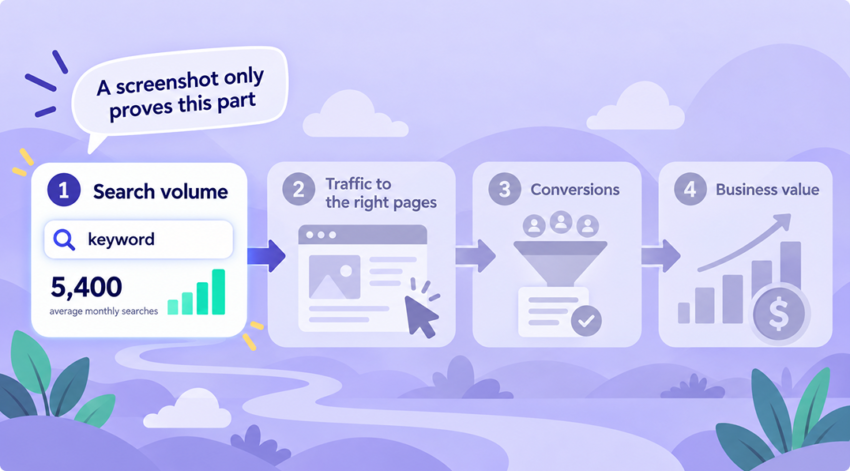
When a ranking screenshot is presented as evidence of progress, it assumes several things: that the keyword has meaningful search volume, that ranking for it drives traffic to the right pages, that the traffic converts, and that the conversions matter to the business. Most reports skip straight to the screenshot and leave the other three assumptions unexamined.
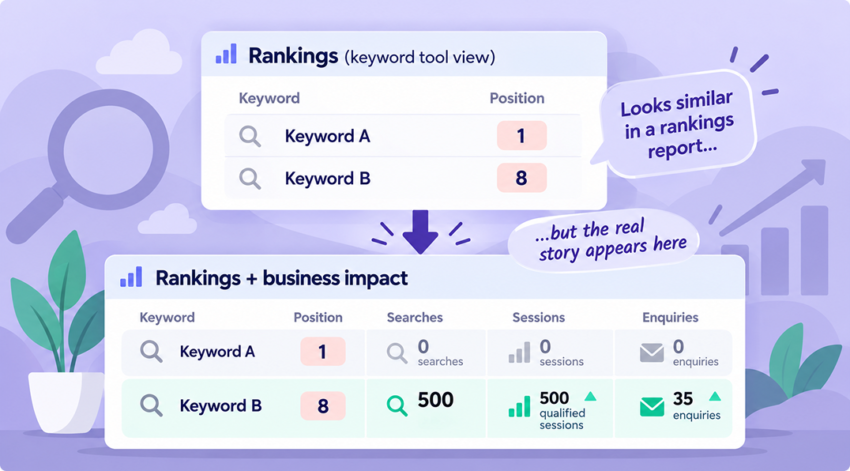
Position one for a term nobody searches is worthless. Position eight for a term that drives 500 qualified sessions per month, 35 of which convert to enquiries, is worth knowing about in detail. Those two scenarios look identical in a ranking table.
There is also the question of stability. Rankings fluctuate. A site can move from position six to three on a single algorithm update, produce no measurable change in traffic, and have an agency report it as a major win. If the business owner does not know to ask for the click data behind that position change, they will probably accept it.
This is not necessarily dishonest. It is often just a reporting framework built to show activity, not outcomes. The distinction matters because one of them is useful and the other is not.
Three questions every SEO report should answer
Before the screenshots, before the keyword tables, before the traffic graphs, a good SEO report needs to answer three things for the business owner sitting on the other side of it.
How much organic traffic did we receive, and was it the right kind?
Not all traffic is equal. A law firm in Parramatta does not benefit from 800 sessions from users in the UK who landed on an informational post and immediately left. Total sessions is not a useful number without knowing the source, the intent, and what those sessions did on the site. Our playbook on law firm SEO and Google Ads explains how to track practice area traffic through to signed matters.
Did that traffic produce leads, enquiries, or revenue?
This is the question most agencies avoid, because the answer requires connecting organic search data to business outcomes. That often means pulling data from a CRM, a booking system, call tracking, or an eCommerce platform. It is harder to report than a keyword table. It is also the only number that actually matters to a business. SEO ROI is not an abstract concept. It is a number you should be able to see in your monthly report.
What changed, why did it change, and what are we doing next?
A report is not a certificate of existence. It is a diagnostic. If organic traffic dropped 15% last month, the report should explain why: an algorithm update, a technical issue, a competitor gaining ground on a key content cluster, or a seasonal pattern. If traffic grew, the report should attribute it and explain how to protect or extend that growth. “Rankings improved” is not an explanation.
What the difference looks like in practice
Pinnacle Mechanical Services is an HVAC company operating across the outer suburbs of Sydney. When they engaged CCM, they had been with a previous agency for 14 months. The reports they received showed consistent keyword ranking improvements across terms like “ducted air conditioning installation” and “HVAC service Sydney.” On the surface, things looked like they were moving in the right direction.
The problem: click data from Google Search Console told a different story. Traffic to the ranking pages had barely changed. Impressions had increased, but the pages were sitting between positions 8 and 14, where organic click-through rates drop sharply. The traffic that was arriving was bouncing at a high rate because the pages were not structured to convert enquiries.
Fourteen months of SEO results had produced almost no business outcome. Not because SEO does not work. Because the reporting framework never asked whether it was. The fix was not complicated: a technical review to resolve crawl issues, a rewrite of the landing pages to match commercial intent, and a content plan targeting terms the business actually converted from.
Five questions to ask your SEO agency about reporting
If you are receiving a monthly SEO report and are not sure whether it is telling you what matters, these five questions are a useful starting point.
- Can you show me the organic conversion data, not just the traffic? If the answer is that conversion tracking is too complex to set up, that is worth understanding before you continue spending on SEO.
- Which three keywords are most valuable to our business right now, and what position are we in for each? The answer should include click volume from Search Console, not just a ranking position.
- If organic traffic dropped 20% next month, what would cause it? A good agency can name the specific risks to your site. A generic answer about algorithm volatility is not sufficient.
- What changed in the last 30 days, and what produced that change? Progress should be attributable. If your agency cannot explain what drove an improvement, they also cannot replicate it.
- What are you working on next month, and why? The plan should connect directly to gaps in last month’s data, not just a rolling list of deliverables.
These questions also function as a useful filter when evaluating a new agency. For a fuller checklist, run any proposal through the agency proposal scorecard.
SEO reporting should serve the business, not the agency
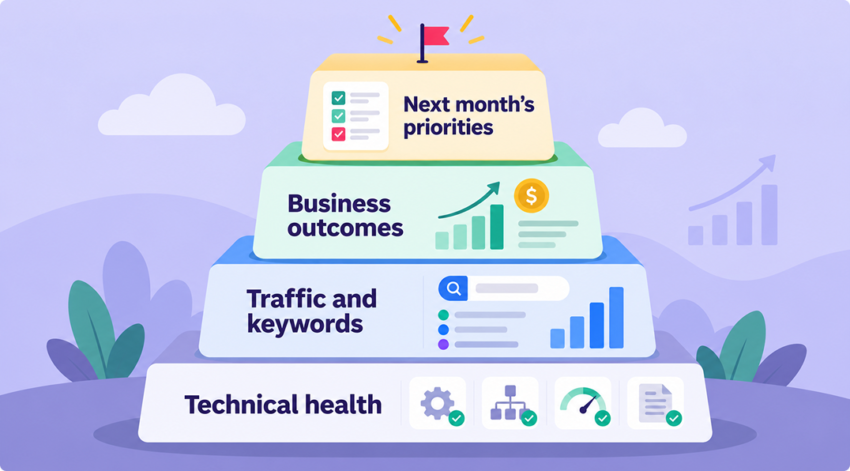
Most SEO reporting is built to protect the agency. Ranking screenshots are easy to produce, easy to defend, and hard to argue with if the business owner does not know what to look for. Revenue and lead data are harder to produce and impossible to hide behind.
Our SEO agency’s approach to reporting sits inside a broader commitment to transparent, commercially grounded work. We have managed over $115 million in Google Ads spend for Australian businesses and maintained 92% combined client and staff retention over 18 years. Both of those numbers are a byproduct of reporting honestly, including when the data is not what a client hoped to see.
If you are receiving SEO reports you cannot act on, we are happy to run a free audit and show you what the data actually says.