
What Is Generative Engine Optimisation (GEO) and Why It Matters
Generative engine optimisation (GEO) is the practice of making your content visible inside AI-generated answers, not just Google’s traditional search results. ChatGPT, Gemini, Perplexity, and Google AI Overviews are already answering millions of Australian searches every day. If your business is not being cited in those answers, you are missing an audience that is growing fast and converting well.
38M+ – AI searches made by Australians every month across ChatGPT and Gemini 1.13B – Referral visits from AI platforms globally in June 2025, up 357% year on year ~10% – Of Australian Google searches now trigger an AI Overview above organic results
The Shift that is Already Happening in Australian Search
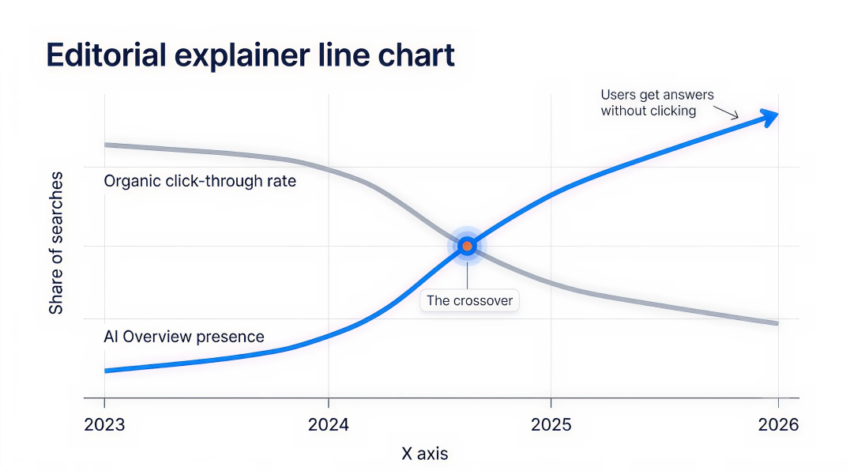
Search behaviour is changing faster than most businesses realise. Australians are increasingly turning to AI tools to get answers directly, without scrolling through a page of links. Australia is one of the most AI-engaged markets in the world. When someone types a question into ChatGPT or asks Google a complex query, they often get a synthesised answer that draws from multiple sources. They read that answer and move on. No click required.
For businesses that depend on organic search traffic, this matters. Click-through rates on traditional organic results are falling across the board. Google AI Overviews now appear for a growing share of queries, sitting above the standard blue links. If your content is not inside that AI summary, users may never reach your site at all, even if you rank on page one underneath it.
This is not a future problem. It is a present one, and the window to act before competitors do is open right now.
So What Exactly is GEO?

Generative engine optimisation is the discipline of making your content easy for AI systems to find, understand, and cite. Traditional SEO earns you a place in a ranked list of links. GEO earns you a place in the answer itself.
When a user asks ChatGPT “What should I look for in an SEO agency?” or asks Google “How do I improve my website conversion rate?”, those platforms pull information from across the web to build their response. They quote content they consider authoritative, well-structured, and factually reliable. GEO is about making sure your content meets those criteria consistently.
A useful way to think about it: Traditional SEO gets you listed in a directory. GEO gets you personally recommended by the advisor your customer just consulted. Both matter. They serve different moments in how a customer finds you.
The term GEO is sometimes used interchangeably with answer engine optimisation (AEO). Google itself refers to both in its own documentation, treating them as variations on the same idea: optimising your content for AI-driven search experiences rather than link-based rankings alone.
How GEO Differs from SEO, and Why You Still Need Both
GEO does not replace SEO. It builds on it. The content signals that help you rank in traditional search, topical authority, clear structure, quality backlinks, accurate technical SEO, are the same foundations AI systems rely on when deciding what to cite. If your SEO is weak, your GEO prospects are weaker still.
Where the two disciplines diverge is in what they optimise for:
| Factor | Traditional SEO | Generative Engine Optimisation |
| Goal | Rank your page in search results | Get your brand cited in AI answers |
| Success metric | Rankings, organic traffic, clicks | Brand mentions, citations, AI referral traffic |
| Key signals | Keywords, backlinks, technical health | Clarity, factual accuracy, structured data, E-E-A-T |
| Content format | Keyword-optimised pages with clear intent | Direct answers, FAQs, cited statistics, clean structure |
| User behaviour | User clicks to visit your site | User reads your content inside the AI response |
| Timeline | Months to build authority | Also months. No shortcut here either. |
A business that invests in strong organic search performance is already partway there. The next step is shaping that content so AI systems can extract and use it confidently.
What AI Engines Actually Look for in Content
Large language models like those powering ChatGPT, Google Gemini, and Perplexity do not rank pages the way Google’s traditional algorithm does. They look for content they can extract a reliable, coherent answer from. Research from Princeton and Columbia universities found that adding statistics, citations, and direct quotations to content significantly improved how often it was cited in AI-generated responses, by as much as 40% in some tests.
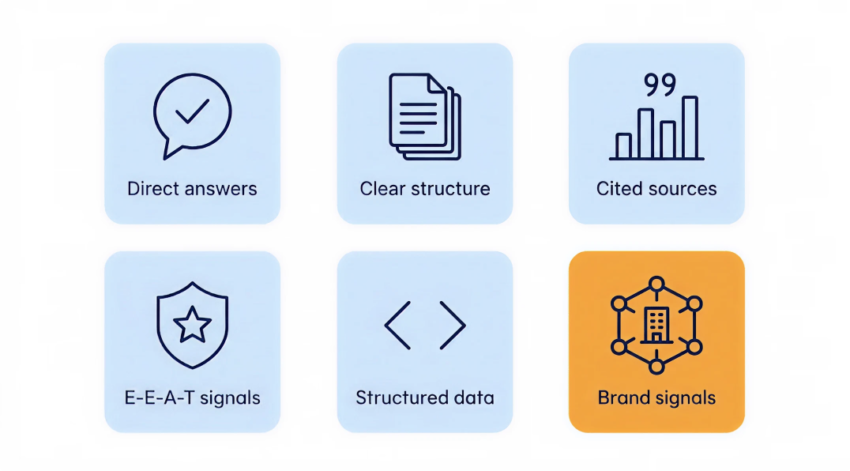
The signals that matter most are:
1. Clear, Direct Answers
AI systems prefer content that states an answer immediately, without burying it in preamble. If a heading asks a question, the first paragraph should answer it plainly.
2. Logical Structure
Short paragraphs, clear headings (H2s and H3s), and well-organised sections allow AI models to chunk your content and cite individual sections independently. Dense, unbroken text is harder to extract from reliably.
3. Factual Accuracy and Cited Sources
AI platforms prioritise content that references credible data. Including real statistics with clear attribution, such as industry reports, government sources, and peer-reviewed research, increases the likelihood of being cited.
4. E-E-A-T Signals
Experience, Expertise, Authoritativeness, and Trustworthiness, Google’s content quality framework, applies just as directly to GEO. Demonstrating real-world expertise, naming qualified authors, and maintaining a consistent, credible brand presence all contribute.
5. Structured Data
Schema markup, particularly FAQPage, Article, and Organization schema, gives AI systems a structured, machine-readable layer on top of your content. It removes ambiguity about what your page is, who wrote it, and what questions it answers.
6. Consistent Brand Entity Signals
AI systems build a picture of your brand across the web. Consistent mentions on reputable sites, an accurate Google Business Profile, and a coherent presence across directories and social platforms all reinforce that your brand is a real, trustworthy entity.
What Australian Businesses Should Do Right Now
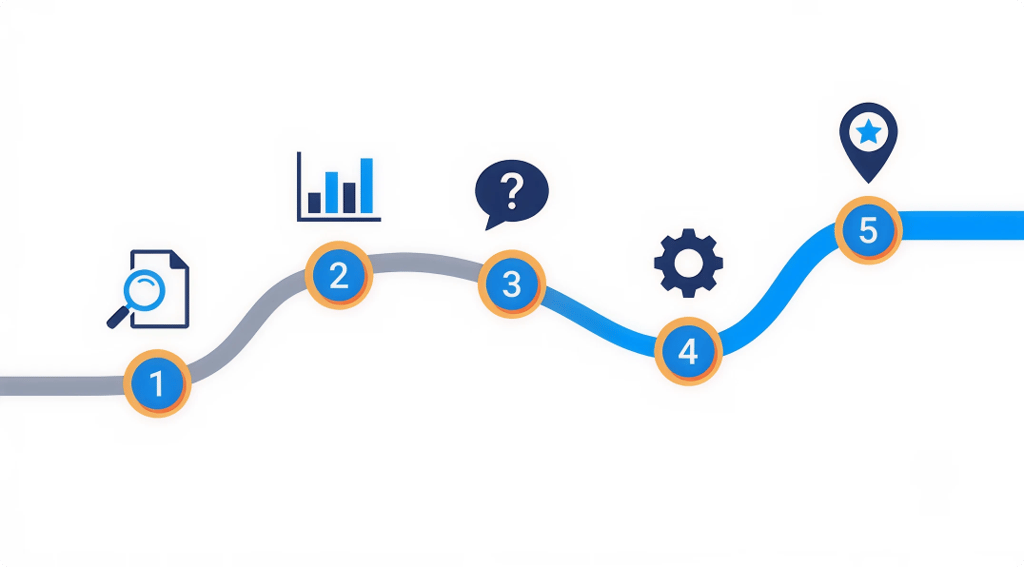
GEO is not a single campaign or a switch you flip. It is a set of content and technical practices that accumulate over time. The businesses that start building those habits now will have a head start on competitors who wait.
Here is where to focus first:
Audit Your Most Important Pages for Direct Answers
Go through your key service pages and blog content (our free SEO audit template is a useful framework for this). For every major topic you cover, ask: does this page give a clear, direct answer to the questions your customers are actually asking? If the answer is buried three paragraphs in, restructure it. AI systems pull from what appears early and clearly.
Add Real Data and Cited Sources
Generic claims do not get cited. Specific, verifiable facts do. Where you make a claim about your industry, your results, or how something works, back it with a source. Australian government data, Google’s own documentation, industry association reports: these are the kinds of references that build credibility with both AI systems and human readers.
Build Out Your FAQ Content
FAQ sections are one of the most GEO-friendly content formats available. They match the conversational, question-based way people interact with AI tools. Write answers that are two to four sentences long, complete in themselves, and structured around the exact questions your customers ask. Apply FAQPage schema so AI platforms can read the structure cleanly.
Get Your Technical Foundations Right
Fast load times, clean crawlability, and proper schema markup are table stakes. If an AI platform cannot reliably access and parse your content, it cannot cite it. A thorough technical SEO audit is often the first place to start, because structural problems undermine everything that comes after.
Keep Your Google Business Profile Accurate and Active
For local businesses, GBP is a primary signal that AI platforms use to verify your existence and service area. Keep your categories, hours, services, and location information current. Reviews matter here too. Businesses with a strong review profile are more likely to be surfaced in local AI responses.
One thing to avoid: Tactics marketed specifically as “GEO hacks”, including llms.txt files, keyword-stuffed AI prompts, and artificial mention-building. Google has explicitly stated these do not work and may actively harm your standing. The principles that matter for GEO are the same ones that have always mattered for good content: clarity, accuracy, and genuine expertise.
Where Click Click Media (CCM) Fits In
Click Click Media has been working through search algorithm shifts alongside Australian businesses since 2008. Every major change in how Google works, from Panda and Penguin through to mobile-first indexing and Core Web Vitals, has required a recalibration of what good SEO looks like. GEO is the next such shift, and it is happening faster than most.
As a Semrush Agency Partner and Google Premier Partner, CCM works from data rather than speculation. Our approach to GEO is grounded in the same principles we apply to technical SEO: audit what exists, identify the gaps, and build a strategy that compounds over time rather than chasing short-term tricks.
If you are not sure where your content currently stands for AI visibility, a free SEO audit is the right starting point. We will show you exactly what is working, what is not, and what to prioritise first.
FAQs
What is generative engine optimisation?
Generative engine optimisation (GEO) is the practice of optimising your content so AI-powered platforms like ChatGPT, Google AI Overviews, Perplexity, and Gemini can understand, summarise, and cite your brand when generating answers to user queries.
How does GEO differ from SEO?
Traditional SEO focuses on ranking your website in a list of search results. GEO focuses on getting your brand cited inside AI-generated answers, where the user may never click through to a website at all. Both matter, and GEO builds on strong SEO foundations rather than replacing them.
Do I need GEO if I already do SEO?
Yes. SEO and GEO serve different parts of how people search. SEO targets users who still click on links in traditional results. GEO targets users who get answers directly from AI tools. As AI search grows, being visible only in traditional results means missing a fast-growing share of your potential audience.
How do I get my business featured in ChatGPT answers?
Focus on clear, authoritative, well-structured content that directly answers real questions in your industry. Add relevant schema markup, cite credible sources, and maintain a consistent brand presence across the web. There is no shortcut. AI systems favour brands that have built genuine authority over time. Note that being cited organically is separate from ChatGPT’s paid ad placements, which we cover in our guide to ChatGPT Ads in Australia.
What is answer engine optimisation (AEO)?
Answer engine optimisation (AEO) is another term for GEO. Both describe the practice of optimising content so it is cited in AI-generated responses rather than ranked in traditional search results. Google uses both terms in its own documentation.
How does Google AI Overviews affect my organic traffic?
Google AI Overviews appear above organic results for a growing share of searches. When users get their answer from the AI summary, they often do not click through to any website. Being cited inside the AI Overview itself is the most effective way to maintain visibility as this trend continues.
What type of content works best for GEO?
Content that answers specific questions directly, uses clear headings and short paragraphs, includes real data with cited sources, and demonstrates genuine expertise performs best. FAQ sections, how-to guides, and well-structured explainer articles are among the most effective formats.
How do I know if my content is being cited by AI search?
You can monitor referral traffic from AI platforms like ChatGPT and Perplexity in Google Analytics 4. Specialist tools such as AthenaHQ and Profound are also emerging to track brand mentions within AI-generated responses. This measurement space is still developing, but improving.
Is GEO relevant for small businesses in Australia?
Yes. Local and service-based queries are among the most common searches on AI platforms. When someone asks ChatGPT for a recommended plumber, accountant, or café in their area, those answers come from somewhere. Small businesses with clear content and a strong Google Business Profile are well positioned to appear.
How long does GEO take to show results?
GEO is a medium to long-term strategy, similar to SEO. Building the authority and trust signals AI systems rely on takes consistent effort over months. Well-structured content and proper schema markup can improve visibility relatively quickly for less competitive queries, but sustained results come from sustained effort.
Not Sure Where Your Content Stands?
A free audit from Click Click Media covers your current SEO and GEO readiness, including content structure, schema, and the gaps that are costing you visibility in AI search.