
Why Design Still Matters in the Age of AI
There’s a quiet panic running through the design industry right now. AI can generate a logo in fifteen seconds. It can spin up a hundred banner variations before lunch. It can write the copy, mock the layout, and serve you a homepage that looks “good enough” by Tuesday afternoon.
So a lot of business owners are asking the obvious question. If AI can do all that, do we still need designers? Do we still need to invest in design at all?
Short answer: yes. More than ever, actually.
But not for the reasons you might think.
Yes, AI Is Genuinely Good. That’s the Problem.
Let’s not pretend. AI tools have become remarkably capable. We use them every day at Click Click Media. They’re in our content workflows, our wireframing, our prototyping, our research. They’ve changed what a small team can ship in a weekend.
What AI is excellent at is production. The mechanical part. The “make a thing that looks like a thing” part. If you need fifty social tiles, six homepage variants, or a quick landing page mocked up before the kickoff call, AI gets you there fast.
That’s not a small deal. It used to take a designer half a day to do what AI now does in five minutes. The bottleneck has moved.
But here’s the part that matters. When the cost of production drops to near zero, the work itself doesn’t become more valuable. It becomes less valuable. Because everyone has access to the same tools.
So if your business is competing on “we have a website,” you’re already losing. Everyone has a website. Everyone’s website was probably half-built by AI. The question is no longer whether you can produce something. It’s whether what you produce is worth looking at.
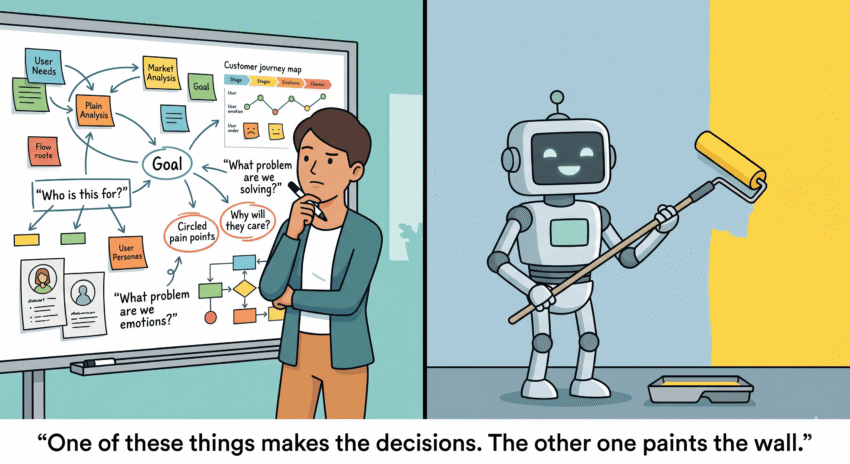
Design Isn’t Decoration. It’s Decision-Making.
There’s a common confusion that design means “making things pretty.” It doesn’t. Choosing a type scale is a good example: it looks like styling, but it sets the hierarchy readers rely on and affects conversions.
Design is the set of decisions that turn a vague brief into something specific, on-brand, and effective. It’s the answer to questions like:
- Why does this homepage open with a customer story instead of a product feature?
Every one of those is a judgment call. And every one of those is the kind of thing AI doesn’t make on its own. AI doesn’t know your customer. It doesn’t know what your competitors look like. It doesn’t know that your last campaign tanked because the trust signals were buried below the fold. It doesn’t know that the founder hates the colour green. That kind of knowledge usually gets lost in the handoff between design and marketing, which is why we keep both under one roof.
AI can execute a design decision. It can’t make one.
That’s the gap. And the gap is where good web design lives.
When Average Gets Cheap, Distinctive Wins
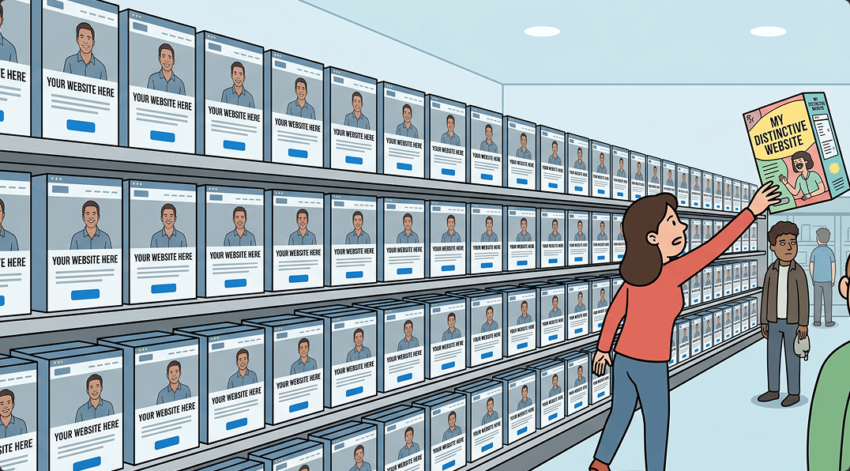
Here’s what’s happening across every industry right now. AI is making “average” work cheaper, faster, and more available. The bar for “looks fine” has never been lower.
Which means the bar for standing out has never been higher.
Think about it from a customer’s perspective. They land on your site. They’ve already seen ten other sites today, all of which were probably built with the same AI tools, the same template logic, the same stock photography, the same generic taglines. If yours looks like all of them, you’re invisible.
The brands that are winning right now aren’t the ones that produced the most. They’re the ones that produced the most distinctive things. The work that feels considered. The work where someone clearly made choices.
That’s design. That’s the human in the loop.
How AI and Designers Actually Work Together
We’re not anti-AI. Far from it. We’re a digital agency that uses AI extensively and unapologetically. What we’ve learned, after building a multi-tenant SEO platform in a weekend and shipping client work daily with these tools, is that AI works best when it’s paired with strong design judgment, not used to replace it.
Here’s the pattern we keep seeing:
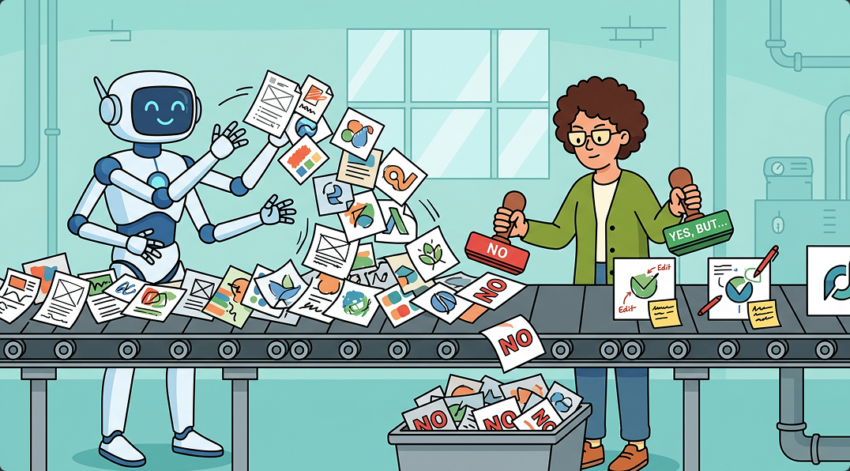
AI handles the volume. Designers make the decisions.
A real example. We need to test six variations of a landing page hero for a Google Ads campaign. AI generates the variations in minutes. A designer reviews them, kills the four that won’t work for this audience, refines the two that have potential, and shapes the final version into something that fits the brand and the campaign. The output ships in a fraction of the old time. The quality is better than what either could have produced alone.
AI handles the iteration. Designers handle the direction.
You can ask AI for fifty homepage layouts. You’ll get fifty homepage layouts. None of them will be obviously “right” because AI doesn’t know what right means for your business. A designer sets the direction — what we’re trying to communicate, who we’re trying to reach, what feeling we want to leave behind — and then uses AI to explore that direction faster than they could on their own.
AI handles the production. Designers handle the trust.
This one matters most. When a customer lands on a site that was clearly thrown together by an AI tool with no human direction, they can feel it. They might not be able to articulate why. But the trust signals are subtly off. The spacing is slightly weird. The copy is slightly generic. The whole thing has a faint “this could be anyone” quality.
That feeling is conversion poison. People don’t buy from “this could be anyone.” They buy from brands that feel like someone gave a damn.
What This Means for Your Next Project
If you’re a business owner thinking about your next website, your next campaign, your next brand refresh, here’s the practical takeaway.
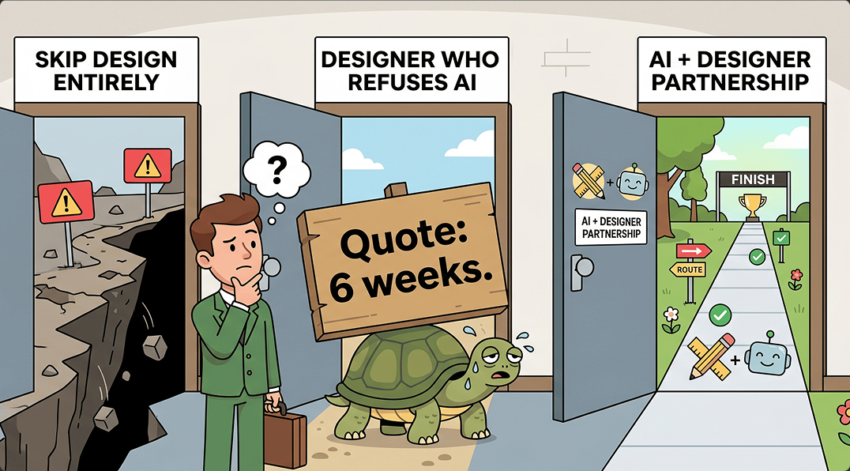
Don’t try to save money by skipping design. That was already a bad bet five years ago. It’s a worse bet now. The cost of production has collapsed, but the value of distinctive, well-designed work has gone up. Cutting design out of the budget is exactly the wrong move at exactly the wrong time.
Don’t pay for designers who refuse to use AI. That’s the other extreme, and it’s just as wasteful. A designer who builds everything from scratch in 2026 is charging you for slowness. Good designers use AI to move faster and explore more. They charge for the judgment, not the keystrokes.
Look for the partnership. What you actually want is a team that brings strong design thinking and uses AI as a multiplier. They should be able to show you what they made, why they made it that way, and what they didn’t make and why not. That third one is the tell. Anyone who can articulate what they cut and why is doing real design work. You can see how that thinking plays out across our client work.
The Honest Bit Most Agencies Won’t Say
We’ll say what most agencies are too nervous to say out loud. AI is going to keep getting better. The next year of model releases will make today’s tools look quaint. Some of what designers do today will be done by AI tomorrow.
That’s fine. We’ve been through this before. Every wave of automation in our industry — page builders, design templates, no-code tools, generative imagery — was supposed to kill design. Design didn’t die. It moved up the value chain. The designers who survived stopped being “people who push pixels” and started being “people who make decisions about what should exist.”
That’s where design is heading again. Less time on the mechanical work. More time on the strategic work. More taste, more judgment, more brand sense, more understanding of what makes a real human want to click, trust, and buy. That includes the basics, where deliberate colour choices shape trust and guide attention across a website.
The agencies that figure this out will produce work that’s faster, better, and more distinctive than what came before. The ones that don’t will produce a lot of generic content very quickly and wonder why none of it converts.
Since 2008, We Know What Doesn’t Change
We’ve been doing this since 2008. We’ve watched a lot of “this changes everything” moments come and go. AI is the biggest one yet. We take it seriously. We use it daily. We also know that the businesses our clients are building need more than fast output. They need work that performs. Work that converts. Work that actually represents the brand the founder spent years building. Our track record reflects that: in business since 2008, $115M+ in managed ad spend, and clients who’ve been with us for a decade or more.
That’s a human job. It always was. The tools just changed.
Ready to Build Something That Actually Stands Out?
If your website looks like every other site built with the same AI tools, it’s costing you customers. We can fix that. Our Sydney design team uses AI to move fast — but every decision that matters still gets made by a senior human who knows your brand, your market, and your numbers.
Book a free discovery session and we’ll show you exactly where your current design is leaking conversions and what we’d do about it. No lock-in contracts. No layers of account managers. Just a straight conversation with the people who’d actually do the work.
Talk to our team or explore our web design service to see what we’d build for you.