
Meta Ads Agency Management Done Properly: Hi-Craft’s Turnaround

Most Meta Ads accounts look busy. Campaigns are live, spend is going out, creative is running. But that doesn’t mean the account is working. You only find out once you check whether the setup is helping the platform or getting in its way.
Hi-Craft Home Improvements has been building and renovating homes across Sydney for years, based out of Penrith. Home improvement is a visual category, the kind of business where a photo of finished work does more selling than a paragraph of copy ever could.
Before this structure was in place, organic and paid reach had stalled. Posts were going out, but engagement was minimal, and follower growth had slowed to a crawl. This is where proper Meta Ads agency management earns its keep: turning a visual category’s natural advantage into consistent enquiries, not just likes.
TLDR
- Dedicated campaigns for each promo, plus one Always On campaign for business-as-usual (BAU) activity, so Meta’s delivery isn’t forced to pick a favourite.
- A deliberate mix of video and static creative, with multiple ad copy variations live at once to prevent fatigue.
- Broad audience targeting, letting Meta’s own algorithm find the audience instead of boxing it in manually.
- +201% clicks, +95% site visits, +85% interactions, and +143% follower growth within 90 days.
- Meta Ads underperforms most often not because of budget, but because of how the platform is set up to work against the account instead of with it.
Campaigns That Looked Active, Weren’t Working
The account wasn’t empty. Campaigns existed, budget was being spent, and creative was going live. What wasn’t happening was growth.
The structural problem was simple but invisible from the outside: everything was sharing the one campaign, or worse, the one ad set. When every promo competes inside the same container, Meta’s delivery system has to pick a favourite. It does that by quietly starving the others of spend.
That’s not a targeting problem or a creative problem. It’s a structure problem, and no amount of better ad copy fixes it if the campaign architecture underneath is working against itself.
The Fix: Structure That Works With the Platform, Not Against It
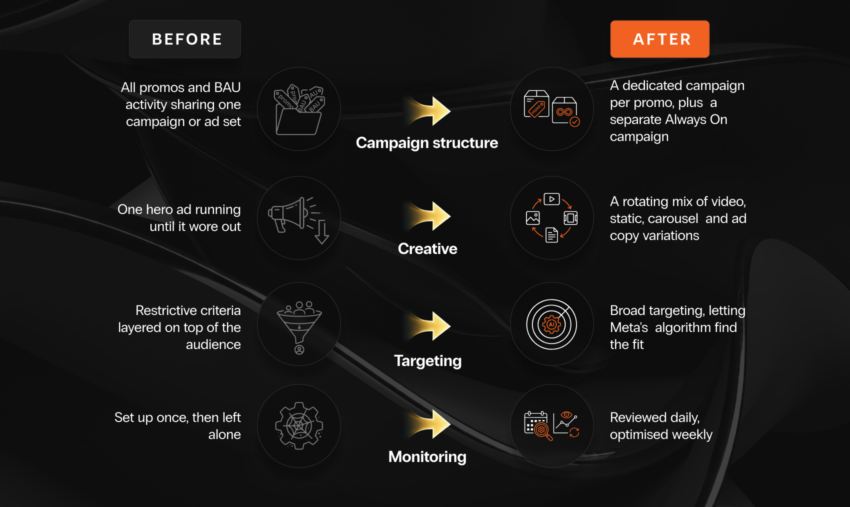
None of the changes here were exotic. They were paid social fundamentals, applied properly, rather than skipped in favour of simply getting ads live.
The busier an account gets, the more this matters. Most home improvement accounts run several promotions alongside everyday activity during a busy season. A looser setup can’t keep up with that. Every additional promo creates another opportunity for Meta to make a decision nobody asked for.
Three Changes That Moved the Needle
The fix scales with the account: more promos, more reason to keep each one in its own lane. Three changes did most of the work.
| What | Before | After |
|---|---|---|
| Campaign structure | All promos and BAU activity sharing one campaign or ad set | A dedicated campaign per promo, plus a separate Always On campaign |
| Creative | One hero ad running until it wore out | A rotating mix of video, static, carousel and ad copy variations |
| Targeting | Restrictive criteria layered on top of the audience | Broad targeting, letting Meta’s algorithm find the fit |
| Monitoring | Set up once, then left alone | Reviewed daily, optimised weekly |
One Campaign Per Promo, Plus an Always On Campaign for BAU
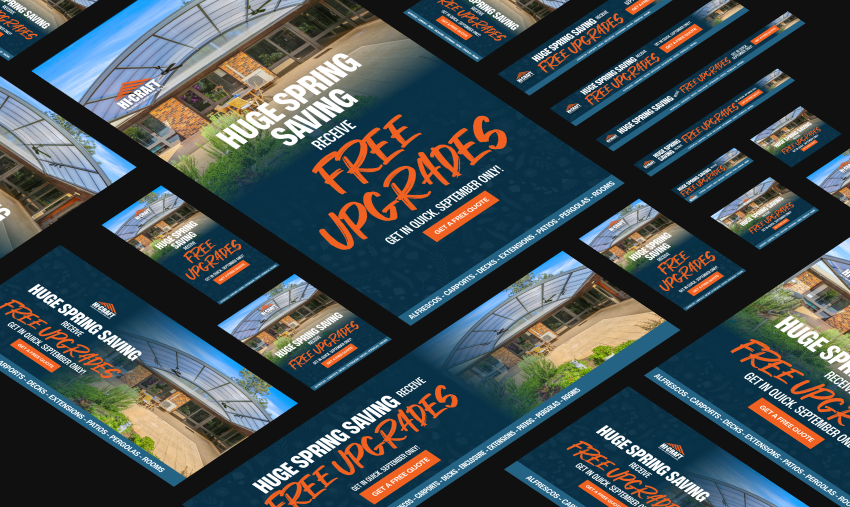
Each promotion now runs in its own dedicated campaign, with a separate Always On campaign carrying business-as-usual activity underneath it. Nothing competes for the same spend pool. A promo running for two weeks no longer has to fight the everyday content that’s supposed to keep ticking over regardless.
That single change is why properly structured Meta Ads agency management can let the algorithm serve each promo fairly, rather than starving one campaign to feed another.
A Deliberate Mix of Video, Static, and Ad Copy Variations

Creative now runs as a genuine mix, with everything live at the same time rather than one asset carrying the whole load. Home improvement work photographs well, and the account finally treats that as an asset instead of an afterthought.
In practice, that mix includes three formats. Video ads walk through a completed project from start to finish. Carousel ads break a renovation into stages rather than one static hero shot. Multiple ad copy angles run concurrently, not sequentially, so winners surface faster. Static before-and-after imagery does the heaviest lifting, the single highest-performing format for a visual category like this.
That variety is what keeps the account ahead of creative fatigue. Even a great hero ad will eventually wear out. A rotating set of formats and angles gives the algorithm room to keep finding fresh engagement instead of serving the same tired asset to an audience that’s already seen it.
Letting Meta’s Algorithm Do the Targeting
Targeting leans on broad reach rather than restrictive criteria. The account uses Instagram advertising to reach homeowners and renovators across Sydney while giving Meta the flexibility to decide who is most likely to convert.
Every unnecessary layer of manual targeting gives the algorithm less room to work. Removing those restrictions lets Meta find a better audience, faster than a heavily constrained setup ever could.
Kept Working After Launch
This doesn’t run on autopilot once it’s set up. Daily performance reviews and weekly optimisation cycles catch fatigue early and reallocate spend towards the campaigns and creative that are converting.
A campaign built properly and then left alone will still drift over time, as audiences saturate and creative ages. In Hi-Craft’s account, that drift showed up as one carousel ad starting to fatigue in week six. The weekly check caught it and shifted ad spend allocation toward the fresher video creative. Audience saturation never had the chance to drag results down.
Tracking Built to Trust the Numbers
Good structure and good creative are wasted if the reporting can’t be trusted. We implemented Meta Pixel and Conversions API properly from the start, the tools that track what happens after someone clicks an ad, so the account isn’t optimising toward numbers that look good on a dashboard but drift from what’s happening in the business.
That matters more than most accounts realise. iOS privacy changes broke a lot of standard Meta attribution a few years back, and an account that never rebuilt its tracking properly is optimising against noise.
The Numbers
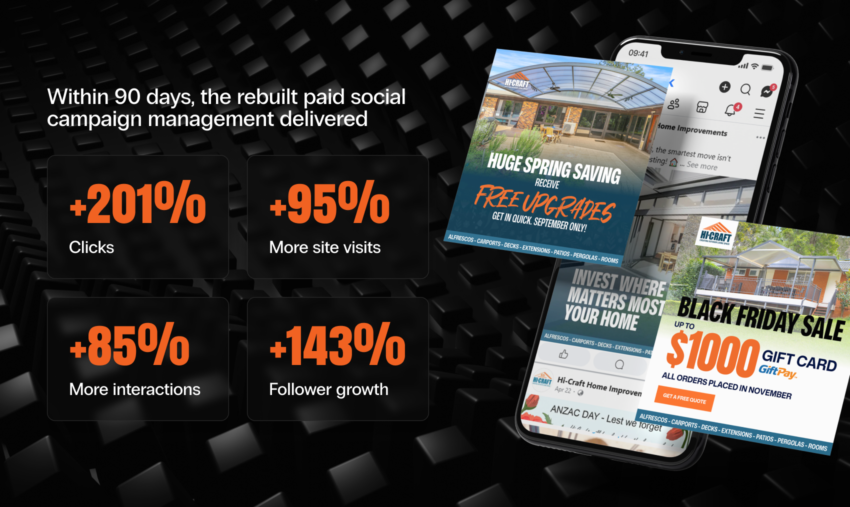
Within 90 days, the rebuilt paid social campaign management delivered:
- +201% clicks
- +95% more site visits
- +85% more interactions
- +143% follower growth
The number that mattered most inside the business wasn’t on that list. Quote requests from Instagram returned for the first time in over a year. That’s the whole point in one line: the platform doesn’t need more budget. It needs to be set up to do its job.
The Standout: A Channel That Started Working Again
For a business like Hi-Craft, the real proof isn’t in the percentage lifts. It’s that Instagram, a channel that had gone quiet, started producing quote requests again.
That’s not a vanity metric. A quote request is a homeowner deciding they’re ready to talk, and for a home improvement business, that’s the kind of track record that matters more than any single percentage.
It also changes what the sales team can rely on. A channel nobody was counting on isn’t part of anyone’s plan, and reviving it means a genuine second source of enquiries, not just a healthier-looking dashboard.
Instagram specifically suits a business like this. Home improvement work is inherently visual, a finished renovation photographs and films well in a way a service invoice never could. Facebook and Instagram ads reward that kind of business more than most.
The Takeaway
Hi-Craft’s Meta Ads didn’t need a bigger budget. They needed structure, creative variety, and targeting that got out of the algorithm’s way.
The same principles show up across well-run Meta accounts. Dedicated campaigns help maintain fair delivery across each promotion, a genuine mix of creative helps protect against fatigue, and broad targeting gives the algorithm enough room to find the right audience.
None of this shows up overnight, and none of it holds without the discipline to keep doing it. But applied consistently, the cumulative effect shows up clearly in the numbers, as it did for Hi-Craft.
More Enquiries From Meta Ads Agency Management Done Right
CCM’s Sydney-based team delivers Meta Ads agency management built around what drives performance, not just the creative sitting on top of it. As a social media advertising agency, CCM treats Facebook Ads management and Instagram advertising with the same rigour: structure and tracking first, creative second.
That track record goes back to 2008, backed by Google Premier Partner status and no lock-in contracts. If you want to see what that could look like for your account, book a strategy chat and we’ll walk you through it.