
Your Social Media Content Isn’t Working. Here’s What to Fix Before You Post Again.
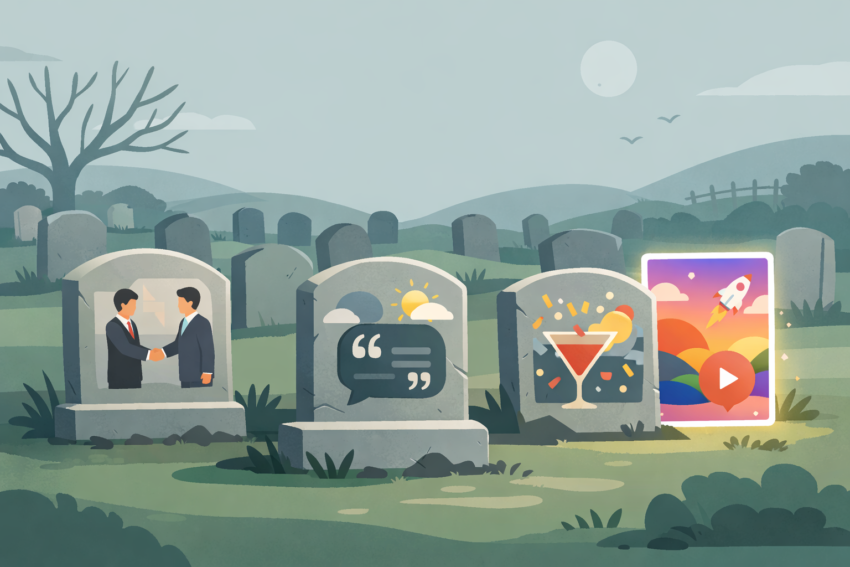
Let’s be blunt: most business social media accounts are a graveyard of motivational quotes, stock photos, and posts that took 45 minutes to create and reached 12 people. If that sounds familiar, you’re not alone, and you’re not failing because social media doesn’t work. You’re failing because your content strategy is built on habits that stopped working three years ago.
At Click Click Media, we’ve managed paid social campaigns for businesses across every industry imaginable, from trades and professional services to ecommerce brands and national franchises. We’ve seen what actually moves the needle, and more importantly, we’ve seen what burns budget without shifting a single metric that matters.
Here’s what we know works right now, and what you should stop doing immediately.
You’re Posting for the Algorithm. Start Posting for People.
Every time a platform tweaks its algorithm, marketers scramble to decode the new rules. Post at 7:14am on a Tuesday. Use exactly five hashtags. Make the first three seconds count. Carousel posts outperform reels this week, wait, no, reels are back.
Here’s the thing: the algorithm rewards content that people actually engage with. That hasn’t changed in a decade. If your content is genuinely useful, entertaining, or relevant to the person scrolling past it, the algorithm will find its audience. If your content is a thinly veiled sales pitch wrapped in a Canva template, it won’t, no matter what time you post it.
The businesses we see winning on social aren’t gaming the system. They’re creating content their audience would actually stop scrolling to read. That’s a fundamentally different starting point.
Stop Creating Content in a Vacuum
One of the most common mistakes we see, particularly with small and mid-sized businesses, is treating social media as a standalone activity. Someone in the team gets tasked with “doing the socials,” and they’re left to come up with ideas in isolation, disconnected from what the business is actually doing, what customers are actually asking, and what’s actually driving revenue.
Your social content should be directly informed by your broader digital marketing strategy. What keywords are driving traffic to your website? What questions are your sales team answering every week? What objections keep coming up in discovery calls? What’s converting on your Google Ads campaigns?
That’s your content roadmap. Not a trending audio clip. Not whatever your competitor posted last week.
If your social media strategy isn’t connected to your SEO, your paid campaigns, and your actual sales conversations, you’re leaving performance on the table.
The Content That Actually Performs (and Why)
After years of testing across hundreds of accounts, here’s what consistently outperforms everything else on social:
Content that answers a specific question your customer is already asking. Not broad industry thought leadership. Not vague tips. A specific problem, answered clearly, in under 60 seconds or 150 words. These posts build trust faster than anything else because they demonstrate that you understand your customer’s world.
Behind-the-scenes content that shows process, not polish. People don’t trust perfection anymore. They trust transparency. Show how you actually deliver your service. Show the messy middle. Show your team solving a real problem. This kind of content consistently outperforms polished brand content by a significant margin, and it costs almost nothing to produce.
Customer proof that isn’t a testimonial graphic. Screenshots of real messages. Quick video reviews. Before-and-after results with actual numbers. Social proof works, but the format matters. A designed quote tile with “Great service! – John S.” doesn’t move anyone. A screenshot of a genuine message from a happy client? That stops the scroll.
Strong opinions backed by experience. The safest content is also the most forgettable. If you’ve been in your industry for more than five years, you have opinions worth sharing. The businesses that build real followings are the ones willing to say what others in their space won’t. You don’t need to be controversial for the sake of it, but having a clear point of view is how you stand out in a feed full of sameness.

The “Post Consistently” Advice Is Incomplete
You’ve heard it a thousand times: consistency is key. Post three times a week. Show up every day. The algorithm rewards regularity.
This isn’t wrong, but it’s dangerously incomplete. Consistency without quality is just noise. Posting five mediocre carousels a week is worse than posting two genuinely useful pieces of content. Every weak post dilutes your brand in the eyes of your audience and trains the algorithm to deprioritise your content.
Here’s a better rule: post as frequently as you can maintain quality. For some businesses, that’s daily. For most, it’s two to three times per week. For some, it’s once a week, and that’s fine if every post is worth the attention it asks for.
Batch your content creation. Dedicate a block of time each fortnight to plan, create, and schedule. This is dramatically more efficient than scrambling for ideas on a Tuesday afternoon when you realise you haven’t posted in four days.
Platform Strategy: Stop Trying to Be Everywhere
Another common trap: spreading yourself across every platform because someone told you that you “need to be on TikTok” or that LinkedIn is “blowing up right now.”
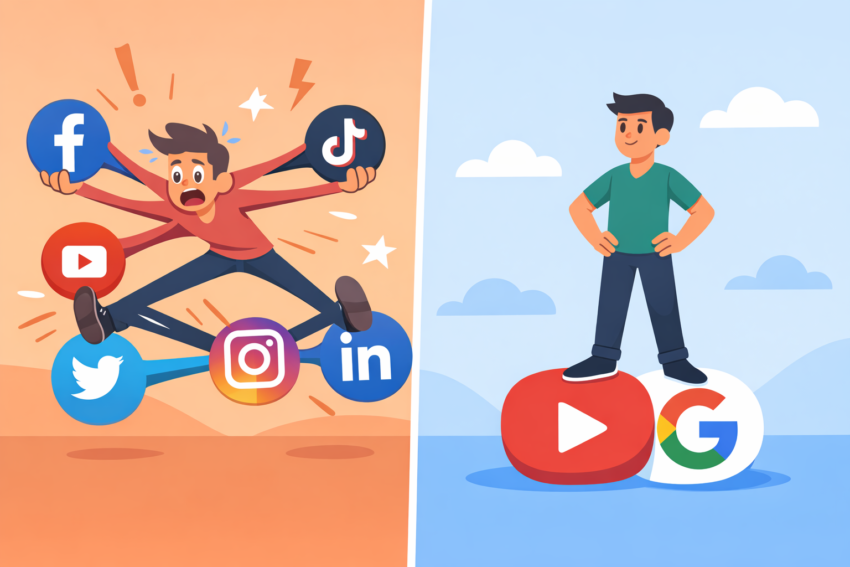
The reality is that most businesses will get better results by doing one or two platforms exceptionally well than by doing five platforms poorly. And platform choice should be driven by where your audience actually spends time, not where the marketing industry is currently excited about.
If you’re a B2B professional services firm, Instagram Reels are probably not your highest-leverage activity. If you’re a consumer brand targeting 25-to-40-year-olds, LinkedIn thought leadership probably isn’t it either.
Pick the platforms where your customers are, commit to them properly, and let go of the rest until you have the resources to expand without sacrificing quality. If you’re running Facebook or Instagram advertising alongside your organic efforts, that focus becomes even more important because your paid and organic strategies should be reinforcing each other, not pulling in different directions.
Repurpose Ruthlessly
The best-performing businesses on social aren’t creating more content. They’re getting more mileage from the content they already have.
A single long-form blog post can become five to eight social media posts. A client case study becomes a carousel, a short video, and three text posts highlighting different results. A webinar becomes a month of content clips.
If you’re creating content from scratch for every platform, every post, every week, you’re working harder than you need to. Build a system where every piece of quality content gets repurposed across formats and platforms. Your audience on Instagram isn’t seeing your LinkedIn posts, and even if they are, repetition reinforces your message.
Engagement Is a Two-Way Street
Posting and walking away is the social media equivalent of putting a flyer on a windscreen. The businesses that build genuine communities, and genuine commercial value, from social media are the ones that treat it as a conversation, not a broadcast.
Reply to every comment. Respond to DMs. Engage with your audience’s content. Ask questions in your captions and actually follow up on the answers. This isn’t about “hacking” engagement metrics. It’s about building relationships that lead to trust, and trust is what leads to revenue.

Measure What Matters
Likes and followers are not business metrics. They’re vanity metrics that make you feel good in a reporting meeting but don’t correlate with the numbers your business actually runs on.
The metrics that matter for social media in a business context are: website traffic from social channels, lead form submissions or enquiries attributed to social, engagement rate relative to follower count, and content saves and shares, which are a far stronger signal of value than likes.
If you can’t draw a line from your social activity to a business outcome, a lead, a sale, a booking, then your strategy needs work. And if you’re spending money on boosted posts or paid social campaigns without proper tracking in place, you’re spending blind. Getting your GA4 and analytics set up correctly is the foundation that makes everything else measurable.
One More Thing: AI Won’t Save a Bad Strategy
AI tools can help you draft faster, brainstorm ideas, and repurpose content more efficiently. We use them ourselves, and they’re a genuine productivity multiplier when used well. Our AI consulting services help businesses work out where AI fits into their workflow without the confusion. But AI is an accelerant. It amplifies whatever strategy you feed it. If your strategy is strong, AI makes it faster. If your strategy is weak, AI just helps you produce mediocre content at scale.
Get your strategy right first. Know your audience, know your message, know what success looks like. Then use AI to execute faster, not to replace the thinking.
The Bottom Line
Social media works. It builds brand awareness, generates leads, and drives revenue when it’s done with intention and connected to a broader strategy. The businesses that struggle with it aren’t struggling because the platforms are broken. They’re struggling because they’re approaching content creation without a clear plan, without a connection to what’s actually driving their business, and without the discipline to prioritise quality over volume.
If your social media feels like a chore that doesn’t deliver results, the answer isn’t to post more. It’s to post better, and to make sure every piece of content you publish is connected to a commercial objective.
Need help building a social media strategy that actually drives results? Book a free discovery session and we’ll map out what’s working, what’s not, and where the real opportunities are.