
Anchor Text SEO: A Practical Guide to Link Text That Actually Helps Rankings
Anchor text is the clickable wording in a hyperlink. It tells users and search engines what a linked page is about before anyone clicks. Get it right and it quietly powers your rankings. Get it wrong and it can trigger a Google penalty that undoes months of work. This guide covers everything.
Note on examples: Throughout this article we use Pinnacle Plumbing, a fictitious Sydney plumbing company, to illustrate concepts in a real-world context. Any resemblance to an actual plumber is purely coincidental and slightly flattering to them.
What is Anchor Text?
Anchor text is the visible, clickable part of a hyperlink. That blue underlined phrase you see on a webpage? That is the anchor text. Click it, and you land on wherever it was pointing.
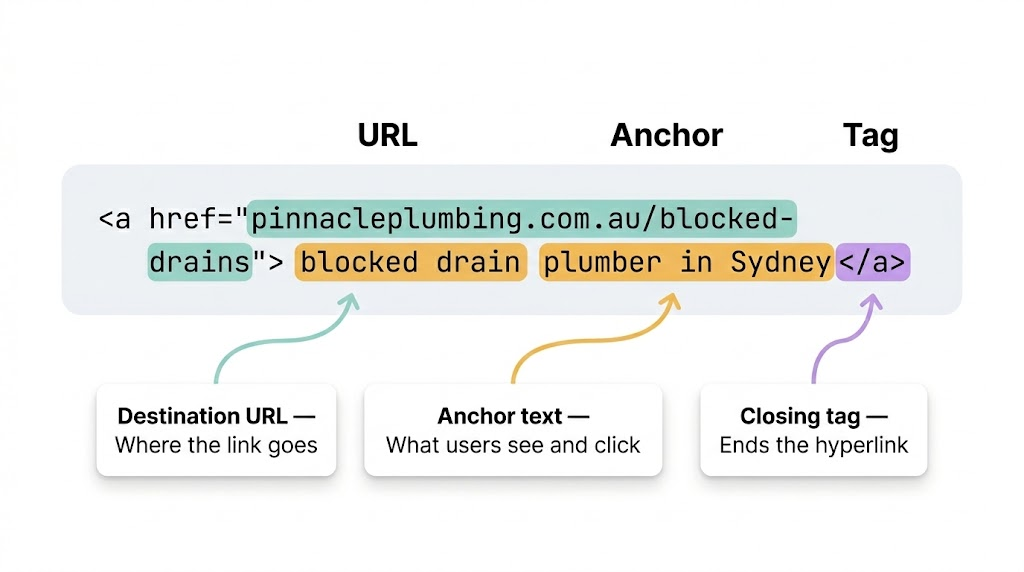
Here is how it looks under the hood:
HTML example:
<a href=”https://pinnacleplumbing.com.au/blocked-drains”>blocked drain plumber in Sydney</a>
The phrase “blocked drain plumber in Sydney” is the anchor text. The URL is just the address. The anchor text is what describes the destination.
Why does the wording matter? Because Google reads it as a relevance signal. If dozens of pages link to Pinnacle Plumbing’s blocked drains page using the phrase “blocked drain plumber Sydney,” Google takes that as strong evidence the page is about exactly that. Anchor text is essentially other people vouching for what your page covers.
This applies to two types of links. Internal links connect pages within your own site. External links (backlinks) come from other websites. Both matter, but they play different roles in your SEO, which we cover below.
Why Anchor Text Matters for SEO
Google has used anchor text as a ranking signal since day one. In the original PageRank paper from 1998, Larry Page and Sergey Brin wrote that anchor text is “often more accurate in describing a page’s contents than the page itself.” That was 1998. The principle still holds.
When a link points to your page with a descriptive anchor, Google treats it as a topical vote. Enough votes, from enough credible sources, and your page climbs for that phrase.
Anchor text works on two levels:
- Topical relevance. It tells search engines what the destination page covers. Think of it as a label Google can read before it even visits the page.
- Link equity distribution. Links pass authority from one page to another. The anchor text shapes which keywords that authority flows toward on the destination page.
The catch? Anchor text is also one of the easiest things to manipulate. Google knows this. Overdo the keyword-heavy anchors and your profile starts looking engineered rather than earned. That is when rankings drop.
The sweet spot is a profile that looks completely natural, because it largely is. This guide shows you how to get there.
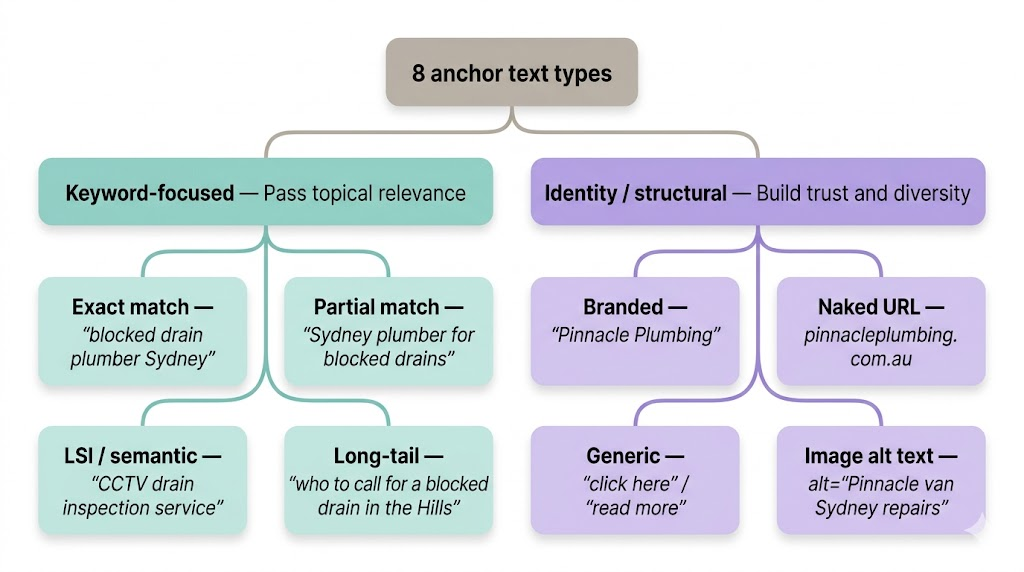
The Eight Types of Anchor Text Explained
Not all anchor text sends the same signal. Google weighs each type differently. Here is what you need to know about each one.
1. Exact match
The anchor uses the precise keyword you want the destination page to rank for. No additions, no variations.
✗ Avoid: Every backlink to Pinnacle Plumbing’s drain page uses the anchor “blocked drain plumber Sydney.” Every. Single. One.
✓ Do this: Using “blocked drain plumber Sydney” as one anchor among a varied mix.
Exact match anchors carry strong relevance signals. The problem is volume. A profile stacked with the same exact phrase looks like someone was trying to game the algorithm. Google’s Penguin update was built specifically to catch this pattern.
2. Partial match
The anchor includes your target keyword alongside other words or modifiers.
✓ Do this: “best Sydney plumbers for blocked drains” / “fixing blocked drains in the Hills District” / “licensed plumber for drain repairs”
Partial match anchors are the workhorses of a healthy link profile. They read naturally in sentences, pass solid keyword relevance, and carry very little penalty risk. Most of your keyword-focused anchors should sit in this category.
3. Branded
The anchor uses your brand name, alone or paired with a descriptor.
✓ Do this: “Pinnacle Plumbing” / “Pinnacle Plumbing Sydney” / “Pinnacle Plumbing’s drain repair team”
Branded anchors are one of the strongest trust signals Google looks for. A high share of branded anchors tells Google your business is recognised across the web. For most established businesses, branded anchors should form the largest chunk of their external link profile.
4. Naked URL
The anchor is the URL. No descriptive text, just the raw address.
✓ Do this: pinnacleplumbing.com.au / https://pinnacleplumbing.com.au/blocked-drains/
Naked URLs show up naturally in directories, forum posts, citations, and social profiles. They do not pass strong keyword relevance, but they add variety to a link profile and look completely organic.
5. Generic
Non-descriptive phrases that tell Google nothing about the destination.
✗ Avoid: “click here” / “read more” / “visit this page” / “learn more”
Generic anchors are the digital equivalent of a signpost that just says “over there.” Fine in small doses as they appear naturally in older content and user-generated posts. But let them dominate your profile and you are wasting link equity.
6. LSI and semantic anchors
These use synonyms and topically related phrases rather than the exact keyword.
✓ Do this: For a page targeting “blocked drain plumber Sydney”: “how to clear a blocked sewer line” / “emergency drain repair in Western Sydney” / “CCTV drain inspection service”
Semantic anchors help Google understand the broader context of a page. They are particularly valuable for pillar pages where you want to rank across a cluster of related terms, not just one phrase.
7. Image anchors
When an image is hyperlinked, Google reads the image’s alt text as the anchor text. This is the one most people forget about entirely.
✓ Do this: An image linking to the blocked drains page with alt text: “Pinnacle Plumbing technician clearing a blocked drain in Sydney” rather than “image1.jpg”
Every linked image without descriptive alt text is a missed opportunity. They are easy to fix and add real signal value when done properly.
8. Long-tail anchors
Longer, more specific phrases that mirror how people actually type into Google.
✓ Do this: “who to call for a blocked drain in the Hills District” / “how much does a plumber charge to unblock a drain in Sydney”
Long-tail anchors carry lower keyword density but align closely with real search queries. They work well for blog content and resource pages where informational intent is the target.
Anchor text types at a glance
| Type | Example | SEO value | Risk if overused |
|---|---|---|---|
| Exact match | “blocked drain plumber Sydney” | High | Penguin penalty |
| Partial match | “Sydney plumber for blocked drains” | High | Low |
| Branded | “Pinnacle Plumbing” | High (trust signal) | Very low |
| Naked URL | pinnacleplumbing.com.au | Moderate | Very low |
| Generic | “click here” | Low | Low in small doses |
| LSI / Semantic | “emergency drain repair near me” | Moderate to high | Very low |
| Image alt text | “Pinnacle Plumbing drain repair van” | Moderate | Low |
| Long-tail | “best plumber for blocked drains in Sydney” | Moderate | Very low |
Anchor Text Ratios: What a Natural Profile Looks Like
The question everyone asks: “How much of each type should I have?” There is no single right answer. But there is a benchmark most experienced SEOs use as a starting point.
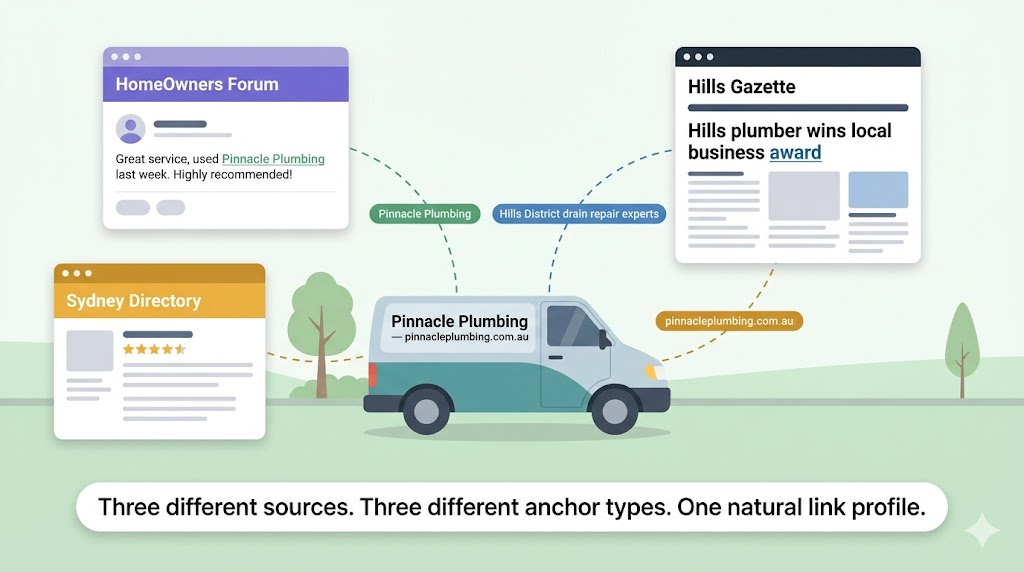
Think of it this way. If hundreds of unrelated people organically linked to Pinnacle Plumbing’s website, what would that profile look like? Mostly brand mentions. Some descriptive phrases. The odd naked URL from a local directory. A handful of keyword-specific anchors from blog posts. That is your target.
| Anchor type | Target range | Notes |
|---|---|---|
| Branded | 50-65% | Foundation of a trustworthy profile. Brand name alone or paired with a generic phrase. |
| Partial match | 10-20% | Target keyword plus additional words. Effective and low risk. |
| Naked URL | 5-15% | Raw URL from directories, forums, and citations. |
| LSI / Semantic | 3-8% | Related phrases and synonyms that build topical context. |
| Exact match | 1-5% | Keep it low. The exact keyword phrase is powerful but Google is watching. |
| Generic | 5-10% | “Click here”, “learn more”. Fine in small amounts. |
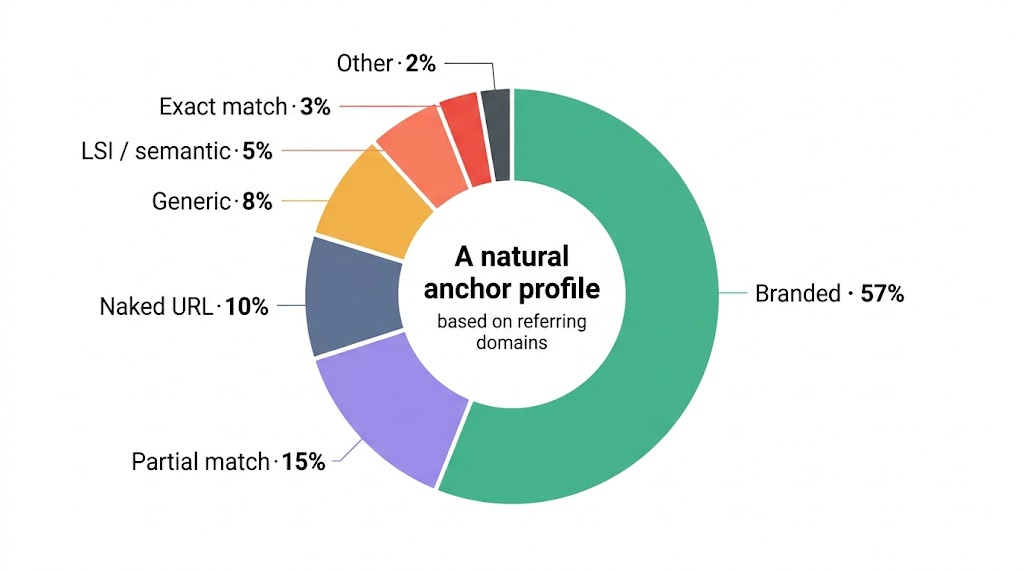
Important: These ratios apply to your external backlink profile. Internal links within your own site follow different rules, covered in the next section.
A profile that is wall-to-wall exact-match anchors is a red flag. A profile that is entirely generic is wasted potential. The goal is variety that looks organic, because organic is exactly what it should be.
Internal vs External Anchor Text
Anchor text behaves differently depending on whether the link lives on your own site or on someone else’s. The rules are not the same for both.
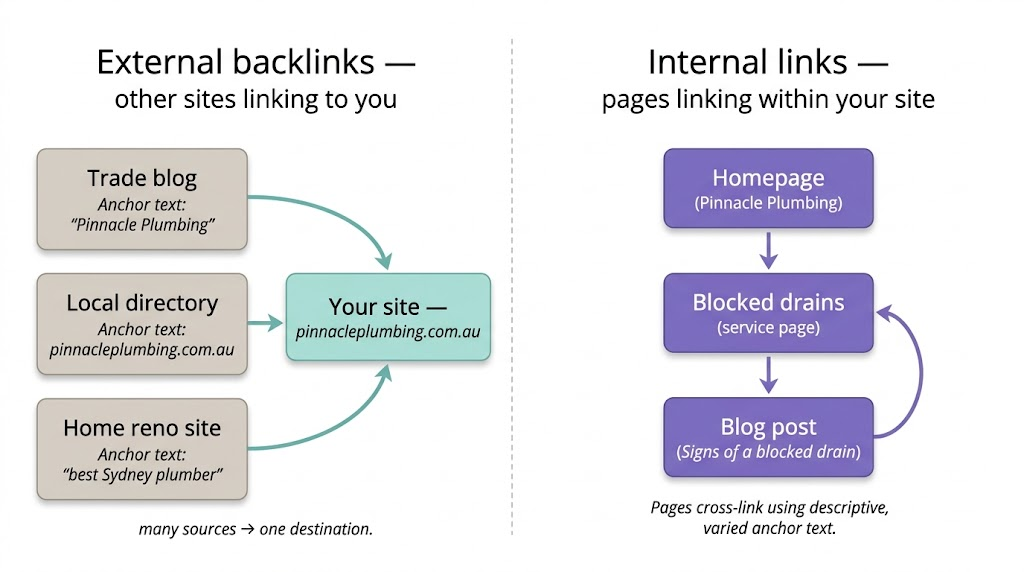
External anchor text (backlinks)
This is the anchor text other websites use when they link to you. You have limited control over it. That is actually a feature, not a bug. A diverse external profile looks natural precisely because different people write about things differently.
When you are actively building links through outreach, guest posting, and digital PR, you do have some say. Use it wisely. Keep exact-match anchors well below 5% of your total external profile. Anything above that starts to look like a strategy rather than organic recognition.
Internal anchor text
This is entirely in your hands. Every link from one page on your site to another is an opportunity to send a clear relevance signal to Google.
You can use keyword-rich anchor text more freely here. You are not trying to manipulate anything. You are just helping Google (and your readers) understand how your pages connect. That said, repetition still looks robotic. If every internal link to Pinnacle Plumbing’s drain page uses the phrase “blocked drain plumber Sydney,” even Google starts to raise an eyebrow. Mix it up.
Good internal anchor practice for service-based websites:
- Parent pages link to child pages using natural, descriptive phrases drawn from the child page’s content
- Child pages link back to the parent, not just by name but with contextual anchor text
- Related service pages cross-link where the services complement each other
- Blog posts link to the most relevant service page, not the homepage
✗ Avoid: A blog post about “signs you have a blocked drain” links to the drain service page using the anchor “plumbing services.” Technically a link. Practically useless.
✓ Do this: The same post links with “how Pinnacle Plumbing clears blocked drains across Sydney” where it sits naturally in the sentence.
Best Practices for Anchor Text Optimisation
Follow these and your anchor text strategy will be solid. Skip them and you will eventually end up in a conversation about recovery.
Write for the reader first
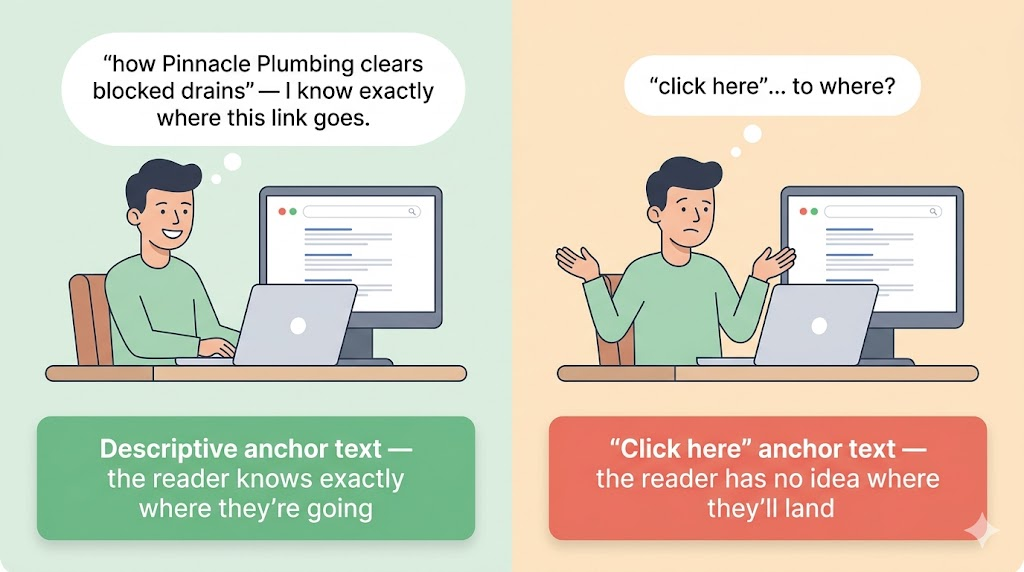
Here is a simple test. Read only the anchor text out of context. Does it tell you what you will find on the other side of the click? If yes, it is good anchor text. If the answer is “I have no idea,” rewrite it.
Google’s own documentation says anchors “should make it clear to the visitor what your link points to.” Optimise for clarity. Keyword relevance follows.
Keep it concise
Two to six words is the sweet spot for most anchors. Too long and the keyword signal dilutes. Too short and you risk being too vague. “Plumber” is not an anchor. “Emergency plumber Hills District” is.
Vary your anchors across links to the same page
When building backlinks to the same page, never use the exact same phrase twice if you can help it. Different anchors from different sources build relevance across a wider range of related keywords, not just one phrase. Variety is what a natural profile looks like. It is also what keeps Penguin uninterested in you.
Match the anchor to the destination
Anchor text is a user experience signal too. If someone clicks “emergency plumber Hills District” and lands on a homepage about Pinnacle Plumbing’s entire service range, that is a mismatch. Google tracks this. The anchor should accurately reflect what is on the other side.
Place links in context
An anchor buried in a footer or jammed into sidebar navigation carries far less weight than one inside a relevant paragraph. Contextual links carry more signal because the surrounding text gives Google additional confirmation of what the link is about. Put your links where they belong: in the body of the content.
Keep your link velocity realistic
Fifty new backlinks all using the same exact-match phrase, all appearing in the same week? That is not a link building campaign. That is a pattern. Google reads patterns. Vary anchors across placements and build at a pace that reflects real growth, not a bulk order.
Common Anchor Text Mistakes and How to Fix Them
| Mistake | Why it hurts | How to fix it |
|---|---|---|
| “Click here” as an internal link anchor | Passes no keyword relevance to the destination. A free SEO opportunity, wasted. | Rewrite the surrounding sentence so the anchor describes the destination. “Read more” becomes “how Pinnacle Plumbing handles blocked drains in Western Sydney.” |
| The same exact-match anchor across multiple backlinks | Matches the pattern Penguin was built to catch. Can cause ranking drops for the affected page. | Audit in Ahrefs or SEMrush. Request anchor changes from link partners. Build new links with varied anchors to dilute the over-weighted phrase. |
| Not updating anchors after URL changes | Internal links pointing to old URLs create redirect chains or dead ends, slowing crawl efficiency. | Run a crawl after any major site change. Update all internal anchors to current canonical URLs. |
| Defaulting to the homepage for every internal link | Piles link equity onto the homepage. Service and blog pages need equity too. | In blog posts, link to the most relevant service page. The homepage does not need the help. |
| Ignoring image alt text | Linked images without descriptive alt text pass no keyword signal. “image1.jpg” tells Google nothing useful. | Write descriptive alt text for every linked image. Include the target keyword where it fits naturally. |
| Anchor text that mismatches the destination | Confuses users and muddies Google’s relevance signals. A lose-lose. | Audit all internal links and confirm each anchor accurately reflects what the destination page is about. |
Google Penguin and the Risks of Over-Optimisation
In April 2012, Google launched the Penguin algorithm update. Its job was to identify and penalise manipulative link building. Anchor text spam was at the top of the hit list.
Before Penguin, SEOs had discovered something wonderful and terrible: if you pointed enough exact-match anchor text links at a page, it ranked for that phrase. The tactic became known as “Google Bombing.” One particularly amusing example saw Tony Blair’s biography page rank for the word “liar” because enough people linked to it with exactly that anchor. It was funny right up until Google decided to put a stop to it.
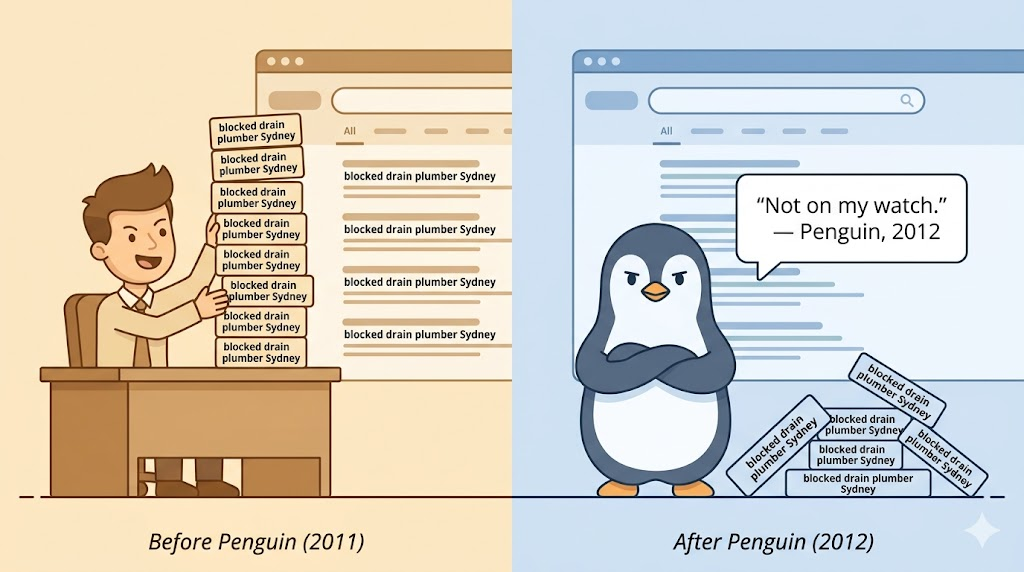
Penguin landed hard. Sites with over-optimised anchor profiles lost 80 to 90% of their organic traffic overnight. Entire businesses built on manipulative link profiles were wiped out in a single update. The message was clear: a backlink profile that looks engineered rather than earned will be penalised.
In September 2016, Penguin became part of Google’s core algorithm. It now runs in real time. There is no update cycle to wait out. Understanding how backlinks actually work is the best defence against landing in Penguin’s crosshairs. Google is continuously reassessing link profiles as it recrawls the web.
The takeaway is simple: build links that are worth having. Vary your anchors. Keep exact-match phrases to a small minority of your total profile. And never, under any circumstances, buy a bulk link package from someone who promises “top rankings in 30 days.” They were not there in 2012 and they will not be there for you now.
How to Audit Your Anchor Text Profile
If you have an established site or have done any link building, a periodic anchor text audit is worth doing. Here is how to approach it without losing your mind.
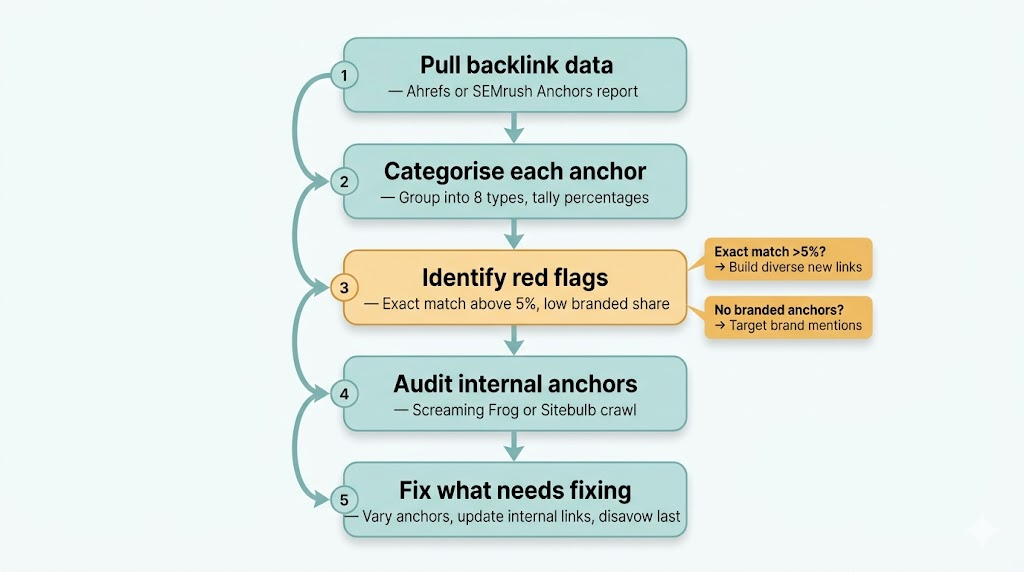
Step 1: Pull your backlink data
You need a backlink analysis tool. The main options are:
- Ahrefs: Site Explorer → Anchors. Shows each anchor phrase, how many referring domains use it, and trend data. This is the gold standard for anchor auditing.
- SEMrush: Backlink Analytics → Anchors. Similar view with slightly different data coverage. Good as a second opinion.
- Google Search Console: The Links report shows you what people are linking to, but not what anchor text they used at phrase level. Useful context, not a substitute for a proper tool.
Step 2: Categorise each anchor
Group your anchors into the eight types from earlier. Count how many referring domains use each type. Work out rough percentages. It does not need to be precise. You are looking for patterns, not decimal points.
Step 3: Identify red flags
These are the things worth acting on:
- Exact-match anchors above 5% of your total profile
- Any single phrase appearing across more than 10% of referring domains
- Keyword-rich anchors from low-quality or irrelevant sources (these are candidates for disavow)
- Barely any branded anchors, which suggests the profile was constructed rather than earned
Step 4: Check internal anchors separately
Run a site crawl using Screaming Frog or Sitebulb. Export all internal links and their anchor text. Flag any generic anchors (“click here”, “read more”) and bare service names that a bit of editing could transform into something useful.
Step 5: Fix what needs fixing
For external links, your options are:
- Contact link partners and ask them to update the anchor text
- Build new backlinks with varied anchors to dilute the over-weighted phrase
- Disavow spammy links through Google Search Console, as a last resort
For internal links, the fix is usually just editing copy. No outreach. No waiting. Just go in, rewrite the sentence, and update the anchor to something descriptive.
On disavowing: Treat the disavow file like a scalpel, not a lawnmower. Only disavow links that are clearly spammy: private blog networks, link farms, and unrelated foreign-language sites you had no hand in creating. Disavowing legitimate links, even anchor-heavy ones, removes link equity and can hurt your rankings. Get an experienced SEO’s opinion before filing anything.
FAQs
Does anchor text still matter in 2025?
Yes. It is one of Google’s oldest ranking signals and it is still in active use. What has changed is that manipulative anchor text now carries real penalty risk. Natural, varied anchor text still sends clear topical signals and contributes meaningfully to rankings.
How many times should I use my target keyword as anchor text?
For internal links, variety is the guiding principle. Use the exact keyword occasionally and mix in partial matches, semantic variations, and descriptive phrases. For external backlinks, keep exact-match anchors below 5% of your total referring domain profile. That is not a guideline. It is a ceiling.
Is it bad to use “click here” as anchor text?
It will not get you penalised. But it is a missed opportunity every time you use it. “Click here” tells Google nothing about the destination. Replacing it with descriptive anchor text costs nothing and improves both usability and SEO. There is no downside.
Can I control the anchor text of links pointing to my site?
You can influence it during outreach and guest posting. You cannot dictate it. That is actually a good thing. A profile where every anchor follows a pattern looks suspicious precisely because real-world link building is messy and varied. Focus on earning links from credible sources and let the anchor diversity happen naturally.
What is anchor text stuffing?
It is the practice of loading up your backlink profile with exact-match keyword anchors, usually through paid links or link schemes. It is exactly what Penguin was built to penalise. The fix is simple in principle and tedious in practice: diversify your anchors, build more branded links, and stop treating Google like it has not noticed.
Does internal anchor text affect rankings?
Yes, more than most people realise. Internal links pass authority between your own pages and help Google map the topical relationships across your site. Descriptive internal anchor text reinforces which keywords a page should rank for. It is one of the most underused on-page SEO levers on established websites.
Should I use anchor text for no-follow links?
Yes. No-follow links do not pass PageRank, but they contribute to a natural-looking overall profile. Write descriptive anchor text for no-follow links exactly as you would for followed ones. Good habits are worth keeping consistent.
What tools are best for analysing anchor text?
Ahrefs is the most widely used for external backlink anchor audits. SEMrush is a solid alternative. For internal link anchor analysis, Screaming Frog and Sitebulb are the standard crawling tools. Google Search Console gives you link data but not anchor-level detail. Use it to cross-reference, not as your primary source.
Want a Free Backlink and Anchor Text Audit for Your Site?
CCM’s SEO team has managed over $115M in Google Ads spend and helped hundreds of Australian businesses build stronger organic rankings and cleaner link profiles. If you want to know whether your anchor text is working for you or quietly holding you back, we can show you. No lock-in contracts.