
Woofers World: What a Long SEO Relationship Actually Looks Like, Year by Year
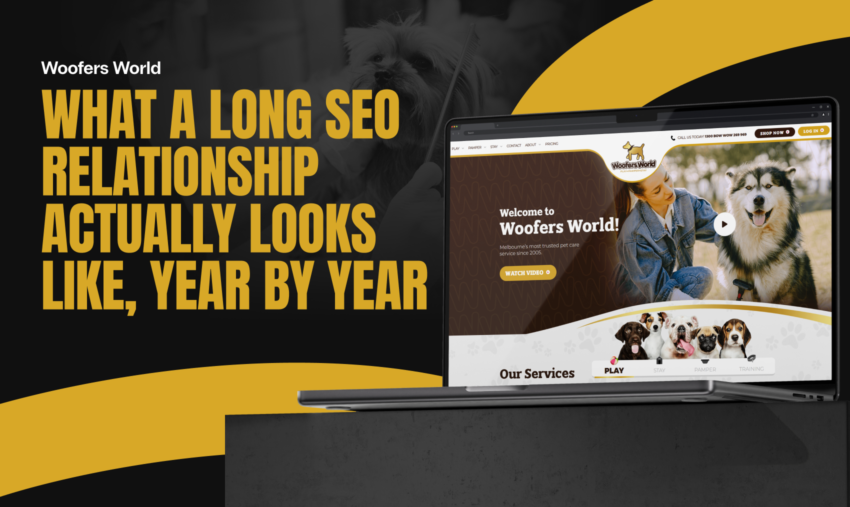
Most SEO case studies start at the beginning and end with a big number. This one does something different. Woofers World is a Melbourne-based dog care business offering daycare, dog walking, grooming, puppy visits, sleepovers, and pet supplies across two locations. CCM has worked with them continuously since 2 June 2022.
A four-year SEO relationship does not look like a smooth upward line. There are algorithm updates that cut traffic despite good rankings. There are months where the numbers consolidate rather than climb. There are new services and new locations that require the strategy to expand. And there are years where the compounding effect of consistent work becomes visible in the data in a way it could not have been in month six.
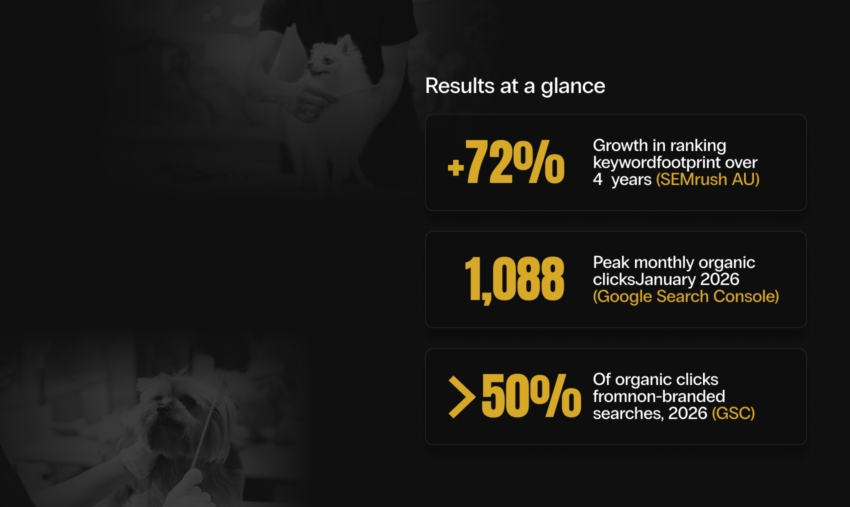
Results at a glance
- +72% Growth in ranking keyword footprint over 4 years (SEMrush AU)
- 1,088 Peak monthly organic clicks, January 2026 (Google Search Console)
- >50% Of organic clicks from non-branded searches, 2026 (GSC)
The starting point
When CCM took on Woofers World in June 2022, the site’s organic presence was almost entirely brand-dependent. The homepage ranked well for people searching “Woofers World” and its variations, but the site had minimal visibility for the non-branded service terms that bring in new customers.
- Primarily brand Traffic composition at start
- 754 Ranking keywords (Jun 2022)
- ~1,118 Est. monthly organic traffic (Jun 2022, SEMrush AU)
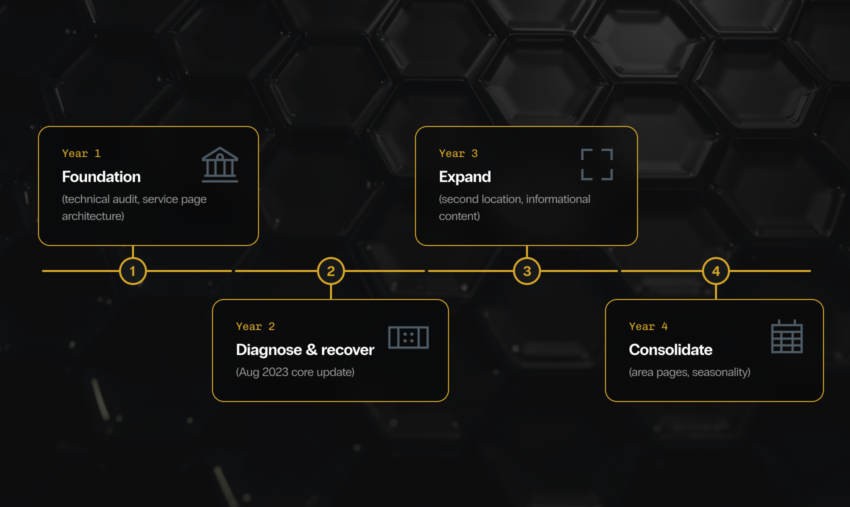
Year 1 (June 2022 to May 2023): Building the foundation
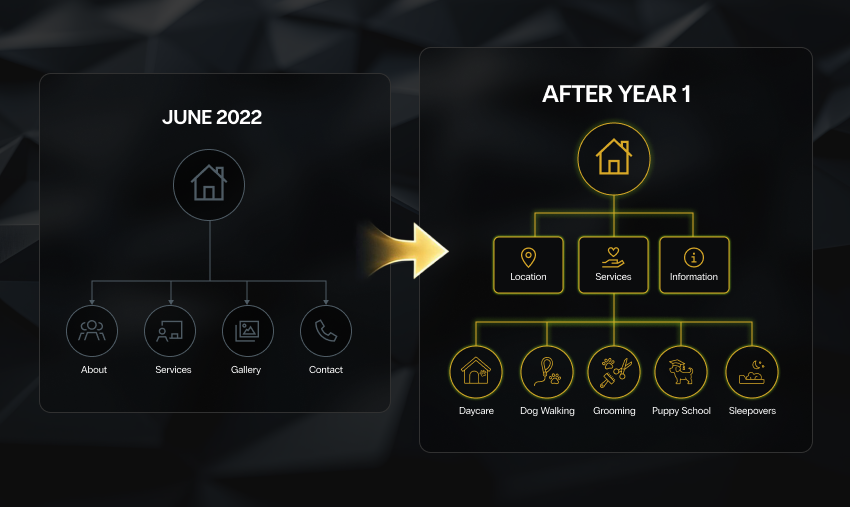
The first year was about establishing the structural conditions for organic growth: a full technical audit, addressing crawlability and indexation issues, building out the service page architecture, and producing targeted content for the keywords most likely to produce enquiries.
By the end of year one, the keyword footprint had grown materially: from 754 ranking keywords in June 2022 to over 1,300 by January 2023. Estimated monthly traffic grew from approximately 1,118 to a peak of around 1,825 in January 2023.
- 1,389 Ranking keywords (Apr 2023)
- ~1,825 Est. monthly traffic peak (Jan 2023, SEMrush AU)
- +84% Growth in keyword footprint, year 1
Early keyword wins included “dog walking” (position 13, 2,900 monthly searches) appearing for the first time, “puppy school near me” entering the top 15, and the grooming pages beginning to rank for local terms. These were positions 10-15, not yet top-three, but the pages were in the index and building authority.
Data note: conversion impact of year one traffic growth is best verified from GSC (organic clicks) and GA4 (organic sessions and key events) for Jun 2022 to May 2023. Traffic estimates from SEMrush AU.
Year 2 (June 2023 to May 2024): An algorithm update and what happened next
August 2023 brought Google’s core update, which affected a large number of sites in local services. Estimated monthly traffic dropped to around 817 in September 2023. This is the part of a long SEO relationship that does not get written up in case studies as often as it should. An algorithm update that causes a traffic drop is a diagnostic event, not evidence of a failed strategy.
Traffic returned above 1,100 by October, above 1,300 by December, and grew to approximately 1,160 by January 2024. Keyword count grew to a high of 1,679 by January 2024. By mid-year-two, service terms were moving up.
- 817 Est. monthly traffic low (Sep 2023, SEMrush AU)
- 1,679 Peak ranking keywords (Jan 2024, SEMrush AU)
- Recovered Traffic trend by end of year 2
| Keyword | Position (Sep 2024) | Monthly searches (AU) |
|---|---|---|
| dog walkers | Position 7 | 880 |
| dog clipping melbourne | Position 2 | 390 |
| dog walking melbourne | Position 4 | 260 |
| dog walker | Position 8 | 1,300 |
| dog walkers melbourne | Position 2 | 170 |
Year 3 (June 2024 to May 2025): The traffic inflection and the second location
Year three is where the compounding effect of the previous two years became visible. From June 2024, estimated monthly traffic consistently exceeded 1,600 visits. By November 2024 it was above 2,300. By April 2025 it peaked at approximately 2,575.
Year three also brought the launch of Woofers Dog Lounge in Moorabbin, a second location requiring its own local SEO treatment. The Dog Lounge launch is visible in the keyword data: “woofers dog lounge” and “bayside dog lounge” both entered the rankings, with the latter reaching position 2 for 170 monthly searches.
- 2,575 Est. monthly traffic peak (Apr 2025, SEMrush AU)
- 2,608 Est. traffic Dec 2024 (SEMrush AU)
- +54% Traffic growth year 3 vs year 1 baseline
The informational content strategy also delivered measurable results. The page “is dog daycare actually good for dogs?” ranked at position 7 for “dogs in daycare” (2,900 monthly searches). A cost-focused page targeting “how much does dog daycare cost in Melbourne” reached positions 2-3 for several related queries. Content like this works because it answers real questions with first-hand expertise, the kind of experience and trust signals Google looks for.
| Keyword | Position (Aug 2026) | Monthly searches (AU) |
|---|---|---|
| dogs in daycare | Position 7 | 2,900 |
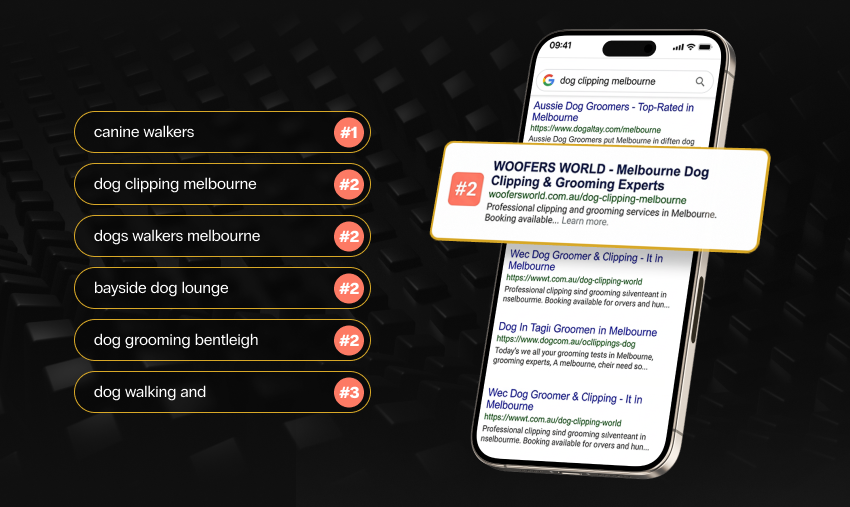
| dog walking and | Position 3 | 1,000 |
| canine walkers | Position 1 | 480 |
| bayside dog lounge | Position 2 | 170 |
| dog grooming bentleigh | Position 2 | 140 |
| how much is puppy daycare | Position 2 | 90 |
Year 4 (June 2025 to present): Consolidation and expanding the footprint
Year four shows the pattern typical of a mature SEO engagement: some seasonality, ongoing keyword growth, and continued expansion of the area page footprint. Google Search Console data confirms peak months of over 1,000 real organic clicks: October 2025 (998), November 2025 (1,008), and January 2026 (1,088). Keyword count reached its highest point in July 2026 at 1,320 ranking terms. The site now generates over 44,000 monthly impressions in organic search.
- 1,088 Peak monthly clicks Jan 2026 (Google Search Console)
- 44,000+ Monthly impressions Jul-Aug 2026 (GSC)
- 1,320 Peak ranking keywords Jul 2026 (SEMrush AU)
The metric that tells the real story
When CCM took on Woofers World in June 2022, the site’s organic traffic was almost entirely brand-dependent. The people finding it through Google already knew the name. That is not growth. That is visibility to people who would have found the business anyway.
Google Search Console now shows that more than half of all organic clicks come from searches with no brand term in them. In the three months to August 2026, non-branded clicks accounted for 448, 425, and 447 of each month’s organic total, an average of 53%. These are people who typed “dog grooming Bentleigh”, “dog daycare near me”, or “dog walkers Melbourne” and found Woofers World without knowing the business existed.
That shift is the difference between an SEO investment that reinforces existing awareness and one that builds a genuine new customer acquisition channel. It’s also the clearest way to measure the return on SEO.
- ~53% Non-branded click share Jun-Aug 2026 (GSC verified)
- ~37% Est. non-branded share at start, Jun 2022 (SEMrush)
- Brand-only to >50% non-branded Direction of organic traffic shift over 4 years
What four years of SEO actually looks like
The thing that is difficult to show in a bar chart is that the gains in year three and year four were only possible because of the work done in years one and two. The pages that ranked for “dog walkers” in 2024 were the pages built and optimised in 2022. The content that ranks for “dogs in daycare” was written and structured with that intent from the start.
Long-term SEO is not the same strategy on repeat. It adapts: a new location requires a new local SEO treatment; an algorithm update requires diagnosis and a tactical response; a business that expands its service offering needs its keyword strategy to expand with it. What stays consistent is the work itself: crawlability maintained, content updated, new pages optimised from launch.
About CCM’s approach
Woofers World is one of several long-term clients managed by CCM’s Sydney SEO agency services team. The approach is the same across each: a technical foundation first, a content strategy grounded in real keyword research, honest reporting tied to the metrics that matter, and enough continuity to let the strategy compound. See more results in our track record.