
AI Advertising in Australia: Where It Sits in Your Media Plan Right Now
TL;DR
ChatGPT ads launched in Australia in April 2026. The self-serve platform is open now with no minimum spend.
Google AI Overviews and AI Mode are the most accessible entry point. They work through your existing Google Ads campaigns.
Perplexity pulled ads in February 2026. You cannot buy them. Guides saying otherwise are out of date.
AI advertising is currently an upper-funnel awareness channel, not a direct response one. Attribution is limited.
Do not pull performance budget from Google Ads to fund AI advertising experiments. These channels add to your plan. They do not replace what is working.
For most Australian businesses, organic AI visibility is the higher-priority investment right now.
The AI advertising conversation in Australia has moved from speculation to market reality in the space of a few months. ChatGPT launched ads here in April 2026, making Australia one of the first international markets after the US. Google’s AI surfaces have been carrying advertising for over a year. And yet most Australian media plans still treat AI advertising as a future consideration rather than a current decision.
This is not a guide to what each AI platform is. This is about the planning question. Where does AI advertising sit in your media mix? What does it change? And what does a realistic allocation look like right now?
Which AI Advertising Surfaces are Actually Available in Australia
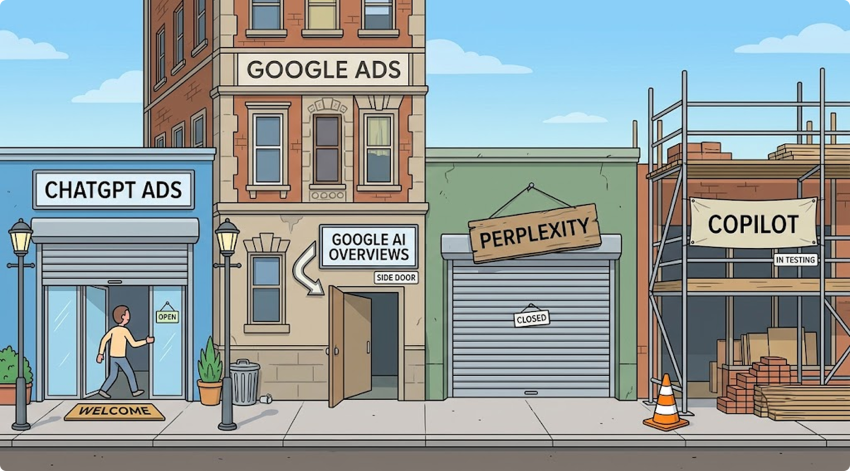
Before planning anything, you need to know what you can actually buy. The category is more varied than most coverage suggests, and conflating all AI advertising as a single thing leads to bad planning decisions.
ChatGPT (OpenAI). OpenAI’s self-serve platform has been open to any Australian business since May 2026, with no minimum spend. Ads appear in a clearly labelled Sponsored box beneath the AI’s organic response. Targeting works through context hints: short descriptions of the types of conversations where your brand is relevant, rather than keyword lists. Reach and awareness objectives are available now. Attribution is aggregated only: total impressions and clicks, no pixel-based tracking or demographic breakdown yet. We have covered the mechanics of the platform in detail in our guide to ChatGPT Ads for Australian businesses, and we run managed ChatGPT Ads campaigns for clients where the fit makes sense.
Google AI Overviews and AI Mode. For most Australian advertisers, these are the most accessible entry point. These surfaces extend your existing Google Ads campaigns into Google’s AI-generated summaries and its conversational AI Mode interface. You cannot bid specifically into them yet. Your campaigns qualify based on relevance signals. AI Mode has surpassed 1 billion users globally, and the average AI Mode query runs roughly three times longer than a traditional Google search. The organic side of the same surface is worth understanding too, because AI Overviews change how organic search performs whether or not you advertise.
Perplexity. Not currently an advertising option. Perplexity ran sponsored questions in late 2024, paused new advertisers in October 2025, and abandoned advertising entirely in February 2026, citing user trust concerns. Any guide describing how to buy Perplexity ads is describing a product that no longer exists.
Microsoft Copilot. Limited advertising integration is in testing in some markets, but not a meaningful paid channel for Australian advertisers at this stage.
Where in the Funnel AI Advertising Operates
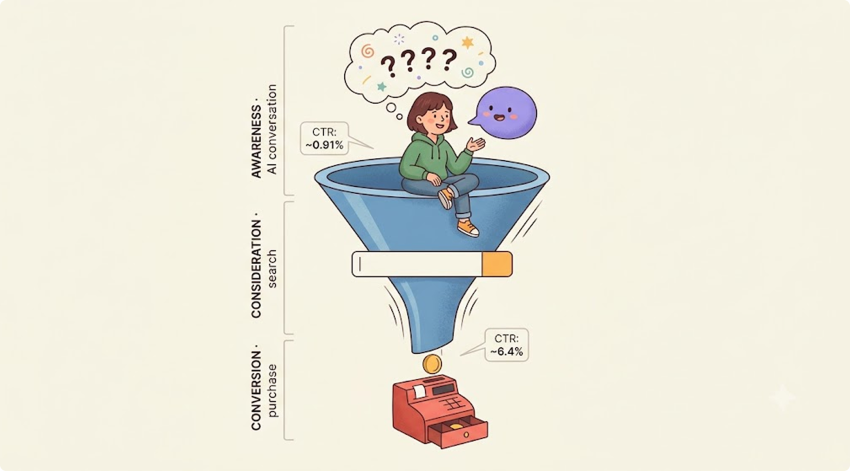
The honest answer is: upper. Understanding that clearly is the most important thing you can do before allocating any budget.
AI advertising in 2026 is a consideration and awareness channel, not a direct response one. A user asking ChatGPT which accounting software suits their business is in research mode. They are working through a decision, not ready to click through and convert. The intent signal carried in a full conversation is richer than any keyword string, but the platform is not built to capture that intent and turn it into an immediate action.
The numbers reflect this. Google Search ads deliver an average click-through rate of around 6.4% in Australia. ChatGPT’s current average sits at around 0.91%. That is not a flaw. It is a reflection of where in the decision process users are, and what kind of advertising fits that moment.
Measuring AI advertising against direct-response KPIs like cost per lead or attributed ROAS will produce disappointing numbers. Planning it as an awareness and consideration channel, with brand recall and share-of-voice metrics, puts it in the right frame.
Platform Comparison for Australian Advertisers
| Channel | Funnel stage | Avg CTR | Attribution | Status in AU |
| ChatGPT Ads | Awareness / consideration | ~0.91% | Aggregated impressions + clicks only | Live (May 2026) |
| Google AI Overviews / AI Mode | Consideration / decision | Varies (via Search) | Standard Google Ads reporting | Live (via Google Ads) |
| Google Search Ads | Decision / conversion | ~6.4% | Full conversion tracking + CRM | Live (20+ years) |
| Meta (Facebook / Instagram) | Awareness / consideration | 0.9–2% | Pixel-based (privacy-limited) | Live |
| Perplexity | N/A | N/A | N/A | No ads (pulled Feb 2026) |
What AI Advertising Changes in Your Existing Media Mix
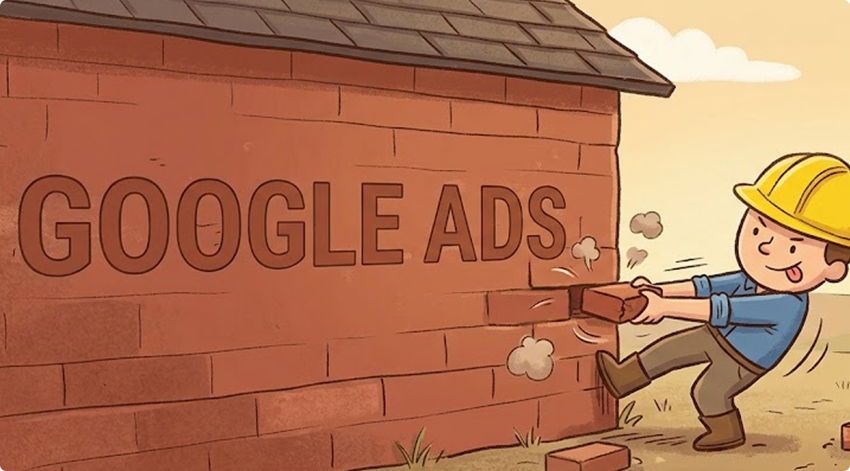
Less than the hype suggests. At least right now.
AI advertising adds a new surface to your plan. It does not replace what is already working. The channels that drive measurable, attributable outcomes today (Google Search, Meta, Google Shopping for eCommerce brands) retain their role. AI advertising extends reach into a surface where users are active earlier in their decision cycle, before they are ready to search.
The sensible structure is an incremental allocation. If you have an awareness or brand budget that sits separately from your performance spend, AI advertising is a logical fit. If your entire media plan is built around performance KPIs and direct attribution, this channel is not yet equipped to prove its contribution on those terms.
The risk to avoid: pulling performance budget from proven channels to fund AI advertising experiments. Google Search has two decades of tooling, full attribution, and known conversion behaviour in the Australian market. ChatGPT advertising has been live here for a few months. Moving budget from what you can prove to what you cannot yet measure is not a rational trade in 2026.
The Attribution Gap You Need to Plan Around
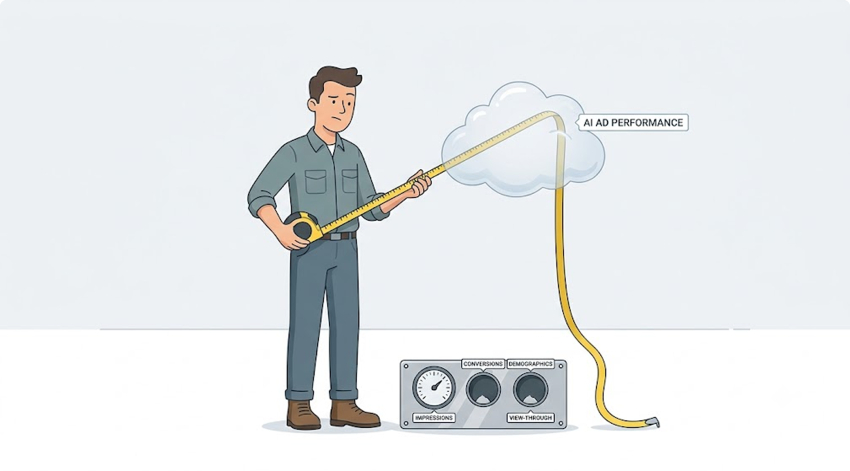
This is the most significant constraint Australian advertisers face with AI advertising right now, and it is largely absent from the enthusiasm around the category.
ChatGPT’s Ads Manager currently provides aggregated impressions and click data only. There is no pixel-based conversion tracking, no demographic breakdown, no view-through attribution, and no CRM integration yet. Google’s AI surfaces have similar limitations: campaigns can serve in AI Overviews and AI Mode, but there is no dedicated reporting to confirm what those impressions contributed to conversions.
Planning without attribution means planning with incomplete information. It also means being disciplined about which numbers you trust, because metrics that look healthy while revenue stays flat are a familiar problem in paid media long before AI entered the picture. That is manageable when your objective is brand awareness with share-of-voice KPIs. It becomes difficult to defend to a CFO or board when cost per acquisition is the primary success metric.
The practical approach: build a separate measurement framework for AI advertising. Use UTM parameters to track AI-referred traffic in GA4. Monitor branded search volume in Search Console as a secondary signal. Document your test parameters clearly. The tooling will improve. Google has confirmed deeper reporting for AI surfaces is on the roadmap, and OpenAI’s CRM integration points toward proper attribution in 2027. But planning as though that tooling exists today overstates what you can currently prove.
A Planning Framework for AI Advertising Budget in Australia
Not every Australian business is in the same position. Here is a plain-English guide.
Allocate test budget now if:
- You have an awareness or brand objective with budget that sits outside your core performance allocation
- You are in a B2C category where ChatGPT users actively research purchases: consumer goods, financial services, education, or professional services
- Your Google Ads account is already well-structured and you are looking for incremental reach higher in the funnel
- You can ring-fence a test budget (think $3,000 to $5,000 per month minimum) without pulling from proven performance channels
Wait 60 to 90 days if:
- Your primary objective is lead generation and you need attribution data to justify spend to stakeholders
- You are a local or regional business. ChatGPT Ads currently targets Australia at country level only. Suburb or postcode-level targeting is not yet available, significantly limiting value for businesses with a narrow geographic audience. If suburb-level reach is what you actually need, multi-location SEO will do more for you than a country-level ad buy
- Your Google Ads account has meaningful room to improve. That same budget, better structured in Search, will deliver more measurable outcomes than a pilot on a less mature platform. The patterns we found across 100+ Google Ads audits show up in most accounts, and if you are not sure whether yours is one of them, our wasted ad spend scorecard will tell you in about two minutes
The Bigger Picture: Where the Market is Heading
WPP Media forecasts Australia’s advertising market will grow 7.4% in 2026 to reach $21.6 billion, with AI-driven formats beginning to influence how performance budgets are allocated. Globally, WPP projects generative search advertising will reach US$32 billion by 2028 and cross US$100 billion by 2030.
These projections do not mean AI advertising should dominate your plan today. They mean the infrastructure is being built, the behaviour is shifting, and the advertisers who understand how these surfaces work now will have a structural advantage when the tooling matures.
The Organic Play that Runs in Parallel
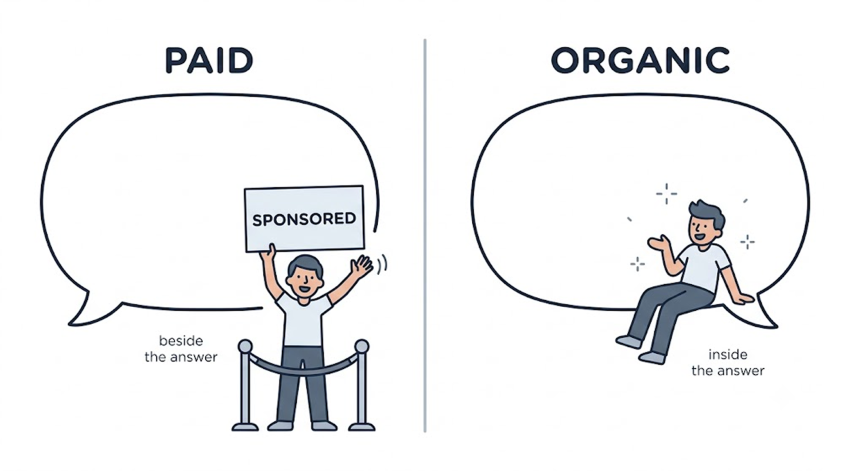
Most coverage of AI advertising conflates two completely different things.
A paid ChatGPT ad appears in a labelled Sponsored box beneath the AI’s response. An organically cited brand appears inside the AI’s actual answer as the recommended solution, with no label and no ad spend. From a user’s perspective, these look and feel completely different. Being the brand a user reads about in a paid placement is not the same as being the brand an AI recommends.
OpenAI has confirmed that paid advertising does not influence ChatGPT’s organic recommendations. These are separate systems. Getting your business into AI answers organically is a function of content quality, entity authority and E-E-A-T signals, structured data, and third-party citation signals. It is not something you can buy through the Ads Manager. We have documented the practical steps in our guide to ranking on ChatGPT.
| Paid: ChatGPT Ads | Organic: AI SEO / GEO |
| Appears below the AI’s answer in a “Sponsored” box | Appears inside the AI’s response as the recommended answer |
| Clearly labelled as advertising | No label. The AI is recommending you. |
| Requires ad spend (CPM or CPC bidding) | Driven by content structure, schema, and entity authority |
| Does not influence the AI’s organic recommendation | Compounds over time and strengthens with each citation |
For most Australian businesses in 2026, building organic AI visibility through a strong AI SEO and generative engine optimisation strategy is the higher-priority activity. It builds visibility across every AI platform simultaneously: ChatGPT, Gemini, Perplexity, and others. It compounds over time and strengthens the broader digital authority that benefits traditional organic search as well.
If your business is not yet appearing in AI-generated answers organically, that is the gap to close first – regardless of where you land on paid AI advertising.
FAQs
Does AI advertising replace Google Ads in an Australian media plan?
No. AI advertising is an additive channel, not a replacement. Google Search operates with two decades of tooling, full attribution, and known conversion behaviour. ChatGPT advertising has been live in Australia for a few months, with limited attribution data available. Both serve different parts of the funnel. Keep your Google Ads campaigns well-managed and treat AI advertising as an incremental awareness layer.
Which AI advertising platforms are available to Australian businesses right now?
ChatGPT (OpenAI) is the main new paid option, with the self-serve Ads Manager open to any Australian business. Google AI Overviews and AI Mode integrate with your existing Google Ads campaigns. Perplexity abandoned advertising in February 2026 and is subscription-only. Microsoft Copilot is in testing but not a meaningful channel for Australian advertisers yet.
How is ChatGPT advertising different from Google Ads?
Google Ads targets users based on keywords and audience segments. ChatGPT advertising targets based on the semantic content of a live conversation, through context hints. There is no keyword bidding, no demographic targeting yet, and no cookie-based tracking. The intent signal from a full conversation is richer than a keyword, but current targeting controls are narrower.
What budget should I set aside for AI advertising in Australia?
A meaningful starting point is $3,000 to $5,000 per month in an awareness-stage allocation, separate from your performance budget. This lets you build channel familiarity without disrupting channels already delivering results. If your current Google Ads account has room to improve, direct that budget there first.
Why did Perplexity stop running ads?
Perplexity launched sponsored questions in late 2024, paused new advertisers in October 2025, and fully abandoned advertising in February 2026. Leadership concluded that ads near AI-generated answers undermined user trust in the objectivity of the responses. Perplexity is now subscription-only. Brands can only appear organically through content quality and authority.
How should I measure AI advertising if attribution is limited?
Set awareness-stage KPIs rather than direct-response ones. Track AI-referred traffic through UTM parameters in GA4. Monitor branded search volume as a secondary indicator of awareness impact. Do not evaluate ChatGPT advertising against cost per acquisition or ROAS targets. The measurement infrastructure does not yet support that level of reporting.
Does appearing in a ChatGPT ad improve my chances of being recommended organically?
No. Paid advertising and organic AI recommendations are completely separate systems. An ad appears in a labelled Sponsored box below the answer. Organic citations appear inside the answer itself, driven by content quality, entity signals, and third-party authority. Both are worth pursuing, but through entirely different strategies.
When will local and suburb-level targeting be available for ChatGPT ads in Australia?
OpenAI has not confirmed a timeline. As of mid-2026, ChatGPT Ads targets Australia at country level only. This is a significant constraint for local service businesses with a narrow geographic audience. In the meantime, Google Ads and local SEO remain the more effective tools for suburb-specific reach.
What to Do With This Now
Keep your existing channels running. Google Ads managed by a Google Premier Partner, strong local SEO, and well-structured Meta campaigns all continue to deliver measurable outcomes in 2026. AI advertising sits on top of that foundation, not instead of it.
If you are in a position to test AI advertising, go in with clear awareness-stage KPIs, a ring-fenced budget, and a realistic measurement framework. Do not expect to prove direct ROAS. Expect to build familiarity with a channel that is maturing fast and will be significantly more powerful in 12 to 24 months.
And regardless of where you land on paid AI advertising, make sure the organic AI visibility work is happening. The brands appearing in AI answers without buying their way in are building a compounding asset. That work matters most over the next few years.
Click Click Media (CCM) is a Google Premier Partner and has managed Australian digital campaigns since 2008. If you want an honest read on where AI advertising fits in your current plan, book a free audit with our team. We will tell you what the data supports, and what it does not.