Zebra Home: A Shopify Build That Held Its Speed After Launch
A Shopify store is easiest to make fast on launch day. The harder test comes six months later, after the product range has grown, the marketing team has added tags and someone has found a clever app. Zebra Home’s store was built to pass that test.
This is how our Shopify development in Sydney team built a custom store for a trade rug supplier moving to direct-to-consumer, and what it took to keep the store fast once it was live. The results below cover the whole engagement, and we are specific about which parts belong to the build and which do not.
TL;DR
- A custom Shopify store for a trade rug supplier moving to direct-to-consumer, with separate trade and retail pricing tiers.
- A mobile performance budget of under 2.5 seconds Largest Contentful Paint, set on day one and kept in place after launch.
- 196.33% overall revenue growth since engaging CCM, from the combined work of ads, SEO, social and the website.
- Purchases up 87% in the first 12 months, and ranking keywords up from 200 to more than 1,100 in six months.
The Client
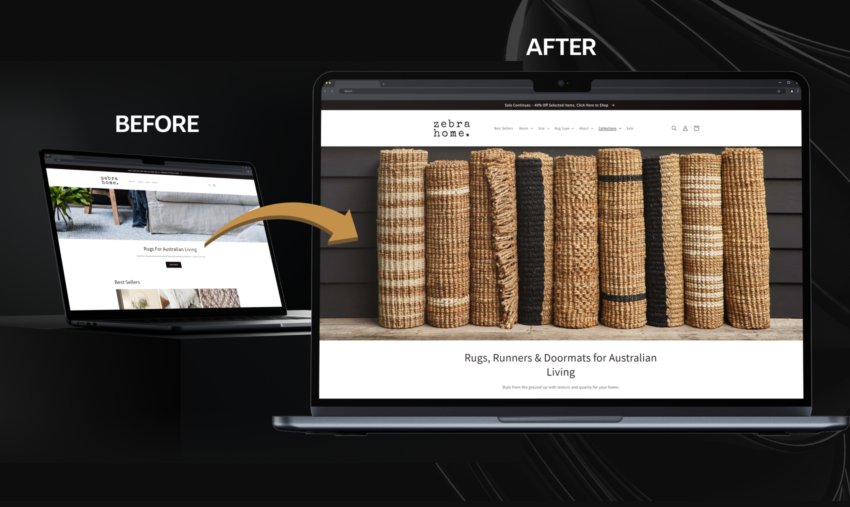
Zebra Home is an Australian supplier of jute and wool rugs. For years the business sold to retailers, interior designers and trade buyers, and its reputation for quality was well established. Its rugs were stocked in stores and featured in styled spaces around the country. What it did not have was an ecommerce store built for everyday shoppers.
Direct-to-consumer buyers behave differently to trade buyers. They compare, they browse on their phones and they leave if a page is slow. The wholesale site’s language and layout did not suit them, and the business needed a retail experience that could carry both channels without compromising either.
The relationship with CCM began with Google Ads, which put Zebra Home’s rugs in front of people already searching for them and lifted purchases 87% over the first 12 months. That result led to a full digital marketing partnership, now several years old, and the store build sits inside that wider work.
The Challenge
The brief was an online store that could sell rugs to consumers. Rugs are a considered purchase, so the build had to carry large product photography, clear sizing and enough detail to give a shopper confidence, without making pages heavy.
That tension was the core design problem. Rich imagery sells homewares, and rich imagery is also the fastest way to slow a store down. Our approach was to set a performance budget on day one and treat it as a constraint on every later decision.
Two other constraints sat alongside speed. The existing site had low organic visibility and an outdated user experience, so the new store had to be found by people who had never heard of Zebra Home. Trade customers had bought for years, so a retail launch could not cannibalise those relationships.
What We Built
The store runs on a custom Shopify theme built around the purchase decision, with five features doing most of the work:
- Large-format photography that shows rugs in real rooms, loaded so it does not hold up the rest of the page.
- Clear dimensions on every product page, so shoppers can judge size before they buy.
- A quick-view that does not break the cart.
- A checkout trimmed to the minimum fields Shopify allows.
- A mobile performance budget of under 2.5 seconds LCP, which is Google’s threshold for a good Largest Contentful Paint, one of the Core Web Vitals.
Product Pages that Build Bonfidence
A rug is a purchase people want to picture before they make it. The photography shows each rug in a real room, so a shopper can judge texture and scale against furniture, and the dimensions sit on the same page so size never has to be guessed.
The quick-view lets shoppers compare options without leaving the collection page, and it was built so it does not interfere with the cart. The checkout asks only for the minimum fields Shopify allows, which removes the last points where a shopper who has already decided can still be lost.
Filters and a Catalogue Built for Search
A shopper who does not know a product name still knows the size, style and material they want. The shop filters were rebuilt so customers can browse by exactly those three: size, style and material, and the published Zebra Home case study reports more customers staying longer, exploring collections and making purchases once they were in place.
The catalogue itself was organised around how consumers search, with category pages and product schema supporting the ecommerce SEO work. This mattered because the old site had low organic visibility, and a store that nobody can find gains little from being fast.
Serving Trade and Retail from One Store
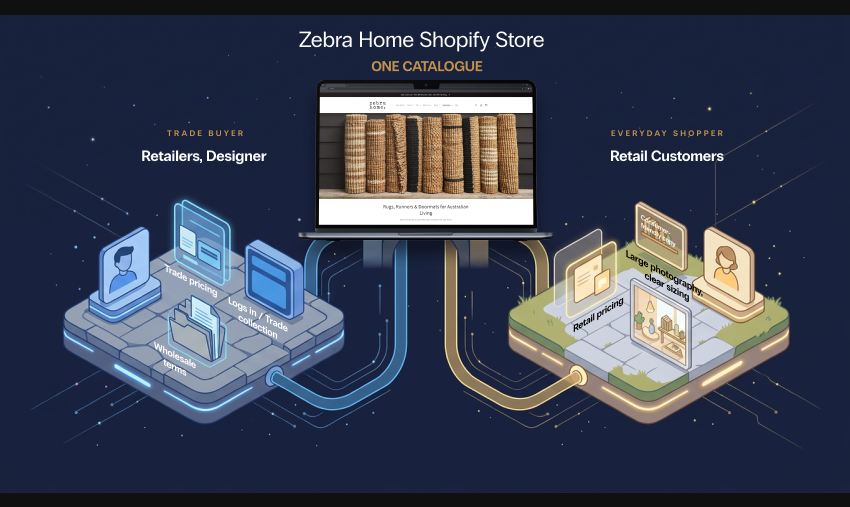
The brief carried a second requirement underneath the first. Zebra Home’s trade customers had bought from the business for years, and a retail store that undercut or confused those relationships would have cost more than it earned. The store was built with separate trade and retail pricing tiers, so each audience sees the pricing that applies to it.
Trade buyers apply to become stockists through a dedicated wholesale enquiry form. Once approved, their customer account unlocks trade pricing through a B2B pricing layer on the same Shopify store, so there is one catalogue, one stock count and one checkout to maintain. Retail shoppers browsing without a trade login only ever see retail prices.
Consumers get a store written for them, with clear sizing and large photography, and trade buyers keep the pricing they already work to. Keeping the channels separate also protects the retail message, since consumer pages carry no wholesale language.
Launch
We followed the launch approach we use on every build, which is a quiet weekday with no campaign attached. The store could prove itself on ordinary traffic before anything was spent driving customers to it, so any problem showed up while it was still cheap to fix.
Launching quietly also gave the team a clean baseline, so every later change to the store could be judged against a measured number rather than against memory. Launch-day mobile LCP was measured in Google PageSpeed Insights at [X.X] seconds, and that figure became the number every later change was checked against. Our website go-live guide sets out the checks we run before and after a store goes live.
Keeping it Fast
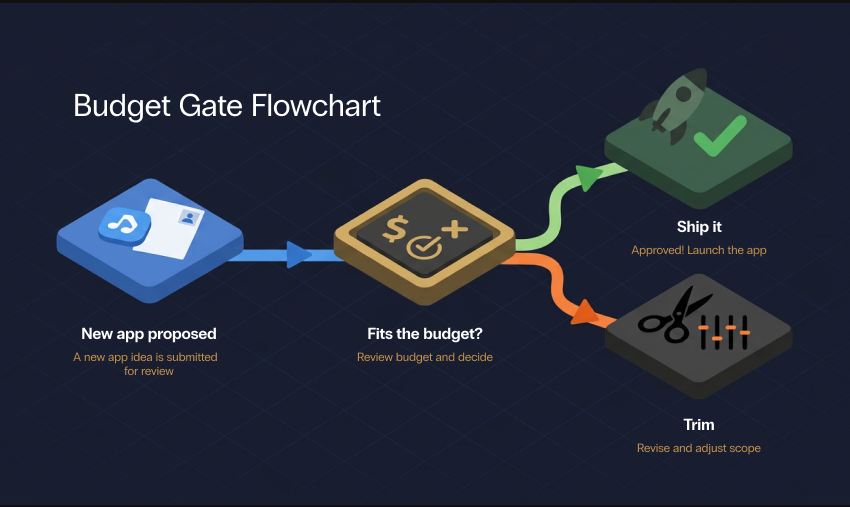
Most stores do not stay fast, which is why Shopify speed optimisation has to continue after launch. Apps get added, tags accumulate and nobody is responsible for the cost. Zebra Home’s store was managed differently, because the budget stayed in place after launch and every new app, tag or section had to fit inside it.
A Budget Every New App Has to Fit Inside
A performance budget works because it turns a vague wish for a fast site into a limit someone can check. When a new app or script is proposed, the question is whether it fits inside the budget, and if it does not, something else has to give.
On Zebra Home, the budget capped mobile LCP at 2.5 seconds and kept the app list short. Today the storefront runs three apps on the front end: product reviews, back-in-stock alerts and the B2B pricing layer that serves trade customers. Each one earns its place by doing a job a shopper or trade buyer can see.
The store has been iterated rather than rebuilt, because the foundations were right. It is cheap to keep a store fast and expensive to make a slow one fast again, which is the practical case for setting the budget before the first template is built.
Who Owns the Number
Page speed slips when nobody is responsible for it. Each addition looks harmless on its own, and the total only becomes visible when conversion rate or ad costs start to suffer. Our free Shopify audit shows what is slowing a store down and what it is costing in conversions.
Naming an owner for the number, and checking it whenever something changes, is what stops the drift. On Zebra Home, CCM’s web team owns the number. Key templates are tested in PageSpeed Insights every month, and Core Web Vitals field data is reviewed in Google Search Console, so a slip shows up before it reaches ad costs.
The Work Around the Store
The Shopify build was one part of a wider engagement, and the results come from all of it working together. Google Ads came first, with campaigns refined and restructured so rugs appeared in front of people already searching for them. More shoppers then found the brand without paid ads, which prompted the move to a full partnership.
SEO gave the store a lasting presence in search. Ranking keywords grew from 200 to more than 1,100 in six months, and organic traffic rose 36.47%. Social advertising added targeted campaigns for first-time customers, showing the rugs in real homes, and lifted customer engagement by 68.04%.
A fast store only pays off when the right traffic is arriving at it. The ads, SEO and social work brought shoppers in, and the build let them browse quickly, judge size with confidence and check out in few steps. The two halves of the work depend on each other.
Results
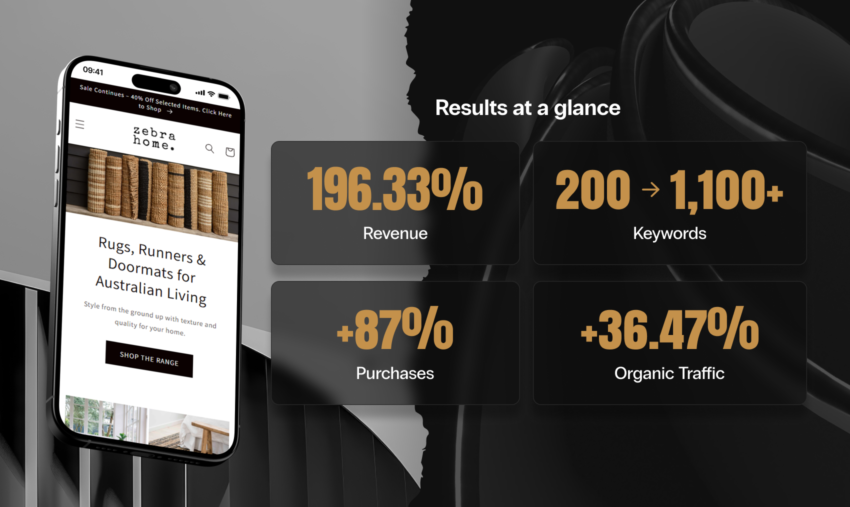
Speed was the supporting story. The commercial result is the one that matters. The figures below come from the published Zebra Home case study and cover the whole engagement, including Google Ads, SEO, social advertising and the website, so they should not be read as the effect of the Shopify build alone.
| Measure | Result | Timeframe |
|---|---|---|
| Overall revenue growth | 196.33% | Since engaging CCM |
| Purchases | +87% | First 12 months |
| Ranking keywords | 200 to 1,100+ | 6 months |
| Organic traffic | +36.47% | After SEO implementation |
| Customer engagement | +68.04% | Social advertising campaigns |
The two headline figures cover different periods and different measures. Revenue growth is measured across the whole time Zebra Home has worked with CCM, while the 87% rise is in purchases during the first 12 months, so the two should not be added together or compared directly.
What this Means for Your Store
A fast launch is not proof of a fast store. Ask what the speed was on launch day, what it is now and who has been watching it in between. If nobody can answer, the store is probably slower than it should be, and the cost is showing up in your ad spend and conversion rate.
For a store like Zebra Home’s, where one catalogue has to speak to trade buyers and everyday shoppers, the same discipline applies to structure as well as speed. Decide early how each audience will be served, set the limits the store has to live within, and name the person who will check them once the launch campaign is over.
If you are planning a Shopify build, or you suspect an existing store has drifted, our Shopify development services include a performance budget, a launch baseline and a plan for keeping the store fast afterwards. For a comparable story about a store that had gone the other way, see the Fitness Hero case study, or browse more CCM case studies.
Is Your Shopify Store as Fast as it was at Launch?
CCM’s Shopify development team in Sydney builds stores around a performance budget and keeps them inside it after launch. CCM is a Shopify Partner and Google Premier Partner, in business since 2008. If you want to know whether your store is as fast as it was on day one, book a speed audit and we will give you a baseline.