
SEO and Google Ads for Logistics Companies in Australia
Written by Andrei Jach, Senior Manager, SEO and Analytics Specialist at Click Click Media · Updated 1 October 2026
Good SEO for logistics puts your lanes and freight types in front of the people who buy freight, and the market is large. Australia’s freight and logistics market was worth US$99 billion in 2025, and road freight alone takes in 64,693 businesses. Manufacturing is the biggest customer, at about a quarter of market revenue. Courier, express and parcel work is the fastest-growing part, at close to 5% a year.
Freight is usually bought in stages, starting when a logistics manager searches a lane or a freight type and asks a few carriers for quotes. They then shortlist on transit times, accreditations and coverage, and sign a rate card or a transport agreement. Your website and your Google Ads account need to serve each stage. They also need to keep existing customers who search for tracking out of your new-business figures.
This guide follows that journey from the first lane search to the tracking that links a signed agreement back to its first click.
Implement this playbook with AI
Opens your assistant with this playbook and seven questions about your business: services, area, website and ads. It then writes your keyword map, page plan and Google Ads starter build with your details filled in.
Copy the prompt for Gemini, Grok or any assistant that cannot open a prefilled link. The prompt points at this page, which is also served as Markdown to assistants that ask for it.
CCM Research: What Freight Advertisers Are Doing
CCM analysed 12 months of Semrush ad history for four Australian freight searches, and none of the 94 ad records from 26 advertisers mentioned a licence, an accreditation, a review or a star rating.
- Your heavy vehicle accreditation, dangerous goods licence or depot reviews can set your ads apart, because no advertiser in this sample used them.
- Name only the accreditations you hold, and send the click to a page that shows them.
Source: CCM analysis of Semrush ad history, Australia, September 2025 to August 2026
On the search freight quote, all 6 advertisers in CCM’s analysis of Semrush ad history from September 2025 to August 2026 were quote marketplaces or shipping software, and no line-haul carrier advertised in any month.
A carrier bidding on this search competes with comparison sites for the click, so the ad should name a lane, a cut-off or a direct rate that a marketplace cannot match.
Ads appeared in 7 of the 12 monthly snapshots (22 ad records), so the search is not contested every month.
Source: CCM analysis of Semrush ad history, Australia, September 2025 to August 2026
Of the 16 advertisers CCM found in Semrush ad history for 3pl in Australia, only one was present in both the first snapshot (15 September 2025) and the last (15 August 2026).
Most 3PL advertisers came and went within the year, so the rivals you see in one month are a poor guide to the next. Before you change bids, check the auction insights report in your own Google Ads account, which lists the advertisers you met that month.
Source: CCM analysis of Semrush ad history, Australia, September 2025 to August 2026
Method: CCM analysed Semrush’s Australian ad history for four searches (3pl, freight quote, interstate freight and customs broker) using 12 monthly snapshots taken on the 15th from September 2025 to August 2026. Semrush keeps one row per advertiser per month, which we call an ad record, and the 94 records held 65 distinct ads (a unique headline and description) from 26 advertiser domains. The 3pl pull reached Semrush’s 60-row limit, so its counts are a minimum, and the data does not separate desktop from mobile.
SEO for Logistics: The Freight Buyer’s Path
Most freight contracts are chosen by logistics managers, buyers or operations teams at manufacturers, retailers and distributors. These are business-to-business purchases with contracts attached, so their searches tend to be specific and they often compare several carriers. This guide follows the three stages they move through:
- RFQ, or request for quote (four sections, starting with RFQ: Freight Searches That Become Quote Requests): the buyer searches a lane, freight type or service. They ask for quotes from the carriers whose pages match.
- Shortlist (three sections, starting with Shortlist: Trust Signals Freight Buyers Check): they compare accreditations, fleet, coverage and transit times. They also check depot profiles and reviews.
- Contract (three sections, starting with Contract: Google Ads for Carriers): paid search covers the searches your pages do not yet rank for, and tracking shows which searches end in a signed rate card.
Existing customers often visit a carrier’s website to check tracking, contact support or log in. That traffic matters to operations but wins no new accounts. In your analytics, a new prospect searching “freight company Australia” looks just like a customer searching “freight company Australia tracking”. Separate branded and tracking traffic from new-business traffic before you judge any campaign. Then add your brand name, tracking URL and login URL as negative keywords in each new-business campaign. Negative keywords are terms that stop your ad showing.
We have not published a freight carrier case study. The nearest is BAC Removals, a moving company. We rebuilt its tracking in Google Analytics 4 (GA4) and Google Tag Manager. That fed cleaner data into its paid campaigns: “Monthly leads surged from 50 to 320+, while conversion rates improved 50% year-on-year.” That quote comes from the BAC Removals write-up on GA4 and GTM consulting. Splitting tracking traffic from new enquiries, as above, is the same kind of clean-up.
RFQ: Freight Searches That Become Quote Requests
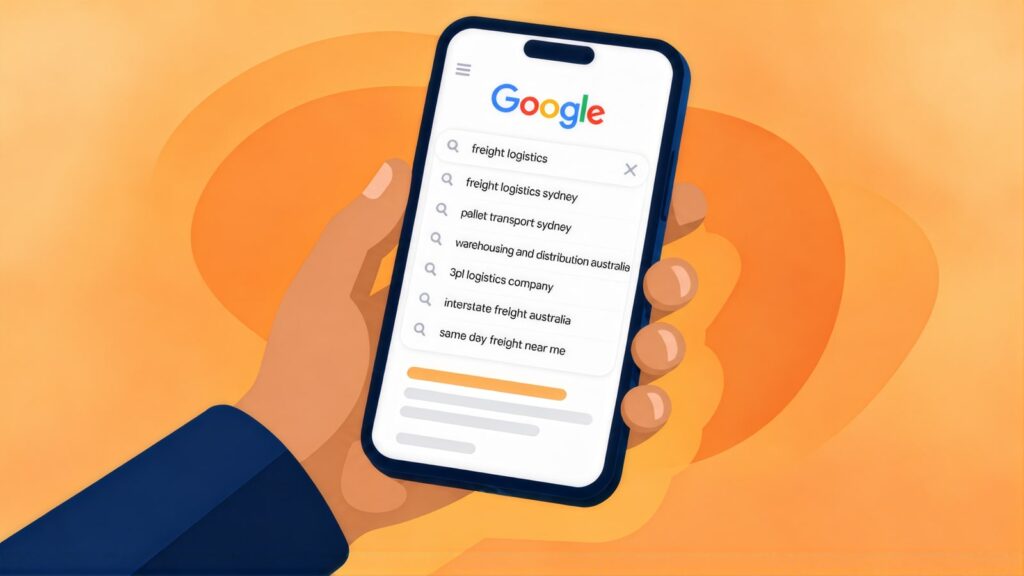
The searches that turn into freight accounts name a lane, a freight type, an industry or a service such as 3PL (third-party logistics). In CCM’s analysis of Google Keyword Planner data (Australia, 12 months to August 2026), 3pl averages about 2,900 searches a month. In the same data, freight companies averages 1,000 and interstate freight 260. Freight forwarding shows 2,400, a figure it shares with freight forwarder because Google groups close variants. A later CCM pull from Keyword Planner, on 1 October 2026, put logistics company at 1,600. Group the terms like this, and build a page for each group.
Lane-Specific
freight Sydney to Melbourne
same day freight [city]
interstate freight company
overnight freight Australia
Freight Type
refrigerated transport [state]
dangerous goods transport
heavy haulage [city]
oversized freight Australia
Industry Vertical
pharmaceutical cold chain
food logistics company
construction materials transport
retail distribution [state]
Last Mile
courier [city]
parcel delivery [suburb]
same day courier
delivery service near me
Warehousing and 3PL
warehousing and distribution [city]
3PL provider Australia
pick and pack services
fulfilment centre [state]
Procurement Research
freight quote Australia
compare freight companies
[competitor] alternative
freight cost calculator
In this market, specific claims tend to work better than vague ones because buyers can check them. A promise of Door-to-door Sydney to Melbourne in 24 hours for pallets under 500kg is a good example. Build service pages around the levels your operation really delivers. Then target the long-tail lane searches, the longer, narrower searches where those details matter most.
RFQ: Lane, Freight Type and 3PL Pages to Build
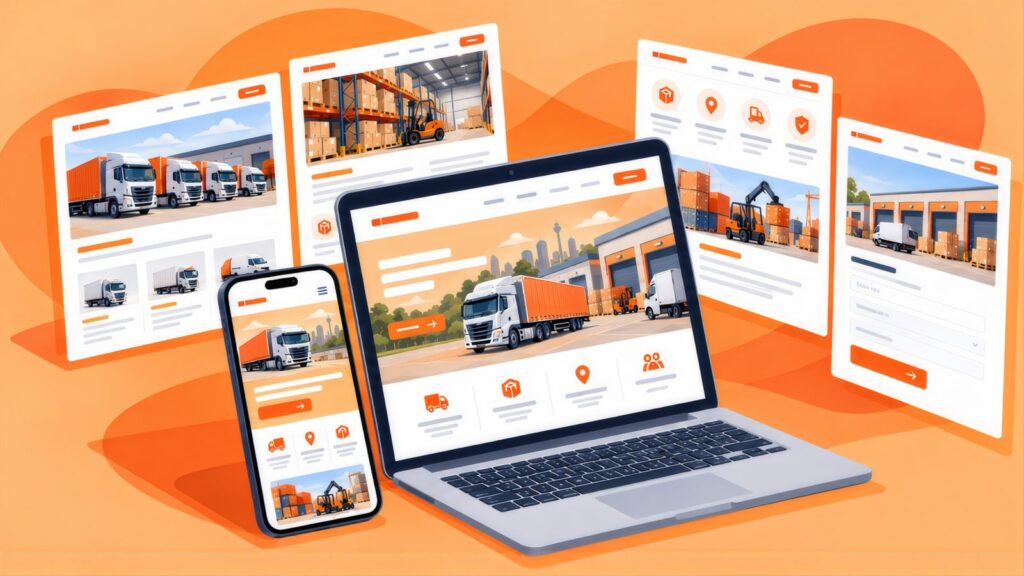
A logistics site needs one page for each lane, freight type and industry you want to win. Add a short quote page too. One services page cannot rank for refrigerated transport Victoria and Sydney to Brisbane freight at the same time.
| Page | Focus keyword | What to include |
|---|---|---|
| Main freight page | freight company [city/state] or logistics company Australia | Services, coverage, freight types, fleet size, depots, a quote form and an FAQ |
| Service lane pages | freight [city] to [city] | Transit times, how often you run, cut-off times, pick-up and delivery areas, and a quote form |
| Freight type pages | refrigerated transport or dangerous goods transport | What you can carry, your certificates, how you handle the goods and the rules you follow |
| Industry pages | [industry] logistics or [industry] freight | What that industry ships, what you can do for it, your certificates, and references where clients allow |
| 3PL / warehousing | 3PL provider [city] or pick and pack | Warehouse size and specs, your warehouse system, goods in and out, extra services and spare space |
| Comparison page | [competitor] alternative or [your brand] vs [competitor] | A fair, factual comparison of lanes, transit times and service terms. Only make claims you can prove. |
| Get a freight quote | get a freight quote | Freight type, lanes, weight or volume, how often, and contact details |
Titles and meta descriptions
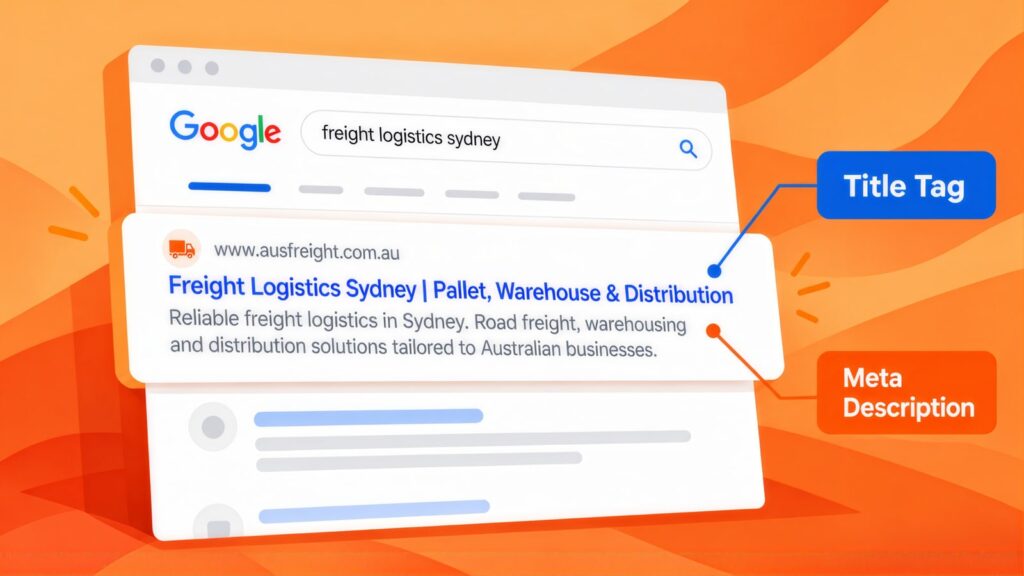
The title tag is the clickable headline in Google’s results. Put the lane or freight type first, and aim for 40 to 50 characters:
- Sydney to Melbourne Freight | Overnight Pallets (47 characters)
- Refrigerated Transport [State] | Cold Chain (43 characters)
Only tack your brand on the end if the whole title still fits in 55 characters. Google often shows your site name beside the result anyway, which makes the brand the easiest part to drop.
Below the title sits the meta description, a brief summary of the page. It should carry what a buyer checks first. For example: “Sydney to Melbourne freight, overnight for standard pallets with a [time] cut-off. Door-to-door or depot drop-off. Request a freight quote today.” (145 characters)
Claims about a named competitor must be accurate and current. The ACCC’s rules on false or misleading claims apply to comparison pages too.
RFQ: The Quote Form and the Tracking Split
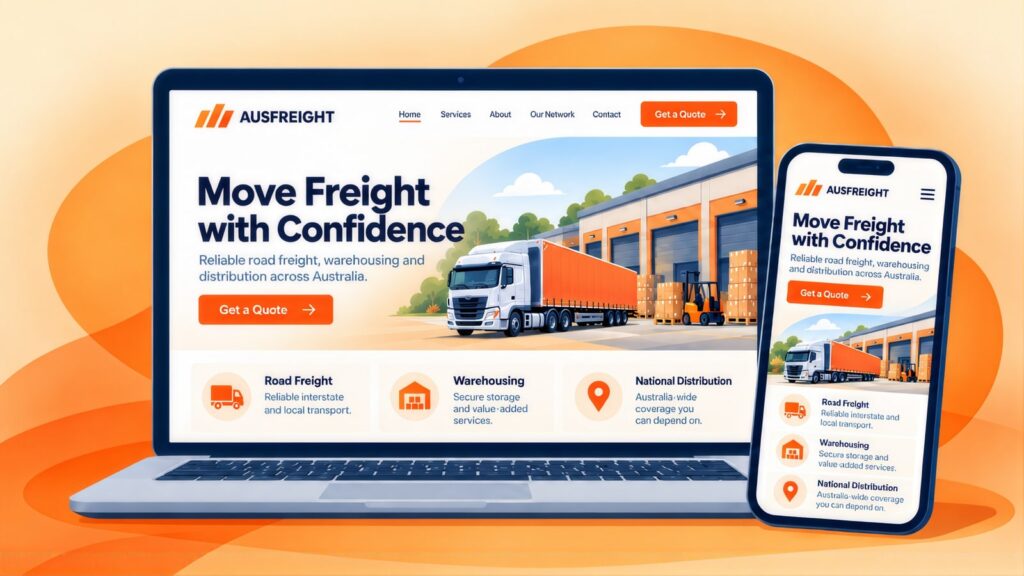
The result that counts is a quote request or a new account application. Ask for what your team needs to price the job: freight type, origin and destination, how often and how much, and contact details. With fewer fields your team cannot price the job, and each extra field gives a prospect another reason to abandon the form.
Put your tracking portal and customer login behind a clearly labelled link in the header. Existing customers then skip your sales pages, and your conversion tracking counts only real new enquiries. Plan that split when you map out your site’s structure. This guide to information architecture for marketing shows how.
Connect Google Search Console, the free tool that shows how Google sees your site. Submit your sitemap and check that your lane and freight type pages are indexed. If your site creates large sets of automatic route or postcode pages, keep only those with real, useful content in Google’s index.
RFQ: Freight Content, Trade Press and AI Answers
The content that brings in freight buyers answers the questions they ask before they request a quote. Most of those questions fall under four topics:
- Freight guides: how to work out costs for palletised goods, what makes a good 3PL partner, and using a broker or a direct carrier.
- Rules: dangerous goods requirements, heavy vehicle fatigue management obligations and cold chain paperwork for food freight.
- How-to guides: packing freight to avoid damage claims, volumetric weight, and full container loads (FCL) versus shared loads (LCL).
- Industry news: how online shopping is changing last-mile delivery, and what a new rail or port project means for your lanes.
Trade press and links
Freight and supply chain titles such as Big Rigs, ATN (Australasian Transport News) and Prime Mover report new depots, fleet spending, contracts and safety milestones. Send them a short, factual story when you open a depot or add capacity on a lane. Offer a guide with data they can quote. Mentions like these are how a carrier earns industry backlinks, which are links from other sites to yours. They also give AI answers a second source that backs up your site.
AI Overviews and assistants
Google says pages need no special work to appear in AI Overviews. They only need to be indexed and able to show with a snippet, according to its AI features guidance. In practice, three habits help a carrier get quoted:
- Keep depot names, addresses and phone numbers identical on your site, your Business Profiles and every directory.
- State each lane fact in one plain sentence, such as “Pallets booked by 4pm in Sydney arrive in Melbourne by 11am next day.”
- Once a month, search your main lanes and note which pages the AI answers cite, yours or a rival’s.
Shortlist: Trust Signals Freight Buyers Check
Handing freight to a carrier is a big financial decision, so buying teams shortlist on hard evidence of how you operate.
| Trust signal | Why it matters | How to use it |
|---|---|---|
| Licences and accreditations | Buyers check heavy vehicle accreditation, dangerous goods licences under the Australian Dangerous Goods Code and cold chain accreditation for the freight they cover. | List them on service pages and the About page. For cold chain, hazardous or oversized freight, put credentials at the centre of the page. |
| Fleet and infrastructure | A business choosing a 3PL wants to see your real fleet and sites. | Show fleet size and type, depot locations, warehouse area, temperature control and load ranges. |
| Coverage and network | The first question is whether you cover their lanes. | Name the states, regions or city-to-city lanes you cover on each relevant page. |
| Service levels | Written service levels carry weight with buyers. | Give typical transit times per lane, your on-time rate (if it is strong and you can prove it) and your claims process. |
Consignment details, client names, freight values and shipment records are confidential. Record each conversion, such as an account opened or a quote sent, by type and date only. Never send client business names or freight details to Google Ads or analytics tools.
Shortlist: Depot Profiles, Directories and Schema
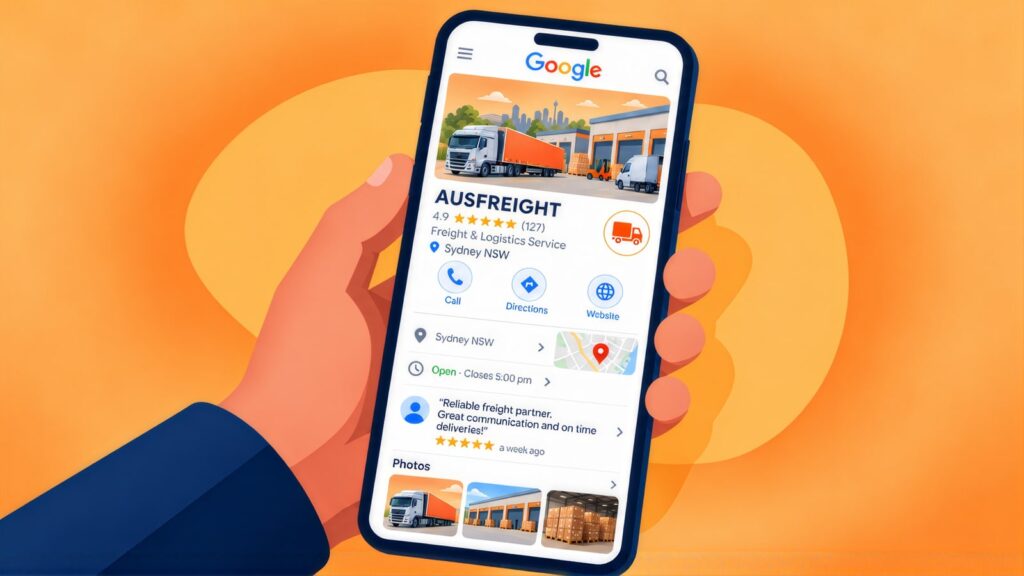
A buyer checking a shortlisted carrier will look at its Google Business Profile, which is why you should verify a profile at each depot. Choose the most specific category that is accurate, such as Freight transportation service or Courier service. List every region the network covers as a service area, and add your freight types under services. If depot hours differ from customer service hours, show them separately.
Reviews help a depot profile stand out on the shortlist. Ask regular shippers for a review after a smooth first month, and send a direct link to make it quick. Reply to each one, good or bad, using Google’s guide to managing customer reviews. A short, factual reply to a complaint shows buyers how you handle problems.
Away from the profile, local SEO means keeping your name, address and phone the same everywhere. That covers freight and transport directories, the member lists of your associations and the supplier lists your customers’ buyers use.
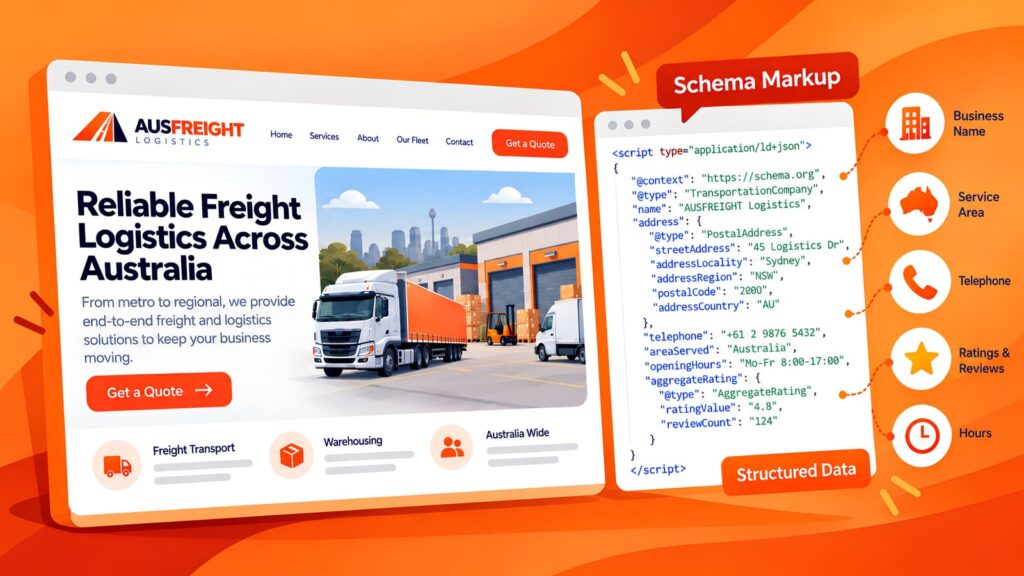
Schema markup is code that tells search engines what your freight business is and where each depot sits. Use Organization for the business as a whole and LocalBusiness markup for each depot, because schema.org has no freight forwarder type. Pages below the homepage should also carry BreadcrumbList markup. Google stopped showing FAQ rich results on 7 May 2026, after limiting them to government and health sites from August 2023 (Search Central updates log). As a result, FAQPage markup on a lane page will not produce a dropdown. The markup still tells search engines and AI tools which text answers a transit time or coverage question.
Shortlist: Linking Lane Pages to Your Quote Form
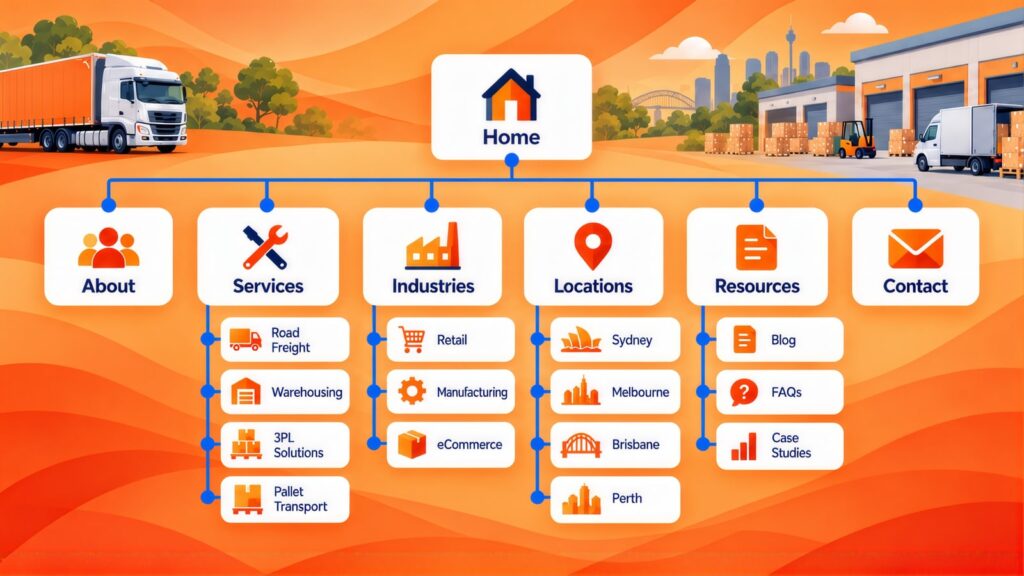
Your main freight page should link to each lane and freight type page, and those pages should link on to the related industry and 3PL pages. Every page should also link to the quote page with descriptive words instead of a bare “contact us”.
| Destination page | Link text examples |
|---|---|
| Quote form | “request a freight quote”, “quote regular pallets”, “open a freight account” |
| Service lane page | “Sydney to Melbourne overnight”, “Brisbane to Sydney next-day”, “our east coast lanes” |
| Refrigerated page | “our cold chain capability”, “temperature-controlled transport” |
Contract: Google Ads for Carriers
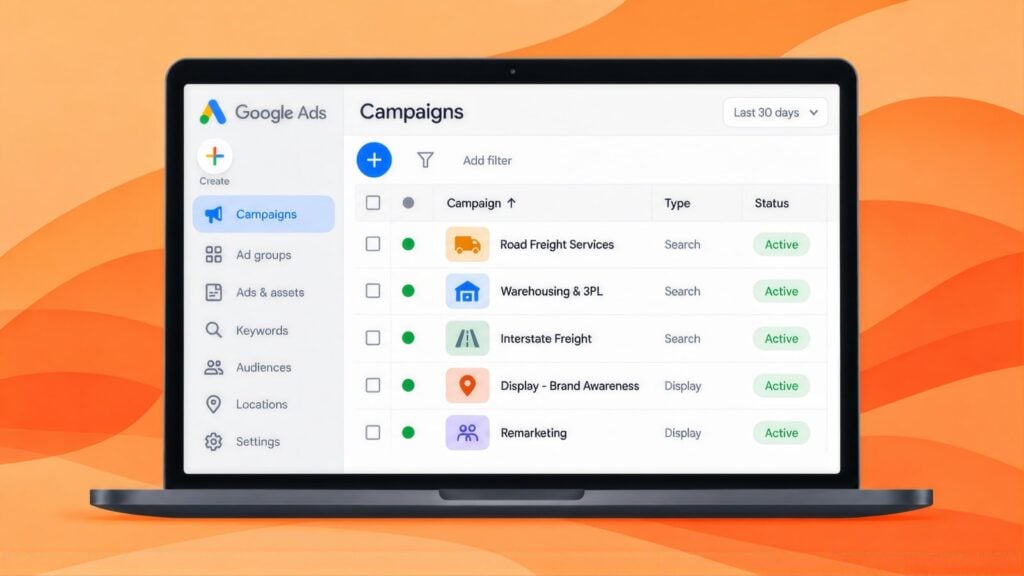
Start with one Search campaign aimed at the origin end of a busy lane and set it to run in business hours. Exclude brand and tracking terms before it launches.
| Setting | What a carrier should do |
|---|---|
| Campaign | Start with a Search campaign, because it shows every search that triggered an ad and lets you split new-business searches from tracking. An account structure self-audit checks the build before launch. |
| Match types | Use phrase and exact match for lane and freight type terms at launch. Broad match reaches more searches, so add it only once your negatives and conversion tracking are solid. Google explains each option in keyword matching options. |
| Location targeting | Target the origin end of the lanes you want to fill. A carrier growing Sydney to Brisbane should target businesses in Sydney. |
| Ad schedule | Business hours, when your quoting team can respond. Once Google is profitable, a Microsoft Advertising campaign is worth testing for office-hours buyers. |
| Bidding | Start with manual bids, where you set the most you will pay per click, or with Maximise clicks. Keep brand, tracking and login terms excluded. |
Keywords and negatives
Bid on “freight company [city]”, “logistics company Australia”, “freight [city] to [city]”, “courier [city]” and “3PL [city]”. Before launch, exclude your brand name, tracking, login, account, jobs, driver, course, owner driver, truck for sale, free freight and “how to send a parcel”. These would bring in customers, job seekers and people sending one parcel.
Ad copy with operational specifics
| Component | Example |
|---|---|
| Headline 1 | Sydney to Melbourne Freight |
| Headline 2 | Overnight Pallets, 4pm Cut-off |
| Headline 3 | Open a Credit Account Today |
| Description | Overnight pallets Sydney to Melbourne. Cut-off 4pm, delivered by 11am. Get a quote. |
For phone enquiries, Google counts a call as a conversion only when it lasts longer than a minimum you set. Its call tracking setup explains how. Set the minimum long enough to screen out wrong numbers and tracking queries. Then check it against your CRM each month.
Contract: Landing Pages That Convert
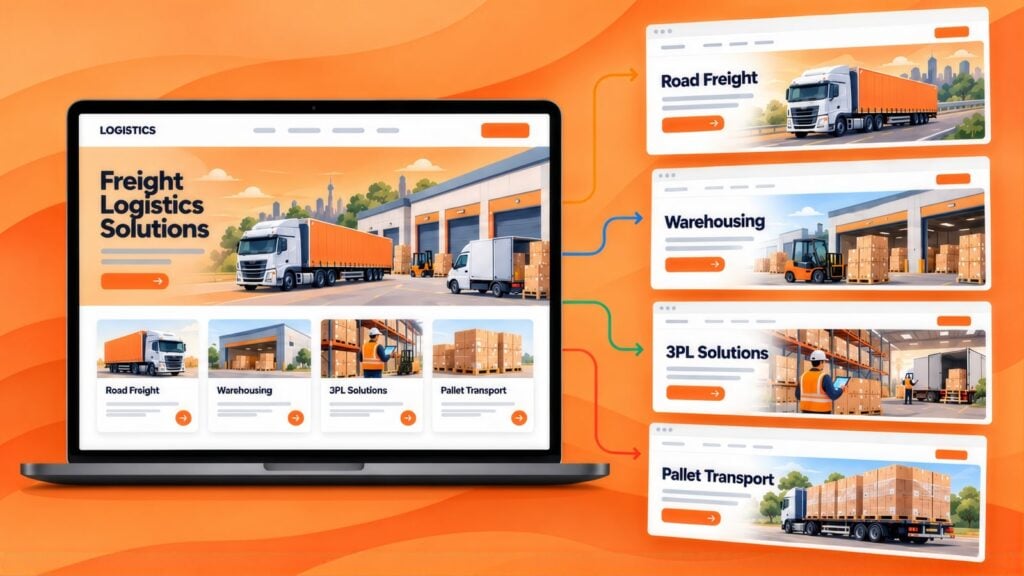
The landing page is where someone arrives after clicking your ad. For freight, it should confirm the lane fast and make quoting easy.
- Confirm the lane or service in the opening line. “Sydney to Melbourne overnight freight” should not sit three paragraphs below the company history.
- Show cut-off times, transit times, delivery windows and weight and volume limits. Do not make people request a quote to see them.
- Give fleet and depot details: vehicle types, the depot nearest their origin and how goods are handled in transit.
- Keep the quote form to freight type, lane, rough weight and volume, how often, and contact details. A custom landing page design lets you build this form for each lane.
- Add an account-opening link for regular shippers, who want a standing rate card rather than a new quote every week.
Contract: Tracking Enquiries to Signed Agreements
Count a win when a rate card is accepted or an account opens, because a sent form is only the first step.
| Stage | What to record | Why it matters |
|---|---|---|
| Quote requested | Lane, freight type, rough volume and source | Shows how many leads each channel brings in. |
| Quote issued | Rate quoted, lane, volume and date | Shows the deals in progress. |
| Account opened or rate card accepted | Lanes, volume, rate card and source | This is the signed agreement, the result to aim your budget at. |
| First consignment moved | Date, lane, volume, revenue and source | Proves the account is live and earning. |
Organic SEO KPIs worth reporting
Each quarter, report three numbers from organic search: quote requests, accounts opened and its share of new pipeline value. Put them next to rankings for your priority lanes. Traffic alone is misleading in freight, because tracking visits inflate it.
Before any paid campaign runs, filter your analytics sessions by “tracking”, “track my parcel”, “where is my freight” and your brand name. If that share of total traffic is above 30%, move tracking and customer service away from your sales pages before you spend on ads. If you skip this, existing customers will distort your cost per conversion, a common cause of misleading marketing metrics. An analytics specialist can set up these filters in GA4.
A 90-Day Checklist for a Carrier’s Website
Give each task an owner on day one. Update the status column at your weekly sales meeting.
| When | Task | Owner | Status |
|---|---|---|---|
| Days 1 to 14 | Connect Google Search Console and submit the sitemap | Marketing | To do |
| Days 1 to 14 | Move the tracking portal and login behind a header link | Web developer | To do |
| Days 1 to 14 | Verify a Google Business Profile for each depot | Depot managers | To do |
| Days 1 to 14 | Build the master negative list (brand, tracking, jobs) | Ads manager | To do |
| Weeks 3 to 4 | Rewrite lane pages for the busiest routes with cut-offs and transit times | Sales and marketing | To do |
| Weeks 3 to 4 | Set up quote form and call tracking, leaving out brand and tracking terms | Analytics | To do |
| Weeks 3 to 4 | Start asking regular shippers for depot reviews | Depot managers | To do |
| Month 2 | Launch one Search campaign for the main lane or freight type | Ads manager | To do |
| Month 2 | Publish one buyer’s guide and pitch one trade press story | Marketing | To do |
| Month 3 | Report cost per new account and organic share of pipeline | Sales manager | To do |
| Month 3 | Choose the next lanes from quote-to-account data | Operations and sales | To do |
Logistics SEO and Google Ads: Common Questions
Where should a freight company start with SEO?
Start by moving tracking and login traffic away from your sales pages. Then build one page for your busiest lane, with cut-off times, transit times and a short quote form. Check in Google Search Console that it is indexed, then repeat for the next lane or freight type.
How long does SEO for logistics take to work?
Lane pages usually rank first, because a route such as Brisbane to Townsville has far fewer competing pages than a broad term like freight company. National carriers and brokers all target those broad terms. A domain with years of history and verified depot profiles also starts well ahead of a new one. As a rough guide, expect early movement around months three and four. Clearer gains tend to come between months six and nine, and growth keeps building after the first year.
What does SEO cost for a freight or logistics company?
The cost grows with the size of your network, because each lane, freight type and depot needs its own page or profile. Routes where national carriers already rank take more work to win. A site that runs its tracking portal through its sales pages also needs untangling first. For scale, an agency retainer runs $1,500 to $10,000+ a month, and an in-house SEO hire costs $80,000 to $170,000+ a year with tools and training. Those figures come from a cost comparison of agency and in-house SEO. Enter your average account value in this SEO ROI calculator to see how many new freight accounts would pay for it.
What do Google Ads clicks cost for freight searches?
Top-of-page bids for freight company run from about $2.54 to $7.36 in Australia, and for interstate freight from $2.62 to $8.89. 3PL provider costs far more, at $7.00 to $25.38. These bid ranges come from CCM’s Keyword Planner pull of 1 October 2026, which is separate from the search volumes in RFQ: Freight Searches That Become Quote Requests. What you pay per click moves with your bid, your ad’s quality and how many carriers bid on that lane at the time.
How much should a carrier spend on Google Ads to start?
Start with enough to buy a steady flow of clicks on one lane, then grow. As an illustrative example, if clicks cost $5 to $9, a $50 daily budget buys about six to ten clicks a day. On a busy day Google may spend up to twice your daily budget, although its daily budget rules cap a month at 30.4 times the daily amount. At $50 a day, that means no more than about $1,520 a month.
Should a logistics company use Performance Max or Search?
Start with Search, because its search terms report lets you keep tracking and support queries away from your new-business budget. Performance Max makes that much harder, so bring it in once you have reliable conversion data on signed accounts.
Do AI Overviews change SEO for logistics companies?
The work stays largely the same, because Google asks for no special steps beyond being indexed and able to show a snippet (its guidance is linked in RFQ: Freight Content, Trade Press and AI Answers above). For a carrier, that means keeping cut-offs, transit times and accreditations current on each lane page. State them plainly, so an AI summary quotes the right figures.
Andrei Jach is Senior Manager, SEO and Analytics Specialist at Click Click Media in Sydney and has over 15 years in digital marketing and strategy. He has led SEO across health, retail, professional services and manufacturing, and oversees strategic SEO planning, analytics implementation and technical audits. Before Click Click Media he worked at Agent 6 Marketing and Red Propaganda.
Implement this playbook with AI
Opens your assistant with this playbook and seven questions about your business: services, area, website and ads. It then writes your keyword map, page plan and Google Ads starter build with your details filled in.
Copy the prompt for Gemini, Grok or any assistant that cannot open a prefilled link. The prompt points at this page, which is also served as Markdown to assistants that ask for it.
Work with Click Click Media
Before we look at a single lane page, our free audit splits your website traffic in two: new-business visits, and customers chasing a consignment. That split affects how every campaign should be judged.
We then check your lane and freight type pages, depot profiles and Google Ads search terms against what freight buyers type. That work comes from a Google Premier Partner team, in search marketing since 2008, with more than $115 million of Google Ads spend managed for Australian businesses.
We work without lock-in contracts, and the senior strategist who reviews your lanes stays on your account and takes your calls.
Verified Sources and References
- Mordor Intelligence: Australia Freight and Logistics Market
- IBISWorld: Road Freight Transport in Australia (2026)
- IBISWorld: Road Freight Transport number of businesses (2026)
- National Transport Commission: Australian Dangerous Goods Code
- NHVR: Fatigue management
- Google Ads Help: About negative keywords
- Google Ads Help: About keyword matching options
- Google Ads Help: Tracking calls to a phone number on a website
- Google Ads Help: About average daily budgets
- Google Search Central: Documentation updates (FAQ rich results deprecated 7 May 2026)
- Google Search Central: AI features and your website
- Schema.org: LocalBusiness
- ACCC: False or misleading claims
- Google Business Profile: Manage customer reviews
- Click Click Media: GA4 and GTM consulting (BAC Removals result)
- Click Click Media: SEO cost comparison, agency vs in-house
Last checked October 2026 · next review January 2027
