

Written by Andrei Jach, Senior Manager, SEO and Analytics Specialist at Click Click Media · Updated 1 October 2026
Australia’s legal services industry is expected to turn over $39.2 billion in 2026-27 across 23,656 businesses. About 97,500 solicitors were practising in October 2024, and demand at the average law firm grew 3.2% in FY2025. Your competitors range from sole practitioners to national firms.
The person searching has a legal problem, and SEO for law firms works best when it starts from there. They want to know whether you handle their kind of matter, whether you have the experience and how the process works. Many law firm websites leave those questions unanswered. They are built around what the firm wants to say rather than what a future client needs to know before calling.
This guide covers keyword strategy for law firms and the content standards Google and the conduct rules expect. It also sets out a Google Ads structure that brings in qualified enquiries at a cost your fees can justify.
Implement this playbook with AI
Opens your assistant with this playbook and seven questions about your business: services, area, website and ads. It then writes your keyword map, page plan and Google Ads starter build with your details filled in.
Copy the prompt for Gemini, Grok or any assistant that cannot open a prefilled link. The prompt points at this page, which is also served as Markdown to assistants that ask for it.
From Our Review of Legal Search Results
In CCM’s analysis of Semrush ad history from September 2025 to August 2026, 52 of 63 distinct consumer legal ads (83%), from 20 of 26 advertisers, promised “no win no fee”. Only 4 of the 63 mentioned a court.
Almost all of these ads ran on personal injury and compensation searches, where the fee promise is standard and does not set a firm apart. Check your state’s rules on injury advertising first (see Employment and Personal Injury: Fixed Fees and Compensation Rules below). Then make your ad specific about the first step, such as who calls back and when.
Source: CCM analysis of Semrush ad history for three consumer legal searches, September 2025 to August 2026
In CCM’s Australia-wide captures of five consumer legal searches on 3 September 2026, the 13 law firms in the map results had a median of 171 Google reviews. Seven of the 15 map places went to firms that did not appear in the organic results at all.
Google ranks the map and the organic results separately. A firm can win a map place through its Business Profile and reviews even when its website does not rank, so work on both.
Source: CCM captures of consumer legal searches, Australia, 3 September 2026
On family lawyer sydney, 8 of the 9 law-firm results in the top 10 were home pages, and on criminal lawyer sydney 7 of 8 were. On no win no fee lawyers, all 10 results were law firms and none was a home page.
For family and criminal searches in a city, Google mostly ranked the firm’s home page, so that page needs to name the practice area and the city. For injury searches it ranked pages deeper in the site, so give each type of claim you take on its own page.
Source: CCM captures of consumer legal searches, Australia, 3 September 2026
CCM analysed Semrush ad history for no win no fee lawyers, compensation lawyers and family lawyer sydney, from monthly snapshots between September 2025 and August 2026. The 89 ad records (one row per advertiser per month) held 63 distinct ads from 26 advertisers, and 86 of the 89 records came from the two injury searches. The map and organic counts come from desktop captures made once each with the DataForSEO SERP API on 3 September 2026, Australia-wide. The five searches were family lawyer sydney, criminal lawyer sydney, best family lawyer sydney, no win no fee lawyers and lawyers near me.
How Clients Search for a Lawyer, Practice Area by Practice Area
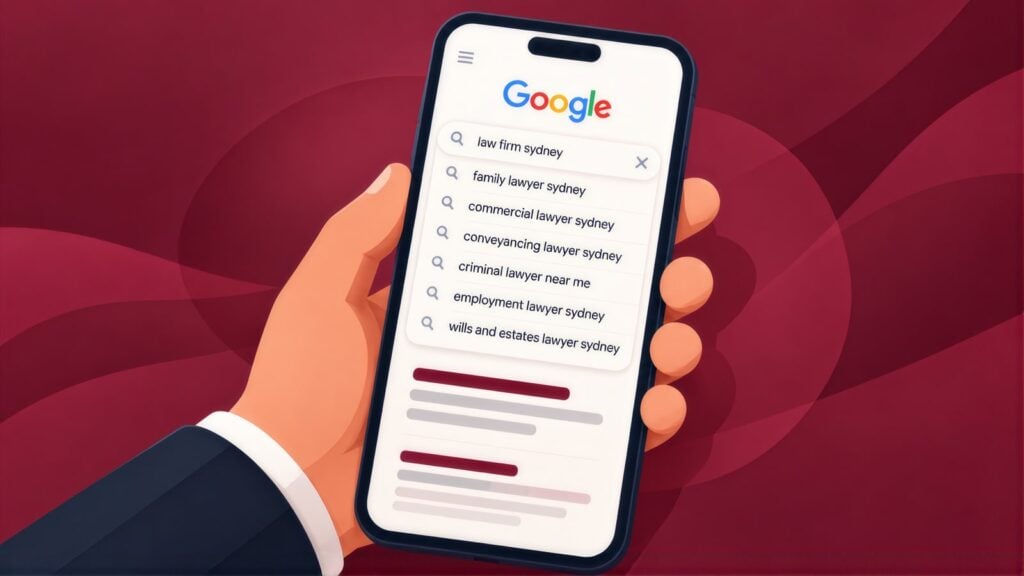
Legal searches are specific to a practice area, so law firm SEO (or legal SEO) has to be planned one practice area at a time. Someone with a family law matter types family lawyer rather than “lawyer”. Someone in a WorkCover dispute searches “workers compensation lawyer “, and someone just dismissed looks for unfair dismissal lawyer near me. These searches are often urgent and emotional, and a clear page on that exact matter gives the person what they came for.
Each practice area also has its own rules. Google treats legal content as YMYL, short for Your Money or Your Life. Content that affects people’s finances or wellbeing is held to a higher standard of trust. The conduct rules on advertising are also stricter in personal injury than in conveyancing. The four practice area sections, starting with Family Law: Fee Pages, Careful Reviews and Local Intent, cover the main areas and the compliance points for each, and the sections from Firm-Wide Foundations: Indexing, Intake and E-E-A-T onwards cover what every firm needs.
A small firm focused on commercial leasing disputes in Melbourne’s CBD can compete with a national full-service firm for “commercial lease dispute lawyer Melbourne CBD”. Its detailed page is more relevant than a general “commercial law” page deep in a big firm’s menu. Build pages for the matters you handle well rather than every area you could practise in.
Practice Area Search Volumes and Click Costs
Search demand and click costs vary widely between practice areas, which should shape where your firm puts its SEO and Google Ads budget.
| Keyword | Average monthly searches | Average cost per click |
|---|---|---|
| conveyancing | 22,200 | $21.70 |
| family lawyer | 12,100 | $25.63 |
| lawyers near me | 4,400 | $9.91 |
| criminal lawyer | 3,600 | $34.47 |
| divorce lawyer | 3,600 | $25.87 |
| employment lawyer | 3,600 | $23.56 |
| personal injury lawyer | 2,400 | $68.65 |
| wills and estates lawyer | 1,300 | $8.64 |
Source: CCM analysis of Google Keyword Planner data, Australia. Search volumes for family lawyer, criminal lawyer, personal injury lawyer and wills and estates lawyer come from CCM’s pull of 3 September 2026 (12 months to July 2026). The other volumes and all costs per click come from CCM’s pull of 1 October 2026 (12 months to August 2026). Suburb and city variants add volume on top of these head terms.
Family Law
family lawyer [suburb]
divorce lawyer [city]
child custody lawyer [area]
property settlement lawyer
Employment
unfair dismissal lawyer [state]
employment lawyer [city]
workers compensation lawyer
workplace dispute lawyer [area]
Criminal
criminal lawyer [suburb]
drink driving lawyer [city]
criminal defence [area]
traffic lawyer near me
Commercial / Business
commercial lawyer [city]
contract dispute lawyer
business lawyer [suburb]
commercial litigation [area]
Property / Conveyancing
conveyancer [suburb]
property lawyer [city]
conveyancing [area]
property settlement lawyer
Wills and Estates
will and estate lawyer [suburb]
probate lawyer [city]
executor lawyer [area]
estate dispute lawyer
Family Law: Fee Pages, Careful Reviews and Local Intent
Family law searches are frequent and local. Family lawyer is the second-biggest search in the Practice Area Search Volumes and Click Costs table, and most people add a suburb. The firms that get these enquiries explain which matters they handle, such as divorce, property settlement and parenting arrangements. They also explain how the process works and what it costs.
Explain your family law fees
Law firms are often reluctant to publish fees. However, someone who reads your family law page and finds no indication of cost may simply move on to the next result. Explain how your family law fees work, give a range for a typical property settlement or parenting matter, and list what affects the cost. You do not need a fixed fee schedule. The explanation only needs to be clear enough for someone to judge whether they can afford to call.
Reviews without matter details
Family law reviews need particular care. Never ask clients to mention matter details, children, outcomes or settlement figures in a public review, and keep the request neutral. Reply to every review without confirming anything about the person’s matter.
Family law ad copy
Google caps headlines at 30 characters and descriptions at 90, so give each message its own line:
| Component | Example |
|---|---|
| Headline 1 | Family Lawyers [Suburb] |
| Headline 2 | Free Initial Consultation |
| Headline 3 | Fixed-Fee Options Available |
| Headline 4 | Property and Parenting Matters |
| Headline 5 | Speak to a Family Lawyer |
| Description 1 | Family law solicitors in [Suburb] for property settlement, parenting and separation. |
| Description 2 | Free 30-minute consultation. Costs agreement before any work starts. Call or book. |
Only use “free” and “fixed fee” if both are true for every client who responds to the ad. A “free consultation” must be free, with no hidden conditions, as the ACCC’s guidance on misleading claims makes clear.
Criminal and Traffic Law: Urgency, Call Ads and After-Hours Intake
Criminal searches happen in a hurry, often on a phone, sometimes late at night after a charge or an arrest. Criminal searches are among the most expensive clicks in the table in Practice Area Search Volumes and Click Costs, so every click that fails to reach someone wastes money. Three things decide whether criminal law marketing brings in matters:
- A phone number one tap away on every page, on a site that loads fast on mobile data.
- Ads that run only when someone can answer, including after hours if you offer contact for urgent matters. Add a call asset, a button that lets people ring straight from the ad, and turn call ads off when no one is available.
- Separate pages for the matters people search for: drink driving, drug charges, assault, traffic offences and bail.
Claims like “24 hours” or “available now” in titles and ads must match what happens when someone calls at 2am. A meta description is the short summary under your page title in Google. For a criminal page, it can be direct without overpromising and still fit within 135 to 150 characters: “Criminal defence lawyers in [Suburb] for traffic, drug and serious criminal matters. Clear advice on your options. Call before your court date.” (143 characters).
Use remarketing, which shows ads to people who have already visited your site, with care in these areas. A criminal or family law ad that follows someone around the web can feel intrusive, and others on a shared device may see it. For these areas, rely on search ads and call assets. Keep remarketing for areas such as wills, conveyancing and commercial work, where a reminder is welcome rather than awkward.
Employment and Personal Injury: Fixed Fees and Compensation Rules
Employment searches are often urgent. An unfair dismissal application generally has to reach the Fair Work Commission within 21 days of the dismissal, according to the Fair Work Ombudsman. People searching unfair dismissal lawyer want to know quickly whether you can help and what it costs. Fixed-fee advice for a Fair Work application is a clear message they can check, as long as your page says what the fee covers.
Personal injury is the most expensive legal click in the Practice Area Search Volumes and Click Costs table, and the most tightly regulated advertising. The rules differ by state and are stricter than for commercial and property work. In Queensland, the Personal Injuries Proceedings Act 2002 limits how personal injury services can be advertised. In February 2026 a Queensland tribunal fined a lawyer $30,000 over “No Win, No Fee” injury ads, as the Queensland Law Society’s Proctor reported. In NSW, the Law Society notes that the old ban on advertising personal injury services did not carry over into the Uniform Law. Have your firm’s compliance partner check your state’s rules before you write any ads or pages.
In NSW, the Law Society’s advertising guidance sets out Rule 36, under which advertising must not be false, misleading, deceptive or offensive. Only solicitors who hold that accreditation may use the words “accredited specialist“. Success-rate claims and promised outcomes are risky in every area, and more so in injury work. The Law Society of NSW, Queensland Law Society and Victorian Legal Services Board each publish current guidance.
Conveyancing, Wills and Commercial Law: Volume and Fixed Fees
Conveyancing is the biggest legal search in the Practice Area Search Volumes and Click Costs table, and people choose a conveyancer much as they would a retail service. They compare fixed fees, speed and whether they can do everything online. Publish your fee, list what is included and explain the steps from contract to settlement. A page like that lets people compare you without having to call for a quote.
Wills and estates has low volume and the cheapest clicks in the table, and the people searching are often planning ahead rather than in crisis. Fixed-fee wills cover much of the demand. Add a plain guide to what happens when someone dies without a will, and separate pages for probate and estate disputes.
Commercial and business law draws far fewer searches than family law but carries the highest value per matter, so specific pages work best. A page for contract dispute lawyer [city] or commercial leasing disputes should be written by the solicitor who runs those matters. It reaches the business owner who already knows what they need.
The title tag is the clickable headline Google shows for a page. Here are examples by practice area:
| Practice area | Example title tag | Characters |
|---|---|---|
| Conveyancing | Conveyancers [Suburb] | Fixed-Fee Conveyancing | 46 |
| Wills and estates | Wills & Estate Lawyers [City] | Fixed-Fee Wills | 47 |
| Family law | Family Lawyers [Suburb] | Divorce & Custody | 43 |
| Employment | Unfair Dismissal Lawyers [City] | Free Consult | 46 |
| Criminal defence | Criminal Lawyers [Suburb] | 24hr Available | 42 |
In a legal title, the practice area and the suburb matter most, so these examples leave the firm out. A short firm name can go at the end if the title stays at 55 characters or less, because Google already prints your site name next to the result.
Firm-Wide Foundations: Indexing, Intake and E-E-A-T
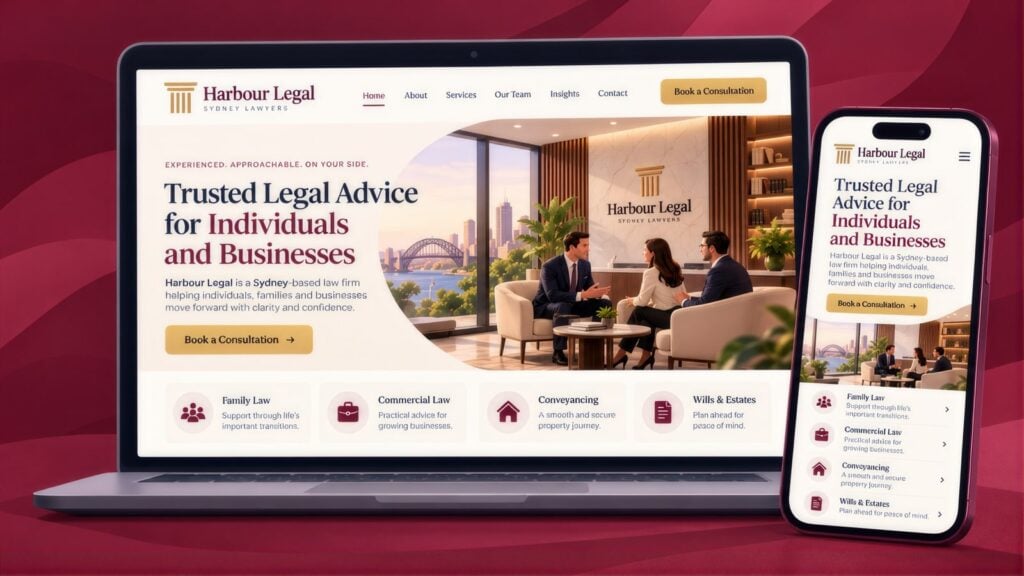
A practice area page only turns into matters if Google has indexed it, your intake team replies within one business day and the site works on a phone. Connect your site to Google Search Console, Google’s free tool for seeing how your pages perform in search. Submit your sitemap and inspect each practice area page there to confirm it is indexed. Name the person who answers website enquiries, and say on the contact page who will call, when, and what to have ready.
Legal content is YMYL, and Google’s guide linked in How Clients Search for a Lawyer, Practice Area by Practice Area above says its systems give even more weight to E-E-A-T on topics like these. E-E-A-T stands for experience, expertise, authoritativeness and trust. This explainer on how Google assesses E-E-A-T sets out what its raters look for.
| E-E-A-T signal | What it means for law firms | How to show it |
|---|---|---|
| Experience | You have handled real matters in the practice area, beyond general legal information. | Share examples with client details removed. List the types of matter you handle and your years in that area. |
| Expertise | Your solicitors hold practising certificates anyone can check on the Law Society register. | Name each solicitor, with their admission year, practice areas and any specialist accreditation. |
| Authoritativeness | Others in the legal world recognise your work in the practice area. | Show awards, published commentary, speaking and legal directory listings (see Legal Directories, PR and Link Building for Law Firms below). |
| Trustworthiness | You are honest about what you do, how you charge and what to expect. | Explain fees and state your limits. Keep general information apart from advice, and never promise an outcome. |
Your intake form must not imply a solicitor-client relationship before a conflict check, a signed costs agreement and a formal engagement. Say on the contact page that sending an enquiry does not create that relationship, and that you will confirm availability and terms separately.
Core Pages and Internal Links for a Law Firm Site

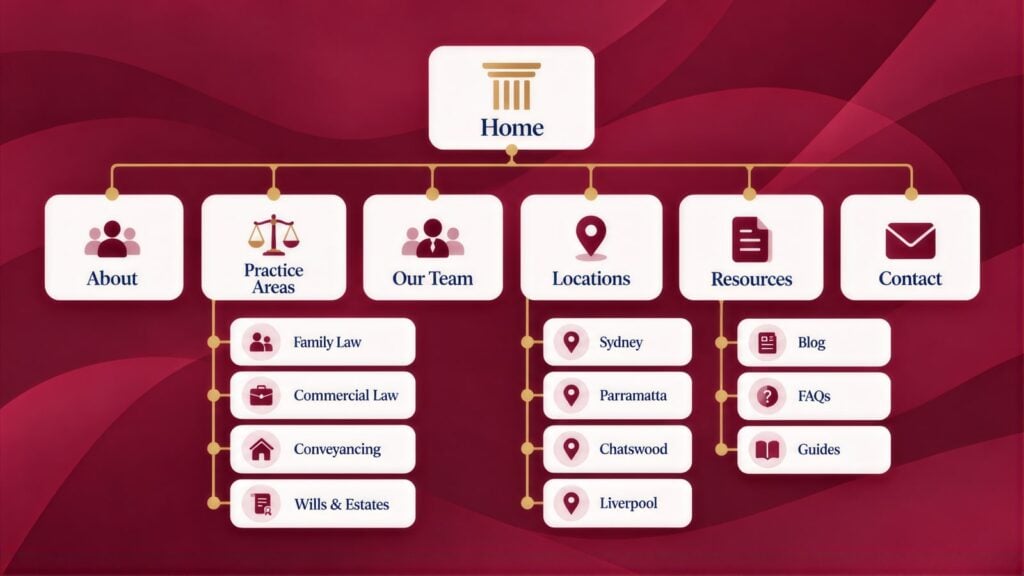
Beyond the practice area pages, a firm needs solicitor profiles, a fees page and a clear first-step page. Together these answer what a client checks before calling. Good SEO services start with that structure.
| Page | Focus keyword | What to put on it |
|---|---|---|
| Practice area main | [practice area] lawyer | The matters you handle, the process, what to bring to the first meeting, fees and an FAQ |
| Sub-practice pages | specific matter type + suburb | The matter, the law or process that applies, what to expect and how to begin |
| Team / solicitors | [solicitor name] lawyer | Admission year, practice areas, past experience and contact details |
| Fees page | legal fees [area] | How you charge (hourly, fixed or conditional), ranges for common matters and what the costs agreement covers |
| Free consultation | free legal consultation | What it covers, how long it takes, who it is with, what to bring and what happens next |
| About | law firm | Your practice focus, team size, service area, accreditations and awards |
Each practice area page links to its sub-practice pages, and team profiles link to the areas each solicitor covers. Every practice area page and profile links to the consultation page. Keep the link text to a few words that say where it goes:
| Destination page | Anchor text examples |
|---|---|
| Free consultation | “book a free consultation”, “start with a free assessment” |
| Fees page | “how we charge”, “family law fees explained” |
| Specific solicitor | “our [area] solicitor”, “meet [name]” |
Title Tags, Meta Descriptions and Schema for Legal Practices
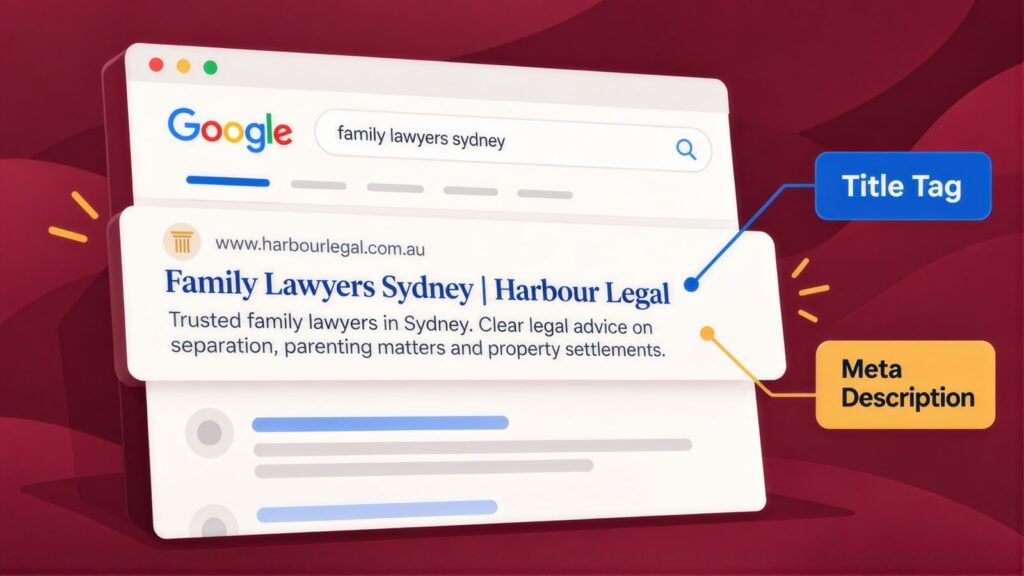
Draft the titles and descriptions for all your practice area pages in one keyword and metadata planner, so no two pages compete for one search. Conveyancing, Wills and Commercial Law: Volume and Fixed Fees has title examples by area. A description of 135 to 150 characters should name the matters, the first step and one honest reason to call. End it with the action: “Unfair dismissal lawyers in [City] with fixed-fee advice for Fair Work applications and a free 30-minute consultation. Book a time with our team.” (145 characters).
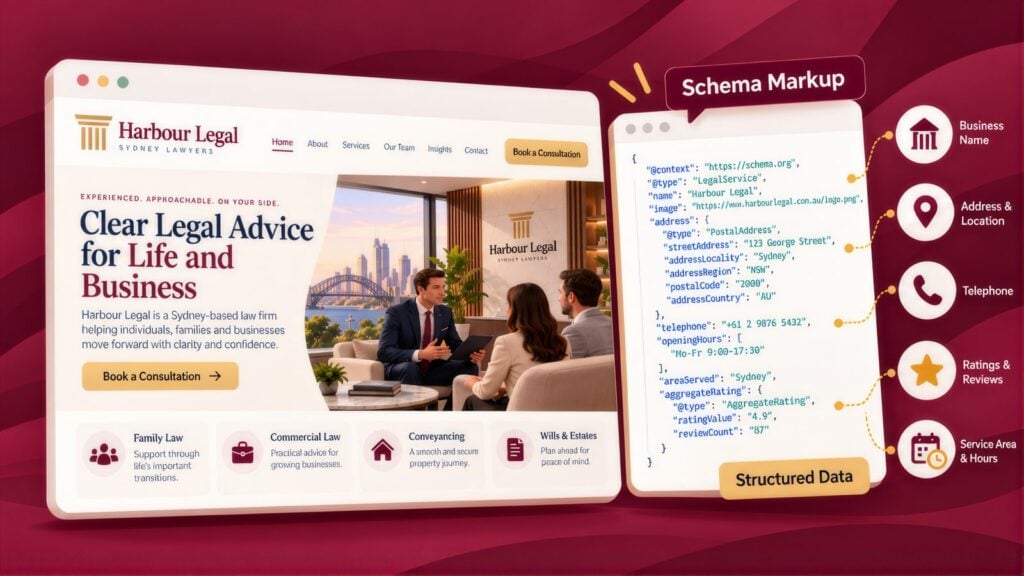
Four types of schema, the code that labels a page for search engines, matter on a law firm site:
| Schema type | Where to use it | What it does |
|---|---|---|
| LegalService (a type of LocalBusiness) | Homepage and practice area pages | Describes the firm, its practice areas, location and contact details. |
| Person | Solicitor profile pages | Gives each solicitor’s name, job title, credentials and firm. The older Attorney type describes a business, and schema.org now points to LegalService instead. |
| FAQPage | Practice area FAQs | Marks up the process and cost questions clients ask. Since 7 May 2026 Google has shown no FAQ rich results, so the markup no longer produces a dropdown. It still helps search engines and AI tools read your answers. |
| BreadcrumbList | All pages below the homepage | Shows how your practice area pages fit together. |
Local SEO for Law Firms: Business Profile and Reviews
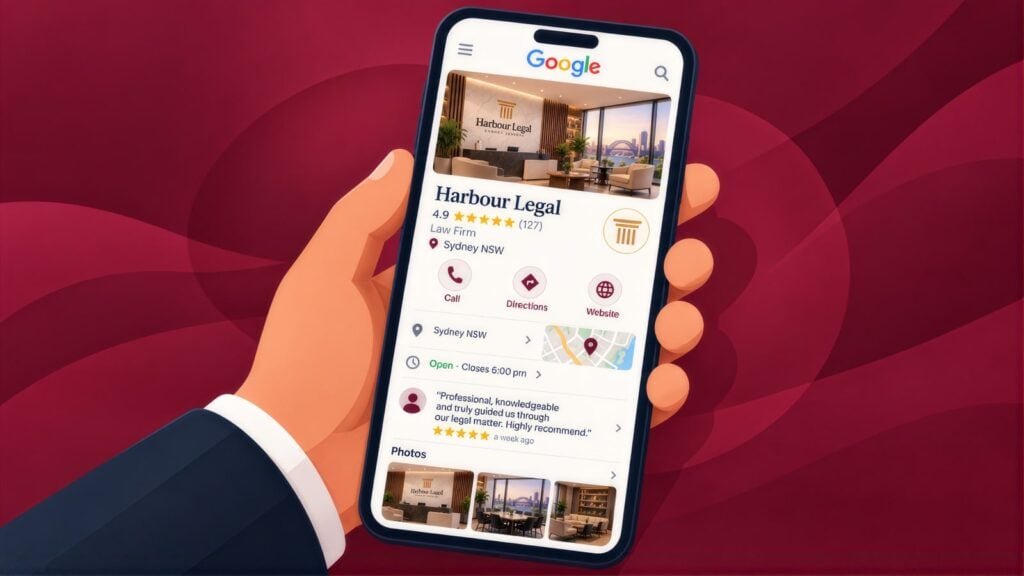
For suburban and regional practices, the map results in Google are often where a new client first sees you. On the legal searches CCM captured, each map pack showed three firms above the normal listings. Local SEO for law firms starts with a complete Google Business Profile and a steady flow of reviews.
| Field | What to do |
|---|---|
| Primary category | Choose the specific practice type, such as family law attorney, criminal justice attorney or conveyancer. Use a general law firm category only where no specific one fits. |
| Services | List every practice area and type of matter you handle. |
| Hours | Keep hours accurate, including any after-hours contact for urgent criminal and family matters. |
| Business description | Describe your practice areas, the area you cover and true fee details, such as a free first consultation or fixed-fee services. |
Keep review requests neutral: say you appreciate the client’s trust and that a review helps others in a similar situation find help. Follow Google’s rules on managing customer reviews. Before you start asking, learn why Google removes some reviews. Reply to a negative review calmly and offer to talk directly, without confirming anything about the person’s matter.
Legal Directories, PR and Link Building for Law Firms
Links from other websites help Google judge whether your firm is trusted. Law firms have strong, relevant link sources that most businesses lack, and these links also serve as E-E-A-T evidence. Work through them with a plan rather than buying links:
- Legal directories and rankings such as Doyle’s Guide and Best Lawyers, where your firm or solicitors are recognised. Add your Law Society’s find-a-lawyer listing and any accredited specialist register entry.
- Legal press and commentary: write or comment for Lawyers Weekly, Law Society journals and the business pages of local news, especially on changes in the law you practise.
- Community and professional ties, such as local business chambers, sponsorships, pro bono partners and university or college law events.
- Referral partners such as accountants, financial planners and real estate agents, who may list trusted solicitors.
Earned, relevant links like these are the basis of sound link building for professional firms.
Legal Content, AI Overviews and Disclaimers
Legal content marketing depends on keeping general information apart from legal advice. Anyone can publish general information, but legal advice needs a solicitor-client relationship. Every article should therefore say it is general information rather than advice for the reader’s situation.
| Topic category | Example content |
|---|---|
| Process explainers | How a property settlement works. What happens at a Fair Work Commission conciliation. The stages of a criminal matter in the Local Court. |
| Rights and obligations | Your rights after an unfair dismissal. Contesting a will in your state. What to do straight after a car accident. |
| Cost guides | What a contested property settlement costs. Fixed fee or hourly rates. What affects family law costs. |
| Changes in the law | Changes to the National Employment Standards. Recent Family Court decisions. Tenancy law updates in . |
A named solicitor should write or review every article, and each needs a publication date. An out-of-date article with no review date undermines trust with readers, and it is also a professional liability risk.
AI Overviews and legal searches
AI Overviews are the AI-written summaries at the top of some Google results. Google shows AI Overviews in Australia, and a law firm page can appear in one as a supporting link. Google’s guidance on AI features and your website says there are no extra requirements and no special schema. A page must be indexed and eligible to show with a snippet. Google does not say which eligible pages it cites, so ranking well and being cited are separate results. This guide to earning AI Overview citations shows what cited pages tend to share.
Google Ads for Lawyers: Structure, Negatives and Compliance
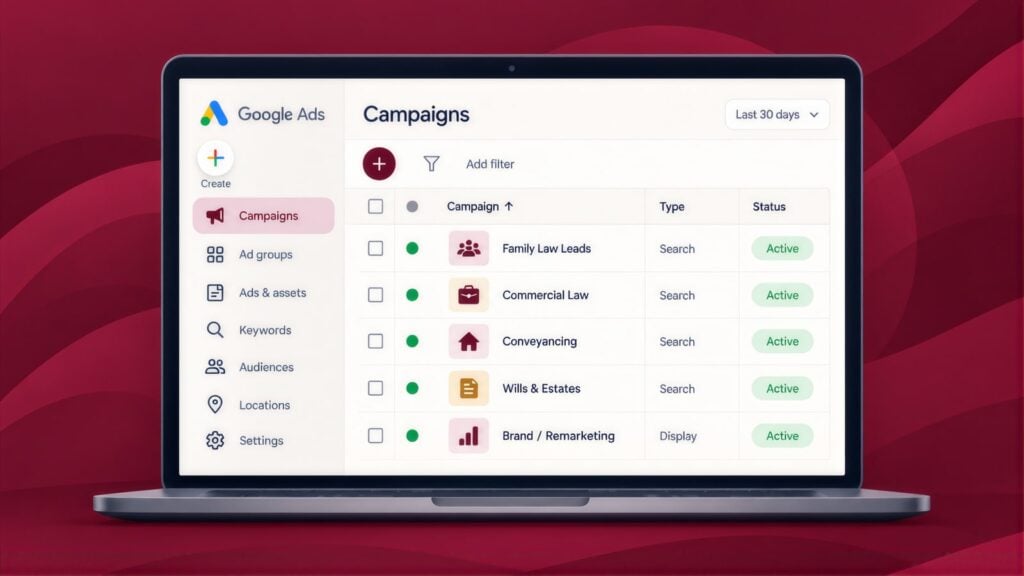
Google Ads can work very well for searches where someone clearly needs a lawyer in your practice area. Clicks on family, criminal and personal injury searches are expensive, because a new client is worth a lot. Tie each campaign to the matters you handle best, and measure it all the way to the signed costs agreement. Specialist Google Ads management helps keep that spend in check.
| Setting | For a law firm |
|---|---|
| Campaign layout | Run one Search campaign per practice area, so family, criminal and conveyancing spend never share a budget or a report. |
| Location targeting | Show ads only to people who are actually in your area. Family and criminal matters are local, while commercial and employment campaigns can cover a wider area. |
| Ad schedule | Run ads in your intake team’s hours. Add after-hours for urgent criminal matters, but only if someone answers. |
| Assets | Assets are extras Google can add to your ad. Use call assets for urgent practice areas, sitelinks to your fees and consultation pages, and a location asset linked to your Business Profile. |
| Bidding | Start by setting your own maximum price per click, or let Google get you as many clicks as it can. Competitive searches in Sydney and Melbourne can cost $15 to $60 or more a click. Keep your maximums low while you check lead quality. |
Negative keywords stop your ad showing for any search that contains them. Use them to block legal aid, study and template searches that will never become a paying matter: legal aid, free legal aid, duty lawyer, law school, study law, paralegal course, DIY legal templates, legal forms download. A wasted ad spend scorecard shows how much missing negatives cost you. Before launch, check every ad against this list:
- No promised outcomes, such as “we will win your case” or “guaranteed compensation”.
- No claims to be better than other firms that you cannot prove.
- Fee and “free” claims that match what you actually do.
- Your state’s rules on compensation and personal injury advertising checked.
CCM has no law firm case study to publish yet, so the nearest comparison is another high-value service sold through paid search. Brisbane Structural Repairs is a licensed builder in South East Queensland. Our Google Ads campaign and landing page produced 393 leads at a 16.01% average conversion rate from September 2025 to March 2026. The landing page has an 18% all-time conversion rate, as the Brisbane Structural Repairs case study details.
LendInsure is a finance client with compliance-sensitive leads. A rebuilt account and landing page lifted its qualified enquiries 54% within 90 days, as the LendInsure landing page result shows. Neither is a law firm, but both show what a focused campaign and page can do for an expensive, considered enquiry.
Landing Pages That Turn Legal Searches Into Consultations
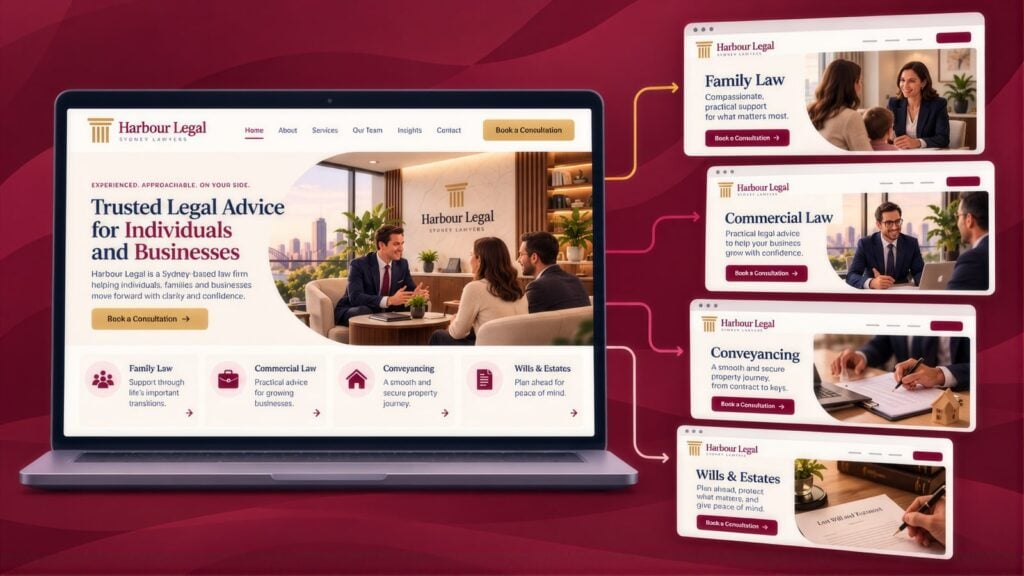
A landing page is the page someone reaches after clicking your ad. The usual rules for structuring a landing page apply, with some legal additions:
- Confirm the practice area straight away, with a headline that matches the ad, such as “Family Lawyers in [Suburb]” or “Unfair Dismissal Lawyers [City]”.
- Say who will handle the matter, because knowing who they will speak to reassures a stressed client.
- Explain the first step: what happens after the form, when they will hear back and what to bring.
- Outline how you charge in broad terms, such as “costs agreement before any work starts”.
- Keep the form short: name, phone, type of matter and a brief description. Conflict checks happen inside the firm, so do not ask for the other party’s name on a public form.
- Add a short note that sending the form does not create a solicitor-client relationship.
Conversion Tracking: Enquiry to Signed Retainer
A conversion is the action you count as a win. For a law firm, the main one is a signed matter rather than a form submission. Track each stage by where the client came from, using only the type of matter and the date.
| Stage | What to record | Why it matters |
|---|---|---|
| Enquiry received | Form, call or email, the type of matter, the source and the date. | It tells you where enquiries come from. |
| First consultation done | The meeting took place, the matter was assessed, there was no conflict, and the date. | When these build up, Google Ads can learn to find more of them. |
| Costs agreement signed | The engagement started, the practice area, the fee arrangement and the source. | This is the signed client your ad spend is meant to produce. |
| Matter completed | Date resolved, fees recovered and type of outcome. | It shows what a client is worth over time, including referrals. |
Never send matter details, party names, allegations or outcomes to an advertising platform. The Australian Privacy Principles and your conduct rules limit how client information can be used. Record conversions by type and date only. A review of your Google Analytics 4 (GA4) and Google Tag Manager setup will show exactly what your forms are sending.
The First Six Months, Month by Month
In month 1, focus on intake and compliance. Connect Google Search Console and complete the Business Profile with every practice area, accurate hours and solicitor names. Check your existing content for named authors, publication dates and general information disclaimers. Fix the intake process so every enquiry reaches a named person within one business day. Check your advertising against your state Law Society’s guidance for each practice area.
In month 2, rewrite the page for your highest-value or most-searched type of matter. Give it a named solicitor, a fee explanation, a visible FAQ and LegalService schema, and set up conversion tracking for forms and calls.
In month 3, launch one Google Ads campaign for that practice area in your main region. Put negative keywords in place, and add call assets if the area is urgent. Review the search terms weekly, and publish one legal information article with a named author and date.
In month 4, work on your reputation online. Update your directory listings and pitch one piece of commentary to legal or local press. Ask referral partners about listing the firm. Build the fees page if you do not have one.
In month 5, work out your cost per consultation booked and per signed costs agreement, as there is usually enough data by then. Check in Google Search Console which practice area pages bring enquiries from search.
In month 6, create the second practice area page, chosen by matter volume or priority. If the first campaign is bringing in matters at an acceptable cost, add a second campaign as well.
Law Firm SEO and Google Ads: Questions Partners Ask
How long does SEO take for a law firm?
It depends on the practice area and the city. A wills page in a regional town, or a narrow commercial matter, can move within months. Family and criminal law pages in Sydney or Melbourne take longer. Solicitor sign-off on each page can also add weeks before anything goes live. For the website overall, expect traction at 3 to 4 months and significant gains between 6 and 9 months. Results usually keep building from around the 12-month mark. Google’s advice on hiring an SEO warns that no one can guarantee a number one ranking.
What is the typical cost of SEO for a law firm?
The price depends mainly on your practice areas, because each one needs its own pages, solicitor review and links. A regional wills and estates practice costs far less to support than a Sydney firm chasing family, criminal and employment matters across several offices. As a guide, an agency costs $1,500 to $10,000+ a month. Employing someone in-house costs $80,000 to $170,000+ a year once salary, tools and training are counted, according to this agency vs in-house comparison.
How much do Google Ads clicks cost for lawyers?
Legal clicks are expensive by Google Ads standards. In CCM’s Keyword Planner pull of 1 October 2026 (Australia, 12 months to August 2026), family lawyer averaged about $25.63 a click, criminal lawyer $34.47 and personal injury lawyer $68.65. Wills and estates lawyer averaged $8.64. Judge your ads on the cost per signed matter rather than the cost per click.
Is $10 a day enough for Google Ads for a law firm?
For most practice areas it is not. At the click costs above, $10 a day buys less than one click on family or criminal searches, which is too little data to learn from. Pick one practice area and a budget that buys a useful number of clicks each week. Otherwise, start with SEO and your Business Profile until you can afford that.
Do Google Ads work for law firms?
Yes, when each campaign targets one practice area, runs while your intake team can respond and is measured to signed costs agreements. Firms that send all legal traffic to their homepage, or skip negative keywords such as legal aid and study searches, usually pay for clicks that never become matters.
Do AI Overviews change SEO for law firms?
They add a new place to appear. Google’s guidance on AI Overviews, covered in Legal Content, AI Overviews and Disclaimers above, asks only that a page is indexed and eligible for a snippet, and it does not say which eligible pages it cites. Clear, current practice area pages with named solicitors give Google accurate text to draw on.
Can our solicitors call themselves specialists?
Only if they hold that accreditation. In NSW, the Law Society’s advertising guidance under Rule 36 says only accredited solicitors may use the words “accredited specialist”. Check the equivalent rule in your own state. Solicitors without accreditation can use plain descriptions such as “practises in family law”.
How do we choose an SEO agency for a law firm?
Look for an agency that plans law firm marketing by practice area and understands the advertising rules in your state. It should not promise rankings or guaranteed results. Ask how it will measure success, which should be consultations and signed matters rather than traffic. Ask who checks legal content for accuracy, and whether you keep ownership of your Google Ads account and website.
Andrei Jach is Senior Manager, SEO and Analytics Specialist at Click Click Media in Sydney. His 15-plus years in digital marketing and strategy include leading SEO for professional services, health, retail and manufacturing businesses, and he oversees strategic SEO planning, analytics implementation and technical audits at CCM. He was previously at Agent 6 Marketing and Red Propaganda.
Implement this playbook with AI
Opens your assistant with this playbook and seven questions about your business: services, area, website and ads. It then writes your keyword map, page plan and Google Ads starter build with your details filled in.
Copy the prompt for Gemini, Grok or any assistant that cannot open a prefilled link. The prompt points at this page, which is also served as Markdown to assistants that ask for it.
Work with Click Click Media
Tell us the practice area you most want to grow. We will show you how it looks today to someone searching for it, including where you rank, what your page says and what your competitors’ ads promise.
The free audit tests your website, Google Ads account and Business Profile against the advertising rules and content standards legal practices must meet. Our team holds Google Premier Partner status, has worked in search since 2008 and has managed over $115 million in Google Ads spend for Australian organisations.
Your firm signs no lock-in contract, and a senior strategist manages the account from the first week.
Verified Sources and References
- IBISWorld: Legal Services in Australia (2026)
- Law Society of NSW: 2024 National Profile of Solicitors
- Thomson Reuters Institute: Australia State of the Legal Market 2025
- Law Society of NSW: Advertising legal services
- Queensland Law Society Proctor: QCAT fine over "No Win, No Fee" injury advertising (February 2026)
- Fair Work Ombudsman: Unfair dismissal (21-day time limit)
- ACCC: False or misleading claims
- OAIC: Australian Privacy Principles
- Google Search Central: Creating helpful, reliable, people-first content
- Google Business Profile Help: Manage customer reviews
- Schema.org: LegalService
- Google Search Central: AI features and your website
- Google Search Help: AI Overviews availability
- Google Search Central: Search documentation updates (FAQ rich result removal, May 2026)
- Google Search Central: Do you need an SEO? (no guaranteed rankings)
- CCM analysis of Google Keyword Planner data, Australia: pull of 3 September 2026 (12 months to July 2026) and pull of 1 October 2026 (12 months to August 2026)
- CCM analysis of Semrush ad history (monthly snapshots, September 2025 to August 2026) and CCM search captures (DataForSEO SERP API), Australia, 3 September 2026
- Click Click Media: SEO cost, agency vs in-house
- Click Click Media: Brisbane Structural Repairs Google Ads case study
- Click Click Media: Landing page design (LendInsure result)
- Click Click Media: SEO services for professional services
- Click Click Media: Google Ads management
Last checked October 2026 · next review January 2027
