
SEO and Google Ads for Accountants in Australia
Written by Andrei Jach, Senior Manager, SEO and Analytics Specialist at Click Click Media · Updated 1 October 2026
Many accounting practices rely on referrals for new work. That supply can slow when a practice changes hands, and it may not bring the kind of client you want to add.
Clients who find you through Google are the other source, and winning them is the job of SEO for accountants (many agencies call it accounting SEO). It is the work that helps your practice show up when people search Google for an accountant, a tax agent or a service like BAS or SMSF help. It covers your website, your Google Business Profile and the articles that answer clients’ questions.
People who search for an accountant in their suburb have usually decided they need help and are comparing practices. Your aim is to appear near the top with a page that looks credible and answers their questions clearly.
This guide starts with the rules that decide what you can publish and advertise: the TPB, the ACCC and Google’s YMYL standards. Then it covers keywords, your website, local SEO, Google Ads, and how to track spend through to signed clients.
Implement this playbook with AI
Opens your assistant with this playbook and seven questions about your business: services, area, website and ads. It then writes your keyword map, page plan and Google Ads starter build with your details filled in.
Copy the prompt for Gemini, Grok or any assistant that cannot open a prefilled link. The prompt points at this page, which is also served as Markdown to assistants that ask for it.
What We Found Searching for Accountants
What we found: In CCM’s Australia-wide capture of the search accountant near me on 3 September 2026, only 4 of the top 10 organic results were accounting firms. The other six were directories, marketplaces and information pages, including H&R Block’s office locator, a professional body directory, Bark, Airtasker, Moneysmart and Xero’s advisor directory. Across the eight searches CCM captured that day, Google showed a map pack on 3 and an AI Overview on the other 5, and never both on the same page.
What it means for your firm: On the broad local search, your practice competes with directories as well as with other firms. A complete, accurate entry in the directories that rank gives you a second way to be found, alongside your own service page and Google Business Profile.
Source: CCM search captures, Australia, 3 September 2026
What we found: When Google showed an AI Overview on four of CCM’s Australia-wide accounting searches on 3 September 2026, 10 of the 24 sources it cited (42%) did not rank in the top 10 organic results on the same page. The four searches were about choosing an accountant, accounting fees, SMSF accountants and the tax return deadline.
What it means for your firm: A clear, dated answer to one client question can be cited in an AI Overview even when the page is not on page one. Ranking still helps, because the other 14 cited sources did rank in the top 10.
Source: CCM search captures, Australia, 3 September 2026
What we found: In CCM’s analysis of Semrush ad history for six Australian accounting searches, from monthly snapshots between September 2025 and July 2026, 7 of 64 distinct ads (11%) promised a maximum refund or a refund guarantee, and all 7 came from one advertiser, H&R Block. A wider group of 14 ads (22%) promised a tax outcome such as minimised income tax or saved tax, and those 14 came from 5 of the 30 advertisers.
What it means for your firm: Most advertisers on these searches made no refund or savings promise, so an ad that describes the service and the fee will not look out of place. Any outcome claim you do make needs facts behind it that you could show the ACCC.
Source: CCM analysis of Semrush ad history, September 2025 to July 2026
CCM captured eight Google searches Australia-wide (location code 2036) on desktop on 3 September 2026: accountant near me, how much does an accountant cost, how to find a good accountant, small business accountant, smsf accountant, tax accountant sydney, tax return deadline and seo for accountants, which was left out of the AI Overview count because it is not a client search. The ad findings come from CCM’s analysis of Semrush ad history for the Australian database, using monthly snapshots taken on the 15th from September 2025 to July 2026, on six searches: accountant near me, bookkeeping services, seo for accountants, small business accountant, tax accountant and tax agent. Each distinct headline and text pair counted as one ad however many months it ran, and each website domain counted as one advertiser. The 30 advertisers included software vendors, marketplaces and a marketing agency as well as accounting firms.
Compliance First: TPB, ACCC and YMYL Rules for Accounting Marketing
All digital marketing for accountants rests on three sets of rules. The Tax Practitioners Board decides who can call themselves a tax or BAS agent. The ACCC polices refund and savings claims under the Australian Consumer Law. Google holds pages about money to its strictest standards. Sort out all three before you write a page or an ad, because fixing a site that breaks the rules costs more than building it correctly from the start.
Google calls topics like tax and money advice YMYL, short for Your Money or Your Life. Pages that could affect someone’s finances face stricter quality standards than most. Name the practitioner who wrote each page and show their credentials, so a reader can see who stands behind the advice.
Google describes what it looks for with its E-E-A-T quality framework: Experience, Expertise, Authoritativeness and Trustworthiness. The table shows what each one means for a practice.
| E-E-A-T signal | What it means for an accounting practice | How to show it |
|---|---|---|
| Experience | You have handled real client situations. | Write about real client scenarios, using case examples with permission or with names removed. Cover niche topics like crypto, property and SMSFs in depth. |
| Expertise | You hold the right qualifications and registrations. | Show your CPA Australia or Chartered Accountants ANZ designation. Put your TPB registration number on the page. Add each author’s credentials to their byline. |
| Authoritativeness | Trusted outside sources recognise you. | Earn links from the ATO, ASIC, ATO Community, CPA Australia and accounting publications. Show reviews from named clients where they agree. |
| Trustworthiness | Your content is accurate and honest. | Show your fees and what the job covers. Avoid “maximum refund” claims. Give tax deadlines with their conditions. Keep your business details the same on every listing. |
TPB registration: display it prominently
The Tax Practitioners Board (TPB) registers tax agents, BAS agents and tax (financial) advisers. Put your TPB registration number in your site footer and on your tax services pages. Anyone can check a practitioner’s status on the TPB public register, so the number on your site should match your register entry exactly.
Auditing an SMSF needs its own credential. The auditor must be registered with ASIC, which is separate from TPB registration as a tax agent. If you offer SMSF audits, show both credentials. A page that offers SMSF audits without the auditor credential is a compliance risk. Check ASIC’s current SMSF auditor requirements and the ATO’s auditor professional standards before you publish any SMSF content.
Refund claims and the ACCC
The ACCC treats a claim like “maximum refund guaranteed” as misleading under the Australian Consumer Law unless it would hold true in every case. That applies to page copy, meta descriptions and ad headlines, and in a paid ad the same claim also breaks Google Ads policy. Describe the work instead, for example “We find every legitimate deduction”, and avoid wording such as “Guaranteed maximum refund”.
What to avoid in accounting content
- Refund or savings claims with no conditions attached
- ATO dates without the conditions that decide who they apply to (31 October is not the deadline for agent clients, who mostly have until 15 May)
- Articles with no named author or practitioner
- Testimonials that quote a client’s financial result without a clear disclosure
- Old tax rates, thresholds or laws with no review date on the page
How Australians Search for an Accountant
Nearly half of Australians who lodge a tax return use a registered tax agent. ATO data puts that at 7.1 million individual returns for the 2025 financial year, out of 14.3 million in total. The other 7.2 million lodge themselves through myTax.
Many of them move to an agent when their affairs become more complex, for example when they buy an investment property, start a business or realise they are missing deductions.
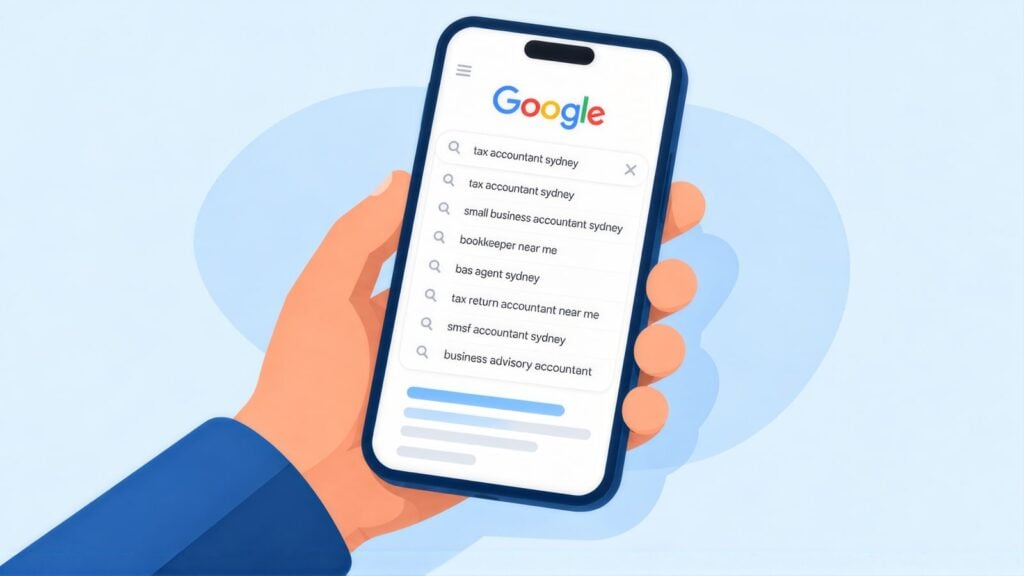
By the time someone searches for an accountant, they have usually decided to hire one. Searches like accountant near me, “tax agent ” and “small business accountant [city]” come from people ready to make contact. Give them a clear page about what your practice does and who it helps, ranking near the top of the results.
The ATO’s lodgment program for tax agents spreads due dates from August through to May the next year. As a result, people search for accounting help all year round, with a peak from July to October. Write content for the whole lodgment calendar and for ongoing small business needs like BAS, payroll and advice, so that enquiries keep coming outside tax time.
Keyword Clusters That Drive Enquiries
Your practice serves several kinds of clients, and each one searches differently. An individual might look for a tax agent near me, while a business owner wants a BAS agent who knows Xero or MYOB. SMSF trustees look for a specialist in super funds.
Practice Discovery
accountant [suburb]
tax agent near me
CPA accountant [city]
small business accountant [area]
Individual Tax
tax return accountant
individual tax agent
tax accountant [suburb]
how much does tax accountant cost
Small Business
small business accountant
business tax accountant
bookkeeping and accounting
BAS agent [suburb]
SMSF
SMSF accountant
self managed super fund accountant
SMSF audit
SMSF setup accountant
Advisory
business advisory accountant
tax planning accountant
CFO services small business
accounting and business advisory
Specialist
investment property tax accountant
crypto tax accountant Australia
medical professional accountant
tradie accountant
Why each cluster matters: the data behind the opportunity
| Cluster | Why it matters | Source |
|---|---|---|
| Individual tax | About half of people already use an agent (see How Australians Search for an Accountant above). The rest come within reach when their tax gets complex. | ATO, April 2026 |
| Small business / BAS | BAS agents lodge activity statements every quarter or month, all year, so a business client brings work in every quarter rather than once a year. | ATO BAS Agent Lodgment Program, 2026-27 |
| SMSF | Every SMSF needs a yearly audit by an ASIC-registered SMSF auditor. That credential is separate from TPB registration. Fees are high, so clients choose mainly on trust and credentials. | ASIC SMSF auditor register |
| Specialist niches | Some people search for an accountant who knows crypto tax, investment property or their industry (medical, legal, trades). They want an accountant who knows their situation. Check each term’s searches and click costs in Keyword Planner before you build a page for it. | Your own Keyword Planner check |
How to prioritise
Start with practice discovery searches in the suburbs you actually serve, because these people are closest to calling. A Google Business Profile and a strong service page bring results fastest here. Next, write pages for the specialist clients you most want. A page for “investment property tax accountant Sydney” is easier to rank than a broad “accountant Sydney” page, and the people who find it are a closer match for the service.
Tax-time searches peak from July to October, but they do not stop after that. Small business searches like “BAS agent [suburb]” run all year. SMSF searches follow their own pattern rather than the tax-time peak, so check the monthly figures in Keyword Planner before you time SMSF content. Writing content for each pattern spreads your enquiries across the year.
- List every service you offer and every suburb you serve.
- Check how often people search for each service and suburb pair, using Google Keyword Planner or Google Search Console.
- Treat the pairs with real demand as your content plan.
- Build suburb-level service pages and specialist pages first. Leave broad city terms for later.
Website Foundations: What Google Needs First
Google has to find, read and display your site before your content can rank. Accounting sites often have problems at this stage, particularly older sites that were built without SEO in mind and rarely updated.
Four checks cover most of it:
- Set up Google Search Console, a free tool that shows how Google sees your site. Verify your site and submit your XML sitemap, which is the list of pages you want found. Check your five most important pages, and give every error an owner and a fix-by date. This Google Search Console setup guide takes you through each step.
- Open your site on a phone and time how long it takes to send an enquiry. A new client should be able to finish in under 60 seconds, and Google indexes your site based on its mobile version.
- Make every page load securely over HTTPS, because your site handles private financial questions. If the security (SSL) certificate lapses, browsers warn visitors away from the site.
- Check page speed by testing your key pages in Google PageSpeed Insights, and fix anything rated “Poor“. Large images and heavy web fonts are common causes.
Then look for orphan pages, which are pages no other page links to. A suburb page that only appears in the sitemap is a common one. Link each one from its main service page.
The Pages Every Accounting Practice Site Needs

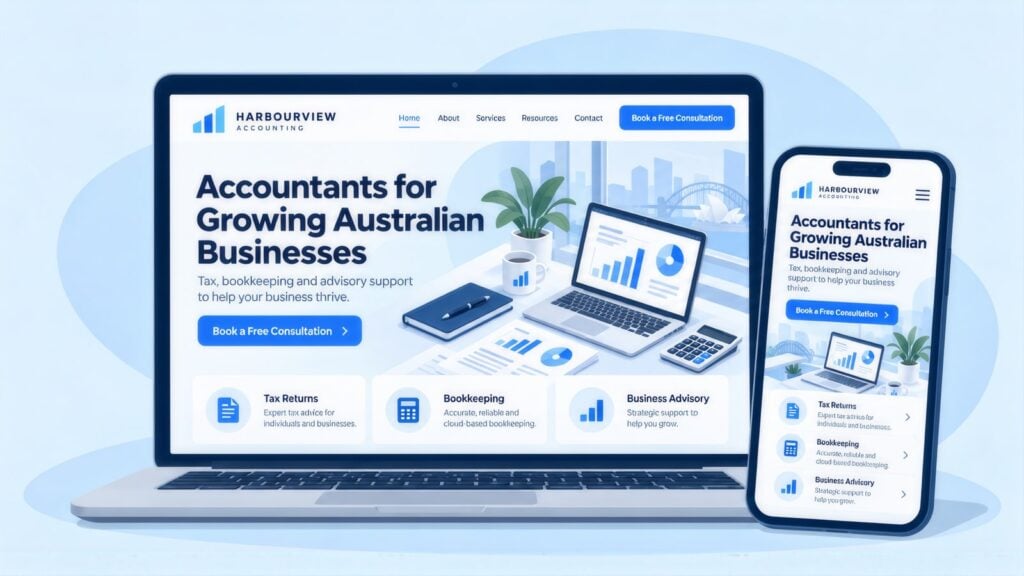
Organise the site around a main services page, with a page for each service and each location linked from it. Each page should have one clear job and one clear reader.
| Page | Focus keyword | What to include |
|---|---|---|
| Tax Agent / Accountant [City] | accountant [city] or tax agent [city] | Services, TPB registration, team credentials, how you set fees, how to enquire, reviews, FAQs |
| Individual Tax Returns | tax return accountant [city] | What’s included, records to bring, due dates with conditions, fee range, FAQs |
| Small Business Accounting | small business accountant [city] | BAS, payroll, bookkeeping and compliance, how you onboard clients, software you use (Xero, MYOB, QuickBooks), fees |
| SMSF Accounting | SMSF accountant [city] | ASIC auditor registration, services covered, fees, what to bring, how referrals work |
| Tax Planning / Advisory | tax planning accountant [city] | What tax planning involves, when to start, results for the business, how meetings work |
| About / Team | [practice name] accountant | Named practitioners, CPA or CA designation, TPB number, years of experience, specialties |
Pages for specific clients, such as crypto tax, investment property, medical professionals or tradies, match a searcher who has a particular situation and wants an accountant who understands it. If you serve these groups, give each one its own page that shows you know the detail. These pages also face less competition than broad city terms.
Location pages
If you serve several suburbs, give each one its own page written about that area rather than a template with the suburb name swapped in. Mention the kinds of local businesses, any big employer or industry your clients work in, and which team members look after that area. This local detail helps the page rank, and without it Google may treat the page as a doorway page, a thin copy made only to catch searches.
What every page needs
- One main heading (H1) that closely matches the focus keyword
- An opening paragraph of 60 to 120 words: who the page is for, what you do, and what happens next
- Your TPB registration number on tax service pages
- A clear fee line: a price, a range, or what decides the quote
- 6 to 10 FAQs that answer real client questions, with FAQPage schema added
- At least one link to an official source when you mention tax rules
- A clear next step: an enquiry form, a phone number or a booking link
Check your site against this page list. Note every service that has no page of its own and add it to your content plan, then pick one specialist client group each missing page could also serve.
Title Tags and Meta Descriptions for Accounting Pages
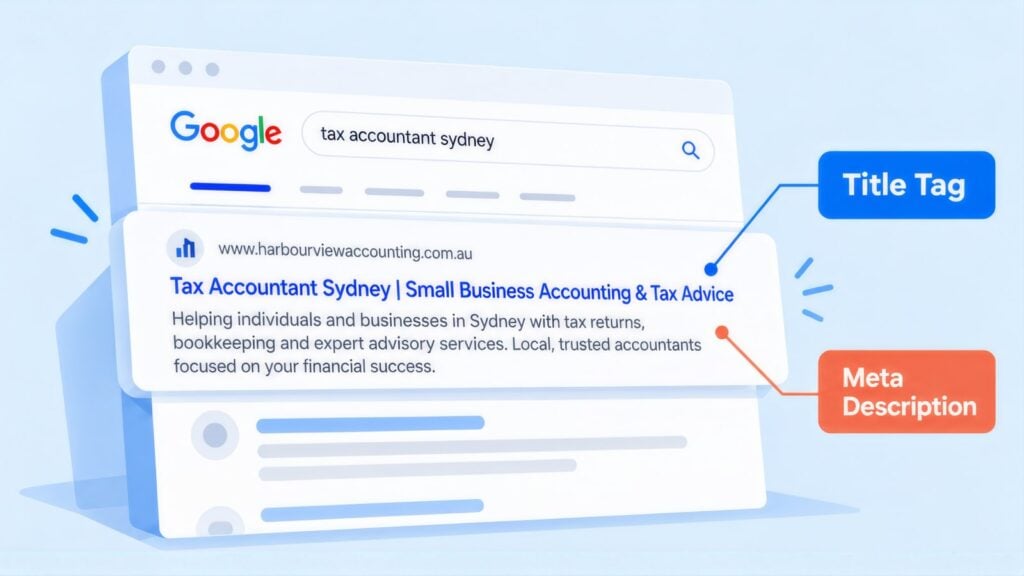
The title tag is the blue headline of your page in Google’s results. The meta description is the short summary under it. Together they decide whether a searcher clicks through to your page, so write them as you would write ad copy, describing the service and why someone should choose you. A keyword and meta planner lets you draft them page by page and spot two pages chasing the same search.
Title tag examples
A practice name such as “Smith and Partners Chartered Accountants” would fill most of a title on its own, so these examples start with the service and suburb. Add the name at the end only when the whole title stays within 55 characters. Google normally prints your site name above the result, which makes the name the first part to drop.
| Page | Example title tag | Characters |
|---|---|---|
| Main service / home | Accountant Sydney | Tax, Business & SMSF | 40 |
| Individual tax returns | Tax Return Accountant Sydney | Rental and Salary | 48 |
| Small business | Small Business Accountant Sydney | BAS and Payroll | 50 |
| SMSF | SMSF Accountant Sydney | Registered Tax Agents | 46 |
| Location page | Accountant Parramatta | Tax Agent and BAS Help | 46 |
| Crypto tax | Crypto Tax Accountant Sydney | ATO Reporting | 44 |
Meta description examples
| Page | Example meta description | Characters |
|---|---|---|
| Main service | Accountant in Sydney for individual returns, small business, SMSF and advisory work. Registered tax agents, fees confirmed upfront. Book a meeting. | 147 |
| Individual tax | Tax return accountant in Sydney for salary, rental property and investment returns. Registered tax agents, fee agreed upfront. Book online today. | 145 |
| Small business | Small business accountant in Sydney for BAS, payroll, bookkeeping and tax. Fixed monthly packages so you know your costs ahead. Get a quote today. | 146 |
| SMSF | SMSF accountant in Sydney for fund accounts, ATO lodgments and coordinating your independent annual audit. Registered specialists. Book a free call. | 148 |
None of these examples promises a refund, because a meta description is held to the same ACCC standard as an ad (see Compliance First: TPB, ACCC and YMYL Rules for Accounting Marketing above).
Schema Markup: AccountingService and FAQs

For a practice, the first piece of schema markup to add is AccountingService on the homepage. Schema is code in the page that labels your type of business, address, phone, hours and service area so search engines can read them without guessing. Five types cover a typical accounting site:
- AccountingService on the homepage and About page. AccountingService is the schema.org type for accountants, and it is a kind of LocalBusiness. There is no AccountingFirm type, so markup that uses it will fail.
- Person on author and team pages. It links your articles to a named, qualified practitioner.
- Article on blog posts and tax guides. It carries the author and the date.
- BreadcrumbList on every page below the homepage. It shows the page’s place in your site, such as Home > Services > SMSF Accounting.
- FAQPage on service pages with FAQs. It no longer adds a dropdown to your result. Google limited FAQ results to government and health sites in August 2023 and stopped showing them from 7 May 2026. It is still worth adding, because it shows search engines and AI tools which text is the question and which is your answer.
FAQs that deserve schema: the questions accountants get asked
Build your FAQs from the questions your front desk answers every week. Good topics include:
- what to bring to the first meeting
- how your fees work
- how a tax agent differs from an accountant
- how long lodgment takes
- whether you handle rental properties and rental income
- what happens if the client owes the ATO
Questions like these often appear in Google’s “People Also Ask” box for accounting searches, and a short, direct answer on your page is the format that box quotes.
In practice, add FAQPage schema to every service page that has FAQs and AccountingService schema to your homepage, then test all markup in Google’s Rich Results Test before you publish. Keep each FAQ answer to one to three full sentences, which gives the reader enough detail and keeps the answer short enough for search engines to quote.
How to Link Your Tax, BAS and SMSF Pages
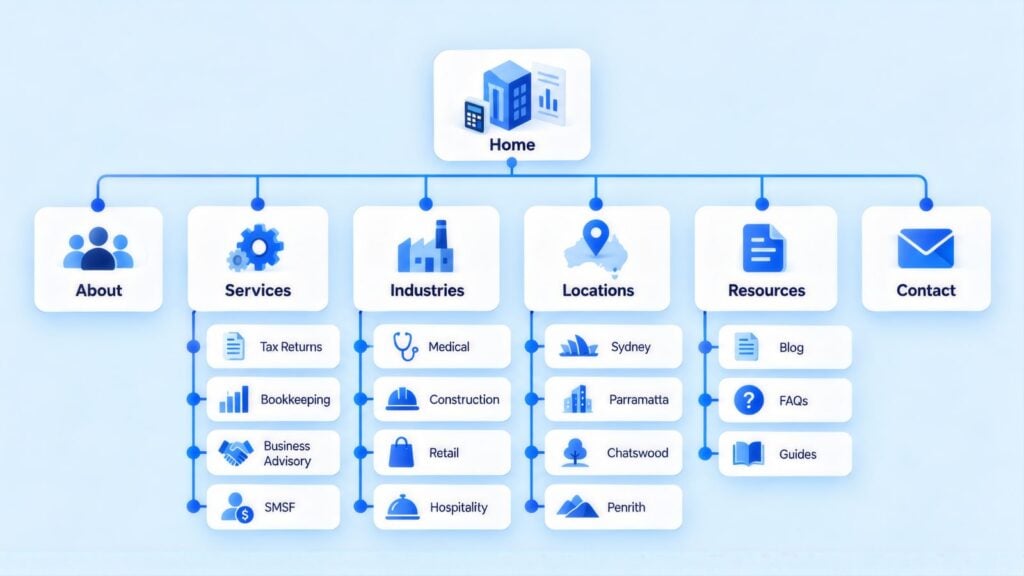
Internal links are the links between your own pages. They help Google see how your site fits together and which pages matter most. Most accounting sites have no plan for them and rely on the main menu alone, which leaves many service and suburb pages with few links pointing to them.
The hub-and-spoke model for accounting sites
Your main service page, such as “Accountant Sydney”, is the hub. Your individual tax, small business, SMSF and advisory pages are the spokes. The hub links to every spoke using varied, natural wording, and every spoke links back to the hub. Also link spokes to each other where a client would move between them. Someone reading about small business accounting may also want your BAS or tax planning page.
Anchor text for accounting practice pages
Anchor text is the clickable wording of a link. It should tell the reader, and Google, what the next page is about.
| Destination page | Avoid | Use instead |
|---|---|---|
| Individual tax returns | “tax returns” | “lodge your individual tax return”, “individual tax agent services”, “personal tax return help” |
| Small business accounting | “small business” | “accounting for small business owners”, “BAS and business tax services”, “how we support growing businesses” |
| SMSF page | “SMSF” | “SMSF accounting and audit”, “SMSF compliance services”, “registered SMSF accountant” |
| About page | “About us” | “our registered tax practitioners”, “the team behind your accounting”, “our TPB-registered accountants” |
Blog to service page links
Every article should link to the service page it relates to most. An article on rental property deductions links to your individual tax page or investment property page. One on setting up a company links to small business accounting. Place the link within the body of the article, where it fits the sentence around it. Short, descriptive link wording works best, and this guide to anchor text shows which phrasings help and which hurt.
Tax Guides and Articles That Bring In Clients
Taxpayers and business owners search Google for answers to tax questions throughout the year. An article that answers one of those questions well, with a practitioner’s name and a date on it, can bring in enquiries long after tax time.
What to write about
| Topic | Example articles |
|---|---|
| Tax time and lodgment | What records to gather before you see your accountant. How long a return takes with an agent versus lodging yourself. What to do if you owe the ATO money. |
| Investment property | Which rental expenses you can claim. Negative gearing in plain words. How capital gains tax applies to an investment property. |
| Small business | When to move from sole trader to a company. What BAS compliance involves. How to set up payroll for your first employee. |
| SMSF | When an SMSF makes sense and when it does not. What the yearly audit involves. Contribution limits and the risk of going over them. |
| Newer topics | How the ATO treats crypto. Tax on side hustles and gig work. Home office deduction rules since the pandemic. |
| ATO dates and deadlines | A full-year calendar of tax agent due dates. What happens if you miss a BAS deadline. How an ATO payment plan works. |
Content standards for accounting articles
A named, qualified practitioner should write or review every article. Their byline should show their qualifications and TPB registration. Put a date on every tax rate, threshold and deadline, and review them at least once a year. A 2022 article on working-from-home deductions that ignores the 2024-25 changes, for example, misleads readers and suggests to Google that nobody maintains your site.
Aim for 1,200 to 2,000 words on in-depth guides and 800 to 1,200 on news and updates. Link every article to at least one official source (ATO, ASIC, Treasury) and at least one of your service pages.
Getting quoted in AI answers and the press
Google’s AI Overviews cite many of the pages that rank in normal results, but not only those. In CCM’s September 2026 captures, many of the sources cited on accounting searches sat outside the top 10 (see the research above). A clear, dated article that answers one tax question well gives you a chance of being cited even before it ranks on page one. Shaping pages so AI tools can find and quote them is often called AI search optimisation, and it uses the pages you already build for SEO.
Journalists covering the federal Budget or tax time want practitioners who can explain a change in plain words. Short expert commentary from your principal in a local paper or trade publication builds trust and often earns a link back to your site.
Ask your front desk which three questions new clients ask most before their first meeting. Write a clear answer to each. Add a named practitioner and a date, then link it to the service page it fits best.
Local SEO for Accountants: Winning Your Suburb
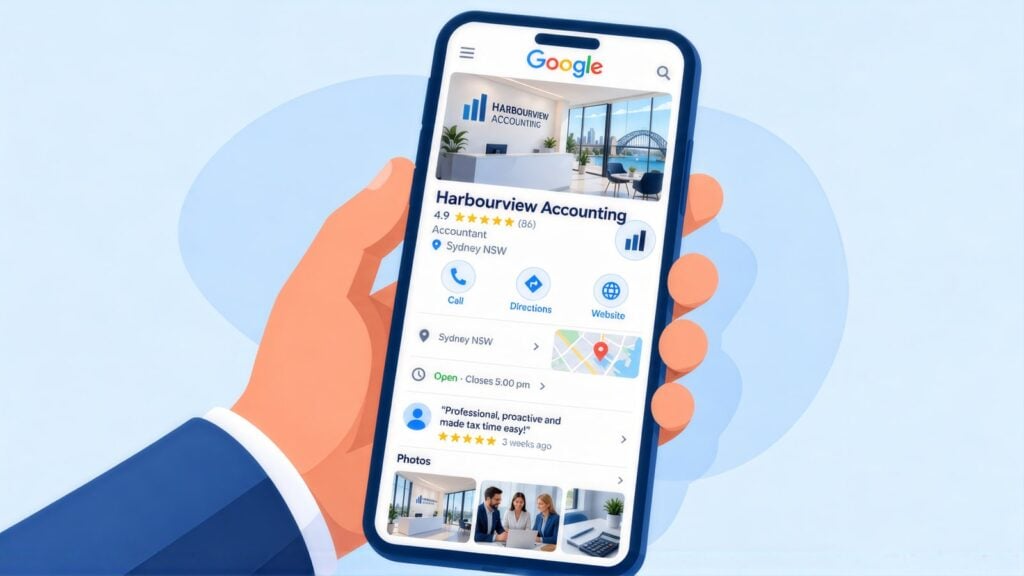
Accounting is a local business built on relationships, and most practices draw most of their clients from a set area. Good local SEO for accountants makes sure people in that area find you first.
Google Business Profile for accounting practices
Your Google Business Profile is the listing that appears in the map results. Fill in every field honestly:
- Business name: your exact trading name, with no suburb or keyword added.
- Main category: Accountant, unless tax preparation or bookkeeping really is your main service. Add Tax preparation service, Bookkeeper or Financial consultant as extra categories where they fit.
- Services: list each one, such as individual tax returns, small business accounting, BAS lodgment, SMSF accounting, tax planning and bookkeeping. Each one helps Google match you to a search.
- Hours: show when you are really available, including after-hours or phone appointments.
- Website link: point it at your best-matching service page, not the homepage.
- Photos: a team photo, the office if clients visit, membership badges and a professional photo of the principal.
Google reviews for accounting practices
Reviews help you rank in the map results. They are also the first thing a new client reads before deciding to call. Ask every client for a review at a set point, such as after a lodgment or a key milestone. Keep the request neutral by thanking them for their business and explaining that a Google review helps other people find you. Do not script the review or offer any incentive, and never mention a client’s finances in a public reply.
Never confirm in public that someone is a client without their consent, because tax records are confidential. A reply that confirms the relationship, or mentions their tax affairs, may breach your duty of confidentiality. A safe reply that confirms nothing about the reviewer is: “Thanks for taking the time to write this. We appreciate it.”
Directory listings for accounting practices
Keep your NAP (name, address and phone) the same everywhere it appears. That includes Yellow Pages, True Local and professional directories like CPA Australia’s find-an-accountant listing, the CA ANZ directory and the TPB public register. Matching listings mean clients and search engines never find two versions of your address or phone number. Clients can look you up on the TPB register, so make sure your entry there is complete and correct.
- Claim and complete your Google Business Profile.
- Check that your TPB registration is correct and easy to find on the public register.
- Make sure your CPA Australia or CA ANZ listing matches your Business Profile.
- Send your review link to every client from the past 90 days, with a short, neutral message.
Google Ads for Accountants: Setup and Compliance
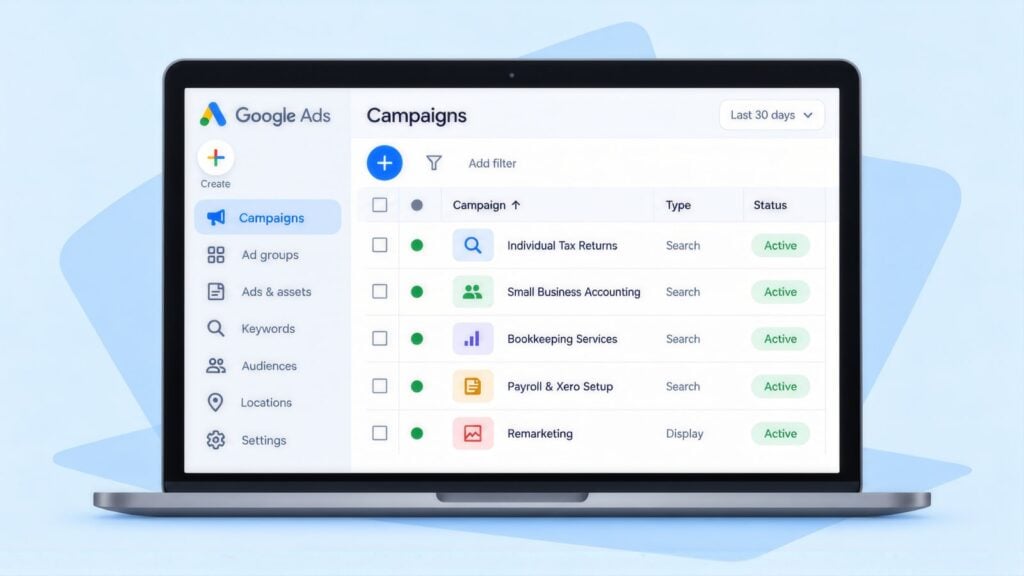
Google Ads works well for practices that run tight, well-planned campaigns. Clicks on most suburb and service searches cost a moderate amount, and the people clicking are ready to hire. Once the rules in Compliance First: TPB, ACCC and YMYL Rules for Accounting Marketing are sorted, your main risk is paying for clicks from the wrong people.
Campaign structure
Start with one campaign, one service and one area. The first campaign should show you which searches bring real enquiries, what a good lead costs in your market and whether your landing page works. If you spread the budget over every service and suburb on day one, each one gets too few clicks to tell you anything.
| Decision | What we set up for a practice |
|---|---|
| Campaign type | Use Search ads only at first, because the search terms report shows the exact searches behind each click and lets you spot job seekers and software users early. |
| Location targeting | Show ads only to people who are in your service area. Leave out people elsewhere who have just shown an interest in it. |
| Ad schedule | Run ads when your front desk or intake team can respond, so each enquiry gets a reply while the person is still choosing a practice. |
| Bidding | While the account is new, set your own maximum cost per click (manual CPC) or let Google get as many clicks as your budget allows. Once about 30 real enquiries are recorded, test a strategy that aims for a set cost per lead (target CPA) or for the most leads. |
| Account ownership | You must own your Google Ads account, with your own billing details. An agency should manage it through a linked manager account. If your agency owns the account now, have it moved into your name before you spend any more. |
Tax time campaign timing
Launch your individual tax campaign in early July, when lodgment opens. Run it through October, while self-lodgers face their deadline. In the weeks before 31 October, change the message for people who have not lodged yet. They can still join an agent’s lodgment program and have until May, as long as they contact a registered tax agent before that date. Run small business and SMSF campaigns all year. Adjust the message around the quarterly BAS cycle and the end of the financial year.
We do not publish an accounting client result, so this is the closest local lead result we can quote. For a North Shore trades client, Google Ads work produced a 48% reduction in cost per lead and a 71% increase in qualified inbound calls within 60 days. The result is listed with CCM’s digital marketing strategy work. The same methods apply to a practice: tight location targeting, a good list of blocked searches, and a page that answers the enquiry.
Remarketing and lead capture for tax season
Many people who click a tax ad in July are not ready to book that day. Offer a free tax time checklist they can download in exchange for an email address. It can cover records to gather, deductions to look for and the 31 October cut-off. A short follow-up email series then brings them back when they are ready.
Pair it with a small display remarketing campaign. These image ads follow up people who visited a service page. Cap how often they see the ad so it does not chase them for months.
If July and August bring far more enquiries than usual, decide in June who answers them and how fast. Also agree how each lead is logged in your CRM or practice software. Plan for an enquiry in late July to get a reply the same day.
Tax Agent Keywords, Negatives and Ad Copy
Your keywords decide who sees your ads, and your negative keywords (the words you block) decide who does not. Bid on searches from people ready to hire, block job seekers and software users before launch, and keep refund promises out of your ads.
Keyword selection
| Intent level | Example keywords | What to do |
|---|---|---|
| High (ready to hire) | “accountant “, “tax agent near me”, “small business accountant [city]” | Include these as your main terms. |
| Medium (comparing options) | “best accountant Sydney”, “how much does an accountant cost”, “accountant vs. myTax” | Include them with care, because they can bring good enquiries if the landing page filters people well. |
| Low (not your audience) | “accountant jobs”, “accounting software”, “MYOB”, “Xero tutorial” | Block these before launch. |
| Free services | “free tax return”, “ATO myTax”, “tax help community” | Check each one, because some are real enquiries with a price question while others want a free government service. Read the actual searches before you block any of them. |
Negative keywords to add before launch
A starting list: jobs, salary, career, course, degree, training, certification, DIY, free, myTax, software, template, spreadsheet, and software brands (MYOB, Xero, QuickBooks). Check your search terms report weekly for the first 60 days and block anything you are paying for that does not fit.
Ad copy: what you can and cannot say
The ACCC and the ATO both publish guidance on what tax agents can claim in ads. Do not promise a refund amount you cannot back up, use “maximum refund” unless you can prove it, or suggest a return is approved before it is lodged. Ads that state the service and the fee clearly can still perform well within those limits.
| Ad part | Example |
|---|---|
| Headline 1 | Tax Agent [Suburb] |
| Headline 2 | TPB-Registered Tax Agents |
| Headline 3 | Individual, Business & SMSF |
| Headline 4 | Book a Free Consultation Today |
| Description 1 | Tax agents for individual returns, rental properties and small business. Fixed fees. |
| Description 2 | Know your fee before you start. Registered tax agents in [Suburb]. Book a call today. |
Landing Pages That Turn Tax Searches Into Bookings

The page behind your ad decides whether someone enquires or leaves. Most prospects want to know what you do, what it costs and what happens next. A page that matches the ad and answers those questions gives you the best chance of an enquiry. A general homepage rarely answers them, which is why a dedicated landing page design usually converts better.
The closest client we can quote is a lender, not an accounting firm. It had a problem many practices share, with too many enquiries that were never going to go ahead. CCM rebuilt its Google Ads account and landing page. Within 90 days, LendInsure recorded:
- a +54% increase in qualified enquiries
- a -31% cost per acquisition reduction, meaning each new customer cost less to win
- a +18% improvement in approval-to-lead ratio, meaning more leads went on to be approved
The figures appear in the LendInsure landing page results. The new page filtered out unsuitable people before they enquired, and a clear fee line can do the same for a practice.
What a converting accounting landing page needs
- A headline that matches the ad. If the ad says “Tax Agent Parramatta”, the page heading should confirm the visitor is in the right place.
- Your TPB registration number, because new clients check it and seeing it reassures them.
- A clear fee structure, since even a range or “fees from $X” tells a visitor more than “contact us for pricing”.
- What to bring to the first appointment, which is the most practical question a new client has.
- Named practitioners with credentials, such as a team photo with a named CPA or CA, which builds more trust than a stock photo.
- Google reviews with your star rating, which often decide the choice when two practices look alike.
- A short enquiry form that asks only for name, phone, email and the service needed.
- Another way to get in touch: a phone number people can tap, and an email address for those who prefer not to use forms.
A landing page with no fee at all leaves a new client to guess, or to call just to ask. Here is a sample fee line: “Individual tax returns from $275. More complex returns (investment properties, rental income, multiple employers) from $375. We confirm your fee before we start.” A line like this answers the first question most visitors have and screens enquiries, since price-sensitive clients ask about fees anyway.
Conversion Tracking: Enquiry to Signed Engagement
Counting form fills is only a starting point. The useful measure is how many enquiries become consultations and then signed clients, because that shows which services and suburbs bring in more than they cost.
| Stage | What to record | How to use it |
|---|---|---|
| Enquiry received | The form, call or email, with the date, the source and the service asked for. | Shows how many leads you get. It is too broad to tell Google Ads what a good lead looks like. |
| Consultation attended | The date the meeting or call took place, and whether the service is a fit. | When the numbers build up, make this the result Google Ads bids for. |
| Signed engagement | The date the engagement letter is signed, the service, and the agreed scope and fee. | This is the result that brings in revenue, so track it for every campaign. |
| Retention | Whether the client comes back next year, and the result of their yearly review. | Shows what a client is worth over time, which tells you how much you can spend to win one. |
Setting up tracking
A conversion is any action you count as a result, such as a form sent. You can track forms through Google Ads conversion tracking. You can also mark them as key events in Google Analytics 4 (GA4) and import them into Google Ads. Most sites install this tracking through Google Tag Manager (GTM), and a GA4 and GTM specialist can set it up properly.
Phone calls need call tracking software, such as CallRail. Set a minimum call length of 60 to 90 seconds so only real enquiries count. In Google Ads, set each enquiry action to count one conversion per click, so a person who sends your form twice counts as one lead. Check your Google Ads conversions against your CRM each month to catch double counting or broken tracking before it affects your bidding.
Judge your ads by the cost per signed engagement rather than the cost per click. The figures in this worked example are assumed for illustration, not taken from a client account:
| Step | Result |
|---|---|
| You spend on ads | $2,400 |
| You get enquiries | 40 |
| They become consultations | 20 |
| You sign new clients | 8 |
| Each signed client costs | $300 |
Whether $300 pays off depends on the yearly fee and how long the client stays. It is a strong return on a business client paying $1,500 a year and a loss on a $275 tax return, so track each service separately.
A Four-Quarter Plan Built Around the Lodgment Calendar
Plan in financial-year quarters rather than calendar quarters, so each piece of work is ready before the demand it is meant to catch. The table assumes you start in Q4 (April to June).
If you start at another time of year, do the Q4 work first: tracking, your Business Profile and your main service pages. Then pick up the table at the next quarter.
| Quarter | What clients are doing | SEO and site work | Google Ads and measurement |
|---|---|---|---|
| Q4: Apr to Jun | Clients plan for the end of the financial year, and business owners review their structure. | Fix the foundations set out in Website Foundations: What Google Needs First and complete the Google Business Profile. Put your TPB number on every tax page, then publish the individual tax and small business pages. | Set up tracking through to signed clients and build your blocked search list. Prepare the tax time checklist and remarketing audience, and decide who answers July enquiries. |
| Q1: Jul to Sep | Individual tax searches peak after lodgment opens on 1 July. | Publish dated tax-time guides, such as records to gather and rental deductions. Ask for a review after each lodgment. | Run the individual tax campaign in one area first, check search terms weekly and judge it on cost per consultation. |
| Q2: Oct to Dec | Self-lodgers face 31 October. Late lodgers look for an agent. | Add suburb pages for the areas that sent Q1 enquiries. Update the About page with practitioner credentials. | Switch ads to the agent lodgment message before 31 October. Then move budget to small business and BAS searches. |
| Q3: Jan to Mar | Individual demand is quieter, while the BAS cycle and business planning carry on. | Write SMSF, advice and specialist pages (crypto, property, medical, trades). Refresh any guide with old thresholds. | Review cost per signed client by service and cut the weakest keywords, then decide which service gets more budget next July. |
If you are reading this in August or September, avoid launching new campaigns into the peak. Use the time to fix your tracking, your profile and your main service page so the tax-time traffic you already get turns into more clients. Then have your Google Ads build ready before 1 July next year.
SEO and Google Ads for Accountants: Common Questions
How long does SEO take for an accounting practice?
Timing against the lodgment calendar matters most. A suburb page published in April or May has time to settle before July, while one published in August mostly misses that year’s peak. Searches like tax agent usually move first, about 3 to 4 months after your Google Business Profile and service page are complete. City-wide terms held by older firms often take 6 to 9 months. After 12 months, each new review and dated tax guide builds on what is already there.
How much does SEO cost for an accounting firm in Australia?
The cost grows with your service list. A sole practitioner doing tax returns in one suburb needs a handful of pages. A firm offering tax, BAS, SMSF and advice from several offices needs a page for each pairing, plus time to check every claim against TPB and ACCC rules. The state of your site, and how many established firms hold your city terms, add to it. Agencies charge from $1,500 to more than $10,000 a month for this work. An in-house hire costs $80,000 to $170,000-plus a year once salary, software and training are counted, according to this agency versus in-house SEO costs comparison. Put a value on a signed business client with an SEO ROI calculator before you decide where in that range to sit.
Can I do SEO for my accounting practice myself?
Yes, a practice manager can handle the basics: a complete Google Business Profile, a page for each service, regular review requests and your TPB number on every tax page. Most firms need help with the technical work, keyword research across suburbs and services, and tracking enquiries through to signed clients. Start with the local setup in Local SEO for Accountants: Winning Your Suburb. After a quarter, decide whether the gaps justify outside help.
What do Google Ads clicks cost for accountants in Australia?
In CCM’s Google Keyword Planner pull of 1 October 2026 (Australia), top-of-page bids for accountant near me ran at about $2.40 to $8.60 a click. “Small business accountant” costs more, at about $7 to $27 a click, and “SMSF accountant” about $3 to $12. CCM’s analysis of Keyword Planner data for the 12 months to July 2026 shows around 12,100 searches a month for accountant near me. Your real cost changes with your suburb, the competition and the quality of your ads, so judge the account on cost per signed client.
Should an accounting practice start with SEO or Google Ads?
Run both if you can, with Google Ads first for speed. One Search campaign shows within 60 days which searches turn into consultations. That tells you which service pages to build for SEO. SEO takes longer to build, but it keeps bringing enquiries without paying for each click.
Is Google Ads worth it for accountants?
Yes, when a client’s yearly fee clearly outweighs what it cost to sign them. The illustrative example in Conversion Tracking: Enquiry to Signed Engagement shows how the same $300 per signed engagement pays off on a business client and loses money on a basic tax return. Point most of your budget at business, SMSF and advisory work, where the fee justifies the click.
Can I advertise a “maximum refund” in my ads?
Only if it holds true for every client, which it almost never does. The ACCC position in Compliance First: TPB, ACCC and YMYL Rules for Accounting Marketing applies to ad headlines as much as to your website, and Google Ads policy blocks the same claim. Describe the work instead, such as finding every legitimate deduction, and state your fees.
How does an accounting firm appear in Google’s AI Overviews?
It needs the same basics as normal search, although AI Overviews also cite pages outside the top 10 results. Google’s guidance on AI features says AI Overviews and AI Mode need nothing beyond what normal results need: a page that is indexed and can show a snippet. Clear answers to client questions, named practitioners with TPB details and matching business listings give AI tools something reliable to quote.
Andrei Jach is Senior Manager, SEO and Analytics Specialist at Click Click Media in Sydney, with over 15 years in digital marketing and strategy. He has led SEO for professional services firms as well as health, retail and manufacturing businesses, and oversees strategic SEO planning, analytics implementation and technical audits. He previously worked at Agent 6 Marketing and Red Propaganda.
Implement this playbook with AI
Opens your assistant with this playbook and seven questions about your business: services, area, website and ads. It then writes your keyword map, page plan and Google Ads starter build with your details filled in.
Copy the prompt for Gemini, Grok or any assistant that cannot open a prefilled link. The prompt points at this page, which is also served as Markdown to assistants that ask for it.
Work with Click Click Media
If you want fewer refund shoppers and more business, SMSF and advisory clients, plan your search work the way you plan a client’s year, quarter by quarter and timed to lodgment.
Click Click Media has worked in search since 2008 and brings Google Premier Partner status and over $115 million in managed Google Ads spend to that plan. The free audit we run for practices looks at your website, Google Business Profile, TPB details and fee wording, plus your Google Ads account if one is live. What it finds can shape SEO for your practice and Google Ads campaigns measured on signed clients. You are also welcome to take the notes and act on them in-house.
We work month to month with no lock-in contract. A senior strategist looks after your account from the first conversation.
Verified Sources and References
- ATO Tax Time Lodgment Statistics
- ATO Registered Agent Lodgment Program 2026-27
- ATO: Lodgment due dates for individuals and trusts
- ATO: Lodge with a registered tax agent
- ATO: SMSF auditor professional requirements
- ASIC: SMSF auditor registration
- Tax Practitioners Board: Public register
- ACCC: False or misleading claims
- Google: Rich Results Test
- Schema.org: AccountingService
- Google Search Central: Changes to HowTo and FAQ rich results (August 2023)
- Google Search Central: Documentation updates (FAQ rich result removed, May and June 2026)
- Google Search Central: AI features and your website
Last checked October 2026 · next review January 2027
