
SEO for Cosmetic Clinics in Australia: Search, Google Ads and TGA Rules
Written by Andrei Jach, Senior Manager, SEO and Analytics Specialist at Click Click Media · Updated 1 October 2026
Australia’s medical aesthetics market reached USD $396.4 million in 2025 and is forecast to grow by 7.89% a year. Aesthetic clinics are also the fastest-growing buyers of aesthetic devices, at a projected 13.02% a year to 2031. SEO for cosmetic clinics, and any Google Ads you run beside it, has to work within some of the toughest advertising rules in Australian health.
Many cosmetic injectables are prescription medicines, and the Therapeutic Goods Administration (TGA) decides which ones. The Therapeutic Goods Act 1989 bans ads for these medicines to the public. The hard part is that you can promote your clinical service but not the medicine used to deliver it. The ban also covers indirect promotion, so your words, images and context all count.
For that reason this guide covers the TGA and AHPRA rules first, then treatment pages, local search and Google Ads. Working through your marketing in that order makes your campaigns far more likely to stay live.
Implement this playbook with AI
Opens your assistant with this playbook and seven questions about your business: services, area, website and ads. It then writes your keyword map, page plan and Google Ads starter build with your details filled in.
Copy the prompt for Gemini, Grok or any assistant that cannot open a prefilled link. The prompt points at this page, which is also served as Markdown to assistants that ask for it.
CCM Research: What Clinic Searches Showed in September 2026
In CCM’s Sydney capture of the search cosmetic clinic sydney on 3 September 2026, 8 of the 9 page-one organic results were clinic home pages.
Why it matters: On a broad clinic and city search, Google listed whole clinics rather than single treatments, so your home page is the page that competes for it.
For your clinic: State your city, your main treatments and who treats patients near the top of your home page. Leave treatment searches to your treatment pages.
Source: CCM search captures, Sydney, 3 September 2026
In CCM’s Sydney captures of laser hair removal near me on 3 September 2026, Laser Clinics Australia ranked first organically on desktop and mobile but held none of the 3 map-pack places.
Why it matters: The map places went to City Laser Clinic, Bella Pelle and Evolution Laser. Google ranks the map pack separately from the organic list, so a strong website does not put a clinic on the map by itself.
For your clinic: Keep a complete Google Business Profile for each location, with the right category, treatments, hours and recent reviews, alongside your treatment pages.
Source: CCM search captures, Sydney, 3 September 2026
How we ran it: CCM captured Google’s first page for six searches on 3 September 2026 using the DataForSEO search results API, one capture per search and device. “Laser hair removal near me” and “botox near me” (desktop and mobile) and “cosmetic clinic sydney” (desktop) were set to a Sydney location. “Lip filler cost”, “how long does botox last” and the owner search “cosmetic clinic marketing” were captured Australia-wide on desktop. A home page is a result whose address is the site’s root, and map-pack places can change within a day.
Why Cosmetic Clinic Marketing Starts With the TGA
Google Keyword Planner shows about 6,600 searches a month for skin clinic near me and 1,600 for “cosmetic clinic” across Australia (CCM analysis of Google Keyword Planner data, Australia, 12 months to August 2026). Keyword Planner groups close variants, such as singular and plural forms, into one figure. In the big cities, you compete for those searches with specialist clinics, dermatologists, day spas and GP-run cosmetic practices. Every page and ad you run for those searches has to meet the advertising rules first.
Many cosmetic injectables are Schedule 4 medicines, which means prescription-only. The Therapeutic Goods Act 1989 bans advertising them to the public, however you describe the treatment. The ban goes further than the brand name, because the TGA’s guidance on advertising prescription medicines to the public says indirect references still count. It no longer accepts generic terms such as wrinkle reducing injections where readers would take them to mean a prescription medicine. A page can also break the rules if the effects it describes point clearly to one product. Have a health advertising compliance specialist check any injectable content before it goes live.
The TGA and AHPRA Rules Every Clinic Page Must Meet
Two regulators shape every clinic page and ad. The TGA controls how medicines and medical devices are promoted. AHPRA (the Australian Health Practitioner Regulation Agency) and the national boards, such as the Medical Board of Australia, set how doctors, nurses and other registered health staff can advertise. Their rules cover testimonials and the job titles staff use.
| Rule | What it means for your clinic | How to meet it |
|---|---|---|
| TGA: prescription medicine ads | You cannot advertise Schedule 4 medicines to the public. Many injectables are Schedule 4. The ban applies whatever name or body-area term you use, if the ad makes the product clear. | Have a TGA compliance expert check each injectable page before it goes live. The TGA looks at context, images and implied effects. An ad that swaps the brand name for a generic term can still breach the rules. |
| TGA: indirect promotion | A page can advertise a prescription medicine by association, even if it never names it. Before and after results from a prescription medicine count. | Get a TGA review before you publish any before and after photo that shows a prescription medicine’s effect. A “results may not be typical” line does not make a banned ad compliant. |
| AHPRA: outcome testimonials | AHPRA’s advertising guidelines ban testimonials about medical results for registered health staff. If anyone who treats at your clinic is registered with AHPRA, testimonials about their results are out. | Check every testimonial and case study. Remove or edit any that mention a clinical result. “I loved the experience” is fine. “My wrinkles are completely gone” is a clinical outcome testimonial. |
| Job titles and claims | Titles that suggest specialist training must be true. “Cosmetic surgeon” has a set meaning that may not match a doctor’s training and registration. Since 2 September 2025, AHPRA’s cosmetic procedure advertising guidelines also ban ads that glamorise higher-risk non-surgical procedures, overstate results or target under-18s. | Use only titles you can prove, and get the registration type, medical degree and further training right. Have each claim about training checked before it goes live. |
A compliant clinic keeps the following out of every page and ad:
- Prescription medicine brand names, and generic terms that point to them.
- Prices for injectables that need a script.
- Before and after photos of a prescription medicine’s result that have not had a TGA review.
- Testimonials that talk about results.
Compliance Checks Before a Clinic Page Goes Live
Three checks find most problems before a page goes live. Review the words and images against TGA rules, look up every device on the ARTG, and keep clinical records away from your marketing tools.
TGA review before content goes live
Any page that mentions injectables, prescription devices or goods on the ARTG needs a check first. Check it against the Therapeutic Goods Act 1989 and the Therapeutic Goods Advertising Code. Do this before you publish, and again each time you update the page.
ARTG status for devices and goods
Laser, IPL, radiofrequency and ultrasound machines are therapeutic goods, and the TGA regulates them. Each one must be listed on the ARTG before it can be legally supplied and marketed in Australia. Look up every device you use on the Australian Register of Therapeutic Goods before you claim anything about its safety or results. Advertising a device that is not listed is a TGA breach.
Clinical records vs marketing
Keep patient records well away from your marketing systems. That includes treatment histories, assessment photos and any before and after image linked to a patient. None of it should reach ad platforms, analytics or social scheduling tools. The only exception is clear, informed consent that meets AHPRA’s rules and the Privacy Act 1988. The OAIC, the national privacy regulator, treats this material as sensitive health information.
SEO for Cosmetic Clinics: Keyword Clusters by Concern
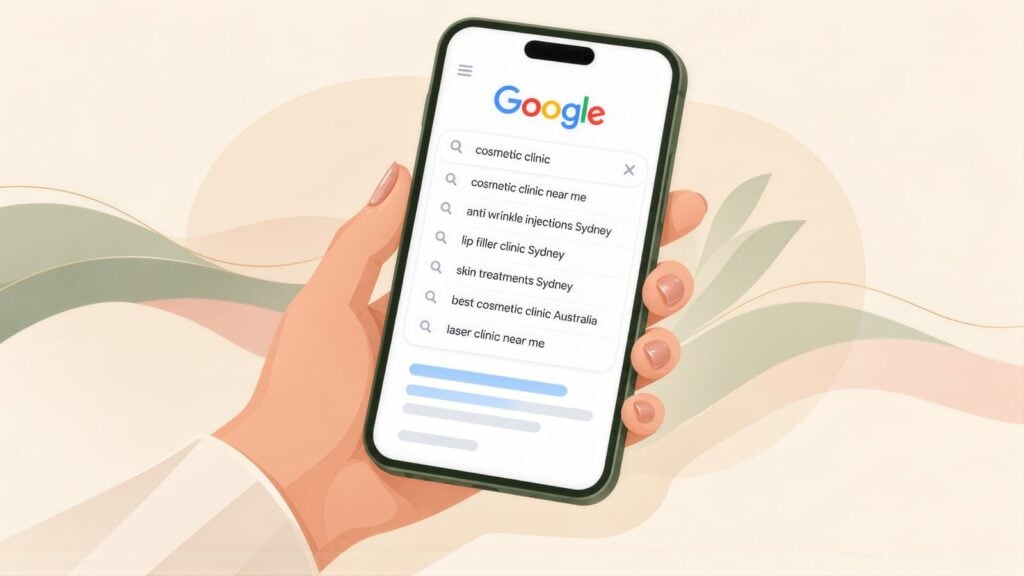
Once those checks are in place, you can plan your treatment pages. Patients search by concern, treatment, clinic and price. Build pages around concerns and non-prescription treatments first, and hold anything that touches injectables until a compliance specialist has checked it.
Skin Treatments
skin clinic [suburb]
skin rejuvenation [area]
chemical peel [suburb]
LED facial [suburb]
Laser Treatments
laser skin [suburb]
laser hair removal [area]
IPL treatment [suburb]
fractional laser [city]
Injectable-Adjacent (Review First)
lip volume consultation [suburb]*
lip enhancement [area]*
facial contouring [suburb]*
collagen stimulation [area]
Concern-Based
pigmentation treatment [suburb]
acne scar treatment [area]
rosacea clinic [suburb]
anti-ageing clinic [area]
Clinic Discovery
cosmetic clinic [suburb]
skin clinic near me
medical aesthetics [city]
cosmetic medicine [suburb]
Cost Research
cosmetic consultation cost [city]
skin clinic prices [suburb]
laser treatment cost [area]
cosmetic consultation [suburb]
* Starred terms may relate to prescription medicine treatments, so get a TGA review before any page targets them. Patients still type “dermal filler” and “anti-wrinkle” into Google, but the TGA no longer expressly permits those terms where readers would take them to mean a prescription-only product. Use them to understand demand, and keep them out of your ads and page titles. The TGA also treats prices for prescription injectables as likely advertising. Describing the concern, such as lip volume, is generally safer than saying what the product does. A keyword and meta planner helps you draft titles and descriptions for each cluster.
The Pages a Skin Clinic Site Needs
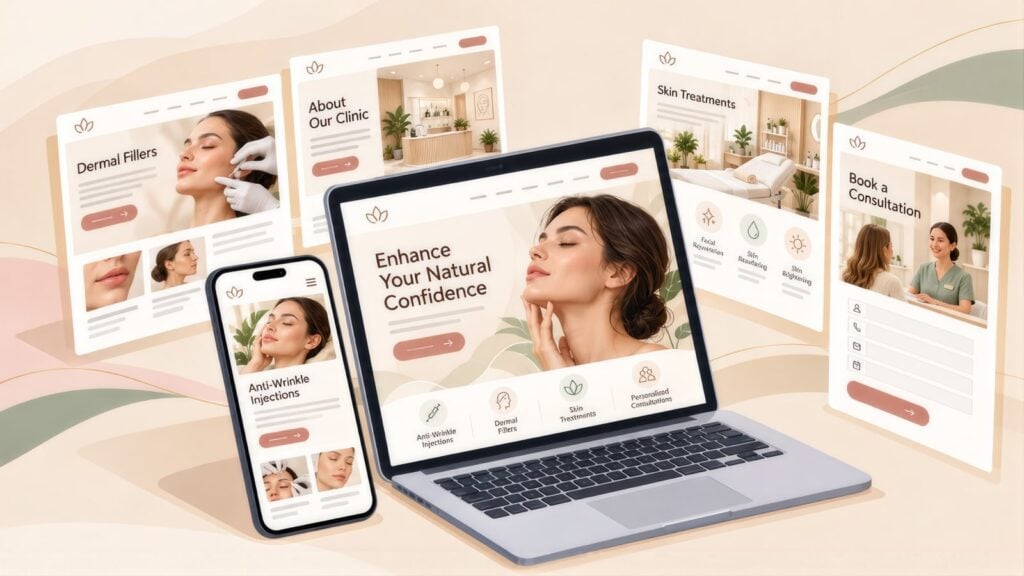
A clinic site needs a main page, one page for each laser or skin treatment, staff profiles and a consult page. Send all injectable enquiries to the consult page.
| Page | Focus keyword | What to include (check all of it against TGA and AHPRA rules) |
|---|---|---|
| Clinic main page | cosmetic clinic or skin clinic [area] | An overview of services, staff credentials, how booking and consults work, and an FAQ. |
| Skin treatment pages | [treatment type] | What the treatment involves, who it suits, what to expect, a rough cost and how to book. |
| Laser treatments | laser [treatment] | The device used (with its ARTG listing confirmed), the process, who it suits, a cost range and how to book. |
| About practitioners | [practitioner name] or [clinic name] team | Their true title, registration type, medical degree, further training and AHPRA number. |
| Consultation page | cosmetic consultation | Explain what the consult covers and that each treatment decision comes after it. Make clear that no script is written without an assessment, and show how to book. |
Concern-Focused Content That Stays Compliant
Clinic content should tell patients about their options without turning into an ad for a medicine. The safest way is concern-focused content. It explains the condition the patient wants treated rather than what a treatment will achieve.
Three kinds of article are generally safe:
- Concern articles, such as what causes facial volume loss or how sun damage ages skin.
- Process articles, such as what happens at a first consult or how a skin clinic differs from a beauty salon.
- Laser and skin treatment articles, such as how laser works on dark spots or what IPL can treat.
An article that describes the result of an injectable can count as an ad for the medicine even if it never names it, so have it checked before it goes up.
Clear Skincare Clinics had a full TGA compliance audit that found and fixed 21 issues. It now holds the #1 organic position for “microneedling”, a term with 9,900 searches a month. It is also cited in Google’s AI Overview, the AI summary above the results, on 4 of the last 7 tracked days. The skin clinic AI Overview study sets out what changed.
A named, registered doctor or nurse at your clinic should write or check all medical content. Publish their name, credentials and the review date, so patients can see who stands behind the advice. This guide to Google’s E-E-A-T explains how Google describes experience and expertise in its own guidance. Check that content again each time the TGA or AHPRA updates its guidance.
How to Link Consultation and Treatment Pages
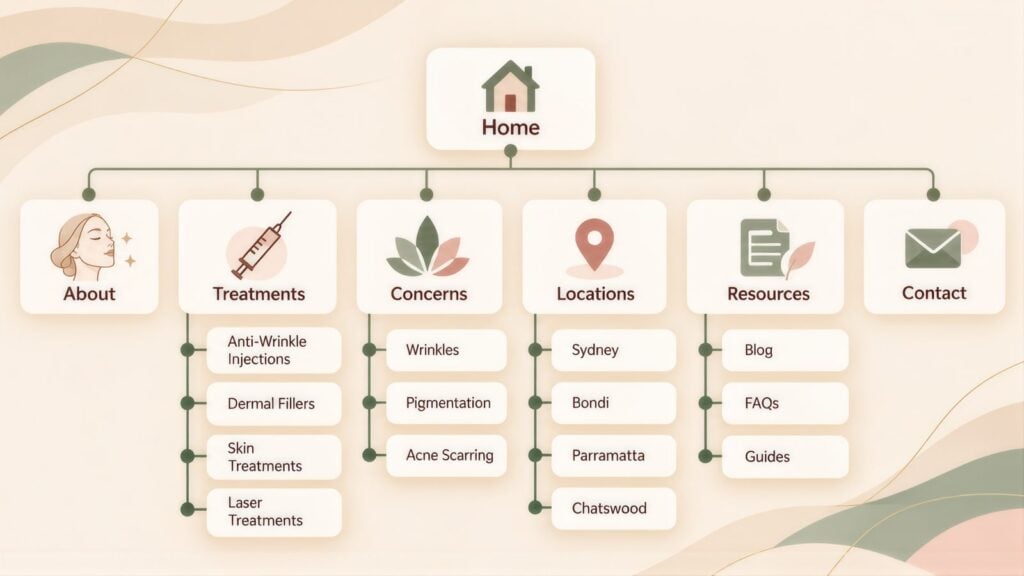
Link each treatment page to the consult page and to the staff who do the work. Link injectable topics only to the consult page, never to a treatment menu. Use short, plain link text:
- To the consultation page: “book a private consultation”, “how consultations work”, “your first assessment”.
- To practitioner profiles: “meet our practitioners”, “practitioner credentials”, “Dr [Name]’s profile”.
- To non-prescription treatment pages: “laser skin treatments”, “non-invasive skin treatments”, “skin rejuvenation options”.
A pigmentation page, for example, explains that laser and IPL are both options and links “laser skin treatments” to the laser page. It ends with a “book a private consultation” link so the practitioner can decide which suits the patient’s skin.
Clinic Title Tags and Meta Descriptions
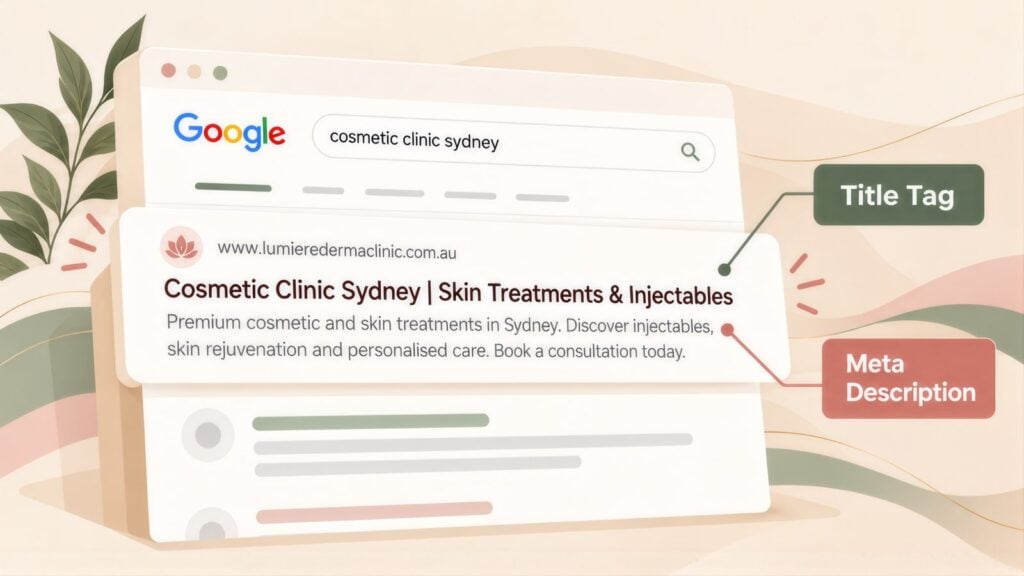
Start each title with the service and the suburb. Keep product names and promised results out of titles and descriptions.
| Page | Example title tag (TGA compliant) | Characters |
|---|---|---|
| Skin clinic | Skin Clinic [Suburb] | Medical Aesthetics | 41 |
| Laser treatment | Laser Skin Treatments in [Suburb] | Book Now | 44 |
| Consultation | Cosmetic Consultation in [Suburb] | Book Online | 47 |
| About practitioners | Dr [Name] | Cosmetic Medicine Practitioner | 42 |
A short clinic name can follow the title as long as the whole tag stays within 55 characters. Most clinic names are longer than that allows, and Google usually prints the site name beside the result, so drop the name before you cut the service or suburb.
TGA-compliant meta descriptions
Build each description around the service, the consult and who will treat the patient. Leave out treatment results and how products work. Here is a compliant example for a skin clinic page, 149 characters including the placeholder: “Skin clinic in [Suburb] offering laser, peel and skin treatments by registered practitioners. Check their credentials and book a consultation online.” If a description hints at a prescription medicine’s result, rewrite it.
Schema for Clinics and Practitioners

Structured data, often called schema, is code in the page that labels your clinic as a medical business and each doctor or nurse as a person. Schema.org defines Physician as an organisation type, so do not use it on its own for a profile page.
| Schema type | Where to use it |
|---|---|
| MedicalClinic or MedicalBusiness (LocalBusiness) | Your homepage and main service pages. |
| Person | Each staff profile page. Add the AHPRA number and name the clinic in worksFor. |
| FAQPage | Service pages and the consult page. |
| BreadcrumbList | All pages under the homepage. |
Do not add FAQPage markup to a clinic page hoping for a dropdown in the results. From August 2023, Google showed FAQ rich results only for a small group of government and health sites. Its Search Central updates log shows the feature was retired on 7 May 2026. The markup is still useful on your consult page because it tells search engines and AI tools which text answers which question.
Local SEO for Cosmetic Clinics
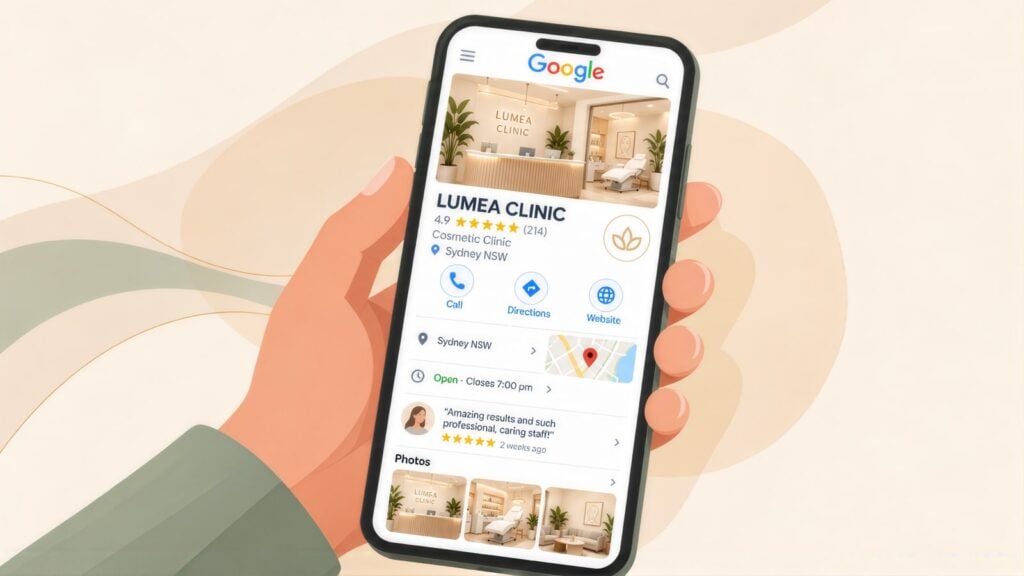
Cosmetic and skin clinic searches are very local. A near me search only shows clinics close to the searcher. That makes local search visibility in Google Maps and your Google Business Profile one of your main ways to be found.
Your Business Profile counts as public advertising too, so the same TGA and AHPRA rules apply. Four fields matter most:
- Primary category: choose Medical spa, Skin care clinic or Laser hair removal service, to match your main service. Avoid a general beauty salon category.
- Services: list services that do not involve prescription medicines. For treatments that need a script, list the consult and assessment instead of the treatment.
- Photos: show the clinic, your equipment (with its ARTG listing confirmed) and the team. Hold back clinical before and after photos until the compliance check is done.
- Reviews: ask patients for genuine reviews. Do not feature any that describe results where a doctor or nurse registered with AHPRA was involved. The same rule applies to your Business Profile posts.
Google Ads for Cosmetic Clinics
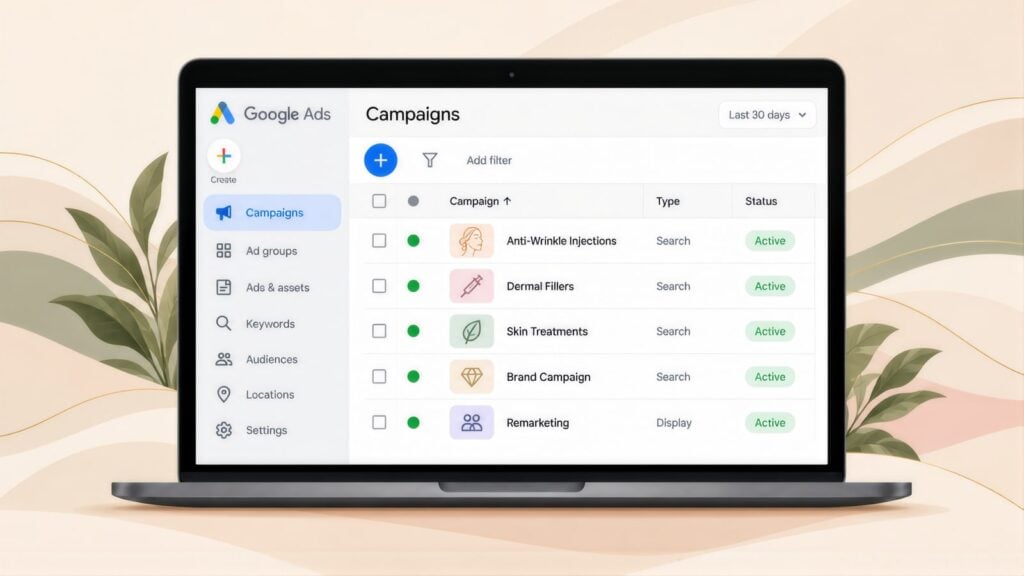
Google Ads works well for clinics when it promotes consults and laser or skin treatments, and clicks cost less than in many health fields. Google adds its own rules on top of the TGA’s. Its healthcare and medicines policy says ads targeting Australia can’t use prescription drug terms in the ad or on the page it links to. This means a landing page that names an injectable brand can get the whole ad disapproved, whatever the ad itself says.
| Clinic account setting | What we recommend |
|---|---|
| Campaigns | Use Search campaigns, with laser, skin and facial treatments in one campaign and consults in another. Do not run ads that mention injectables until a TGA check clears them. |
| Location targeting | Show ads only to people in or regularly in your area. Start with a tight radius around the clinic. Widen it only if the search terms report shows patients travelling further for a treatment. |
| Ad schedule | Run ads in business hours, when reception can answer booking requests. |
| Bidding | Start with manual CPC (cost per click), where you set the most you will pay for a click. Click prices vary a lot by treatment, and the FAQ below lists Google Keyword Planner ranges for three clinic terms. Learn how many consults turn into treatments before you set a target cost per booking. |
Clear Skincare Clinics takes bookings through Zenoti, a clinic booking system. CCM repaired its Zenoti conversion tracking, which counts each booking as a result in Google Ads. Over the year to November 2024, compared with the year before, conversions rose 665%. Revenue attributed to Google Ads rose 542%, and the conversion rate rose 111%. Part of that lift comes from the tracking fix itself. The clinic booking tracking turnaround sets out the before and after figures.
Keywords, Negatives, and Compliant Ad Copy
Bid on searches for your clinic, consults and laser or skin treatments. Block training, wholesale and DIY searches with negative keywords, which stop your ad showing for those words. Your ad copy should then promote the consult and the person who will treat the patient.
| Bid on (non-prescription services) | Add as negative keywords |
|---|---|
| “skin clinic “, “laser hair removal [area]”, “skin rejuvenation “, “cosmetic consultation “ | DIY, home kit, cheap (a brand reputation risk), training, course, wholesale, job, surgical (if you don’t offer surgery), hospital (if you are not a hospital) |
Rules for compliant ad copy
- Name the clinical service rather than the prescription medicine or how it works.
- Make the consult the first step. The TGA’s cosmetic injections advertising FAQ points clinics towards this approach.
- State who will treat them, such as a Medical practitioner or Registered nurse, instead of promising results.
- Have every ad checked for TGA compliance before it goes live.
Same concern, two ads
Both ads below target a patient worried about forehead lines. The first breaks TGA and AHPRA rules in several places. The second promotes the consult, which the TGA says is unlikely to count as an ad for a therapeutic good.
| Component | Non-compliant | Compliant |
|---|---|---|
| Headline 1 | Wrinkle Injections $X a Unit | Clinic Consultations [Suburb] |
| Headline 2 | Painless, Flawless Results | Doctor-Led Skin Clinic |
| Description | Become the best version of yourself. Pick your treatment and book online in 60 seconds. | Private consultation with a registered medical practitioner to assess your concerns. |
| Why | It uses a generic term for a prescription medicine and a per-unit price, and the TGA’s injections FAQ flags both. AHPRA’s cosmetic guidelines name “painless”, “flawless” and “best version of yourself”. It also lets patients pick their own treatment. | It names the service and who will treat them. It makes the consult the first step and promises no result. |
Landing Pages That Convert Compliantly
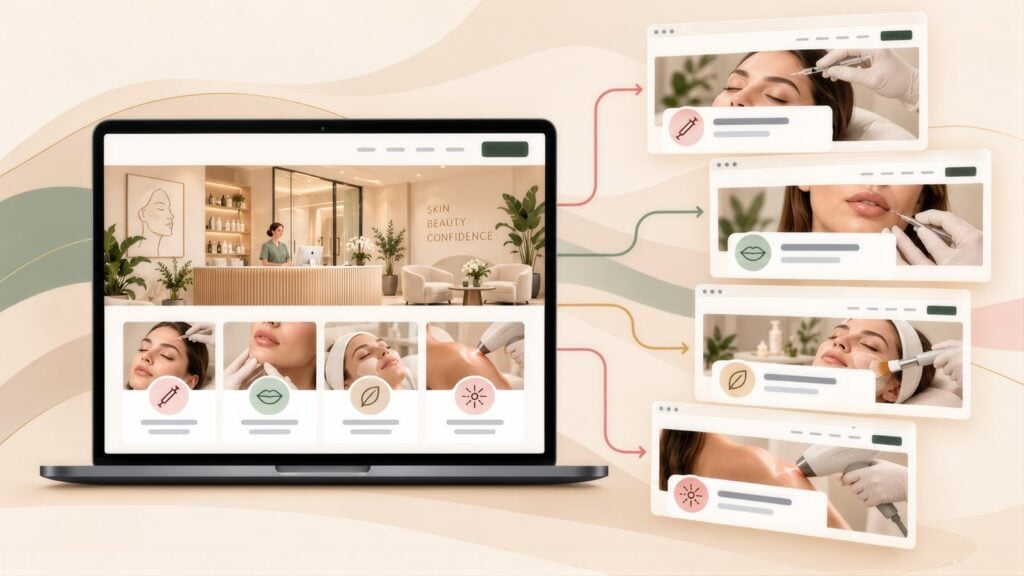
A clinic landing page works best when it shows who will treat the patient and makes a consult the clear next step. Check each page for these five things:
- Staff credentials in plain view: medical degree, registration type, AHPRA number and further training where relevant.
- The consult as the first step. Send each service page to a consult booking rather than a treatment booking, because a script needs a proper assessment first. A clear booking path makes a measurable difference. In the 30 days after its new site design went live in August 2025, SILK Laser Clinics recorded 104.8% more purchases and 86% more booking requests. The aesthetics clinic redesign case study shows what changed.
- No before and after images until they have been cleared. Clinical images that suggest a prescription medicine’s result need their own assessment before they appear in ads.
- No clinical outcome testimonials, because patient quotes about results are banned where a doctor or nurse registered with AHPRA was involved.
- A privacy statement that explains how you handle enquiry details and clinical photos. Link to it from the enquiry form as well as the footer.
Conversion Tracking: Enquiry to Treatment
Track each enquiry through to a consult and a treatment, and note where each one came from. Keep clinical details out of every analytics and ad platform.
| Stage | What to record |
|---|---|
| Enquiry or consult booked | The treatment area of interest, the source and the date. Record no clinical details at this stage. A careful Google Analytics 4 (GA4) setup, with Google Tag Manager, makes sure none are collected. |
| Consult attended | Whether the patient came, the date and the source. |
| Treatment agreed and started | The treatment category (not the specific medicine) and the source. |
| Follow-up visits | Whether the patient came back for follow-up or more treatments. This laser clinic GA4 revenue study shows these stages tied back to revenue. |
Never upload patient clinical photos, identifiers, treatment records or condition details to an ad platform. Assessment photos are clinical records, and the Privacy Act 1988 and AHPRA guidance both set strict privacy and consent rules for them. Get informed consent that meets both, and record it, before any clinical image appears in your marketing.
A 90-Day Plan for a Cosmetic Clinic
Compliance audit first
Have a TGA advertising compliance specialist review every service page, testimonial and before and after image on your site. Pause any Google Ads campaigns that describe how injectables work until they are cleared. Check each claim about staff training.
Compliant content foundation
Build or rebuild your non-prescription treatment pages (laser, IPL, skin care, facials) with compliant content, and build your consult booking page. Confirm the ARTG listing for every device named on the site. Add staff schema with AHPRA numbers.
Launch compliant campaigns
Launch Google Ads for non-prescription services only, while injectable advertising is still being assessed. Check every ad against TGA guidance before launch. Set up conversion tracking so each consult booking is counted.
Review and refine
Work out your cost per consult booked. See how many consults turn into treatments for each service, and compare that pipeline with your clinic’s capacity. Use those figures to decide which of your busiest, lowest-risk treatments get new content next.
Cosmetic Clinic SEO and Ads: Common Questions
Can a cosmetic clinic advertise injectables online in Australia?
Not if the ad refers to the prescription-only medicines involved. Most cosmetic injectables contain Schedule 4 substances, which cannot be advertised to the public. The TGA no longer expressly permits generic terms such as “wrinkle reducing injections” or “dermal fillers” where readers would take them to mean a prescription product. The safer approach is to advertise the consult.
Can we publish prices for injectable treatments?
Generally not, because the TGA says a price for a prescription-only cosmetic injectable is likely to be an ad for that product. That applies to a price per unit or for the whole treatment. Only community pharmacies can publish prescription medicine price lists, and only under strict conditions.
How long does SEO take for a cosmetic clinic?
The compliance audit has the biggest effect on how quickly a clinic’s SEO moves. Pages pulled or rewritten after a TGA and AHPRA review take time for Google to recrawl. A domain with a few years of history also moves faster than a new one. Suburb and Maps results for laser or skin treatments tend to move first, and city-wide treatment terms later. On the stages in CCM’s agency vs in-house comparison, linked in the next answer, expect early movement at 3 to 4 months. Consult bookings should lift clearly by 6 to 9 months, and gains keep building after the first year.
How much does SEO cost for a cosmetic clinic?
Your treatment menu and the compliance work behind it set the price. Each injectable-related page needs a TGA and AHPRA check, and each doctor or nurse needs a true profile. Every extra clinic location adds its own pages and Business Profile. A single-site laser and skin clinic usually sits at the lower end of agency fees, which run from $1,500 to $10,000+ a month in this agency vs in-house comparison. Employing your own SEO specialist costs $80,000 to $170,000+ a year, including tools and training.
How do you attract new patients to a cosmetic clinic?
Make your clinic easy to find for the concern a patient types, then make a consult the clear next step. You need concern and treatment pages that pass a TGA review, a complete Google Business Profile, genuine reviews and Google Ads for laser and skin services. Staff credentials on each page help patients choose and help AI search tools cite your clinic.
What do Google Ads clicks cost for a skin or cosmetic clinic?
Most clinic clicks cost under $8 at national top-of-page bids. Google Keyword Planner shows $1.14 to $4.07 for “skin clinic near me”, $1.48 to $7.13 for “cosmetic clinic” and $0.50 to $2.25 for “laser hair removal” (CCM analysis of Google Keyword Planner data, Australia, 12 months to August 2026). Your cost per consult depends on your landing page and booking process, so track consults booked as well as clicks.
Can we use testimonials or before and after photos?
Testimonials are out for higher-risk cosmetic procedures, and photos come with strict conditions. AHPRA’s cosmetic guidelines ban testimonials in this advertising. They also ban filtered or retouched images and images of anyone under 18. If a photo shows the result of a prescription medicine, it also needs a TGA review.
Should a cosmetic clinic start with SEO or Google Ads?
Start with compliant pages, then run Google Ads for laser and skin services while SEO builds. Ads can bring in consults within weeks of launch. Organic rankings for concern-based searches take months, but you pay nothing per click once they hold.
Andrei Jach is Senior Manager, SEO and Analytics Specialist at Click Click Media in Sydney, with over 15 years in digital marketing and strategy. He has led SEO for health businesses as well as retail, professional services and manufacturing, and oversees CCM’s strategic SEO planning, analytics implementation and technical audits. He previously held digital strategy roles at Agent 6 Marketing and Red Propaganda.
Implement this playbook with AI
Opens your assistant with this playbook and seven questions about your business: services, area, website and ads. It then writes your keyword map, page plan and Google Ads starter build with your details filled in.
Copy the prompt for Gemini, Grok or any assistant that cannot open a prefilled link. The prompt points at this page, which is also served as Markdown to assistants that ask for it.
Work with Click Click Media
Our free audit shows which of your treatment pages are likely to pass a TGA review. We look at your website, Google Ads account and Business Profile, flag the pages and ads with the highest compliance risk, and list what to fix first. There is no obligation to go further.
Click Click Media has worked in search marketing since 2008 and is a Google Premier Partner. We have managed more than $115 million in Google Ads spend for Australian businesses, including the skin and laser clinic work in this guide. For aesthetic medicine, we bring in compliance specialists before a campaign launches. A senior strategist runs your account from the first call. We do not use lock-in contracts, so you can leave whenever you choose.
Verified Sources and References
- IMARC Group: Australia Medical Aesthetics Market
- Mordor Intelligence: Australia Aesthetic Devices Market
- TGA: Complying with the restrictions on advertising prescription medicines to the public
- TGA: Advertising health services and cosmetic injections FAQ
- TGA: Australian Register of Therapeutic Goods (ARTG)
- AHPRA: Advertising hub
- AHPRA: Advertising guidelines and other guidance
- AHPRA: Advertising higher risk non-surgical cosmetic procedures
- OAIC: Health information and privacy
- Schema.org: Physician type
- Google Ads policy: Healthcare and medicines
- Click Click Media: SEO cost, agency vs in-house
- Google Search Central: Documentation updates (FAQ rich result removed, May 2026)
- Google Search Central Blog: Changes to HowTo and FAQ rich results (August 2023)
- ACCC: False or misleading claims
- Click Click Media: SEO services
- Click Click Media: Google Ads management
Last checked October 2026 · next review January 2027
