
SEO and Google Ads for Allied Health Practices in Australia
Written by Andrei Jach, Senior Manager, SEO and Analytics Specialist at Click Click Media · Updated 1 October 2026
Allied health is the second largest clinical workforce in Australia, after nursing and midwifery. Around 300,000 allied health professionals deliver about 200 million Medicare Benefits Schedule services a year, according to the Department of Health, Disability and Ageing. Clinics cluster in every capital city, so most practices compete for the same suburb searches as clinics a few kilometres away.
SEO for allied health practices works best for clinics whose websites answer the searcher’s questions. Patients want to know who they will see, what it will cost, whether they need a referral and how to book.
This guide starts with where patients come from: GP referrals, health funds and other funders, and direct search. Then it covers keywords, local SEO, the AHPRA advertising rules that limit what you can say, and a Google Ads approach built around attended appointments. It applies whether you call it physiotherapy SEO, physio marketing or allied health marketing.
Implement this playbook with AI
Opens your assistant with this playbook and seven questions about your business: services, area, website and ads. It then writes your keyword map, page plan and Google Ads starter build with your details filled in.
Copy the prompt for Gemini, Grok or any assistant that cannot open a prefilled link. The prompt points at this page, which is also served as Markdown to assistants that ask for it.
What We Found Searching for Allied Health
In CCM’s captures of five Sydney physiotherapy searches on 3 September 2026, a Google Maps local pack appeared on all 5, and clinic home pages held 45 of the 50 top-ten organic positions.
- On a local search, patients see your Google Business Profile and your home page first, so keep both complete and specific to your suburb.
- The five captures cover physiotherapy in Sydney only, so check your own profession and suburb on a phone and on a desktop.
Source: CCM search captures, Sydney, 3 September 2026
On the three national question searches CCM captured the same day, Google showed an AI Overview on all 3 and on none of the 5 Sydney local searches. On is physio covered by medicare, none of the top 10 results were home pages, and 9 of the 10 sites did not rank in the top 10 of any of the Sydney physio searches.
- Questions about Medicare, treatment types and choosing between professions are answered by different pages from the ones that win local searches, so give each common question its own guide.
- A clear answer near the top of a dated guide gives the page a chance to rank on these searches or be cited in the AI Overview.
Source: CCM search captures, Australia and Sydney, 3 September 2026
In CCM’s analysis of Semrush ad history for six Australian searches, from monthly snapshots between September 2025 and August 2026, none of the 32 distinct ads mentioned Medicare.
- If your clinic sees patients on a GP chronic condition management plan, saying so in the ad and on the landing page answers a question none of these ads did.
- Mention Medicare or NDIS only where reception can honour it, and track bookings to see whether the wording helps.
Source: CCM analysis of Semrush ad history, September 2025 to August 2026
CCM captured eight Google searches on 3 September 2026 (Sydney time): physio sydney and physio near me in Sydney on desktop and mobile, physiotherapy in Sydney on desktop, and is physio covered by medicare, what is physiotherapy and physio vs chiro Australia-wide on desktop. A result counted as a home page when its web address was the bare domain with nothing after it. The ad finding comes from CCM’s analysis of Semrush ad history for the Australian database, using monthly snapshots from September 2025 to August 2026, on the six searches that returned ads: chiropractor near me, physiotherapy near me, physio sydney, physiotherapy sydney, psychologist near me and physio marketing, an agency search that is included in the count. Each distinct combination of advertiser, headline and description counted as one ad, however many months it ran.
Where Allied Health Patients Come From: GPs, Insurers and Direct Search
Before any keyword work, map where your new patients actually come from. Most clinics have three sources: GP referrals, patients steered by a funder, and people who search and book directly. Funders include private health funds, the NDIS, DVA and workers compensation insurers. Each group arrives with a different question. Allied health marketing works best when your website serves all three, with a page and a follow-up for each.
1. GP referrals
GPs are the main source of Medicare-funded referrals. Under a GP chronic condition management plan, a patient can claim up to five individual allied health services a calendar year. Aboriginal and Torres Strait Islander patients can claim 10. With the referral in hand, the patient often searches your clinic name or “physio “. Your referral page should quickly tell them whether they can use the plan at your clinic and what they will pay.
Treat local GPs as an audience in their own right as well as a source of referrals. Send referring practices a short, useful email each quarter with news of new practitioners, appointment availability or a plain summary of a condition you treat. Send it only to practices that have agreed to hear from you, and keep patient details out of it. Add a referrer page to your site with your fax or secure messaging details, referral forms and turnaround times, which saves their reception staff a phone call.
The closest result we can quote is dental and from New Zealand, not an Australian allied health clinic. Kidz Teeth is a children’s dental practice in Meadowbank, Auckland. We rebuilt its GP referral page and set up new-patient tracking. Key events, meaning referral form downloads and new patient enquiries, rose from an average of 75.7 to 139.0 a month between March and 31 May 2026 (+83.7%). The Kidz Teeth case study sets out the work.
2. Insurers and funders
Private health extras, the NDIS, DVA and state workers compensation schemes all shape where patients book. Some health funds run preferred provider deals that steer members to certain clinics, so say which funds you accept and whether members can claim on the spot. For NDIS work, show your registration status and say whether you see plan-managed, self-managed or agency-managed participants.
The NDIS was designed for about 410,000 participants. By 2026 it had grown past 760,000, according to the NDIS quarterly reports. Government reform aims to bring it back towards 600,000. Average early intervention packages also fell sharply in some categories between 2024 and mid-2025. Practices that rely on the NDIS need private and Medicare patients as well, and a home page that leads only with NDIS narrows the audience.
3. Direct search
The third group finds you on Google with no referral at all. It might be an acute injury, a parent worried about a child’s speech, or an adult looking for a psychologist. Most of this guide is about them, from keywords and local SEO to Google Ads. They look for the same trust signals referrers want, such as credentials, fees and referral rules, so one well-built page can serve both groups.
Those referral relationships help your search results too. A local GP practice, sports club or school might list your clinic as a provider. A community health story in the local paper might link to you. These are the relevant local links a link building program for a clinic should aim for.
How Patients Search for Allied Health Care
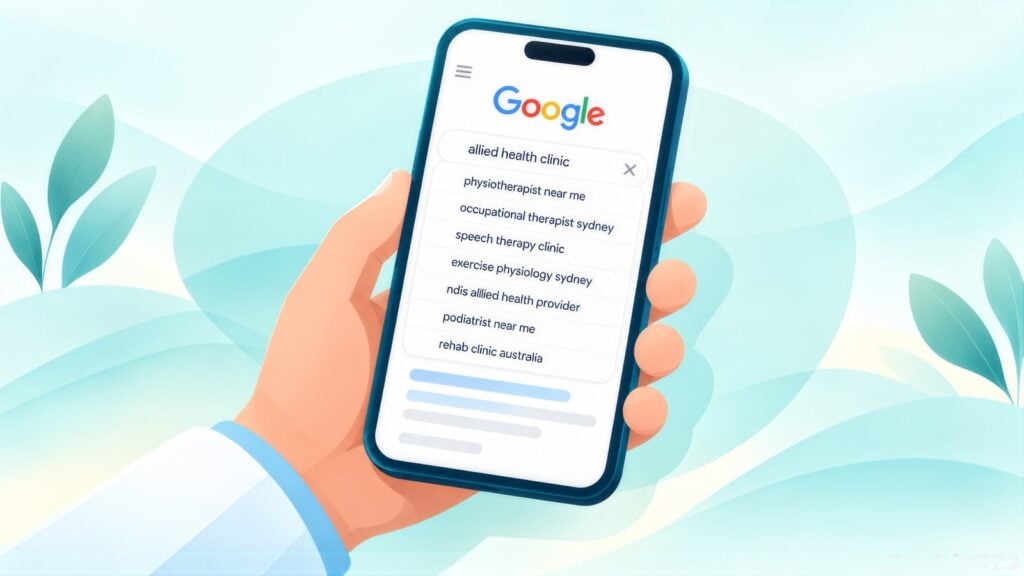
In the cities, someone looking for a physio in Chatswood or a speech pathologist in Parramatta is often comparing several clinics within two kilometres. That is why local SEO for clinics matters so much.
How people search changes with the profession, the funding and the urgency. Someone with an acute sports injury searches on their phone straight away, while a parent after a speech assessment may have been reading for weeks. Both end up on Google, but they need different answers and book from different pages.
Whatever the search, a page that states five things plainly gives the patient what they need to book: the profession, the suburb, the appointment types, the fees and billing options, and what happens after someone books.
Allied Health Keywords by Profession and Funding Pathway
Allied health searches vary in two ways: by profession and by how the patient will pay. The same person with knee pain might type “physiotherapist Surry Hills”, “physio with GP referral” or physio bulk billing [city], depending on what they know about their options. Each of those three searches needs a page that answers it.
Profession Discovery
physiotherapist [suburb]
psychologist near me
occupational therapist [area]
speech pathologist [suburb]
Condition / Symptom
physio for back pain [city]
anxiety psychologist [suburb]
shoulder injury physio
podiatrist for plantar fasciitis
Funding Pathway
physio with Medicare rebate
GP referral allied health
bulk billing psychologist [suburb]
NDIS allied health provider [city]
Appointment Type
same day physio appointment
after hours psychologist
online psychology session
home visit occupational therapist
Paediatric / Specialist
paediatric speech pathologist [city]
child psychologist [suburb]
kids physio near me
autism OT [city]
Assessment / Diagnosis
neuropsychological assessment [city]
ADHD assessment psychologist
falls risk assessment OT
work capacity assessment
Why the funding pathway cluster matters most
Searches that mention how the patient will pay, such as Medicare rebate, bulk billing, NDIS, DVA or private health, come from people who have mostly decided on treatment. What they still need to know is whether they can afford it or whether their funding covers it. Answer that on the page, so the patient does not have to ring reception to find out.
Not all allied health is bulk billed. The plan visits described in Where Allied Health Patients Come From: GPs, Insurers and Direct Search carry a Medicare rebate, but whether you bulk bill them is up to your practice. Medicare does not require it, and some clinics charge a gap above the rebate. Only use “bulk billing” in page copy, title tags or meta descriptions if you bulk bill. Spell out the conditions: a valid GP referral and an eligible plan appointment. If you bulk bill plan visits but charge a gap for private ones, explain the difference on the landing page.
- For each profession you offer, list the top three ways your patients pay: private, Medicare, NDIS, DVA, WorkCover or private health insurance.
- For each one, check in Google Search Console which searches already bring patients to your site.
- Any payment pathway with no matching page is a gap where you are losing bookings.
Local SEO for Allied Health Clinics
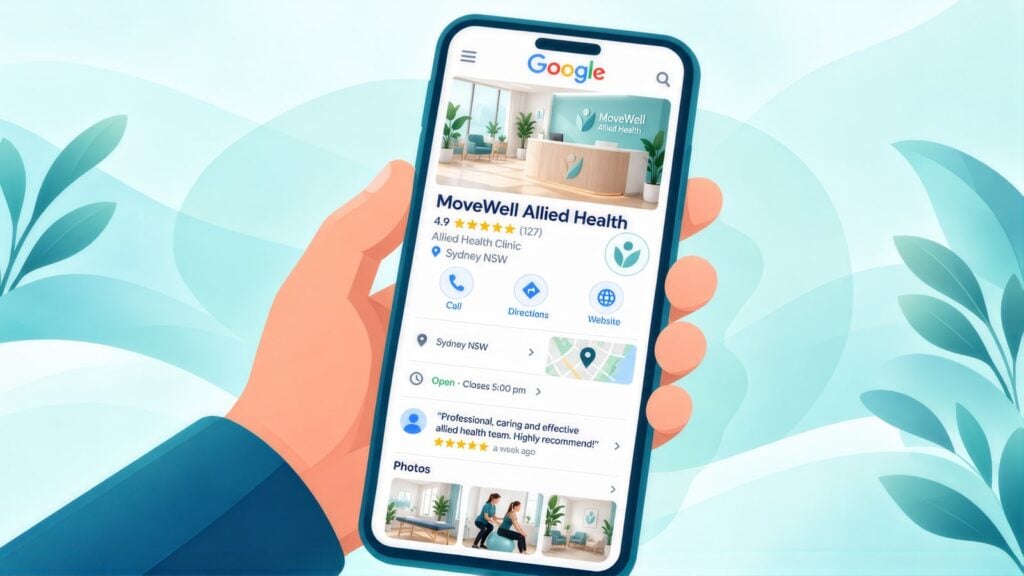
Patients usually choose an allied health clinic close to home or work, so competition happens suburb by suburb. Getting into the Google Maps results (the local pack) for your suburb is usually the first goal of a clinic’s SEO. A suburb lookup tool helps you list the nearby suburbs your patients actually come from.
Google Business Profile for allied health practices
A map pack appeared on all five Sydney physiotherapy searches CCM captured, so your Google Business Profile is often the first thing a direct-search patient sees. Here is a worked example for a two-discipline clinic in Chatswood:
- Name: “[Practice name]” only, without “Physio Chatswood” tacked on.
- Main category: Physical therapist, which is Google’s label for physiotherapy. Add Podiatrist as an extra category, because the clinic also offers podiatry.
- Services: list each one patients search for, such as sports injury, back pain, post-surgery rehab, orthotics and NDIS physiotherapy.
- Hours: real clinic hours, including the Tuesday and Thursday evening sessions, because after-hours appointments set clinics apart in busy suburbs.
- Booking link: straight to the Cliniko or Halaxy booking page, not the contact page.
- Photos: treatment rooms, reception, gym equipment and the team. Never show patients being treated.
Google reviews for allied health practices
Read AHPRA’s advertising guidelines before you set up your review process. AHPRA bans testimonials about clinical results in advertising you control. A patient writing “my physio fixed my knee” in a Google review is treated differently, because it is a public review on a platform you do not control. Your response to that review is advertising, however, so do not confirm any clinical details in your reply or encourage the reviewer to add any.
A safe process is to send a neutral review link after a course of treatment that went well. Keep the message about the service rather than the treatment: “We value your feedback. If you’re happy to share your experience, we’d appreciate a Google review.” Do not tell people what to say, do not offer incentives, and do not screen anyone before you send the link.
Website Foundations: What Google Needs First
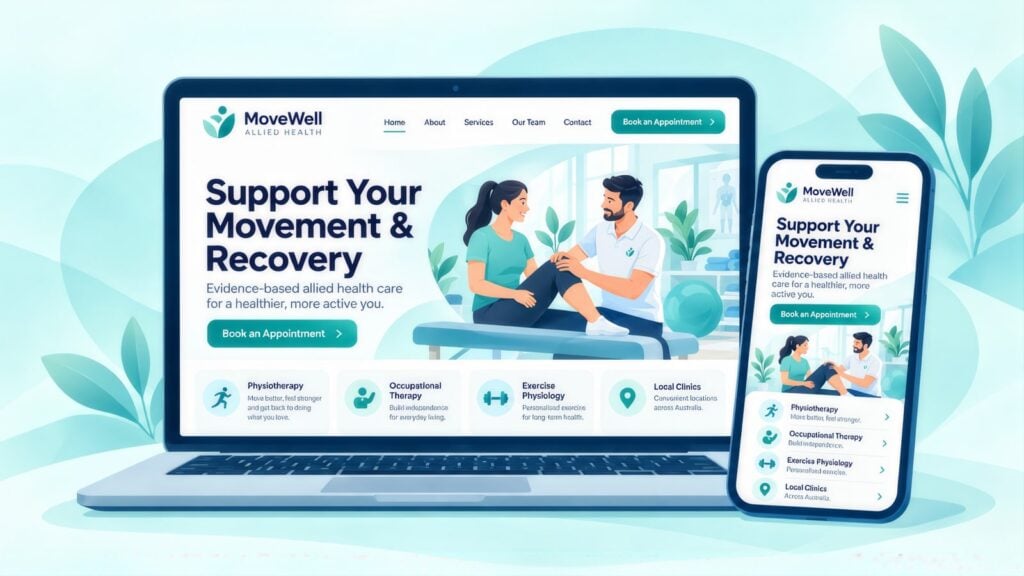
A parent looking for a speech pathologist often searches on a phone, during school drop-off or a lunch break. Many clinic sites make that hard in two ways. Generic health templates can load slowly and look like every competitor’s site, and long clinical bios bury fees, availability and booking.
Google Search Console and indexing
Google Search Console, a free Google tool, reports which pages Google has found and any problems with them. Connect your domain, verify that you own it and submit your sitemap, a map of your pages for Google. Check each profession page and confirm it is indexed, meaning it sits in Google’s index and can appear in results. If any page is blocked or showing errors, fix it before anything else.
Mobile performance
Acute injury searches also happen on phones, so your booking process must work smoothly on a small screen. Test the whole journey on a phone, from the search to the fee and the booking button, and remove every step you do not need.
Online booking integration
Integrated online booking brings in appointments that a “call us during business hours” button misses. Those include people searching at night and people who would rather not discuss their condition on the phone. If your practice software (Cliniko, Halaxy, Power Diary) takes bookings, put that button on every service page. Where standard tools fall short, custom booking systems can link intake forms and funding details to the diary.
HTTPS and clinical data security
Any form that collects clinical details, including questionnaires before a visit, must run over HTTPS, the secure version of a web address. Health information is sensitive information under the Privacy Act 1988. The OAIC’s health information guidance explains what that means. An unsecured intake form leaves your practice open to a complaint.
AHPRA Rules, Self-Regulated Professions and E-E-A-T
A physio’s website and Google Ads answer to two sets of rules. AHPRA’s advertising guidelines limit what registered practitioners can say. Google holds health pages to a higher standard than most, because it treats them as YMYL, short for Your Money or Your Life. Get both right before you write ads or pages.
AHPRA advertising rules: what they mean for your website and campaigns
The Guidelines for advertising a regulated health service cover registered practitioners and the businesses that advertise their services. The main limits are:
- No testimonials about clinical results in ads you control. A patient quote such as my back pain is completely gone on your website, your Google Ads or your social pages breaks AHPRA’s rules. Comments about wait times, friendly reception or easy booking are treated differently, and the rules on that line are specific.
- Offers and discounts must state their terms. You can offer something like a cheaper first visit, but only if the ad also states the terms and conditions. Check the AHPRA advertising hub before you run any offer.
- Do not raise false hopes about what treatment will do. Saying your physio will “fix your back”, or that your psychology sessions “cure” a condition, is a promise you cannot make. Describe what the service involves and leave results out.
- Do not claim you are better than other clinics. You cannot suggest your practice is better than a named competitor.
The AHPRA register covers physiotherapy, psychology, occupational therapy, podiatry, chiropractic and osteopathy, among others. It does not cover speech pathology, dietetics or exercise physiology. Those professions are self-regulated, run by their own professional bodies. Speech pathologists show Certified Practising Speech Pathologist (CPSP) status with Speech Pathology Australia. Dietitians show Accredited Practising Dietitian status with Dietitians Australia. Exercise physiologists show Accredited Exercise Physiologist status with ESSA. Put that credential on their profiles instead of an AHPRA number. Take the same care with result claims, because the Australian Consumer Law applies to every clinic.
Safe ways to describe your services
The simplest test is to describe the service and the process and leave the outcome out, as in these examples:
- Fine: “Our physiotherapists assess and treat musculoskeletal conditions including back pain, neck pain, and sports injuries.”
- Not fine: “We fix back pain”, because it creates an unreasonable expectation.
- Not fine as an ad claim: “Many of our psychology clients report feeling better equipped to manage their anxiety after completing our program.” It implies a clinical result.
- Fine: “We use evidence-based cognitive behavioural therapy for anxiety and related conditions.”
The AHPRA advertising hub has current guidance and checklists if you are unsure.
E-E-A-T signals for allied health
Google’s quality raters look for four signals, known as E-E-A-T. This explainer on Google’s E-E-A-T standards sets out how each one is judged. For a clinic, they mean the following:
- Experience: name your practitioners, with their AHPRA number or professional credential. Show their years of experience with specific conditions and any postgraduate training.
- Expertise: show AHPRA numbers on profiles for registered professions, and CPSP, APD or AEP status for self-regulated ones. List any specialist endorsements and memberships (APA, APS, SPA, OTA).
- Authoritativeness: earn links from Services Australia, AHPRA and professional associations. Name the local GPs and medical practices you work with.
- Trustworthiness: state Medicare rules and NDIS registration correctly, show your fees honestly, and make no claims AHPRA bans.
The Pages Every Allied Health Site Needs
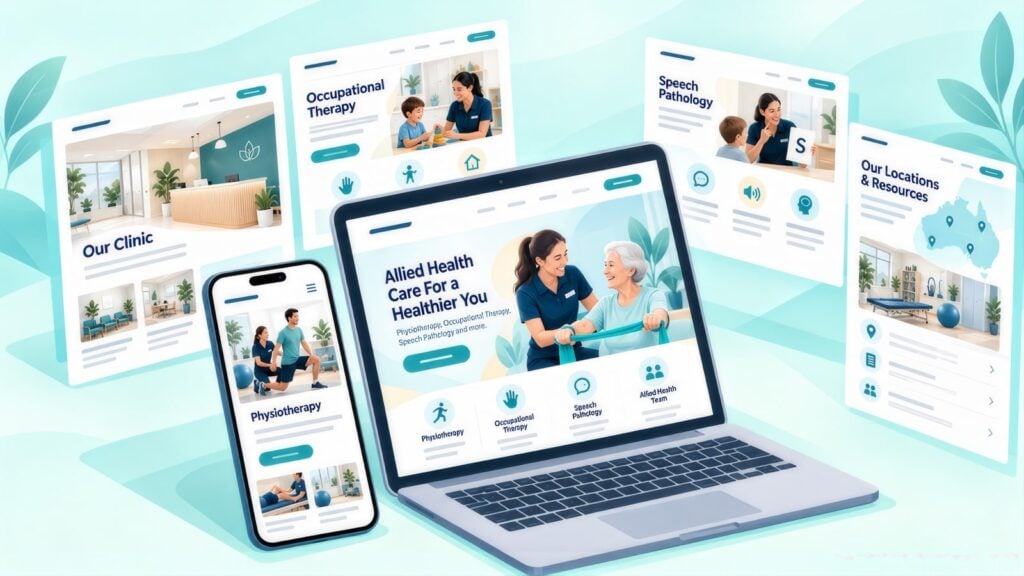
Give every profession, every main condition group and every way of paying its own page. Someone searching “bulk billing physiotherapy Chatswood” wants the gap fee, while someone searching “NDIS occupational therapy Chatswood” wants to know which plan types you accept.
| Page type | Focus keyword example | What to include |
|---|---|---|
| Profession + suburb (e.g. Physiotherapy) | physiotherapist | Practitioner names and AHPRA numbers, conditions treated, appointment types, fees (private and Medicare rebate), how to book, FAQs |
| Condition-specific (e.g. Back Pain) | physio for back pain | How physio helps with the condition (the process, not promised results), what happens at the visit, fees, FAQs |
| Medicare / GP referral pathway | allied health Medicare rebate or chronic condition plan physio | How the plan works, how many visits it covers, how to get a GP referral, what the rebate covers and any gap fee |
| NDIS pathway | NDIS allied health provider [city] | Your NDIS registration status, which professions and supports you offer, how participants can use you, and that you accept plan-managed and self-managed participants |
| Paediatric services | paediatric [profession] | Conditions and ages you see, how children are assessed, how parents take part, school reports, whether a GP referral is needed |
| Practitioner profiles | [practitioner name] [profession] | AHPRA number or professional credential, qualifications, areas of practice, how they work, and how to book with them |
Patients want to know what a visit will cost before they book, and a fees page answers that without a phone call. State your private fee, the Medicare rebate for plan visits, the out-of-pocket gap and whether you take private health extras claims. Say what the rebate needs: a valid GP referral under a chronic condition management plan, within the yearly limit. State clearly whether you charge a gap on plan visits.
What every page needs
- The practitioner’s AHPRA number, or CPSP, APD or AEP status for self-regulated professions, on profession and practitioner pages
- Clear fees, including the private fee and the Medicare rebate where it applies
- An online booking link or booking request form that is easy to find, not just on the contact page
- Whether a GP referral is needed and, if so, how to get one
- 6 to 10 FAQs, with FAQPage schema added
- Your professional association memberships (APA, APS, SPA and so on)
Title Tags and Meta Descriptions for Clinic Pages
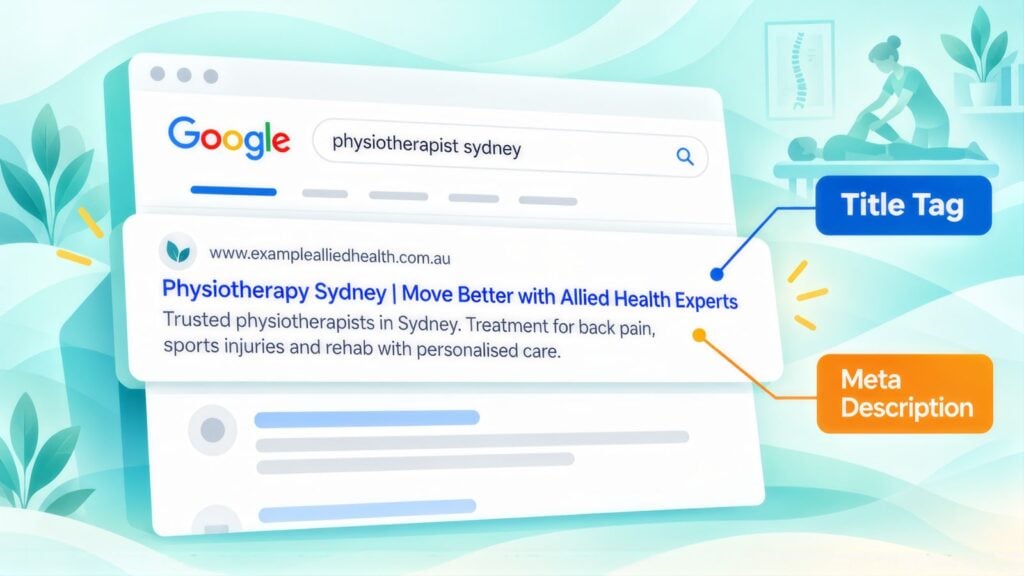
The title tag is the linked headline patients see in search results. The meta description is the snippet of text below it. Draft both for each profession page in a keyword and meta planner, so lengths and focus terms sit side by side.
Title tag examples
Clinic names can be two words or eight, so these titles start with the search term and stop there. Add your clinic name at the end only if the full title stays within 55 characters. Google usually shows your site name above the result, so the name is what you cut first.
| Page | Example title tag | Characters |
|---|---|---|
| Physiotherapy main | Physiotherapist [Suburb] | Book Online Today | 44 |
| Psychology | Psychologist [Suburb] | Anxiety and Depression | 46 |
| Occupational therapy | Occupational Therapist [City] | NDIS and Private | 48 |
| Condition page | Back Pain Physio [Suburb] | Same-Week Appointments | 50 |
| Medicare page | Allied Health Medicare Rebate | GP Referrals | 44 |
| Paediatric | Paediatric Speech Pathologist [Suburb] | NDIS | 45 |
Meta description examples
| Page | Example meta description | Characters |
|---|---|---|
| Physiotherapy | Physiotherapist in [Suburb] for sports injuries, back pain and post-surgery rehab. Private and Medicare rebate appointments. Book online today. | 143 |
| Psychology | Psychologist in [Suburb] for anxiety, depression and trauma. Private sessions, or Medicare rebates with a GP referral. Book a confidential session. | 147 |
| Medicare / GP plan page | Allied health Medicare rebates under a GP chronic condition management plan: what is covered, how many visits and any gap fee. Book your plan visit. | 148 |
| NDIS page | NDIS-registered allied health in [City]: physiotherapy, OT and speech pathology for plan-managed and self-managed participants. Enquire about a visit. | 150 |
The bulk billing note in Allied Health Keywords by Profession and Funding Pathway applies to metadata too, so only use the phrase where it is true for that type of appointment.
Schema Markup for Allied Health Practices
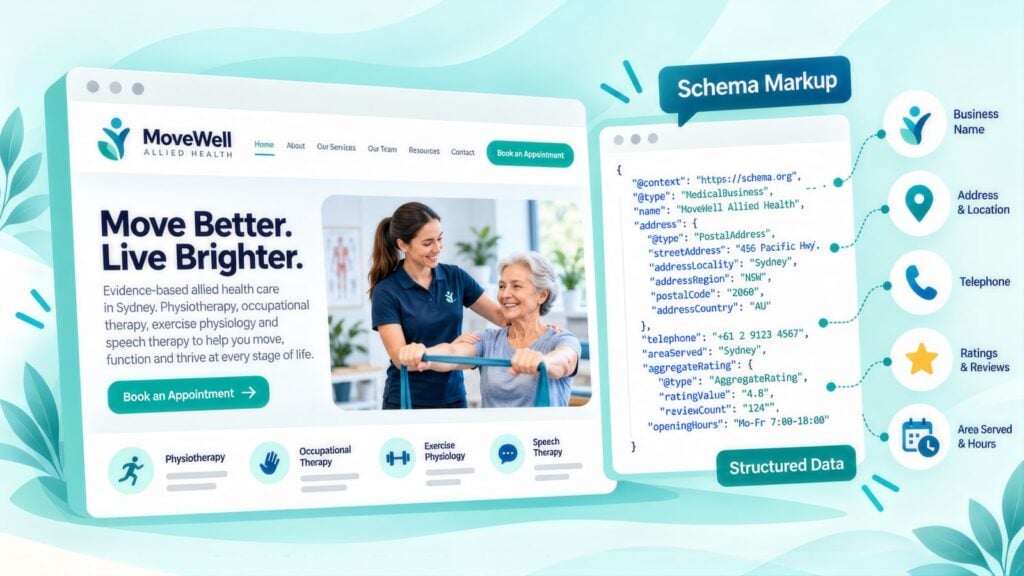
For a clinic, schema markup does two jobs. It marks the practice up as a health business, and it gives each practitioner an entry linked to that practice. The code sits in the page source, where it tells Google which clinic you are, where you are and who treats patients there.
In practice, that means:
- A LocalBusiness type such as MedicalBusiness or PhysicalTherapist on the homepage and each clinic location page.
- A Person entry on every practitioner profile, with worksFor pointing to the practice. Do not use Physician for allied health practitioners, because schema.org keeps that type for medical doctors.
- Article markup on condition guides, so the named author and review date are clear.
- BreadcrumbList on pages below the homepage, showing a path such as Services > Physiotherapy > Back Pain.
- FAQPage on service pages with FAQs.
FAQs that matter in allied health
The most useful clinic FAQs answer five questions:
- whether a referral is needed
- what a visit will cost after Medicare
- how many sessions are likely
- what to wear or bring
- which health funds you accept
Questions like these often appear in Google’s “People Also Ask” box, and a clear answer on your page saves the patient a call to reception.
A clinic will not get an FAQ dropdown in results. After August 2023, Google showed them only for well-known government and health sites, and the Search Central updates log records their removal from 7 May 2026. FAQPage schema is still worth adding, because it tells search engines and AI tools which patient question each answer belongs to.
Linking Profession, Condition and Funding Pages
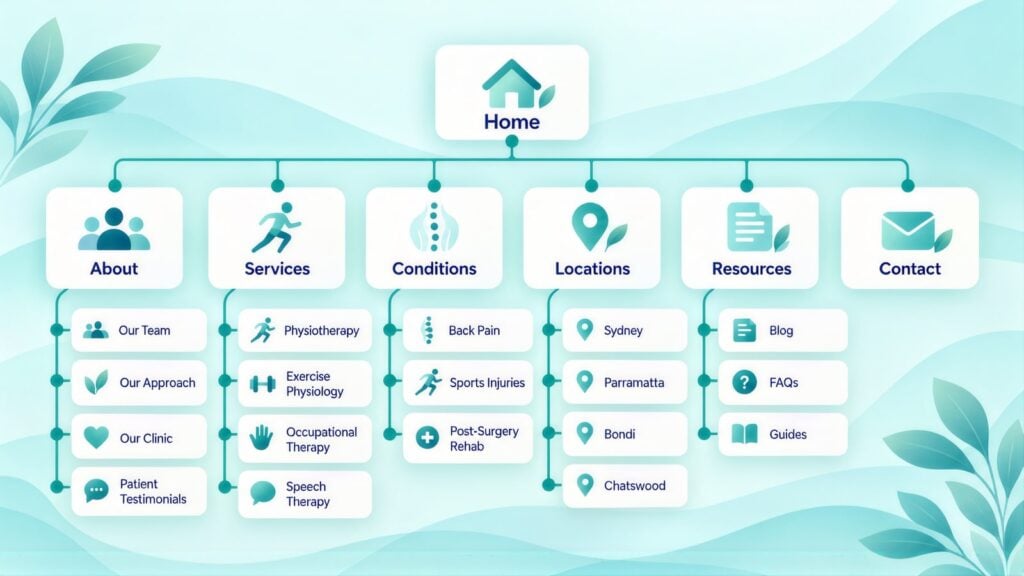
A clinic site covers several professions, conditions and ways to pay. Links between your own pages help patients and Google find their way through it all. Without a plan, Google sees each page in isolation, and some important pages end up with few links pointing to them.
Hub-and-spoke for allied health
Your homepage or main services page is the hub of the site. Each profession page, such as Physiotherapy, Psychology or Occupational Therapy, is a main spoke. Condition pages (back pain, anxiety, ADHD) and payment pages (Medicare, NDIS, private health) are smaller spokes. They link back to their profession page, and to each other where it helps. Every page links back toward the hub, using natural and varied link wording.
| Destination page | Avoid | Use instead |
|---|---|---|
| Physiotherapy page | “physiotherapy” | “our registered physiotherapists”, “physiotherapy in “, “musculoskeletal treatment options” |
| Medicare page | “Medicare” | “using your GP referral”, “how Medicare rebates work”, “chronic condition plan appointments” |
| NDIS page | “NDIS” | “NDIS-funded allied health services”, “therapy for NDIS participants”, “booking with an NDIS plan” |
| Practitioner profile | “our team” | “our AHPRA-registered physiotherapists”, “our clinical team”, “meet our psychologists” |
Condition Guides and Digital PR That Bring In Patients
Someone who reads a condition article on a clinic site may already be choosing a provider. Plain-language content about their condition, with no jargon and no promised results, makes your practice a credible choice before they book.
| Topic | Example articles |
|---|---|
| Condition explainers | What causes lower back pain. How psychologists treat anxiety. What to expect from a neuropsychological assessment. |
| Funding guides | How to get a GP referral for allied health. What a chronic condition management plan covers and who can get one. Using your NDIS plan for physio. |
| Exercise and self-care | Exercises for knee pain between physio visits. Breathing techniques for everyday anxiety. Keep these as general wellness tips, with no promised results. |
| Paediatric guides | Signs your child might benefit from speech pathology. What happens at a child’s OT assessment. How school reports feed into therapy plans. |
| Choosing care | When to see a physio versus a chiropractor for back pain. How to choose a psychologist in [city]. How OT differs from physio. |
Getting cited in AI answers
Well-structured condition guides are also the pages that can be cited in AI Overviews. In CCM’s captures, AI Overviews appeared on all three question searches and on none of the local ones. On is physio covered by medicare, 9 of the top 10 sites did not rank on any of the Sydney physio searches. Google’s AI features guidance lists no extra technical steps: a page must be indexed and eligible to show a snippet. Answer one patient question clearly near the top of each guide. Name the practitioner who reviewed it and show the date, so AI tools have a clear and trustworthy answer to quote.
AHPRA compliance in blog content
A blog article that promotes a regulated health service counts as advertising, so AHPRA’s guidelines apply. Leave out clinical result testimonials, claims that raise false hopes, and comparisons with named competitors. Articles can describe how assessment and treatment work, the evidence behind an approach and what to bring to a visit. They cannot promise the treatment will work for the reader. Have a practitioner from the right profession review each article before it goes live, and name them on the page.
Digital PR and links for a clinic
Look for links from relevant local and health sources rather than general directory listings. Good sources include:
- a sports club your physios look after
- a school or kindergarten where your speech pathologist runs a parent session
- your professional association’s find-a-practitioner listing (APA, APS, SPA, OTA)
- local news, when a practitioner comments on something topical, such as injury prevention before a fun run
The AHPRA rules apply here too, so a press comment can explain a condition but cannot promise a result.
Google Ads for Allied Health: Setup and Compliance
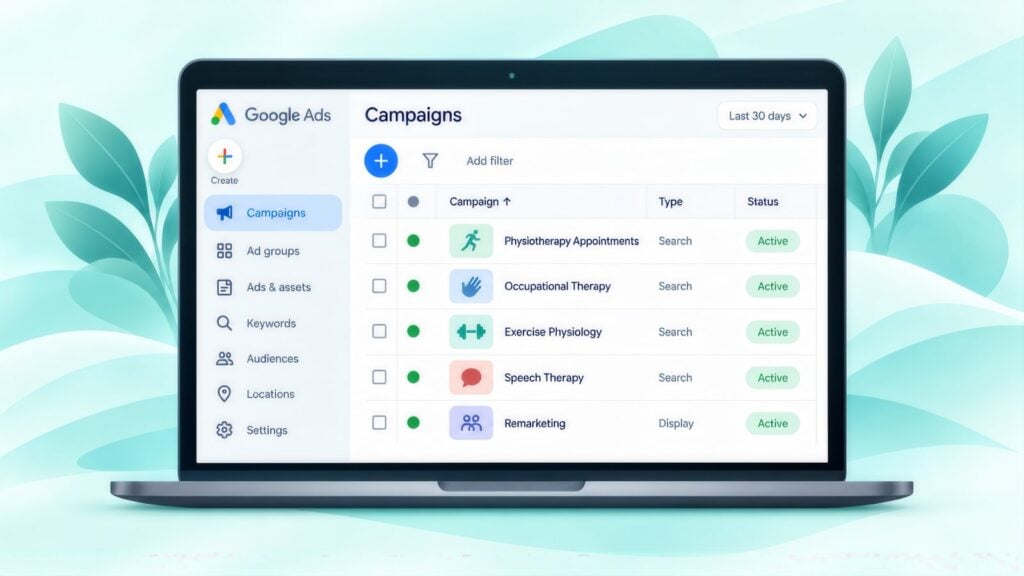
Paid search for practices works well when organic competition is strong and the diary has gaps. The AHPRA rules that govern your website apply to your ads as well.
Google’s healthcare advertising policies
Google also has its own Healthcare and medicines policy. Health ads must follow local law and industry advertising codes. Google does not require pre-approval for allied health ads in Australia, but it can reject ads that make misleading medical claims. An ad saying “we treat and cure back pain” would fail under Google’s policy and AHPRA’s guidelines alike.
Campaign structure
| Item | How we would start a clinic |
|---|---|
| Campaign type | Run a separate Search campaign for each profession, so physio, psychology and OT bookings each show their own cost. |
| Location targeting | Show ads only to people within a set distance of your clinic. For most city practices, 3 to 8 kilometres covers where patients really come from. |
| Ad schedule | Run ads when reception can answer calls and manage bookings. With online booking you can run longer hours, because patients book without staff. |
| Bidding | Start by letting Google get the most clicks for your budget, or set your own maximum cost per click (manual CPC). Once a profession’s campaign has logged about 30 bookings or forms, try a bid strategy that aims for a set cost per booking (target CPA). |
| Conversion | A conversion is whatever action you decide counts as a win. Track form fills and online bookings separately. A booking is worth far more than a form, because the patient has already picked a time. |
Facebook and retargeting as a second channel
Google Ads reaches patients who are already searching. Meta ads and display retargeting reach two other groups. The first is people who visited a service page but did not book, and the second is parents researching a child’s speech or OT needs over several weeks. Keep retargeting audiences broad, such as all site visitors, rather than narrow groups like “visited the anxiety page”. Meta’s and Google’s health policies limit targeting people by health condition, and an ad that hints you know someone’s condition reads badly. Use the same AHPRA-safe wording, covering process, availability and fees and leaving out results.
Clinic Keywords, Negatives and Compliant Ad Copy
Bid on profession and suburb searches, plus the payment terms you can honour, and block job and study searches before launch. Keep every headline inside AHPRA’s rules, and make sure any billing claim in an ad matches what reception says on the phone.
Keyword selection
| Intent level | Example keywords | What to do |
|---|---|---|
| High (ready to book) | “physiotherapist “, “book psychologist [city]”, “physio near me” | Include these as your main terms. |
| Funding intent | “bulk billing physio [city]”, “Medicare rebate psychologist”, “NDIS OT [city]” | Include these if you offer the options, because the searcher already knows how they want to pay. |
| Low / unsuitable | “physio jobs”, “physiotherapy degree”, “become a speech pathologist”, “physio salary Australia” | Block these before launch. A wasted ad spend scorecard shows what they cost if you skip this. |
| Symptoms only | “back pain causes”, “anxiety symptoms”, “what is OT” | Leave these out of booking campaigns, because blog content in organic search serves them better. |
Ad copy within AHPRA constraints
| Ad part | Example (compliant) |
|---|---|
| Headline 1 | Physiotherapist [Suburb] |
| Headline 2 | Book Your Physio Online |
| Headline 3 | No Gap on GP Plan Visits |
| Headline 4 | Same-Week Appointments |
| Description 1 | AHPRA-registered physios in [Suburb] for sports injuries and back pain. Medicare options. |
| Description 2 | Book online. No GP referral needed for private visits. Fees shown before you book. |
Landing Pages That Turn Clicks Into Bookings

The patient who clicked your ad is interested but still unsure about cost, availability and whether you treat their problem. A landing page works when it answers each of those questions, which is why dedicated landing page design tends to convert better than your home page.
What a converting allied health landing page needs
- The profession, suburb and main conditions in the headline, matching the ad’s wording exactly.
- The fee, the Medicare rebate (if any) and the out-of-pocket amount, given as actual numbers rather than “competitive rates” or “call for pricing”. If you bulk bill plan visits, say “no gap on GP referral appointments” clearly.
- The treating practitioners’ AHPRA numbers, or their SPA, Dietitians Australia or ESSA credentials, visible without scrolling.
- Whether a GP referral is needed, or a note that private visits need no referral.
- An online booking button near the top of the page on mobile.
- A real phone number that is answered during clinic hours and can be tapped on mobile.
- Waiting times or the next free slot, since a line such as Next available: this week tells a patient with an urgent need they can be seen soon.
The nearest result we can quote is from dentistry rather than allied health. 1300 Smiles has 26 locations. We rebuilt its site, connected the Centaur booking system and reworked the path to an appointment, lifting bookings by 66%. The figure is listed on CCM’s client results page. A physio or podiatry group with several clinics faces the same issue, because each extra step between the ad and a confirmed time loses some patients.
Conversion Tracking: Enquiry to Attended Appointment
The measure that matters most commercially is the attended first appointment, and forms and bookings are steps toward it. Track the patient from search to booking to the visit itself. That takes Google Analytics 4 (GA4) and Google Tag Manager (GTM), which installs the tracking on your site. A sound GA4 and GTM tracking setup makes the whole path visible.
| Stage | What to record | How to use it |
|---|---|---|
| Enquiry received | The form, booking request or call, with the date, profession and source. | Shows how many enquiries you get. |
| Appointment booked | The appointment confirmed in your practice software, with the profession and appointment type. | Tell Google Ads to bid for more of these. |
| First appointment attended | The date of the completed visit, the practitioner, the appointment type and how the patient paid. | The result that proves the campaign works. |
| Ongoing appointments | How many more visits follow in the same course of care, and the revenue per patient. | Shows what a patient is worth, so you know how much you can spend to win a first visit. |
Some booked patients do not turn up, and every no-show raises the cost of each attended visit. This illustrative example assumes a booking cost of $60 and a 10% no-show rate:
| Step | Result |
|---|---|
| Each booking costs you | $60 |
| Bookings that do not show | 10% |
| Each attended visit really costs | $67 |
Track no-shows by source if your practice software allows it. Patients from Google Ads, organic search and referrals may turn up at quite different rates.
The First 12 Weeks for an Allied Health Clinic, Week by Week
Work through one profession at a time. Tick off each line before you move to the next week. If a week slips, push the rest back instead of skipping ahead.
| Week | Checklist |
|---|---|
| 1 | Connect Google Search Console and submit the sitemap. List your top referring GP practices and funders from the last six months. |
| 2 | Complete the Google Business Profile for each location. Point the booking link straight at your practice software. |
| 3 | Put every practitioner’s AHPRA number, or CPSP, APD or AEP status, on their profile. Remove any clinical result claims across the site. |
| 4 | Publish the fees page: private fee, Medicare rebate, gap and health funds accepted. Test booking on a phone from start to finish. |
| 5 | Build the GP referral page and the chronic condition management plan page, with current visit limits. |
| 6 | Rewrite your main profession page with fees, credentials and FAQs. Set up separate conversions for bookings and form fills. |
| 7 | Launch one Google Ads Search campaign for that profession in your main suburb, with job and study searches blocked. |
| 8 | Send the first quarterly update to GPs who have agreed to get it. Review search terms and block poor matches. |
| 9 | Publish a condition guide reviewed and signed by a named practitioner. Start neutral review requests after completed courses of care. |
| 10 | Ask one local club, school or association for a provider listing or link. |
| 11 | Work out cost per booking and cost per attended visit, including no-shows, by source. |
| 12 | Decide on a second profession, a second suburb or more work on the first. Book in a review of Medicare and AHPRA wording every six months. |
Allied Health SEO and Google Ads: Clinic Questions
How long does SEO take for an allied health clinic?
The map results usually move first for a clinic. A complete Google Business Profile with services and a booking link can show results within 3 to 4 months. Profession and condition pages take longer where several clinics compete within a couple of kilometres, and 6 to 9 months is a fair guide there. After the first year, condition guides signed by named practitioners keep adding visibility. No agency can guarantee rankings.
How much does SEO cost for an allied health practice in Australia?
For a clinic, the price follows the number of professions, locations and payment options to cover. A solo physio in one suburb needs a few profession, condition and fees pages. A group with physio, psychology and OT across three sites needs a set for each, plus an AHPRA wording check on every page. Agency SEO in Australia sits between $1,500 and more than $10,000 a month. A full-time in-house specialist costs $80,000 to $170,000-plus a year with tools and training, based on these in-house versus agency figures. Weigh that against an attended first visit, and the course of care that follows, with an SEO ROI calculator.
What are good SEO keywords for physiotherapists and other therapists?
Start with profession plus suburb (“physiotherapist “, “psychologist near me”). Then add condition plus profession (“physio for back pain “) and payment terms you can honour (“Medicare rebate psychologist”, “NDIS OT [city]”). Each group needs its own page. Allied Health Keywords by Profession and Funding Pathway lists example clusters for six search types.
What do Google Ads clicks cost for allied health?
In CCM’s Google Keyword Planner pull of 1 October 2026 (Australia), top-of-page bids for psychologist near me ran at about $1.80 to $6.30 a click. “Podiatrist” sat at about $1.60 to $6.20 and “occupational therapist” at about $2.30 to $9.70. CCM’s analysis of Keyword Planner data for the 12 months to July 2026 shows around 27,100 searches a month for psychologist near me. Your real cost depends on profession, suburb and ad quality, so judge the account on cost per attended appointment.
Do speech pathologists need to show an AHPRA number?
No, speech pathology is not an AHPRA-registered profession, so a speech pathologist has no AHPRA number to show. Display Certified Practising Speech Pathologist status with Speech Pathology Australia instead. Do the same with Accredited Practising Dietitian and Accredited Exercise Physiologist status for those professions.
Can we advertise a free or discounted first session?
You can, as long as the ad states the terms. AHPRA’s advertising guidelines allow a gift, discount or other inducement for a regulated health service if the ad also states the terms and conditions of the offer. Avoid wording that suggests a clinical result, and check the AHPRA advertising hub before you launch.
Should we still say “CDM plan” on our website?
Mention it once to explain the change, then use the new name. GP chronic condition management plans replaced CDM plans from 1 July 2025, and Where Allied Health Patients Come From: GPs, Insurers and Direct Search sets out the visit limits under the new plan. Update your page titles, meta descriptions and ads to match.
How does a clinic appear in Google’s AI Overviews?
A clinic page appears there by answering a patient’s question clearly, because in CCM’s September 2026 captures AI Overviews showed on question searches, not local ones, and the sites ranking for those questions were mostly different from the clinics ranking locally (see the research above). Google lists no extra technical steps for AI Overviews or AI Mode. Under its guidance for site owners, the page just has to be indexed and able to show a snippet. Clear condition guides, named practitioners with their credentials and accurate fee pages give AI tools something reliable to quote.
Andrei Jach is Senior Manager, SEO and Analytics Specialist at Click Click Media in Sydney and has worked in digital marketing and strategy for over 15 years. He has led SEO for health businesses as well as retail, professional services and manufacturing clients, and oversees strategic SEO planning, analytics implementation and technical audits at CCM. His earlier roles include Agent 6 Marketing and Red Propaganda.
Implement this playbook with AI
Opens your assistant with this playbook and seven questions about your business: services, area, website and ads. It then writes your keyword map, page plan and Google Ads starter build with your details filled in.
Copy the prompt for Gemini, Grok or any assistant that cannot open a prefilled link. The prompt points at this page, which is also served as Markdown to assistants that ask for it.
Work with Click Click Media
Referred patients, fund members and people searching “physio near me” late at night all check your site for the same three things. They look for the fee, the referral rules and the next free appointment. Showing these up front makes it easier for patients from every source to book.
Click Click Media has worked in search since 2008, holds Google Premier Partner status and has managed more than $115 million in Google Ads spend. For clinics, we build search visibility and AHPRA-compliant Google Ads campaigns judged on attended appointments. The free audit reviews your website, Google Business Profile and any Google Ads account. It pays close attention to credential wording, fee pages and gaps in your booking path.
No lock-in contract applies, and one senior strategist manages your clinic’s account throughout.
Verified Sources and References
- Department of Health, Disability and Ageing: Allied health care (workforce and MBS service figures)
- Health Workforce Data: Allied health statistics and reports
- Services Australia: Services available under a GP chronic condition management plan
- NDIS: Quarterly reports
- AHPRA: Advertising hub
- AHPRA: Guidelines for advertising a regulated health service
- OAIC: Health information and privacy
- Google Ads Help: Healthcare and medicines policy
- Google Search Central: Search updates log (FAQ rich result removal)
- Google Search Central: Changes to HowTo and FAQ rich results (August 2023)
- Google Search Central: AI features and your website
- AHPRA: Register of practitioners (regulated professions)
- Speech Pathology Australia: Speech pathology is a self-regulated profession (FAQs, March 2025)
- ACCC: False or misleading claims
Last checked October 2026 · next review January 2027
