
SEO and Google Ads for Restaurants, Cafes and Bars in Australia
Written by Andrei Jach, Senior Manager, SEO and Analytics Specialist at Click Click Media · Updated 1 October 2026
Australian cafes, restaurants and takeaway food services turned over $5.58 billion in June 2025 alone, according to the Australian Bureau of Statistics. Independent venues compete for that spend on thin margins and high wage bills, so each extra diner makes a real difference.
Good SEO for restaurants, cafes and bars puts you first when someone searches restaurants near me at 6pm on a Friday. To win that search, keep your reviews coming in, say clearly whether you take walk-ins and make booking quick on a phone.
This guide covers what to fix, what to build and how to run Google Ads that bring in diners and function enquiries. Throughout, success is measured in bookings rather than in how many people saw an ad.
Implement this playbook with AI
Opens your assistant with this playbook and seven questions about your business: services, area, website and ads. It then writes your keyword map, page plan and Google Ads starter build with your details filled in.
Copy the prompt for Gemini, Grok or any assistant that cannot open a prefilled link. The prompt points at this page, which is also served as Markdown to assistants that ask for it.
What We Saw on Venue Searches
In CCM’s three Australia-wide captures of dining searches on 3 September 2026, venues’ own websites held only 4 of the 30 top-10 organic places (13%).
Directories, booking and delivery platforms, food publishers and social sites held the other 26 places. A diner often meets your venue on someone else’s page before they reach your site.
Keep your Zomato, OpenTable and delivery listings accurate, with the same hours, menu and booking link as your website and Business Profile.
Source: CCM captures of venue searches, Australia, 3 September 2026
On christmas party venues sydney and function venues sydney, venues held 6 and 5 of the top 10 organic places, and none of those 11 results was a home page.
Each of the 11 was an events or functions page deeper in the venue’s site.
Build a functions page and a Christmas page with capacity, packages and an enquiry form, and keep each at the same web address every year.
Source: CCM captures of venue searches, Australia, 3 September 2026
On corporate catering sydney, all 10 of the top 10 organic results were caterers’ own home pages, with no directory, marketplace or publisher among them.
A second capture of the same search from a Sydney location that day found home pages in 9 of the top 10 places.
If you cater, state your menus, minimum order and delivery area on the home page, and link it to a full catering page with a quote form.
Source: CCM captures of venue searches, Australia and Sydney, 3 September 2026
CCM captured these searches once each on desktop with the DataForSEO SERP API on 3 September 2026, Australia-wide, and also captured restaurants near me on mobile. The dining searches were restaurants near me and best restaurants sydney, and the others were function venues sydney, christmas party venues sydney and corporate catering sydney. Corporate catering sydney was captured again from a Sydney location, and two agency searches are left out of these counts. A home page means a URL at the root of the venue’s or caterer’s site.
Seasonal and Day-Part Demand: When Diners and Planners Search
Restaurant marketing follows a yearly calendar of demand. Everyday dining searches are large and steady, while searches for occasions and functions rise sharply at set times of year. Venues that take those bookings have their pages and ads live a month or more ahead. Restaurant SEO therefore begins with a map of when your diners search.
CCM’s analysis of Google Keyword Planner data for Australia (12 months to August 2026) shows the pattern clearly:
| Search | Low month | Peak month | What it tells you |
|---|---|---|---|
| christmas party venues | 50 (January) | 1,000 (September) | Planners book end-of-year functions in spring. A Christmas page published in November is late. |
| mothers day lunch | 10 (most months) | 14,800 (May) | Searches reach 880 in March and 12,100 in April. Your menu and booking link need to be live by early April. |
| rooftop bar | 27,100 (June) | 60,500 (October to January) | Searches for outdoor and rooftop venues roughly double in the warm months. |
| function venue | 320 (December) | 1,300 (September) | Function enquiries cluster in spring and fall away over the holidays. |
Day-parts, the times of day you serve, matter as much as seasons. In the same Keyword Planner data, breakfast near me averages about 368,000 searches a month, brunch near me 135,000 and bars near me 450,000. People search for the meal they want right now as often as for a type of food. Name each service you run on your website and Business Profile, with its hours. Breakfast, brunch, dinner and late drinks also peak at different points in the week, which is why the ad schedule in Google Ads for Restaurants and Function Venues below changes with the service you are promoting.
People search for dining, functions and catering in different ways, and each brings in a different return. A search for restaurant Surry Hills is usually a same-day decision, while “function venue Sydney” starts 30 to 90 days of planning. “Event catering Sydney CBD” may involve a committee and a formal brief. Give each stream its own page and its own conversion tracking, and in most cases its own campaign.
Keyword Clusters by Occasion, Cuisine and Need
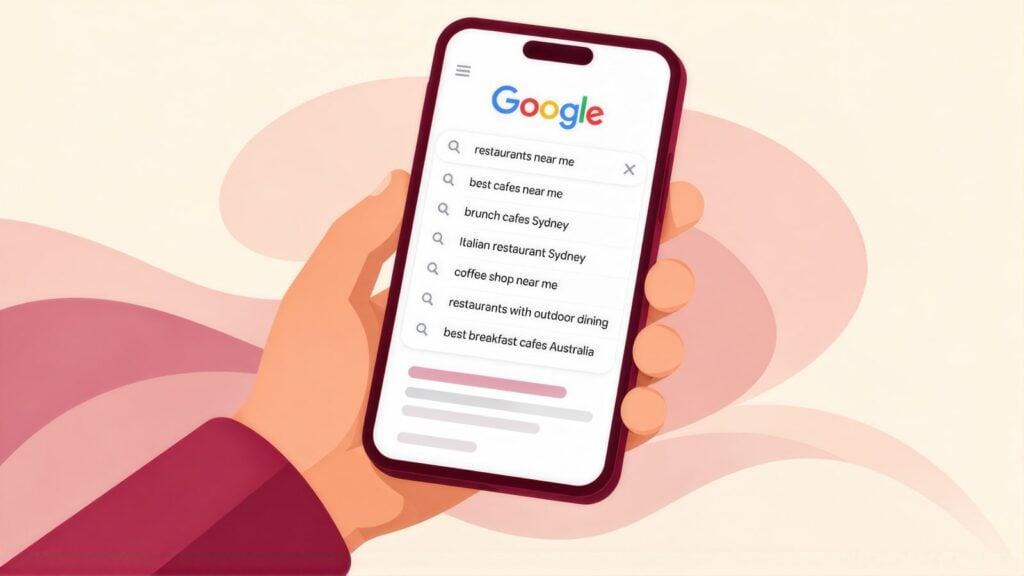
Diners search by place, cuisine, occasion and practical need, and function planners search in different ways again. Group your pages and campaigns around those patterns rather than one general restaurant keyword. Suburb searches add up as well. In CCM’s analysis of Keyword Planner data, restaurants Surry Hills alone averages about 33,100 searches a month. Google groups close variants such as restaurant Surry Hills into that figure.
Dining Discovery
restaurants [suburb]
restaurants near me
best restaurants [area]
dinner [suburb] [city]
Cuisine Type
Italian restaurant [suburb]
Japanese [area] [city]
seafood restaurant [city]
modern Australian [suburb]
Occasion
birthday dinner [city]
mothers day lunch [suburb]
romantic restaurant [suburb]
christmas party venue [city]
Function and Events
function venue [city]
private dining room [city]
event venue [suburb]
corporate function venue [city]
Breakfast and Cafe
cafe [suburb]
brunch [area] [city]
breakfast near me
best coffee [suburb]
Practical Intent
restaurants with parking [suburb]
restaurants open Sunday [area]
dog-friendly cafe [suburb]
BYO restaurant [suburb]
Practical searches such as dog-friendly cafe Newtown or BYO restaurant Surry Hills get few searches each, although the person has already narrowed the field and is picking a venue. These searches are usually easy to rank for, and your Business Profile settings answer many of them, so the work shows results quickly.
Open your Google Business Profile and check the attributes, the yes-or-no features of your venue. Options such as dog-friendly, outdoor seating, BYO, private dining, wheelchair access and parking show in search results and help people who filter their search find you. Switch on every one that is true today.
Local SEO for Restaurants: The Map Pack, Profile and Reviews
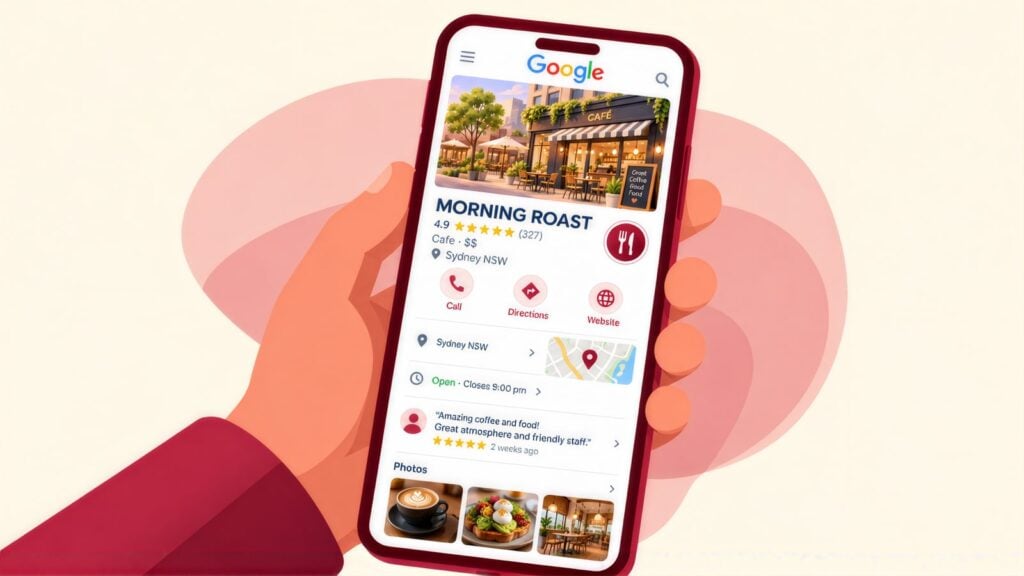
For restaurants and cafes, the local pack in Google Maps is usually the first place to work on. A search for restaurants near me shows a map with three venues above the normal results. That is why local SEO for restaurants starts with the Business Profile.
On many dining searches, the first normal result is a Zomato listing, an OpenTable page or a Broadsheet article. It sits ahead of the restaurant’s own site, which means your profile is often the first thing a diner sees about you.
| Field | What to do |
|---|---|
| Primary category | Choose the most specific category that is accurate, such as Restaurant, Cafe, Bar, Italian restaurant or Seafood restaurant. |
| Menu link | Link to your current menu page in plain text, so Google can match menu searches like restaurants with oysters near me. |
| Reservation link | Link straight to your booking system so diners can go from the map to a booking. |
| Attributes | Switch on what applies: dine-in, takeaway, delivery, outdoor seating, dog-friendly, BYO, good for groups, private dining, wheelchair access. Each one appears in filtered searches. |
| Hours | Set hours for each day, including when the kitchen closes if that is earlier. Set special hours ahead of public holidays. |
| Photos | Show food, the room during service, the bar, the function space and the outside. Use your own photos and add new ones monthly. |
| Posts | Post seasonal menus, events and occasions such as Mother’s Day or Christmas a few weeks before demand peaks. |
Your business name, address and phone number must match exactly on your website, Business Profile, Zomato, OpenTable and every other directory. When anything changes, update all of them on the same day.
Reviews for restaurants
More reviews help you rank, and better reviews help diners choose you. Ask every guest in the same way at the same point, either at the table after the meal or by SMS soon after they leave. Never ask during or after a complaint.
Google’s review content policy bans offering discounts or free items for reviews, and those reviews get removed. Genuine reviews can also be filtered out. If Google is removing reviews from your profile, find out why before asking for more. When you reply to a negative review, do not share details of the guest’s visit beyond what they wrote.
Delivery Apps and Direct Online Ordering
Use delivery apps to reach new diners and your own site for repeat customers, because the apps take a share of every order. Uber Eats’ published Australian pricing lists:
- a marketplace fee of 30% when Uber delivers, 16% when your own staff deliver and 8% for pick-up
- 25% on Webshop orders with Uber delivery, or 6% for self-delivery and pick-up (Webshop is an ordering site you link from your own website)
Check the current rates for every platform you use, and send regulars and search traffic to direct ordering where you can. Takeaway near me alone averages about 201,000 searches a month in Australia (CCM analysis of Google Keyword Planner data, 12 months to August 2026). An order placed on your own site keeps more of the margin and gives you the customer’s details for your next promotion.
Watch searches for your venue’s name too. If a delivery app’s page outranks your own ordering page, point your website, Business Profile order link and menu page to direct ordering.
Menus, Bookings and Site Speed
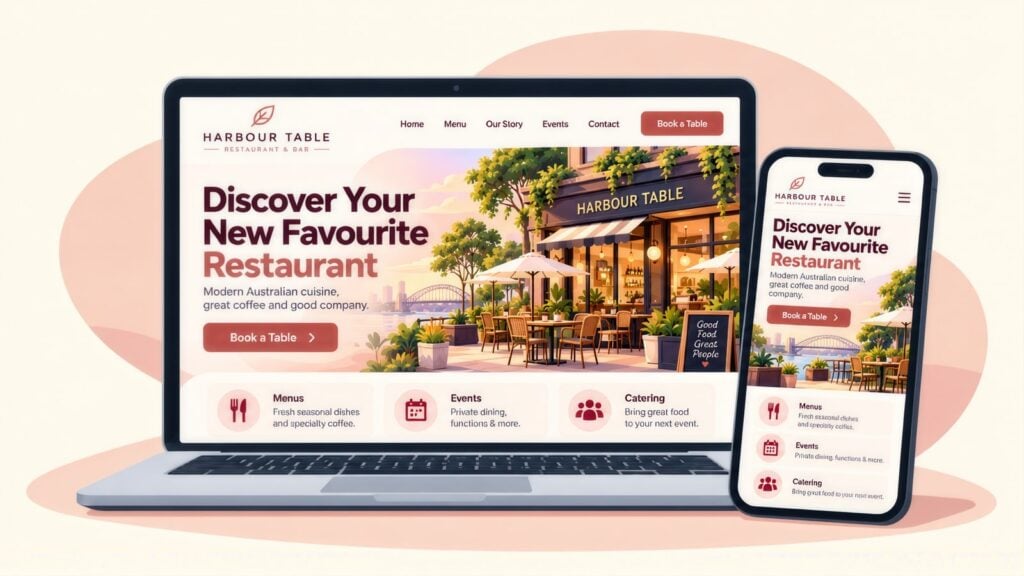
Your website needs to show the current menu, take the booking and, if you do takeaway, take the order. Diners who find you on Maps or a review site check your site for the menu, the prices and a sense of the room before they book.
Menu accuracy
An online menu that does not match what the kitchen serves leads to disappointed diners. Update it every time it changes, and date seasonal menus. If your menu is only a PDF, publish it as text on a web page so Google can read it and show it in search.
Online reservations
Whether you use OpenTable, SevenRooms, ResDiary or a simple form, put the reservation link on every page and test it on a phone. Keep the booking short, with no step a diner does not need. For venues that seat people in ways the standard tools do not handle, a custom booking system built into the site is an option.
Mobile speed
Many dining decisions happen on a phone, often on the street or on the train, and a page that loads slowly on mobile data loses those diners. Compress every food and venue photo, then run the site through Google PageSpeed Insights on the mobile tab, and fix anything rated “Poor”.
The Pages Every Restaurant, Cafe and Bar Site Needs
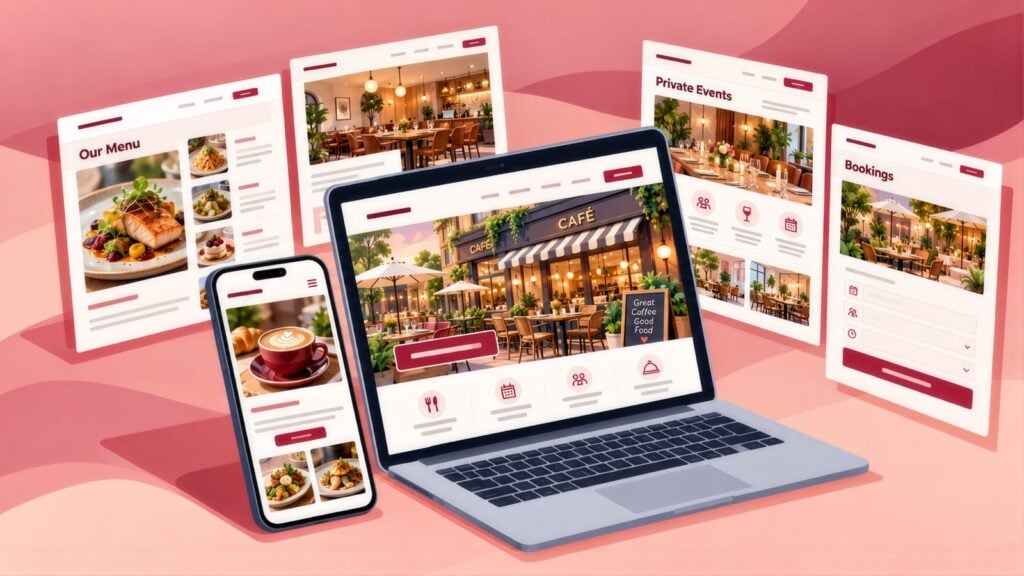
Most venues need five core pages, plus a seasonal page for each occasion you sell. The functions page usually brings the most value per enquiry.
| Page | Focus keyword | What to put on it |
|---|---|---|
| Restaurant / main dining | [cuisine] restaurant | Menu, prices, hours for each service, booking link, photos, parking, dietary information, reviews and an FAQ |
| Function and private dining | function venue or private dining [city] | Capacity seated and standing, room layouts, catering options, minimum spend, audio-visual gear, an enquiry form and a gallery |
| Menu page | [venue name] menu | The current menu as page text, prices, dietary labels, the date it was updated and a booking link |
| Occasion pages | christmas party venue , mothers day lunch | Set menus, dates, prices and a booking or enquiry link. Keep the same web address each year and update the content. |
| About / Story | [venue name] or [chef name] restaurant | The venue’s story, the head chef’s background, where your produce comes from, awards and media coverage |
| Contact / Find Us | [venue name] reservations | Map, parking, public transport, phone, email, booking link and public holiday hours |
Keep occasion pages live all year and refresh them before each season. The existing page keeps the links and rankings it built up last year, which a new page each December would lose.
How to link them
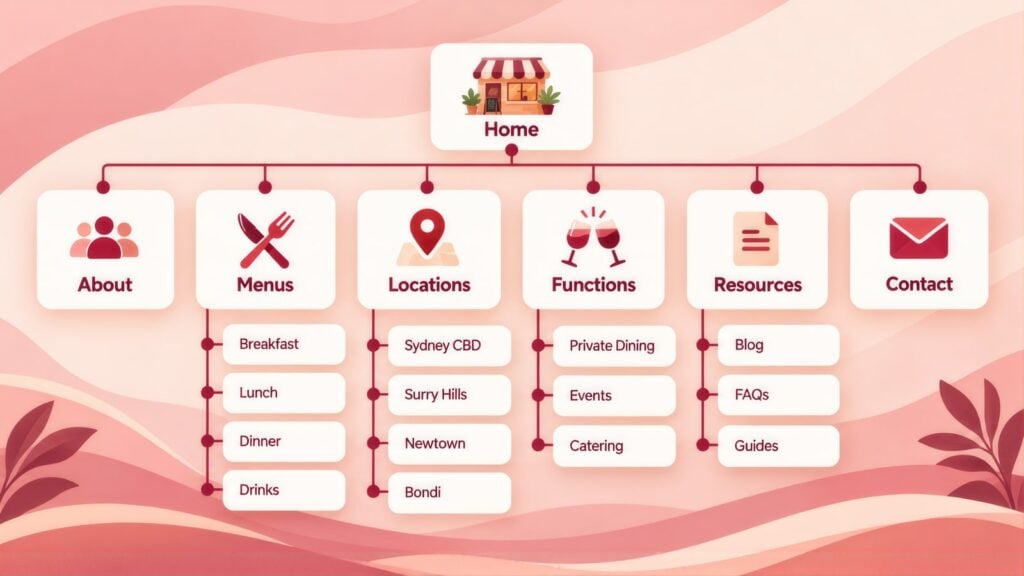
Link the main restaurant page to the menu, functions, occasion, about and contact pages, and link each of those back to it. The menu links to reservations, the functions page links to its gallery and enquiry form, and occasion pages link to the menu and to booking. Short link text that says where it goes works best:
| Destination page | Anchor text examples |
|---|---|
| Menu page | “our seasonal menu”, “this week’s specials” |
| Function enquiry | “private dining and functions”, “view event capacity” |
| Reservations | “book a table online”, “check availability” |
Title Tags, Meta Descriptions and Schema for Venues
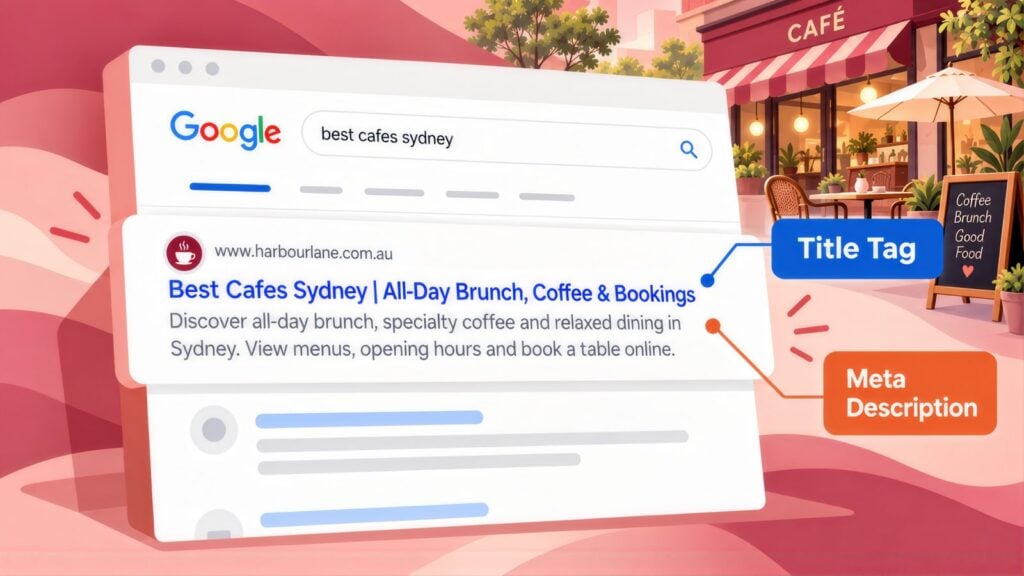
The title tag is the clickable headline Google shows for a page. Put cuisine and suburb first, then a reason to choose you, such as walk-ins, private dining or an all-day menu. Plan titles for every page together in a keyword and meta planner so your menu, functions and brunch pages do not compete for the same search.
| Page | Example title tag | Characters |
|---|---|---|
| Main restaurant | Italian Restaurant [Suburb] Sydney | Book a Table | 49 |
| Function venue | Function Venue [Suburb] | Private Dining Rooms | 46 |
| Menu page | Dinner Menu & Prices | Italian Restaurant [Suburb] | 50 |
| Brunch / breakfast | Brunch [Suburb] Sydney | All-Day Menu & Coffee | 46 |
| Group bookings | Group Dining Sydney | Set Menus for [N]+ Guests | 47 |
A one-word venue name can sit after the pipe if the title stays at 55 characters or less. Leave a long group name out, because Google shows your site name with the result anyway.
Under the title sits the meta description, a line or two of summary. Aim for 135 to 150 characters: the search phrase first, one concrete detail, then a next step. A function page might read: “Private function spaces in [Suburb] for 20 to 200 guests, with sit-down dinners, cocktail events and custom menus. Check your date and enquire now.” (147 characters). A brunch page: “All-day brunch in [Suburb] every weekend from 9am, with the full menu and specialty coffee. No booking needed for groups under six. See the menu.” (145 characters).
Schema for restaurants and venues
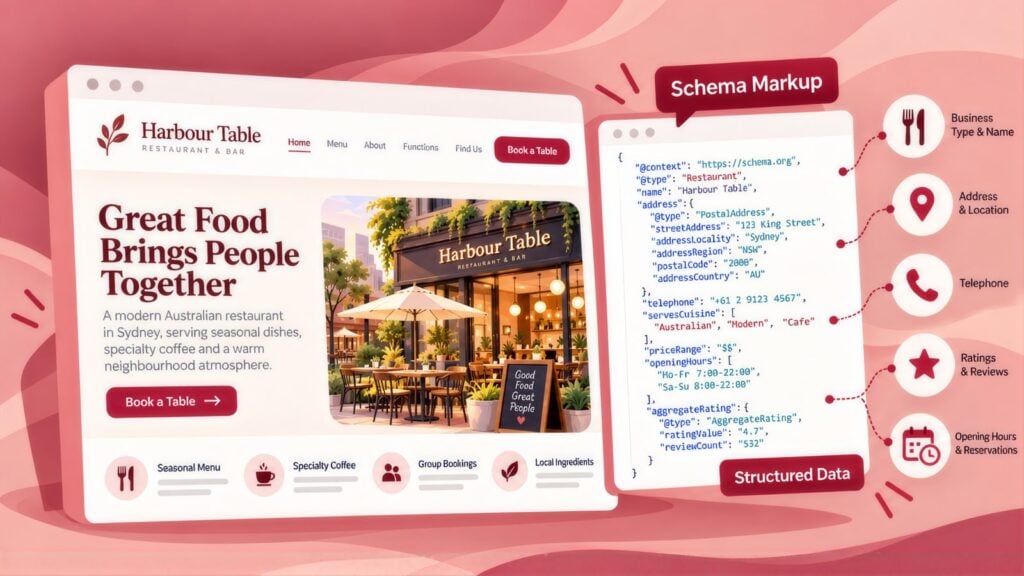
Structured data, often called schema, tells Google in code what you serve, when you open and how to book. AI tools that answer questions such as where should we eat tonight can read it too, although Google’s page on AI features and your website says AI Overviews need no special markup. A page only has to be indexed and eligible to show a snippet, and CCM’s notes on AI Overview citations cover what else helps.
| Schema type | Where to use it | What it does |
|---|---|---|
| Restaurant (a type of LocalBusiness) | Homepage and main dining page | Describes your cuisine, hours, price range and dining options. Fill in servesCuisine, hasMenu (a link to your menu page) and acceptsReservations. |
| Menu | Menu page | Marks up each dish with its name, description and price. |
| Event | Special dining events and function nights | Makes the page eligible for event rich results, which show the date, time and booking details in search. |
| FAQPage | FAQ sections on dining and function pages | Shows search engines and AI tools which text answers a diner’s question, such as walk-ins, minimum spend or vegetarian options. It no longer adds a dropdown, because Google limited FAQ rich results to government and health sites in August 2023 and then removed them from Search on 7 May 2026. |
A short Restaurant block for a homepage looks like the example below. Replace the bracketed details with your own, and check the finished code in the Schema Markup Validator before it goes live.
{
  "@context": "https://schema.org",
  "@type": "Restaurant",
  "name": "[Venue name]",
  "address": {
    "@type": "PostalAddress",
    "streetAddress": "[Street address]",
    "addressLocality": "[Suburb]",
    "addressRegion": "NSW",
    "postalCode": "[Postcode]",
    "addressCountry": "AU"
  },
  "telephone": "[Phone number]",
  "servesCuisine": "Italian",
  "priceRange": "$$",
  "hasMenu": "https://www.[your-domain].com.au/menu/",
  "acceptsReservations": true
}
Photos, Reviews and Trust Signals for Hospitality
Google applies stricter quality checks to YMYL topics, short for Your Money or Your Life, such as health and finance. Hospitality is not one of them, although trust still affects every dining and event booking. For a venue, trust comes mostly from what diners can see and what other diners say.
| Trust signal | Why it matters | How to use it |
|---|---|---|
| Real venue and food photos | Honest images show diners what the venue will look like when they arrive. | Use professional photos of real dishes, the room during service and the function space. Refresh them each season and show them on every page. |
| How many reviews, and how recent | A first-time diner looks at how many reviews you have and how recent they are, as well as the star rating. | Ask for a review after every visit in neutral words, and reply professionally to every review. |
| Accurate prices | A diner who expects $30 mains and finds $55 mains is likely to leave a bad review. | Publish menu prices, even rough ones (“mains from $28”). For functions, publish a minimum spend or package range. |
| Certifications | Food safety, liquor licensing and dietary credentials such as halal, kosher or gluten-free matter to some diners. | List the credentials you hold on your about and menu pages. Never claim one you do not hold. |
You can show your NSW Food Authority Scores on Doors rating on your website and in ads, provided it is current and reflects your latest inspection. Showing an old or wrong rating risks breaching the ACCC’s rules on misleading claims.
Food Media, PR and Links for Restaurants
Restaurants earn links more easily than most businesses, because food media and city guides write about venues all the time. A mention in Broadsheet, Good Food, Gourmet Traveller, Time Out or Urban List sends diners to you directly. When it links to your site, it also helps you rank for your suburb and cuisine.
- Send a short, specific pitch when you have news, such as a new chef, a seasonal menu, an occasion set menu, an opening or a refit. City guides plan seasonal lists such as Christmas parties, Mother’s Day or winter warmers weeks ahead, so pitch before the search peaks shown in Seasonal and Day-Part Demand: When Diners and Planners Search above.
- Ask the suppliers, wineries and producers you feature whether their “where to find us” pages link to you.
- Council, business chamber and tourism sites often list venues and events, so keep those listings accurate and linked to your site.
- Name and date any awards and guide ratings on your about page, such as a hat in a recognised food guide.
When coverage appears, link to it from your about page and ask the writer to fix any wrong details, especially opening hours. Press mentions date quickly, and a link building program can turn them into links that support your rankings over time.
Content That Helps Diners Choose
Venue content is worth publishing when it helps someone decide where to eat or hold an event. A “best restaurants in Sydney” post with your own venue at number one rarely ranks or brings bookings. Articles that answer a real question from your diners do both, such as how far ahead to book a group.
| Topic category | Example content |
|---|---|
| Occasion guides | A birthday dinner for 10 in . Farewell dinner venues. Planning a corporate function in the CBD. |
| Food and drink | What makes our [signature dish] different. How our sommelier builds the wine list. This season’s menu changes. |
| Practical guides | How to book a private dining room. What to ask a function venue. How far ahead to book Christmas parties. |
Link each article to the page where people book, so a function guide links to the enquiry form and an occasion guide links to reservations.
Google Ads for Restaurants and Function Venues
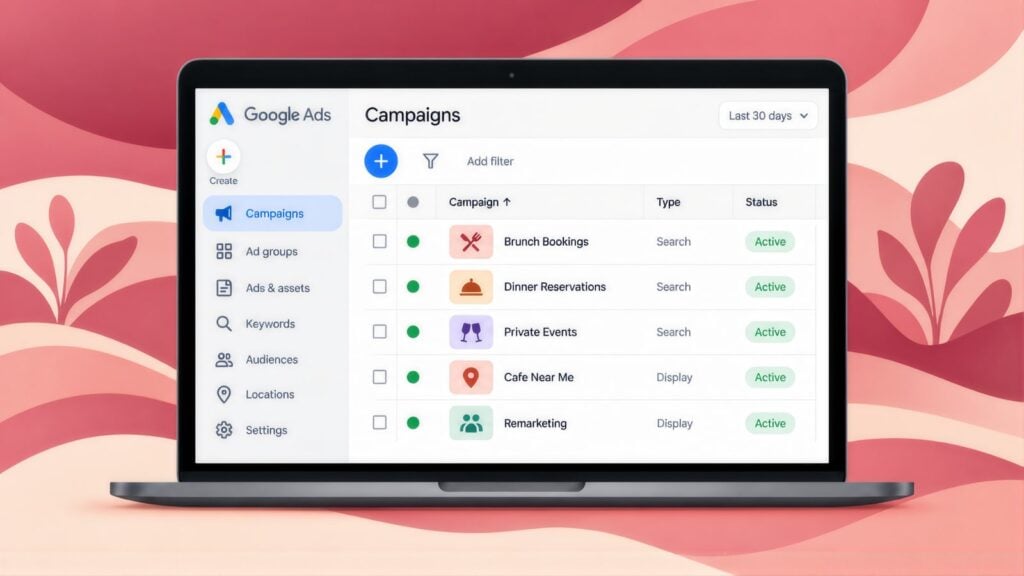
Google Ads management for a venue works best when each campaign has one job, such as filling tables, bringing in function enquiries or selling an occasion. Give each job its own campaign, keywords and landing page.
| Setting | For a venue |
|---|---|
| Where to start | Run dining and function campaigns as Search campaigns first. Hold back Performance Max, Google’s automated campaign type, until you know which searches book tables. |
| Location targeting | Show ads only to people who are actually in your area. Use 5 to 10 kilometres for dining and up to 20 kilometres for functions, because people travel further for events. |
| Ad schedule | Run dining ads from mid-afternoon, Thursday to Sunday, when people decide where to eat. Run breakfast and brunch ads early in the morning and on Friday evening for the weekend, and function ads in business hours, Monday to Friday. |
| Seasonal budgets | Raise function and occasion budgets ahead of the peaks in Seasonal and Day-Part Demand: When Diners and Planners Search above, such as September for Christmas parties and April for Mother’s Day, and reduce them afterwards. |
| Bidding | Start by setting your own price per click, or let Google get you as many clicks as it can. Once bookings come in steadily, switch to Target CPA, which aims for a cost per booking you set. |
Assets and remarketing
Assets are extra details Google can add to your ad. Add a call asset so diners can ring straight from the ad, and a location asset linked to your Business Profile so your address and distance show. Sitelinks add extra links to your menu, functions and booking pages.
For function campaigns, use remarketing, which shows ads to people who have already visited your site. Build a list of people who viewed the functions page but did not enquire, and show them a reminder ad while they plan. Event planners compare several venues, and showing them ads for a few weeks costs little compared with the value of one booking.
Smashville is a catering business that kept the same quarterly budget throughout. From 2024 to 2025, our Google Ads work lifted its results like this (2024 covers Q2 to Q4 only):
- enquiries up 50%
- conversion rate up 1.3 points
- cost per lead down 4.5%
Q4 2025 produced 70 catering enquiries at a cost per lead of $51.93, as the Smashville catering case study shows. Compare that cost per lead with the value of your own average function or catering order.
Keywords, Negatives and Ad Copy for Venues
Bid on searches from diners or planners who are ready to book, and keep dining and function keywords in separate campaigns. Block job and supplier searches from day one, or restaurant jobs and similar searches will use up your budget quickly.
| Intent | Example keywords | What to do |
|---|---|---|
| High (ready to dine) | “restaurants “, “dinner tonight”, “book Italian restaurant Sydney” | Include these as your main dining keywords. |
| High (ready to book a function) | “function venue “, “private dining Sydney”, “christmas party venue Sydney” | Include these in a separate function campaign. |
| Low or unsuitable | “restaurant jobs”, “chef course”, “commercial kitchen equipment”, “food delivery driver” | Block these straight away as negative keywords, which stop your ad showing for any search that contains them. |
Ad copy examples
Headlines are capped at 30 characters and descriptions at 90, so each message gets its own line:
| Component | Example |
|---|---|
| Headline 1 | Italian Restaurant [Suburb] |
| Headline 2 | Open Tonight, Book Online |
| Headline 3 | Seasonal Menu, Wood-Fired |
| Headline 4 | Walk-Ins Welcome |
| Headline 5 | Private Dining Room [Suburb] |
| Description 1 | Modern Italian in [Suburb]. Wood-fired dishes and a long wine list. Book online or call. |
| Description 2 | Private dining for groups and functions. See menus and capacity, then check your date. |
Landing Pages That Fill Tables and Function Rooms
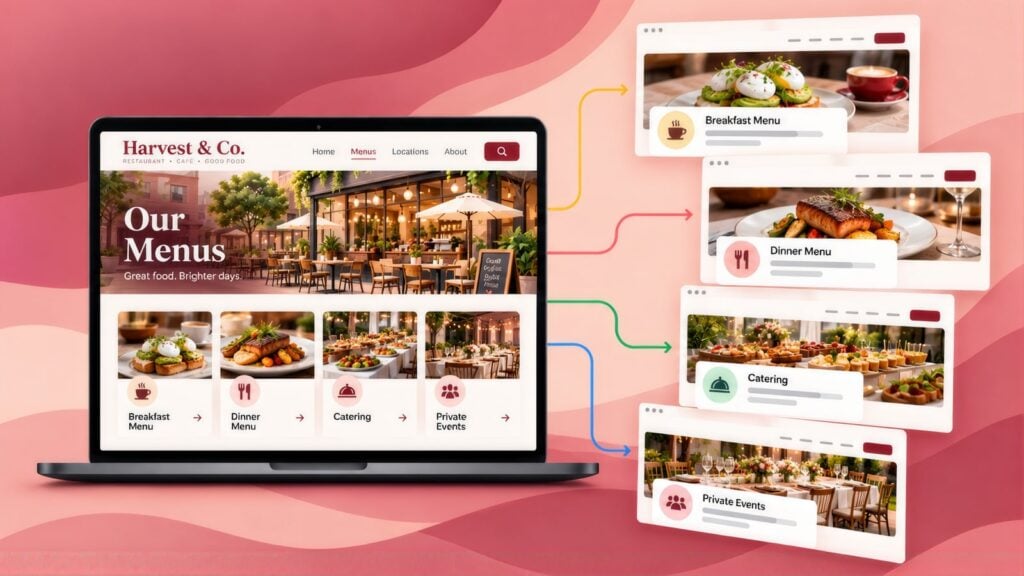
A landing page is the page someone reaches after clicking your ad, and it works when it answers the remaining questions before booking. Diners want to see the food, know the price, find a free table and know how to get there. Function planners want capacity, catering options, minimum spend and a way to enquire. Include:
- Unedited or lightly edited food photos that show what you actually serve.
- The current menu with prices, on the page rather than a click away.
- A booking link that shows on a phone without scrolling.
- Your address, parking and transport details, which answer a common last-minute question.
- Your hours, including kitchen close times if they differ from when the venue closes.
- Your Google star rating and a few recent written reviews.
The same approach worked for Orlando Wines, a food and beverage brand. Its rebuilt campaign landing page delivered a 28% uplift in campaign conversions and a 46% increase in session duration within 90 days. CCM lists the result with its landing page design service.
Conversion Tracking: Click to Cover or Event
A conversion is an action you count as a win, such as a booking. In hospitality, payment happens at the venue when a diner sits down or pays a function deposit. Your analytics only records the reservation or the enquiry form, so each month, match your booking system data against the conversions recorded in Google Analytics 4 (GA4).
| Stage | What to record | Why it matters |
|---|---|---|
| Reservation made online | Number of guests, date, session and where the booking came from. | This is the main signal Google Ads learns from for dining. |
| Covers attended | Whether the booking turned up, number of guests, average spend and source. | It shows how much each diner is worth. |
| Function enquiry submitted | Date, number of guests, occasion and source. | This is the main signal for function campaigns. |
| Function confirmed and deposit paid | Deposit received, final guest numbers, catering package and source. | It shows what your function ad spend actually returned. |
The conversion window is how long Google Ads waits after a click to credit a booking to an ad. Set it to at least 30 days for function campaigns, because the path from enquiry to confirmed booking can take several weeks.
A Year of Seasons: When to Do What
Whatever season you start in, fix the listing, the menu and the functions page first, then work through the calendar below. It follows the Australian seasons and the search peaks in Seasonal and Day-Part Demand: When Diners and Planners Search above.
| Season | What diners and planners search | Search and site work | Google Ads |
|---|---|---|---|
| Spring (Sep to Nov) | Christmas party venue searches peak in September, and function and rooftop searches rise. | Have Christmas and end-of-year pages live by August, pitch city guides for seasonal lists and refresh outdoor photos. | Raise function budgets in September and show reminder ads to people who viewed the functions page. |
| Summer (Dec to Feb) | Rooftop and outdoor dining searches peak, while function searches drop in December. | Post holiday hours early, ask December diners for reviews and plan autumn menus. | Move spend to dining and walk-in searches, and cut function spend over the holidays. |
| Autumn (Mar to May) | Mother’s Day lunch searches rise from March to a May peak, and function searches return. | Have the Mother’s Day page and set menu live by early April, and publish the autumn menu as page text. | Run an occasion campaign in April and May, and restart function campaigns. |
| Winter (Jun to Aug) | Dining demand is quieter, and planners start on end-of-year events in August. | Rebuild or improve the functions page, and add winter menu and private dining content. | Work out your cost per diner and per confirmed function, and set spring budgets. |
By the end of your first full quarter, you should know your cost per cover, meaning per diner seated, and your cost per confirmed function. Use those figures to set the budget for the next peak.
Restaurant and Cafe Marketing: Common Questions
How long does SEO take for a restaurant or cafe?
For venues, the map results usually move first, and attributes, a menu link and fresh photos on your Business Profile can show an effect within weeks. A new venue on a new website takes longer, and so does a functions page chasing city-wide searches. If you rely on a seasonal peak such as Christmas parties, start well before it. For the website, first signs usually come at 3 to 4 months and significant gains between 6 and 9 months. After the first year, results usually keep building.
How much does SEO cost for a restaurant?
Restaurant SEO is priced on scope, which depends on how many venues you run and how many rival venues share your dining strip. It also depends on whether functions, catering and occasion pages need building alongside the menu. A single cafe needs much less than a group with three venues and a function room. Across the market, agency work runs $1,500 to $10,000+ a month. An in-house specialist costs $80,000 to $170,000+ a year once salary, tools and training are included, as this agency vs in-house comparison shows.
What do Google Ads clicks cost for a restaurant?
Dining clicks are inexpensive by Google Ads standards. CCM’s Keyword Planner pull of 1 October 2026 covers Australia over the 12 months to August 2026. In it, restaurants near me averaged about $0.33 a click, cafe near me $0.27 and bars near me $0.28. Function searches cost far more, with function venue averaging about $4.55, which still makes sense given what one confirmed function is worth.
Is $10 a day enough for Google Ads?
For a dining campaign in a tight radius around one venue, it is enough to start. At about $0.33 a dining click, $10 buys roughly 20 to 30 clicks a day, but at $4.55 a function click it buys only two or so. Run dining and functions as separate campaigns so one does not use up the budget meant for the other.
Should we rely on Uber Eats or build our own online ordering?
Use both: the apps reach new diners, and your own ordering site serves regulars. The fees in Delivery Apps and Direct Online Ordering above explain the split, as Uber Eats’ Australian pricing takes up to 30% of an order when Uber delivers. Point your website, Business Profile order link and receipts to direct ordering for repeat customers.
Can I do SEO for my restaurant myself?
Yes, most of the core work is something an owner can do. It covers a complete Business Profile, a text menu on your site, real photos, a booking link that works on a phone and a steady review routine. Outside help is worth paying for when you run several venues, sell functions and catering, or need Google Ads and tracking set up properly.
Does SEO still matter when diners use Google Maps and AI answers?
Yes, because Maps results and AI answers draw on your Business Profile, your website and what reviews and food media say about you. Many diners also still check your website for the menu, the room and the prices before they book, so keep the profile, menu and site accurate.
Will FAQ schema show a dropdown under our listing?
Google’s Search documentation updates show FAQ rich results were switched off from 7 May 2026, so no dropdown will appear. They had been limited to government and health sites since August 2023. Keep the walk-in, dietary and minimum spend answers on the page, because the markup helps search engines and AI tools match them to diners’ questions.
Andrei Jach is Senior Manager, SEO and Analytics Specialist at Click Click Media in Sydney. In more than 15 years in digital marketing and strategy he has led SEO across retail, professional services, health and manufacturing, and he oversees CCM’s strategic SEO planning, analytics implementation and technical audits. Before CCM he worked at Agent 6 Marketing and Red Propaganda.
Implement this playbook with AI
Opens your assistant with this playbook and seven questions about your business: services, area, website and ads. It then writes your keyword map, page plan and Google Ads starter build with your details filled in.
Copy the prompt for Gemini, Grok or any assistant that cannot open a prefilled link. The prompt points at this page, which is also served as Markdown to assistants that ask for it.
Work with Click Click Media
Planners start looking for Christmas party venues in September. If your functions page, Maps listing and ads are not ready by then, we can help you get them there.
Our free audit follows your venue the way a diner or event planner would, from the Maps listing to the booking confirmation. It covers your website, Google Ads account and Business Profile. You leave with a priority list and no obligation. Behind it sits search work since 2008, Google Premier Partner status and over $115 million in Google Ads spend managed for Australian clients.
We do not use lock-in contracts. Your venue gets a senior strategist from the first week, and that person is the one you call.
Verified Sources and References
- Australian Bureau of Statistics: Retail Trade, Australia (June 2025)
- Uber Eats Australia: Merchant pricing and fees
- NSW Food Authority: Scores on Doors
- ACCC: False or misleading claims
- Google Business Profile Help: Manage customer reviews
- Google Maps user contributed content policy: Prohibited and restricted content
- Google PageSpeed Insights
- Google Search Central: Event structured data
- Google Search Central: Changes to HowTo and FAQ rich results
- Google Search Central: Search documentation updates (FAQ rich result removal, May 2026)
- CCM analysis of Google Keyword Planner data, Australia, 12 months to August 2026 (CCM's pull of 1 October 2026)
- CCM search captures (DataForSEO SERP API), Australia-wide and Sydney, 3 September 2026
- Click Click Media: Smashville catering Google Ads case study
- Click Click Media: Landing page design (Orlando Wines result)
- Click Click Media: SEO cost, agency vs in-house
- Click Click Media: SEO services for Australian businesses
- Click Click Media: Google Ads management
Last checked October 2026 · next review January 2027
