
Solar SEO and Google Ads for Installers and Retailers in Australia
Written by Andrei Jach, Senior Manager, SEO and Analytics Specialist at Click Click Media · Updated 1 October 2026
Australia passed 4.5 million rooftop solar installations in August 2026, and the federal government counts about one in three Australian homes with rooftop solar. For installers, that makes solar SEO and Google Ads a contest for a maturing market. The installation industry is worth $2.3 billion a year, although IBISWorld reports revenue fell 14.7% in 2026 as basic panel work matures. New demand is coming from batteries, EV charging and heat pump hot water, helped by the federal Cheaper Home Batteries Program.
That program is also where much of the advertising risk sits. Rebate, incentive and savings claims all have to be accurate. The ACCC’s solar and battery guidance covers each of them. The Clean Energy Regulator and state fair trading offices watch the sector too.
This playbook starts with incentives and compliance, then covers SEO for solar companies (installers and retailers) and Google Ads. A worked example takes real click prices through to the cost of a signed installation.
Implement this playbook with AI
Opens your assistant with this playbook and seven questions about your business: services, area, website and ads. It then writes your keyword map, page plan and Google Ads starter build with your details filled in.
Copy the prompt for Gemini, Grok or any assistant that cannot open a prefilled link. The prompt points at this page, which is also served as Markdown to assistants that ask for it.
What Our Research Found in Solar Search
In CCM’s analysis of Semrush ad history for five solar searches from September 2025 to August 2026, 4 advertisers still called themselves CEC accredited installers and only 1 named Solar Accreditation Australia, which has run installer accreditation since February 2024.
What we saw: Five of the 38 advertisers mentioned installer accreditation in their ads. Four of the five used the old CEC wording.
What to do: Search your ads, landing pages and Google Business Profile for “CEC accredited” and replace it with your SAA accreditation and number. The right wording keeps you within the rules. It also sets you apart from rivals still using the old name.
Source: CCM analysis of Semrush ad history, September 2025 to August 2026
None of the 38 advertisers in CCM’s analysis of Semrush ad history for five solar searches (September 2025 to August 2026) mentioned payback, feed-in tariffs or export limits in 101 distinct ads, while 26 of the 38 (68%) mentioned batteries.
What we saw: On the four searches other than solar battery, 15 of the 27 advertisers also mentioned batteries. Nine of the 38 advertisers showed a dollar figure.
What to do: No advertiser in this sample used payback or feed-in tariffs. If you can give a payback estimate with its assumptions, test it in an ad and on the landing page, following the ACCC guidance on savings claims. Run battery ads only if you install batteries well.
Source: CCM analysis of Semrush ad history, September 2025 to August 2026
On solar battery rebate, 6 of the 10 page-one results in CCM’s Australia-wide desktop capture of 3 September 2026 were government or official-body pages, and only one was an installer.
What we saw: People checking the battery discount were mostly shown energy.gov.au, state energy sites, the Clean Energy Council and the federal energy department.
What to do: Make your battery discount page the practical one. Explain who qualifies, how the STC discount shows on your quote and which of your batteries are eligible, and link to the official pages.
Source: CCM search captures, Australia, 3 September 2026
For the organic finding, CCM captured six customer searches on desktop through the DataForSEO SERP API, run Australia-wide on 3 September 2026: solar panels, solar battery rebate, solar panels sydney, solar quotes, best solar installers australia and how do solar panels work. For the ad findings, CCM analysed Semrush ad history for Australia from monthly snapshots on the 15th, September 2025 to August 2026, for solar battery, solar panels, solar quotes, solar panels sydney and solar leads, a search installers use to buy leads. An advertiser is one website domain, a distinct ad is a unique headline and text from that advertiser, and a battery mention is any use of the word battery or batteries. The solar quotes export reached Semrush’s 50-row limit, so its count may be incomplete.
Incentives First: The Cheaper Home Batteries Program and STCs
The federal Cheaper Home Batteries Program started on 1 July 2025. It gives households, businesses and community groups a discount of around 30% on the installed cost of a battery. The battery must be 5 kWh to 100 kWh and connected to new or existing solar.
The discount works in four steps:
- The Clean Energy Regulator runs the program through the Small-scale Renewable Energy Scheme.
- Each battery earns small-scale technology certificates (STCs), with the number based on how much power it can store.
- The customer usually assigns those STCs to the retailer or installer.
- In return, the customer gets a discount upfront or a rebate after installation, so customers do not apply to the government themselves.
The discount shrinks on a set timetable. The federal energy department (DCCEEW) has published the schedule. The STC factor is 6.8 for May to December 2026 and 5.7 for January to June 2027. After that it drops every six months, down to 2.1 in the second half of 2030. The factor on the day of install is the one that counts. Support also tapers for bigger batteries. Each kWh above 14 and up to 28 kWh earns 60% of the factor, and each kWh above 28 and up to 50 kWh earns 15%. Only the first 50 kWh of usable capacity earns certificates, although batteries up to 100 kWh qualify for the program. Batteries must be on the Clean Energy Council’s approved list and fitted by an installer accredited by Solar Accreditation Australia (SAA).
State programs
States run their own programs on top, and the rules change often. In Victoria, for example, the Solar Homes panel rebate offers eligible households up to $1,400 as at October 2026. Owners must live in the home and earn under $150,000 combined, and the property must be worth under $3 million.
In Western Australia, the WA Residential Battery Scheme adds a rebate to the federal discount. It is up to $1,300 for Synergy customers and up to $3,800 for Horizon Power customers. The WA Government page was updated on 21 May 2026. Households with a combined income under $210,000 can also get a no-interest loan of up to $10,000. The battery must join a virtual power plant. The approved vendor applies for the customer.
In NSW, the state’s own battery installation discount is no longer available. The NSW battery incentive page (updated 1 July 2026) says a battery installed under the federal program cannot also claim it. The NSW incentive for connecting a battery to a virtual power plant can be combined with the federal discount. Check each state program’s official page before you mention it in an ad, and date the claim.
How to advertise the battery discount
- Name it accurately: the “federal Cheaper Home Batteries Program discount”, applied by you through STCs. Avoid free battery or “government rebate of $X” with no conditions.
- Tie any dollar figure to the battery’s usable capacity and the installation date, because the STC factor steps down on set dates.
- Use only real deadlines, such as “The discount steps down on 1 January 2027”, and never invent one to create urgency.
- State the full installed price, and say that the customer assigns their STCs to you in exchange for the discount.
Compliance: Savings Claims, Accreditation and Approved Products
The ACCC and state consumer agencies watch solar advertising closely. Common failures include:
- promising a rebate before confirming the customer is eligible
- quoting savings without the assumptions behind them
- calling an STC assignment a government rebate
- claiming “CEC accreditation”, when installers are now accredited by SAA.
Check every ad and landing page against the ACCC rules for solar suppliers before it goes live.
| Obligation | What it means | How to meet it |
|---|---|---|
| Installer accreditation | SAA accredits installers and designers, and a job without that accreditation earns no STCs. The Clean Energy Regulator’s installer requirements also call for a full electrical licence in the state where you work. | Show your accreditation number and scope on the site. Customers can check it with Solar Accreditation Australia. Drop generic “CEC accredited” wording. |
| Approved products | Panels, inverters and batteries must be on the Clean Energy Council’s approved lists, or the system is not eligible for STCs. | Name the brands and models you install. Only claim an STC discount for products on the list on the day of installation. |
| Total price and eligibility | The installed price must be clear. Show what is included, what is not and how the STC discount is applied. | Do not promise an incentive amount before you check the postcode, installation date and system size. |
| Savings assumptions | Savings estimates must state the tariff, usage pattern, system size, roof direction and shading. Say whether export income is included. | Put the assumptions beside every figure. A claim that a system saves $1,500 a year depends on a usage pattern, so state that pattern next to it. |
| Grid connection | Connection times vary by state, network and system size. | Do not promise a connection date before the network approves it. |
A solar system is a five-figure household purchase. Naming your accredited installers and stating your assumptions gives buyers proof they can check. Our guide to Google’s E-E-A-T guidance explains how Google describes that kind of trust.
Installer vs Retailer: Two Different Search Strategies
A local installer and a solar retailer that sells across a state can both rank, but for different searches.
An installer competes on being close by, and its best traffic comes from solar installers near me and suburb searches. The Google Business Profile, service-area pages, real job photos and reviews matter most for that traffic. Focus on the suburbs your crews can reach in a reasonable drive, because leads from further out are harder to service.
A retailer sells systems and often pays another firm to install them. It can target state and city pages, product and battery comparisons, and cost guides at scale. It must also say clearly who installs the system and who holds the accreditation. Pick the model that matches your business, and do not build suburb pages for areas your crews do not reach.
Keyword Clusters for System and Battery Searches
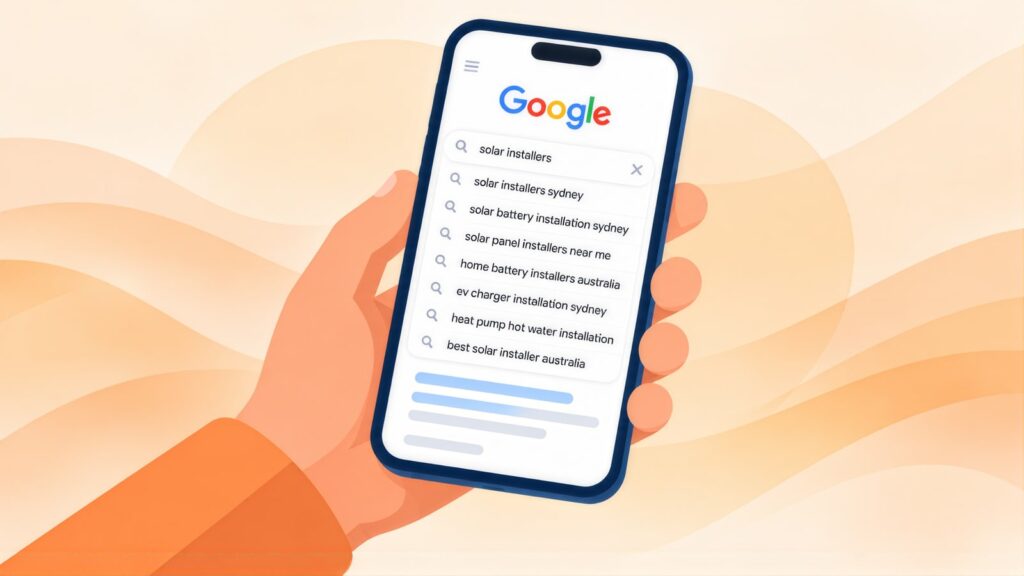
Solar searches split into six groups, and battery and rebate searches are now among the busiest. Solar battery alone draws about 22,200 searches a month in Australia (CCM analysis of Google Keyword Planner data, Australia, 12 months to August 2026).
Solar System
solar panels [suburb]
solar installation [area]
solar system cost [city]
rooftop solar [suburb]
Battery Storage
solar battery [suburb]
home battery storage Australia
Tesla Powerwall [city]
battery backup solar system
Cost and Rebates
solar system cost [state]
solar battery rebate 2026
solar STC rebate
how much does solar cost Australia
EV and Heat Pump
EV charger solar [suburb]
heat pump hot water solar
solar EV home charger
virtual power plant [state]
System Upgrade
upgrade solar system [suburb]
add battery to existing solar
solar panel upgrade [area]
replace solar inverter [suburb]
Commercial Solar
commercial solar [city]
business solar installation
solar for business [state]
commercial battery storage
SEO for Solar Companies: Pages, Titles and Schema
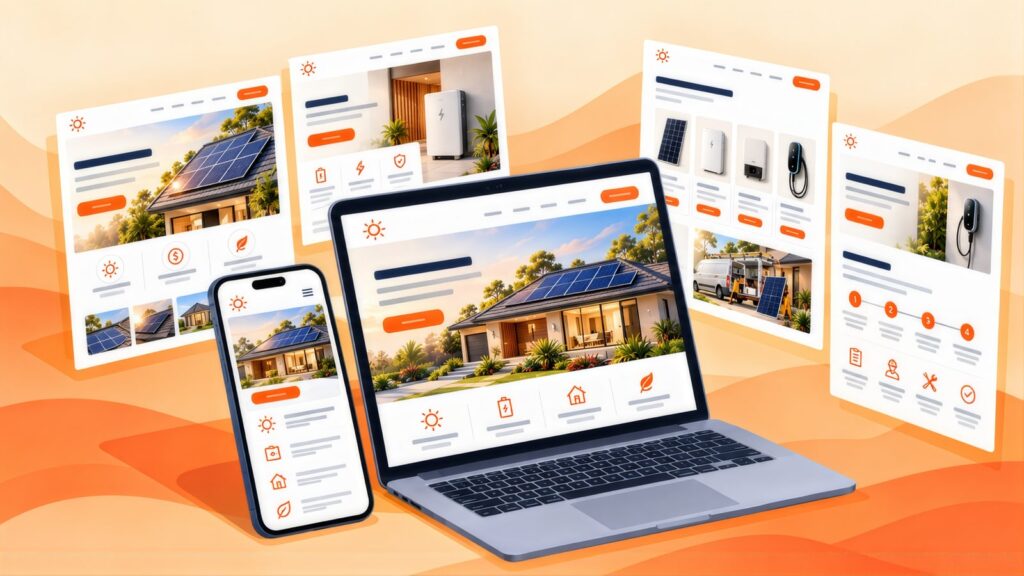
A solar site needs separate pages for systems, batteries, costs, commercial work and rebates. The title tag is the clickable headline Google shows for each page. Lead it with the system and the city, and end with a claim you can prove.
| Page | Focus keyword | What the page should include | Example title tag (characters) |
|---|---|---|---|
| Solar systems | solar panels | Systems and brands, price ranges with inclusions, the STC discount explained, your accreditation number | Solar Panels [City] | Accredited Installer (42) |
| Battery storage | solar battery | Batteries you fit, sizes, whether they work with existing solar, how the federal discount applies | Solar Battery Installer [City] | Powerwall & More (49) |
| Cost guide | solar cost | System size against cost with the assumptions, an STC explanation, state incentives with their conditions | Solar System Cost [State] 2026 | Price Guide (44) |
| Commercial solar | commercial solar [city] | System sizes, STC eligibility for business, case studies, how quoting works | Commercial Solar [City] | Rooftop Systems (41) |
| Rebates and incentives | solar rebate 2026 | A dated explanation of STCs and state programs, what reduces the amount, how the discount is applied | Solar & Battery Rebates [State] 2026 Explained (46) |
A system size, a city and a proof point fill most of a solar title. Add the business name only if the title stays within 55 characters. Google often prints your site name with the listing, so the brand can go before the city or system does. Keep rebate amounts out of titles and put them on the page, next to their conditions.
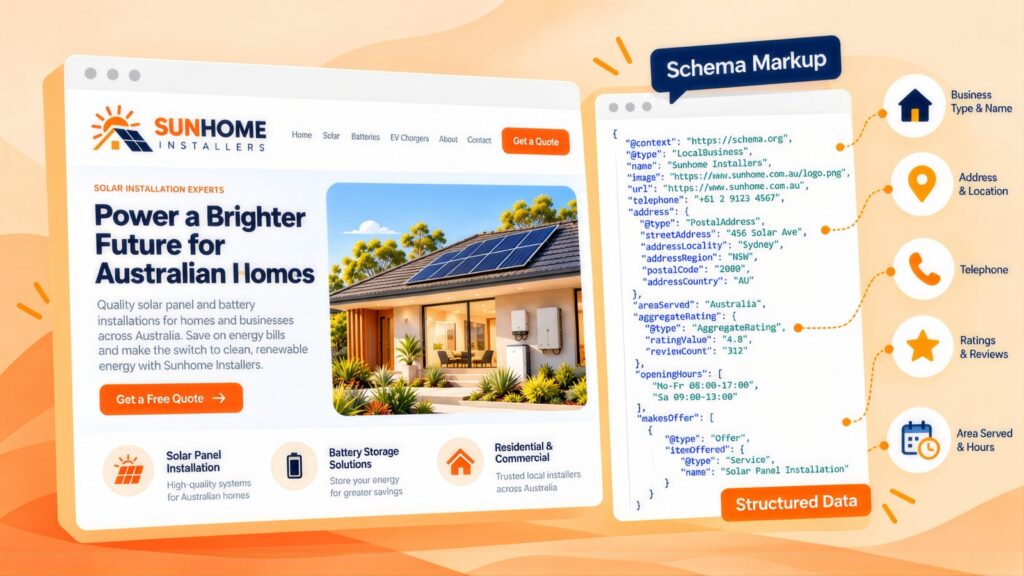
Schema.org has no solar installer type. Mark up the business in your page code as a LocalBusiness with your service area, and add BreadcrumbList to pages below the homepage. You can add FAQPage to a rebate page so search engines and AI tools can tell each question from its answer. It will not produce a dropdown in Google. FAQ rich results were narrowed to government and health sites in August 2023 and stopped appearing from 7 May 2026.
Commercial solar pages
Business buyers ask different questions from homeowners. They want to know the payback period and how the system fits their daytime energy use. They also ask what happens to the roof warranty and who signs off on the design. Give commercial work its own page rather than a paragraph on the home solar page. Show system sizes you have installed, the types of building and named case studies with permission. Explain how STCs apply to business systems, and offer a site assessment rather than an instant quote form. Run commercial ads as a separate campaign, in business hours only.
Local SEO for Your Installation Area
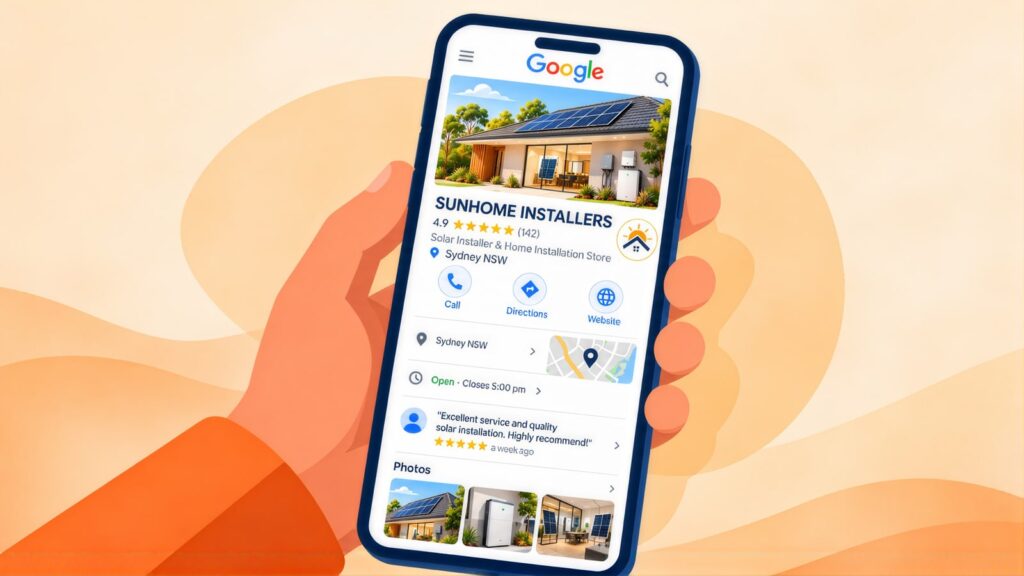
Homeowners want an installer who can reach their roof, so your Google Business Profile has to show where you work and prove you are accredited.
| Field | What to do |
|---|---|
| Primary category | Choose Solar energy equipment supplier or Solar energy company. |
| Accreditation | Put your SAA number in the business description. |
| Service area | List every suburb and postcode you install in. A postcode and suburb lookup speeds this up. |
| Photos | Show real jobs with the owner’s permission, let panel and inverter brands show, and add before-and-after roofs. |
Solar is well suited to local SEO services, because customers want an installer nearby. Reviews also let them check you before a large purchase.
Cost and Rebate Content, Links and AI Search
Rebate questions draw real search volume, with solar battery rebate at about 8,100 searches a month in the Keyword Planner data in Google Ads for Solar Installers: Settings and Click Costs below. Dated, specific answers that show their assumptions are the pages AI Overviews tend to cite. Useful topics include:
- what a 10kW system costs in your state in 2026
- how the battery discount is worked out for a given capacity
- when to upgrade from 6.6kW to 10kW
- how heat pump hot water pairs with solar.
Update your battery and rebate pages each time the STC factor changes.
Links from the solar industry
Relevant links for an installer come from the solar industry. Good sources include installer profiles on comparison sites such as SolarQuotes and Solar Choice, and the approved installer lists on battery and inverter brand sites. Local news may cover your community or commercial projects, and suppliers you buy from can link to you. A few links like these count for more than many unrelated ones, which is the approach behind quality link building.
Lead marketplaces
Comparison sites can also sell you leads. Some pass the same enquiry to more than one installer. Check whether leads are exclusive before you compare their price with the cost per signed installation in Illustrative Example: From Cost Per Click to Cost Per Signed Installation below.
AI search
Google’s guide to AI Overviews and AI Mode sets one condition for a supporting link. The page must be indexed and eligible to show a snippet in Search, and there are no additional technical requirements. Clear cost guides, a correct account of the battery discount and the same business details everywhere help with both. The same groundwork supports AI search optimisation for tools like ChatGPT.
Google Ads for Solar Installers: Settings and Click Costs
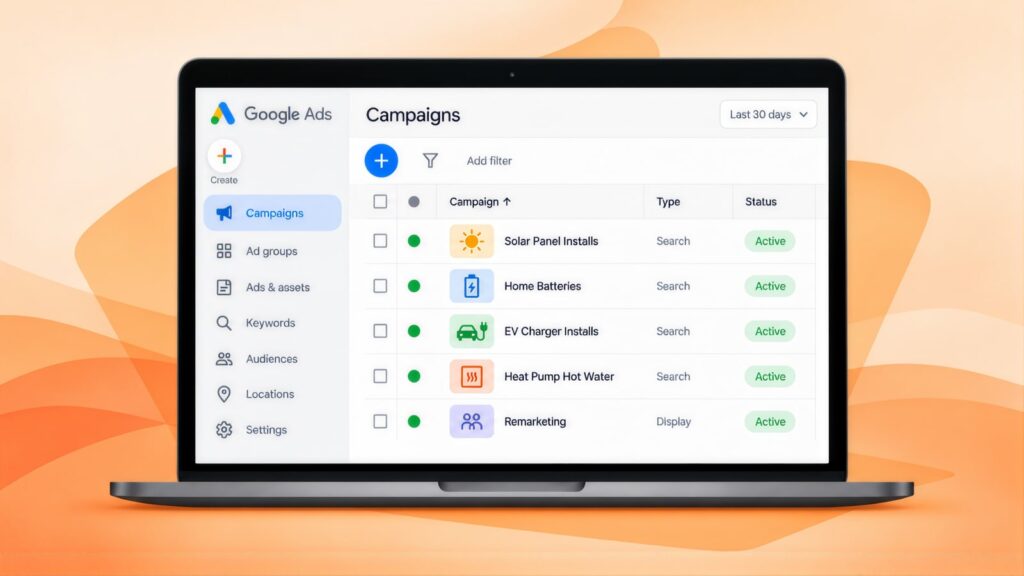
Run residential solar, batteries and commercial work as separate Search campaigns, each with its own landing pages. For each campaign, set three things:
- Location: show ads only to people in your installation area, set to the distance your crews actually travel from base.
- Hours: run ads when your quoting team can call people back.
- Bidding: set your own maximum cost per click (CPC) at first. Once you know how many quotes turn into installations, you can set target CPA bids, which tell Google what you want to pay per lead.
Searches from people looking for an installer cost about three times as much as broad ones. Solar panel installation averages about $23 a click, against about $7 for solar panels.
| Keyword (Australia) | Monthly searches | Top-of-page bid range | Average CPC |
|---|---|---|---|
| solar panels | 40,500 | $3.04 to $11.46 | $6.86 |
| solar battery | 22,200 | $3.34 to $12.03 | $11.98 |
| solar quotes | 9,900 | $3.33 to $13.54 | $6.45 |
| solar battery rebate | 8,100 | $3.55 to $11.18 | $11.68 |
| solar panel installation | 8,100 | $5.84 to $22.24 | $22.92 |
| solar installers near me | 1,900 | $5.90 to $22.65 | $21.08 |
Source: CCM analysis of Google Keyword Planner data, Australia, 12 months to August 2026; average CPC is the average Google has seen in the past. It can sit above the top-of-page bid range, as it does in the rebate and installation rows. Rebate searches may come from people who are only checking eligibility. Send them to a page that explains the discount and qualifies the job before the quote form.
Campaign types beyond Search
- Call ads are useful on mobile for solar installers near me, as long as someone answers during the scheduled hours.
- Remarketing shows ads again to people who read your battery or cost page but did not ask for a quote.
- Performance Max is Google’s all-channel campaign type. Test it only once Search is profitable, and feed it signed installations rather than form fills, or it will optimise for cheap, low-quality leads.
Illustrative Example: From Cost Per Click to Cost Per Signed Installation
Use this formula: cost per signed installation = CPC ÷ click-to-quote rate ÷ quote-to-contract rate. The click prices below come from CCM’s analysis of Google Keyword Planner data for the 12 months to August 2026, while the two conversion rates are illustrative assumptions only:
- 8% of clicks request a quote.
- 20% of quote requests sign a contract.
- Both rates are the same for every keyword, so you can see the effect of the click price.
| Keyword | You pay per click (real) | $3,000 buys | Quote requests (8%) | Each quote costs | Signed installs (20%) | Each install costs |
|---|---|---|---|---|---|---|
| solar panel installation | $22.92 | About 131 clicks | About 10.5 | About $287 | About 2.1 | About $1,433 |
| solar battery | $11.98 | About 250 clicks | About 20 | About $150 | About 4 | About $749 |
| solar quotes | $6.45 | About 465 clicks | About 37 | About $81 | About 7.4 | About $403 |
Do not read the bottom row as the best buy, because real conversion rates differ by keyword. Someone typing solar quotes is often collecting several quotes, while people in your area searching solar panel installation may convert better. The rates also change the result a lot. If only 4% of solar panel installation clicks request a quote, each signed installation costs double, about $2,865.
Replace both assumptions with your own figures from call tracking and your CRM, and compare the result with your margin on an average system. Fund the keywords whose cost per signed installation sits comfortably inside that margin first.
Keywords, Negatives and Ad Copy for Solar
Bid on system, battery and installation searches in your area, and add negative keywords before launch. Negative keywords stop your ads showing on searches that will never become an installation.
- Include: “solar panels “, “solar battery [city]”, “solar installation [area]”, “solar cost “.
- Exclude: solar jobs, solar career, solar farm, solar stocks, community solar, solar lease (if you only sell), portable solar, camping solar, DIY solar kit, how solar panels work.
| Component | Example |
|---|---|
| Headline 1 | Solar Panels [City] |
| Headline 2 | Accredited Solar Installer |
| Headline 3 | STC Discount Applied |
| Headline 4 | Battery Add-Ons Available |
| Description 1 | Accredited solar installation in [city]. 6.6kW to 13.3kW systems. |
| Description 2 | STC discount applied at sale, eligibility conditions apply. Free site assessment. |
Make sure the landing page backs up every claim, including the conditions behind the STC headline.
Quote Landing Pages and Lead Quality Filters
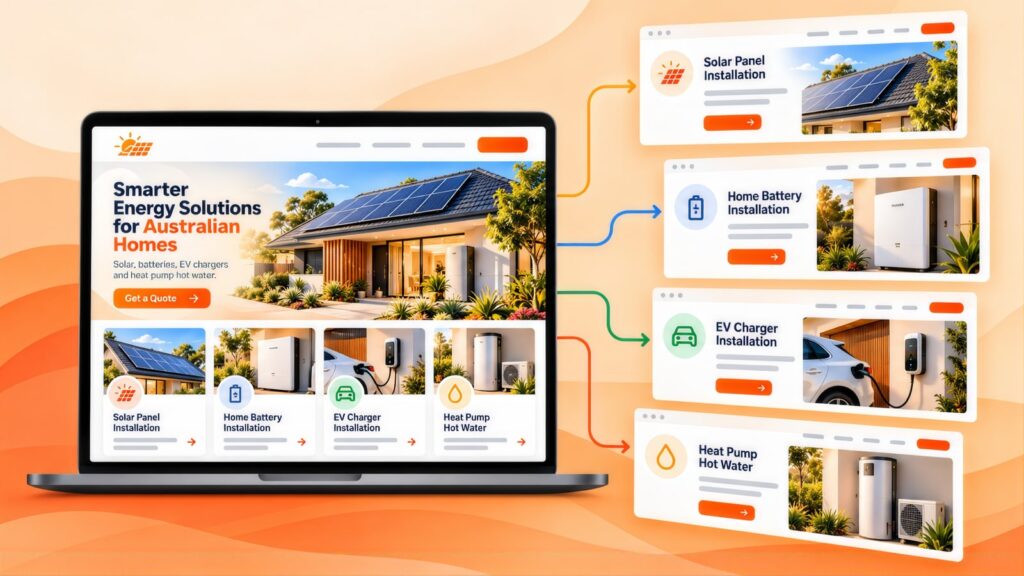
A custom landing page for quotes has to carry the compliance detail and still make the next step easy. Include:
- Your SAA number, which the customer can check.
- The panel, inverter and battery brands and models you install, so buyers can compare them against other quotes.
- A price range, with what is included and what is not.
- The STC discount with an eligibility note: “approximately $[X] applied at point of sale (eligibility depends on postcode, system size and installation date)”.
- Recent installation photos from your area, with suburbs labelled.
Use the quote form to filter lead quality. Ask whether the person owns the home and what kind of dwelling it is (house, townhouse, apartment). Ask about the roof type and a rough quarterly bill too. Renters and apartment owners can still get a polite answer or a strata option without reaching your sales team as a hot lead.
The nearest match in our client list is EV charging rather than solar. EVSE sells and installs chargers across Australia and New Zealand. We built custom calculators that answer the buyer’s cost question, “lifting lead-to-sale conversion by 25%+ and cutting admin work”. The figure is recorded on the Click Click Media clients page. The home estimator includes solar preferences, and this write-up explains how the EVSE estimator works.
Tracking: From Quote Request to Signed Contract
Track each lead from quote request to commissioned system, or you will judge campaigns on enquiries that never became installs. Start with quote and call tracking in Google Analytics 4 (GA4), because GA4 tracking for quotes feeds every later report. Record these stages in your CRM:
| Stage | What to record |
|---|---|
| Quote requested | System size they want, suburb, dwelling type, source and date |
| Site assessment completed | System designed, size, whether a battery is included, and date |
| Quote accepted and deposit paid | System value, source and date |
| Installation completed | System switched on, revenue and source |
A Phased Plan for a Solar Installer
The plan puts compliance first, then pages, then paid campaigns, and ends with a review of the cost per signed installation.
- In phase 1, the compliance check (weeks 1 to 2), check site copy and live ads against the ACCC’s solar guidance. Fix savings claims that lack assumptions, replace “CEC accredited” wording and show your SAA number. Check battery discount wording against the current STC factor.
- In phase 2, pages and profile (weeks 3 to 6), rewrite the solar systems and battery pages with compliant pricing, and publish a dated cost guide. Complete the service area on your Google Business Profile, and add qualifying questions to the quote form.
- In phase 3, campaigns (weeks 7 to 10), launch separate home solar and battery Search campaigns, with negative keywords loaded. Check the search terms each week. A wasted spend scorecard shows how much any leak costs. Ask for a review after each completed installation.
- In phase 4, review and expand (weeks 11 to 13), work out the cost per quote and cost per signed installation for each keyword, using the formula in Illustrative Example: From Cost Per Click to Cost Per Signed Installation above with your own rates. Then decide whether to add remarketing, a commercial page or a Performance Max test.
Solar Installer SEO and Google Ads: Questions Answered
What is the Cheaper Home Batteries Program?
It is a federal discount of around 30% on the installed cost of a 5 kWh to 100 kWh battery connected to solar, which started on 1 July 2025. It works through STCs under the Small-scale Renewable Energy Scheme, which the Clean Energy Regulator runs. The installer or retailer usually applies it at the point of sale. The STC factor steps down on a published schedule, 6.8 for May to December 2026 and then every six months from January 2027, so the discount shrinks over time.
How should installers advertise the battery discount?
Call it the federal Cheaper Home Batteries Program discount. Explain that it comes from the customer assigning STCs to you. Link any dollar figure to the battery’s usable capacity and installation date. Avoid free battery claims and rebate amounts without conditions.
Do solar installers still need CEC accreditation?
No, installers and designers are now accredited by Solar Accreditation Australia (SAA). The installer also needs a full electrical licence in the state where the job is. Show your SAA number on your site.
Who runs the approved products list for panels, inverters and batteries?
The Clean Energy Council keeps the approved lists. The Clean Energy Regulator, which runs the STC scheme, requires products to be on those lists for a system to be eligible.
How much do Google Ads cost for solar, and what does a signed installation cost?
Clicks run from about $7 for solar panels to $12 for solar battery and $23 for solar panel installation. Those figures come from CCM’s analysis of Google Keyword Planner data for Australia, 12 months to August 2026. To get to the cost of a signed installation, divide the CPC by your click-to-quote rate and then by your quote-to-contract rate. Illustrative Example: From Cost Per Click to Cost Per Signed Installation works this through with labelled assumptions.
How long does solar SEO take?
An installer targeting its own service area usually moves sooner than a retailer chasing state-wide terms. Suburb and battery pages on an established site, backed by a busy Google Business Profile, often gain ground in 3 to 4 months. Cost guides and city-level system pages tend to pay off over 6 to 9 months. Strong local competitors, or a site that needs compliance rewrites, push that out. After a year, results keep building as long as rebate pages stay current each time the STC factor drops. The agency vs in-house cost comparison linked in the solar SEO cost answer below uses the same stages.
What does SEO cost for a solar business?
Your footprint, product range and compliance work set the budget. An installer covering one metro area with solar and batteries needs fewer pages than a retailer selling across several states. A retailer with commercial, EV charging and heat pump lines needs more again. Any site with old “CEC accredited” or unqualified rebate wording needs a rewrite before new pages go up. This SEO pricing comparison puts outsourced SEO at $1,500 to $10,000+ a month. A full-time in-house person costs $80,000 to $170,000+ a year, including salary, tools and training. The SEO ROI calculator shows what extra installations are worth.
How do solar companies generate their own leads?
Solar companies can generate their own leads through local and paid search. The basics are a complete Google Business Profile with real installation photos and reviews, plus system, battery and cost pages that rank in your area. Add Search campaigns judged on signed installations. Bought leads from comparison sites can top up the pipeline, but check whether they are shared with other installers.
Andrei Jach is Senior Manager, SEO and Analytics Specialist at Click Click Media in Sydney. In more than 15 years in digital marketing and strategy he has led SEO across manufacturing, retail, health and professional services, and he now oversees strategic SEO planning, analytics implementation and technical audits. He previously worked at Agent 6 Marketing and Red Propaganda.
Implement this playbook with AI
Opens your assistant with this playbook and seven questions about your business: services, area, website and ads. It then writes your keyword map, page plan and Google Ads starter build with your details filled in.
Copy the prompt for Gemini, Grok or any assistant that cannot open a prefilled link. The prompt points at this page, which is also served as Markdown to assistants that ask for it.
Work with Click Click Media
The STC factor steps down every six months from January 2027. Battery ads, cost guides and quote pages that mention the discount need checking on the same cycle. Our free audit reviews your rebate and savings wording against ACCC guidance first. It then covers your website, Google Ads account and Google Business Profile.
Click Click Media holds Google Premier Partner status and has worked in search marketing since 2008. In that time we have managed more than $115 million in Google Ads spend for Australian businesses. For installers, our SEO and Google Ads management work starts with a compliance review of your claims before any paid campaign goes live.
Installers and retailers are not tied in, as we use no lock-in contracts. One senior strategist handles your account through each STC step-down.
Verified Sources and References
- Clean Energy Regulator: Small-scale installation postcode data
- WA Government: WA Residential Battery Scheme
- NSW Climate and Energy Action: Install a battery
- energy.gov.au: Australia hits rooftop solar milestone (November 2024)
- Clean Energy Regulator: Rooftop solar installers and designers
- Clean Energy Regulator: Small-scale renewable energy systems eligibility
- Solar Accreditation Australia
- DCCEEW: Cheaper Home Batteries Program
- energy.gov.au: Australians can now access support for small-scale batteries (1 July 2025)
- Clean Energy Regulator: Quarterly Carbon Market Report, December quarter 2025 (small-scale scheme)
- Clean Energy Regulator: Manufacturers and importers (Clean Energy Council approved lists)
- Solar Victoria: Solar panel (PV) rebate
- ACCC: Solar panel systems and home batteries (business guidance)
- IBISWorld: Solar Panel Installation in Australia (2026)
- Google Search Central: AI features and your website
- Google Search Central: Removal of FAQ rich results (2026)
- CCM analysis of Google Keyword Planner data: Australian search volumes and CPCs, 12 months to August 2026
- CCM search captures (DataForSEO SERP API), Australia, desktop, 3 September 2026
- CCM analysis of Semrush ad history, Australia, monthly snapshots September 2025 to August 2026
- Click Click Media: SEO cost comparison, agency vs in-house
- Click Click Media: SEO services
- Click Click Media: Google Ads management
Last checked October 2026 · next review January 2027
