
SEO and Google Ads for Car Dealers and Workshops in Australia
Written by Andrei Jach, Senior Manager, SEO and Analytics Specialist at Click Click Media · Updated 1 October 2026
Australia had 22.3 million registered motor vehicles in January 2025, and the average one was about 11.5 years old. That comes from BITRE’s Road Vehicles report, the latest edition. Older cars need more upkeep, so demand for servicing, repairs and replacement cars is steady and long term.
Automotive SEO is the work that gets your workshop or dealership found when local drivers search Google. It covers your website, your Google Business Profile, your reviews and your stock pages.
Those searches are local and specific. A driver typing mechanic near me often wants to book within the hour, while a logbook service search is usually about next weekend. Someone looking at used Hiluxes is often comparing three or four dealers at once.
This guide covers the shared groundwork first, then treats the two businesses separately. The eight shared sections, starting with How Drivers Search for Mechanics and Car Dealers, cover what every automotive site needs: search habits, keywords, trust signals, technical SEO, schema and content. The three workshop sections, starting with Workshops: Service Pages, Price Guides and Local SEO, are for workshops filling a service bay. The three dealer sections, starting with Dealers: Inventory Pages, Stock Accuracy and Listings, are for dealers moving stock. Together they cover what people call automotive SEO, mechanic SEO and car dealer SEO.
Implement this playbook with AI
Opens your assistant with this playbook and seven questions about your business: services, area, website and ads. It then writes your keyword map, page plan and Google Ads starter build with your details filled in.
Copy the prompt for Gemini, Grok or any assistant that cannot open a prefilled link. The prompt points at this page, which is also served as Markdown to assistants that ask for it.
What the Search Data Shows for Workshops and Dealers
The data: In CCM’s five captures of local mechanic and car service searches on 3 September 2026, Google showed the map pack as the first result on all 5 and an AI Overview on none of them, while all 3 non-local searches carried an AI Overview. Where independent workshops reached the top 10 on those local searches, 15 of their 18 listings were the business’s home page rather than a service or suburb page.
The move: A local searcher sees your Google Business Profile first, so keep it complete and keep reviews coming. Make sure your home page names your suburb, your main services and your prices, then add service pages for the jobs you most want.
Source: CCM search captures, Sydney and Australia, 3 September 2026
The data: When CCM searched how much does a car service cost Australia-wide on 3 September 2026, Google’s AI Overview cited 10 websites, and 9 of the 10 did not appear in the organic results on that page. Eight of the 10 were independent workshops’ own price guides or service pages, and only one of those eight also ranked organically.
The move: A plain price guide on a workshop site can be quoted in the AI Overview without ranking in the organic results. Publish indicative prices for your common services, with the conditions stated.
Source: CCM search captures, Australia, 3 September 2026
The data: In CCM’s analysis of Semrush ad history for eight Australian car-service searches, from monthly snapshots between September 2025 and August 2026, 22 advertisers appeared and none of them appeared on more than one search.
The move: The advertisers you meet on a windscreen or smash repair search are a different set of businesses from those on a mechanic search. Set the budget and bids for each service’s campaign on its own results.
Source: CCM analysis of Semrush ad history, September 2025 to August 2026
CCM made eight Google captures of seven searches on 3 September 2026: mechanic near me in Sydney on desktop and mobile, mobile mechanic sydney in Sydney on mobile, and car service near me, pink slip near me, used cars, how much does a car service cost and automotive marketing Australia-wide on desktop. The first five captures are the local ones, and a home page was any result whose web address was the root of the site. The ad finding comes from CCM’s analysis of Semrush ad history for the Australian database, using monthly snapshots taken on the 15th between September 2025 and August 2026, on mechanic near me, car service near me, mobile mechanic, windscreen replacement, tyre shop near me, smash repairs, pink slip near me and automotive marketing (an agency search). Each website domain counted as one advertiser.
How Drivers Search for Mechanics and Car Dealers
The fleet figures above point to steady workshop demand, because cars are getting older and many are out of manufacturer warranty. New sales add to that demand, with FCAI reporting 1.21 million vehicles sold in 2025. Each of those cars will need its first service, and after the warranty ends, many will visit an independent workshop.
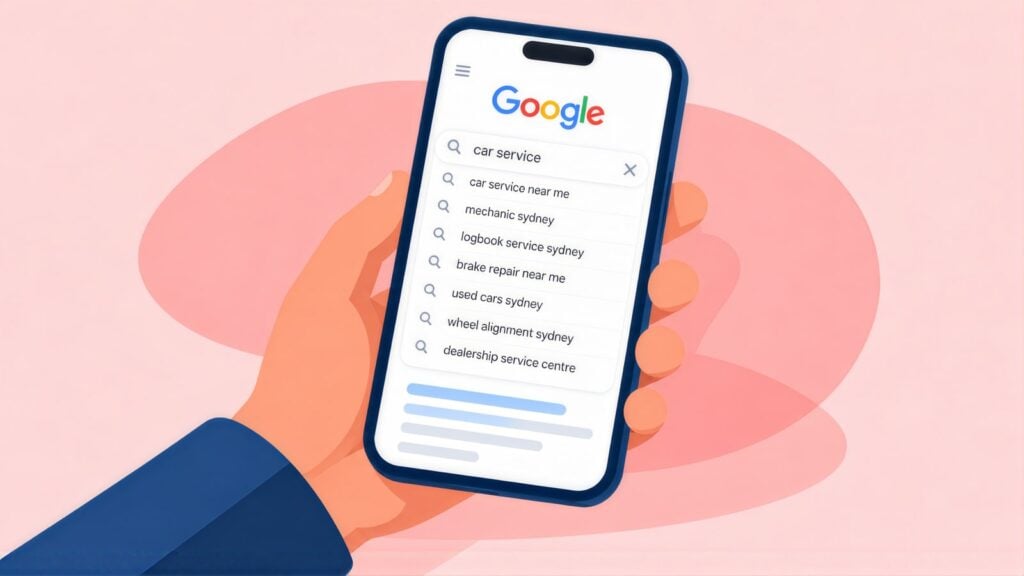
Searches before a workshop booking are local and often urgent. Someone typing “car service ” has already decided to get the car serviced and is comparing workshops. To be in that comparison, a workshop needs to appear in the map results with recent reviews and prices the driver can see without phoning.
Workshop searches name a service and a suburb: “logbook service [suburb]”, “brake replacement near me”, “car mechanic [area]”. Dealer searches name a vehicle, and they move through stages. A buyer starts with research (“Toyota Hilux review”), then compares (“used Hilux under $50k”), and then looks for a dealer (“used Hilux [city] dealer”). Both need local SEO, but the keywords, page layout and tracking differ, which is why the workshop and dealer sections, starting with Workshops: Service Pages, Price Guides and Local SEO below, treat them separately.
Workshop and Dealer Keywords That Bring Enquiries
Workshop searches name a service and a place, while dealer searches name a vehicle and a place. Build a page for each service, inspection type and make or model you stock, matched to the suburb or city people type.
Workshop Discovery
mechanic near me
car service [suburb]
auto repair [area]
workshop [suburb]
Service Type
logbook service [suburb]
brake replacement near me
roadworthy certificate [city]
transmission service [suburb]
Inspection / Cert
pink slip [suburb] NSW
roadworthy inspection [city]
safety certificate [area]
pre-purchase inspection near me
Vehicle Sales
used [make/model] [city]
second hand cars [suburb]
[make] dealer [area]
car dealership near me
Quote / Pricing
how much does car service cost
logbook service price [suburb]
brake pad replacement cost Australia
car service quote online
Specialist / Marque
Toyota specialist mechanic [suburb]
European car service [area]
diesel mechanic [suburb]
4WD service [city]
Why each cluster matters
- Workshop discovery searches have the most volume, and the map results answer most of them, so a complete Google Business Profile with recent reviews matters most here.
- Service searches, such as logbook service, brake replacement or pink slip, come from drivers who know what they need. They are comparing workshops, so each service needs its own page.
- Price searches are answered by workshops that publish rough prices, such as “logbook service from $X” or “brake pads from $Y”. A page that only says “call for a quote” gives the searcher nothing to compare.
- Car sales searches have high volume but a slower path to a sale. Buyers take days or weeks and want to see actual stock, prices and photos before they enquire.
- List every service your workshop offers.
- For each one, check what suburb searches people use, with Google Keyword Planner, Google Search Console or a free keyword planning tool.
- Turn that list into your plan for service pages.
- For each page, note whether you can publish a rough price range.
E-E-A-T and Trust Signals for Automotive Businesses
Most drivers cannot judge mechanical work before it is done, and they have few options if it goes wrong. They look for things they can check before handing over the keys, such as licences, reviews, years in business and real photos. Google looks for similar signals, which it groups under E-E-A-T (experience, expertise, authority and trust).
The trust signals drivers check
- Licences and authorisations. Workshop licensing varies by state. In NSW, some work needs a motor vehicle repairer’s licence. Inspections also need approval: a pink slip in NSW, a roadworthy certificate in Victoria, or a safety certificate in Queensland. Show your licence or authority number on your site. On inspection pages, state your approved station or examiner status, because drivers need to know you can issue the certificate.
- Brand authorisation. Some workshops are authorised service centres for certain makes, which means warranties stay intact and the work follows the maker’s parts and procedures. Show this clearly, because it matters most to drivers whose cars are under warranty or close to the end of it.
- Years in business. A workshop that has been in the same spot for 20 years gives drivers evidence of a stable business. Mention your years of operation on your About page and in your Google Business Profile description.
- Google reviews. The review count and star rating are among the first things a driver sees in the map results. Send a review link after every job. Reply to every review, good or bad, politely and without revealing car or money details.
- Real photos. Photos of your workshop, equipment and technicians build more trust than stock images, because drivers want to see where their car is going and who will work on it. Dealers should photograph the actual cars in stock and show their condition honestly.
The ACCC has specific guidance on motor vehicle pricing and ads. For dealers, an advertised drive-away price must include all on-road costs: registration, CTP, dealer delivery and stamp duty. For workshops, a quoted repair price must not be exceeded without the customer’s approval. Before any campaign goes live, check your pricing page and ads against the ACCC motor vehicle pricing manual. A misleading price in an ad breaks Google’s policy and may breach the Australian Consumer Law.
Technical SEO for Car Dealers and Workshops
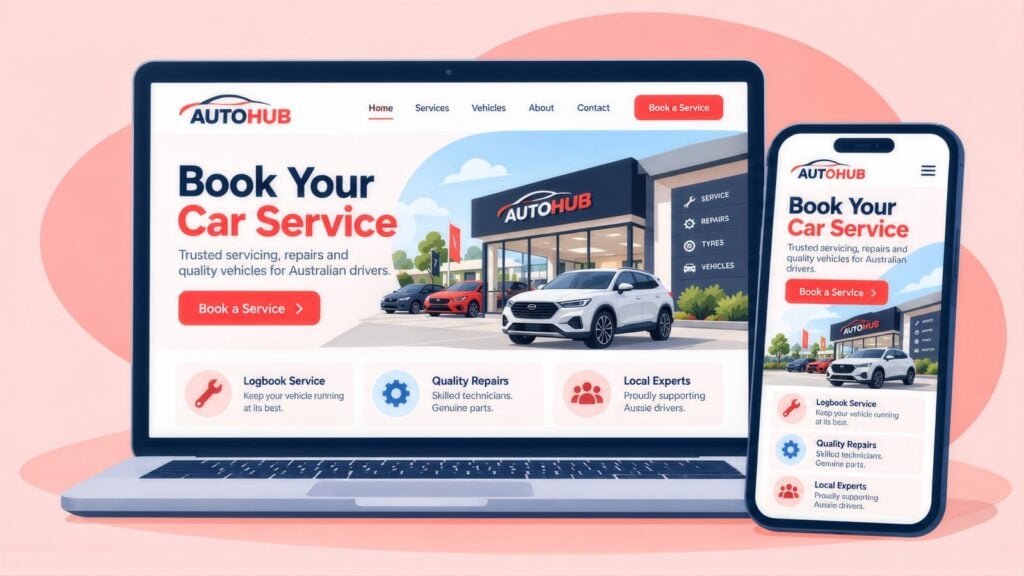
These checks apply to workshops and dealers alike, and the rules for dealer stock pages are in Dealers: Inventory Pages, Stock Accuracy and Listings below. If your site is old, slow or hard to use on a phone, it works against you. A driver searching for a mechanic on a phone in a car park will not wait for a slow page. They also will not scroll past three paragraphs of company history to find the booking button. Fix the technical foundations before you spend on Google Ads.
Google Search Console and indexing
Google Search Console is free, and it tells you which of your pages Google can find and show. Connect Google Search Console to your domain and submit your XML sitemap, a file listing the pages you want in Google. Check your main service pages and confirm they are indexed, meaning Google has stored them.
Dealers have one extra decision to make about whether each car’s listing page should appear in Google. If it should, leave it indexed. If you only want category pages to rank, keep listings out with a noindex tag, a line of code that tells Google not to list the page. Do not use robots.txt for this. Google says robots.txt is not a way to keep a page out of Google. A page blocked by robots.txt cannot be crawled, so Google never sees its noindex tag. When a car sells, its page should show a “not found” (404) error or redirect to the closest model page. Do not leave it live with “sold” in the title.
Mobile performance and booking
Open your website on a phone and try to book a service. If it takes longer than 60 seconds, you are likely losing bookings. The booking link, a phone number people can tap and your address should all show without scrolling on a phone. Pages should also load fast on mobile data. Test them in Google PageSpeed Insights and fix anything it rates “Poor“.
HTTPS
Every page must load over HTTPS, which encrypts what visitors send you. Automotive sites collect enquiry forms, finance details and trade-in information, so all of it must travel securely. Check that your security (SSL) certificate is current and that old HTTP pages redirect to HTTPS.
Title Tags and Meta Descriptions for Service and Stock Pages
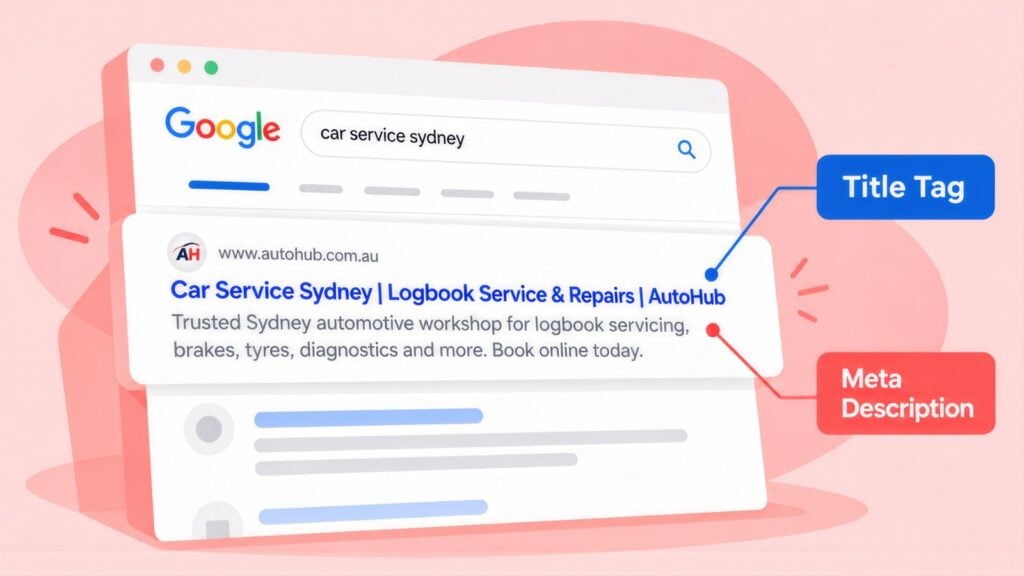
A title tag is the headline Google shows for your page, and the meta description is the short blurb under that headline. Lead workshop titles with the service and suburb, and dealer titles with the make, model and city. If you put a price in a title or description, make it one the page can honour: a “from” price for servicing, and a drive-away price for cars.
Workshop and dealership names run from a single word to something like “Western Suburbs Prestige Motor Group”, so the examples below stop before the name. Add it at the end only when the whole title stays within 55 characters. Google usually shows your site name next to the result, which makes the name the first part to drop.
Title tag examples for workshops
| Page | Example title tag | Characters |
|---|---|---|
| Main service page | Mechanic [Suburb] | Car Service & Repairs | 41 |
| Logbook service | Logbook Service [Suburb] | From $189, All Makes | 47 |
| Brakes | Brake Replacement [Suburb] | Same-Day Service | 45 |
| Pink slip (NSW) | Pink Slip [Suburb] NSW | Authorised Station | 43 |
| Specialist marque | Toyota Mechanic [Suburb] | Logbook & Service | 44 |
Title tag examples for dealers
| Page | Example title tag | Characters |
|---|---|---|
| Main inventory | Used Cars [City] | [N]+ Vehicles in Stock | 41 |
| Make/model category | Used Toyota Hilux [City] | [N] Available Now | 44 |
| Finance page | Car Finance [City] | Low-Rate Dealer Options | 44 |
| Trade-in | Sell Your Car [City] | Free Trade-In Valuation | 46 |
Meta description examples
| Page | Example meta description | Characters |
|---|---|---|
| Workshop main | Mechanic in [Suburb] for logbook services, brakes, tyres and general repairs, with prices shown upfront. Book online or call [day] to [day] [hours]. | 148 |
| Logbook service | Logbook service in [Suburb] from $189 for all makes, keeping your new car warranty intact. Most cars are ready the same day. Book your service online. | 150 |
| Used car inventory | Used cars in [City] with [N]+ vehicles in stock, drive-away prices, finance options and trade-in valuations. View current stock and enquire online. | 147 |
If a dealer title or meta description states a car’s price, it must match the drive-away price, with all on-road costs included. The ACCC’s single price rule says a business must show the total price as a single figure. A price in metadata without on-road costs may breach the Australian Consumer Law, and buyers who then see a higher figure on the page are likely to leave.
Schema for Workshops and Dealers: AutoRepair and AutoDealer
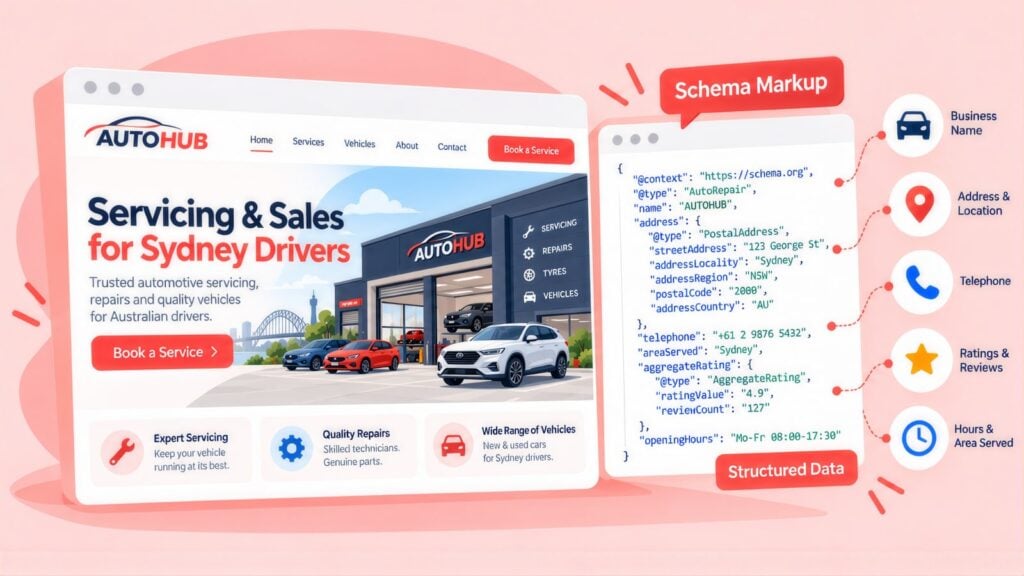
Workshops should use AutoRepair markup and dealers AutoDealer, the schema code that tells Google which kind of automotive business a page belongs to. Both are LocalBusiness types on schema.org. There is no AutomotiveDealer type, so markup using that name will fail.
| Schema type | Where to add it | What it does |
|---|---|---|
| AutoRepair (a LocalBusiness type) | Workshop homepage and service pages | Says you are a repair shop and gives your location, hours and services. |
| AutoDealer (a LocalBusiness type) | Dealer homepage and stock pages | Says you are a car dealer, which helps you show up for local car searches. |
| FAQPage | Service and car category pages with FAQs | Labels price and availability questions for search engines and AI tools. It no longer adds an FAQ dropdown in Google. |
| Vehicle (schema.org) | Each car’s listing page | Describes the car: make, model, year, kilometres and price. |
| BreadcrumbList | All pages below the homepage | Shows where the page sits in your site. |
Vehicle schema for dealer listing pages
Add Vehicle markup to each listing page, with the make, model, year, kilometres, colour and asking price. Google stopped showing vehicle listing rich results in 2025, so the markup will not change how your listing looks. It still describes each car clearly to search engines. Keep it accurate, and remove Vehicle schema from sold vehicle pages quickly.
FAQ markup is in the same position. Google restricted FAQ dropdowns in August 2023 to well-known government and health sites, so workshops and dealers lost them. From 7 May 2026, Google stopped showing them for anyone. FAQPage schema is still worth keeping on service pages, because it tells search engines and AI tools which answer goes with which driver question.
Linking Service Pages and Stock Pages
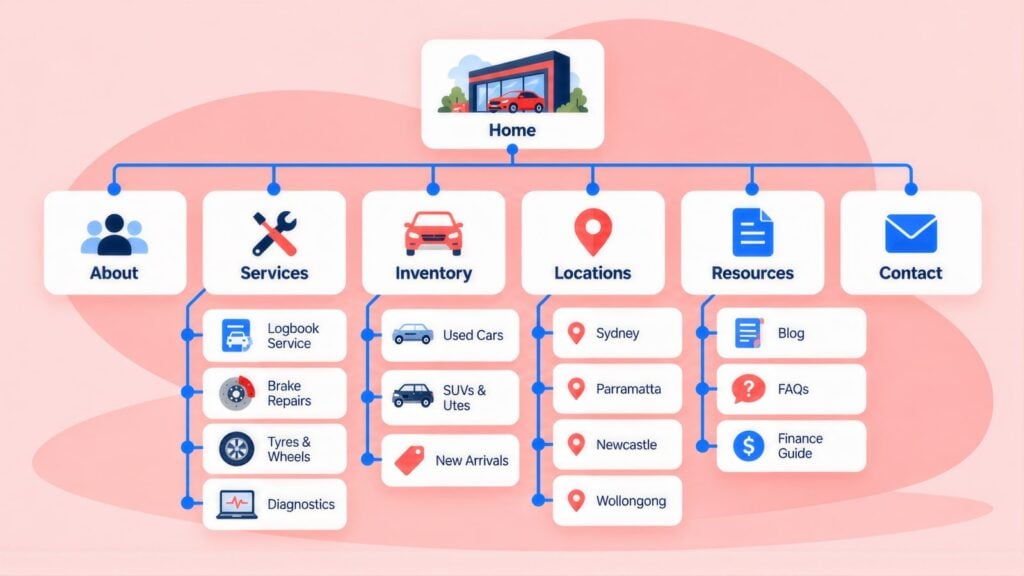
Link every service page back to a main service page. Link every car listing back to its model page and your main stock page. That shows Google which pages matter, and it keeps buyers moving between similar cars.
For workshops
Your main service page is the hub of a workshop site. Each service page, such as logbook service, brakes, tyres or inspections, is a spoke. The hub links to every spoke, and every spoke links back. Related services link to each other where the connection is genuine. A brake page might link to a tyre page, since both affect safety and are often checked together.
For dealers
Your main stock page is the hub. Make and model pages are the main spokes, and each car’s listing is a smaller spoke. The hub links to every model page. Each model page links to the cars available and back to the hub. Each listing links back to its model page. Add a “view similar vehicles” section, so buyers keep browsing after one listing.
| Destination page | Avoid | Use instead |
|---|---|---|
| Logbook service | “logbook service” | “logbook servicing for all makes”, “our logbook service process”, “warranty-safe logbook servicing” |
| Brake service | “brakes” | “brake inspection and repairs”, “our brake replacement service”, “signs of worn brake pads” |
| Used car inventory | “our stock” | “our current vehicle inventory”, “[N]+ vehicles available now”, “used [make] in [city]” |
Articles Drivers Search Before They Book
Drivers who read workshop and dealer articles are usually trying to work something out. They may want to know what a noise means, what a service includes or which used car to shortlist. Useful, practical articles earn trust and pick up specific searches well before a booking.
What to write about
| Topic | Example articles |
|---|---|
| Servicing guides | What a logbook service includes. How often to service your car. The difference between a minor and a major service. |
| Warning signs | Signs your brakes need attention. What common engine noises mean. Dashboard warning lights in plain words. |
| Inspection guides (by state) | What a NSW pink slip checks. What fails a car on a Victorian roadworthy. How to prepare for a Queensland safety certificate. |
| Buying guides (dealers) | What to check when buying a used Hilux. Questions to ask before buying a used car. How to read a PPSR certificate. |
| Cost explainers | Why logbook services cost different amounts. When aftermarket parts make sense and when they do not. How to compare mechanic quotes. |
State-specific content
Inspections, registration and some licensing rules differ by state. State pages suit these searches because the driver wants their state’s rules rather than a national summary. A page that explains exactly what a NSW pink slip covers, what fails a car and how to prepare can rank for specific inspection searches in that state.
Getting cited in AI answers
Practical articles like these can also get cited in AI Overviews. On the car service price search CCM captured, 9 of the 10 sites the AI Overview cited did not appear in the organic results (see the research above). Google’s AI features guidance lists no extra technical steps: a page must be indexed and eligible to show a snippet. Answer one driver question clearly near the top of each article. Add your prices, your state and your workshop details, so AI tools have accurate facts to quote.
Workshops: Service Pages, Price Guides and Local SEO
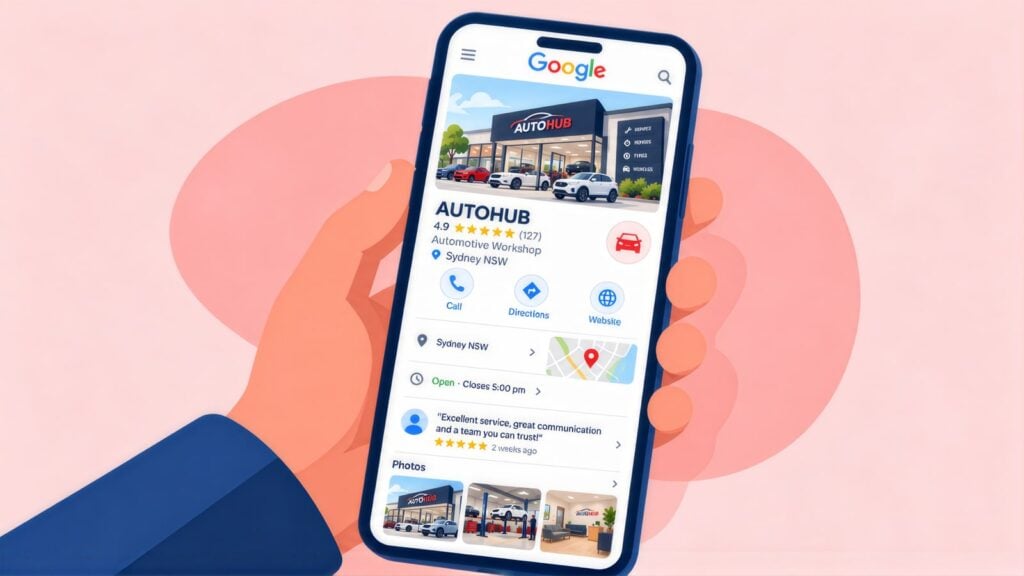
From here the guide treats workshops and dealers separately. The three workshop sections, starting with Workshops: Service Pages, Price Guides and Local SEO, cover service pages, local search, Google Ads and tracking. For workshops, local search visibility is the main channel, because the map results sit above the organic results on most “near me” searches.
Service pages for a workshop
Give each main service its own page, and make each one answer the questions drivers ask:
- Main mechanic page (for “mechanic ” or “car service “): your services, licences, “from” prices, how to book, your team, reviews and FAQs.
- Logbook service (for “logbook service “): what the service includes, how your warranty stays intact, a rough price and a booking link.
- Brakes or tyres (for “brake replacement ” or “tyre fitting “): signs of wear, what the job involves, the price range, how long it takes and a booking link.
- Inspections (for “pink slip ” in NSW, “roadworthy [city]” in Victoria or “safety certificate [city]” in Queensland): what is checked and how long it takes. Explain what happens if the car fails, and show the price, your examiner status and a booking link.
- Specialist services (for “[make] mechanic ” or “diesel mechanic “): why you suit this type of car, your equipment and experience, and a rough price.
Most workshops can add rough prices for common services in an afternoon. “Logbook service from $189” tells the searcher enough to decide whether to enquire, while call for a quote leaves them to ring around. A range, such as from $X for standard cars and from $Y for SUVs and 4WDs, is better than no price. Owners often worry that prices only attract bargain hunters, but a “from” price with its conditions stated still leaves the final quote until after the inspection. The ACCC rule on quoted prices in E-E-A-T and Trust Signals for Automotive Businesses applies either way.
Platinum Automotive is a European car specialist in Pagewood, Sydney. CCM built pages for the European makes it services, plus local SEO. Between May 2025 and May 2026, its organic traffic grew +154.7% year on year (1,220 sessions) and its ranking keywords grew +186.4% (1,011 keywords), according to Semrush. It reached #1 for “Audi mechanic Sydney” and “Mini mechanic Sydney”, #2 for “BMW mechanic Sydney” and #2 for “Mechanic Pagewood”. The Platinum Automotive case study has the full story. CCM’s client results page adds that sustained paid and organic marketing made Platinum the recognised name, which helped lead to a successful sale of the business.
State-specific inspection pages
Inspection rules differ by state. A NSW pink slip page, a Victorian roadworthy page and a Queensland safety certificate page each target different searches in a different market. If you work in more than one state, build a page for each instead of one general “roadworthy” page. Never describe NSW rules on a page aimed at Queensland drivers.
Google Business Profile for workshops
Use your exact trading name, with no suburb or service added. Set the main category to Auto repair shop. Add Brake shop, Tyre shop, Oil change service, Auto body shop or Car inspection station as extra categories, but only where you really offer them.
List every service, such as logbook service, brake replacement, tyre fitting, inspections, transmission service and air conditioning regas. Show Saturday hours if you open, and point the booking link at your online booking page. Photograph your actual workshop, equipment and technicians (with consent). Refresh the photos at least once a year.
Reviews for workshops
Send a review request after every completed job, by text or email when the customer picks up the car. Keep it neutral by thanking them for their business and explaining that a Google review helps others nearby find you. Do not coach them on what to say. Google’s review content policy bans incentives and asking only happy customers, so avoid any system that screens people before sending the link. Reviews gathered that way are also the ones Google tends to remove.
When you reply to reviews, never reveal car details, money matters or repair history in public. A reply like this works: “Thanks for leaving a review, we appreciate the feedback. Look forward to seeing you next service.”
Workshops: Google Ads and Landing Pages That Fill the Service Bay
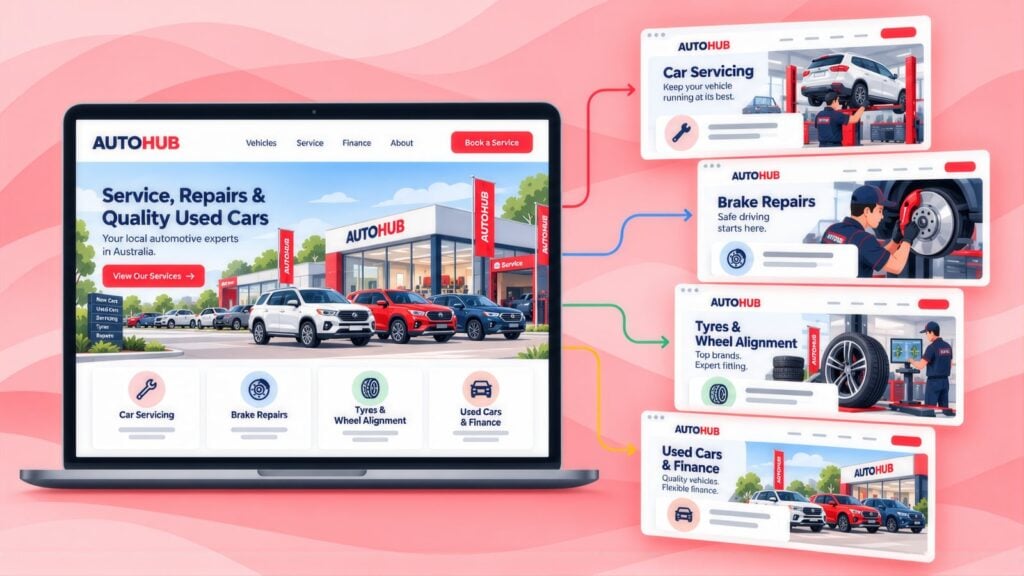
Start with one Search campaign for one service in one area, and send it to a page that shows the price and the booking button.
Workshop campaign structure
Workshop campaigns are local and built around one service. Start with your most valuable, most searched service in your main suburb, which for most workshops is logbook servicing or mechanical repairs. Run it for 60 days before you add a second service, so you learn what a booking costs in your market.
| Setting | Workshop starting point |
|---|---|
| Campaign type | Use Search ads built around one service. The search terms report shows which searches come from car owners and which come from apprentices or people after a car wash. Performance Max, Google’s automated campaign type, can wait until bookings are tracked. |
| Location targeting | Show ads only to people within a sensible driving distance of your workshop. Start with 5 to 10 kilometres for a suburban workshop, then adjust it once you see where bookings come from. |
| Ad schedule | Match the hours you answer the phone and take bookings. If you open at 7:30am and close at 5:30pm, run ads in that window. If you offer online booking after hours, you can run longer hours at a lower bid. |
| Bidding | For the first month or two, set your own maximum cost per click (manual CPC) or let Google get the most clicks for your budget. After about 30 confirmed bookings, move to target CPA bidding, where Google aims for a set cost per booking. |
Workshop keyword selection and negatives
Bid on searches that name a service and a place, such as “mechanic “, “car service near me”, “logbook service [area]”, “brake replacement ” and “pink slip “. Negative keywords block your ads from searches you do not want to pay for. Before launch, add jobs, course, training, salary, apprenticeship, car wash, detailing (unless you offer it), NRMA, car insurance and roadside assist as negatives.
Workshop ad copy examples
| Ad part | Example |
|---|---|
| Headline 1 | Car Service [Suburb] |
| Headline 2 | Logbook Service From $189 |
| Headline 3 | All Makes Serviced |
| Headline 4 | New Car Warranty Kept |
| Headline 5 | Same-Week Appointments |
| Description | Mechanics in [Suburb] for logbook services, brakes and tyres. Upfront prices. Book online. |
Workshop landing pages
A workshop landing page that converts answers the driver’s remaining questions about cost, booking and whether they can trust you with their car. The page needs:
- a clear description of the service
- a rough price or price range
- a booking link that stands out, not just a contact form
- recent Google reviews on the page
- your licence or authorisation status
- a phone number people can tap
Workshops: Tracking Bookings to Completed Jobs
Count completed, invoiced jobs as well as booking requests, and tie each one back to the click or search that started it.
| Stage | What to record | How to use it |
|---|---|---|
| Enquiry / booking request | The form, call or online booking, with the date, service and source. | Counts your enquiries and shows which channel sent each one. |
| Confirmed booking | The booking in your system for a set date, with the service and the type of car. | Tell Google Ads to bid for more of these. |
| Job completed and invoiced | The date, invoice value and service, linked to the original source. | The number that proves the budget is working. |
Cost per completed job tells you more than cost per click. The figures in this worked example are assumed for illustration, not taken from a client account:
| Step | Result |
|---|---|
| You spend on ads | $1,500 |
| You get booking requests | 30 |
| They become completed jobs | 24 |
| Average invoice | $320 |
| Revenue from that spend | $7,680 |
| Cost per completed job | $62.50 |
Whether that works for you depends on your margins, overheads and job values. Track each service separately. A logbook service and a transmission rebuild earn very different amounts, and averaging them hides which one is worth winning through Google Ads.
Dealers: Inventory Pages, Stock Accuracy and Listings
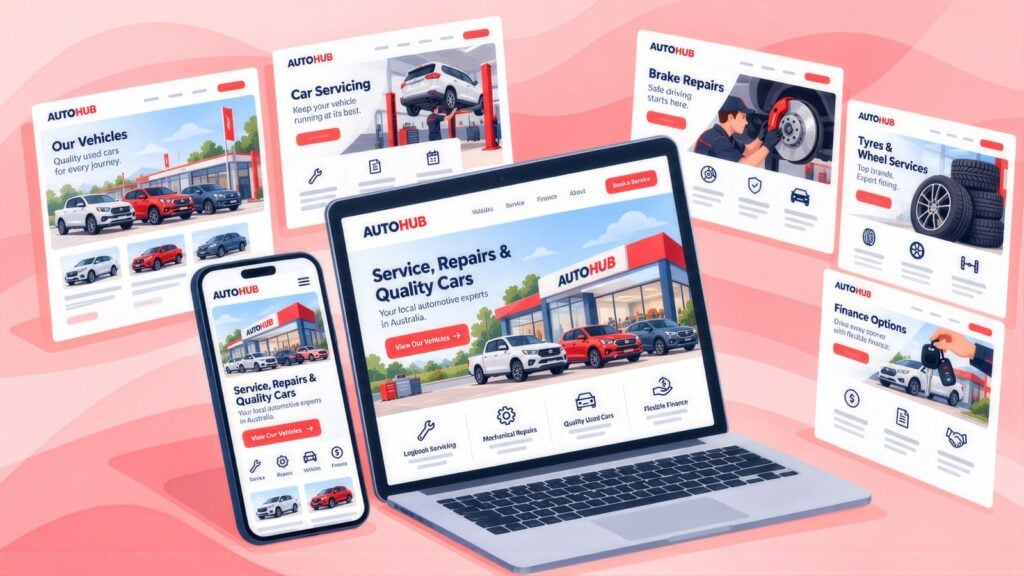
The three dealer sections, starting with Dealers: Inventory Pages, Stock Accuracy and Listings, are for dealers. Your approach depends on the kind of yard you run:
- A franchise dealer has a car maker behind it and a service department to fill. Check your maker’s dealer agreement and brand rules before writing ads or pages. Many car makers control how their name, logos and national offers are used. Some co-op ad programs only pay for ads that follow their templates.
- Every dealer with a workshop should give the service department its own pages, such as “[make] service ” and “[make] logbook service”. Give it its own Google Business Profile category too. That way it can rank in its own right for the workshop searches in the three workshop sections above, starting with Workshops: Service Pages, Price Guides and Local SEO. If you sell parts over the counter, give parts a page as well.
- An independent used-car dealer competes on stock and price alone, so accurate listings matter most.
- A dealer group must stop its own sites competing for the same searches. Give each site its own location page and profile, and decide which site targets which suburbs.
Stock accuracy for dealers
A car that sold three weeks ago but still shows in Google wastes clicks and annoys the buyer who finds it gone. Connect your stock system to your website so sold vehicles come down or redirect quickly and buyers only see cars you can sell.
Dealer inventory pages: listings, filtered searches and canonicals
Stock pages come in three types, and each needs a clear rule before your stock starts turning over.
- Vehicle listing pages. Give each car one clean web address and a unique title (year, make, model, variant, city). Add at least ten real photos, the kilometres and the drive-away price. When the car sells, show a 404 or redirect to the closest model page within a day or two.
- Filtered search pages. Make, model and body-type pages that match real searches, such as used Hilux Brisbane, should be indexed, each with a short unique introduction. However, sort orders and combinations of colour, price and kilometre filters create thousands of near-copies. Keep those out of Google with noindex, or point them at the main category page with a canonical tag. Use robots.txt only to stop Google crawling filter pages you never want indexed, as Google’s faceted navigation guide explains.
- Canonicals. The same car often appears at several web addresses, through tracking codes, two category paths or a printable version. A canonical tag (rel=”canonical”) tells Google which address is the main one. Point every version at one address, following Google’s duplicate URL guidance, so links and ranking signals are not split across copies.
The pages a dealer site needs
- Main stock page (for “used cars [city]” or “car dealer “): a stock overview, makes and models, price range, finance, your location and hours.
- Make and model pages (for “used Toyota Hilux [city]”): the cars available, key specs side by side, price range, finance from, and an enquiry button.
- Each car’s listing (for “[year] [make] [model] [variant]”): at least 10 real photos, accurate specs, the compliance plate, kilometres, service history notes, drive-away price, a finance guide and an enquiry form.
- Finance page (for “car finance ” or “dealer finance [city]”): your finance options, deposit needed, how approval works, and comparison rates shown as the rules require.
- Trade-in page (for “sell my car ” or “trade in car [city]”): how valuation works, what affects the value, the steps from valuation to credit, and an online estimate.
Google Business Profile for dealers
Link your Google Business Profile to your live stock page rather than only your homepage, so buyers go straight to the cars. Post photos of actual cars on the yard and keep your hours up to date, especially on public holidays. A profile showing old hours, or “closed” on a day you are open, can cost you walk-in buyers.
Reviews for dealers
A smooth purchase can bring a strong review, while hidden costs or problems after the sale can bring a damaging one. Ask for the review at handover, while the buyer is still with you, rather than days later.
Dealers: Google Ads, Vehicle Ads and Pricing Rules
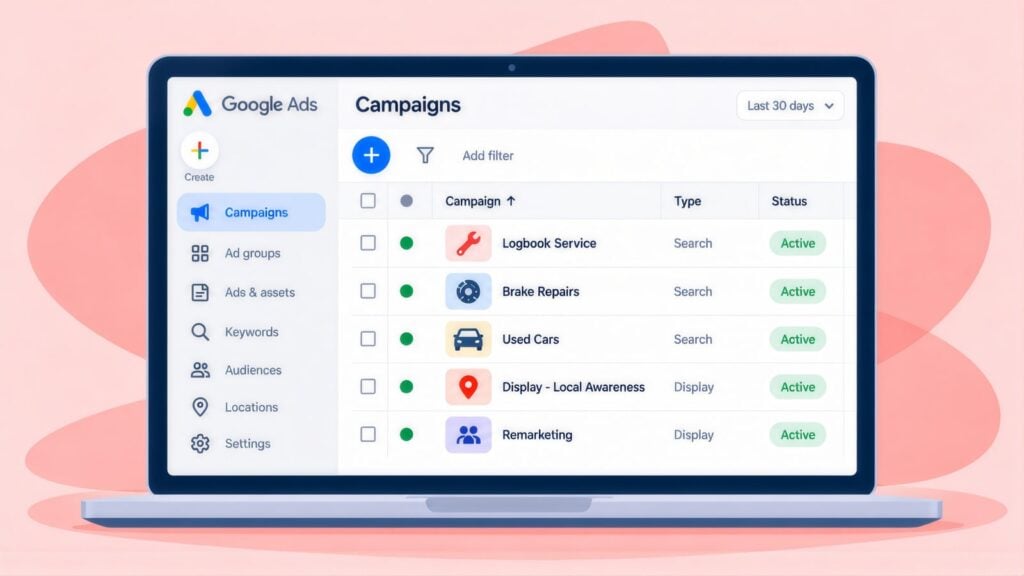
Build dealer campaigns around the makes and models in stock, and judge them on viewings and test drives.
Clicks on broad used-car searches are cheap. In CCM’s Google Keyword Planner pull of 1 October 2026 (Australia), top-of-page bids for used cars ran at about $0.12 to $1.57 a click, and “car dealership near me” at about $1.43 to $6.13. These clicks still need filtering, so send them to stock pages for the makes and models you hold and block research searches.
Dealer campaign structure
Buyers take days or weeks to decide, so the main goal for dealer Google Ads is good enquiries such as viewing requests, test drive bookings and trade-in valuations. Run separate campaigns for each make/model category you want to promote. Spend your budget on the cars you have in stock and want to sell, rather than spreading it evenly across your whole range.
Google offers Vehicle Ads (once called Automotive Inventory Ads) to dealers who upload their stock as a feed in Google Merchant Center. Each ad shows a specific car with its photo, price and kilometres, much like Google Shopping campaigns do for online stores. For a dealer with lots of stock, they are worth testing, because they match each buyer to a specific car. Check eligibility and feed rules in Google’s vehicle ads overview before you set one up.
How well they run depends on the feed. Each car needs accurate details such as make, model, year, kilometres, price and a link to its own listing page. It also needs clear photos of the actual car. Merchant Center lists the full set of required details. Refresh the feed at least daily so sold cars drop out. Google runs Vehicle Ads through Performance Max or Standard Shopping campaigns, so treat them as an addition to your Search campaigns rather than a replacement.
Dealer keyword selection and negatives
Bid on searches that name a car you stock and a place, such as “used [make/model] [city]”, “second hand cars [area]”, “car dealer near me” and “buy used Hilux [city]”. Add negatives for searches that will not lead to a sale on your yard: “new [make model]” if you only sell used, lease, hire, car rental, reviews (unless you want researchers) and searches for specific parts.
Price and finance claims in dealer ads
Advertised prices must be drive-away, with all on-road costs included, or must clearly state what is and is not included. Any finance interest rate needs a comparison rate and its conditions. A “from $X per week” finance claim needs the rate, the term and the total cost on the landing page. Check the ACCC’s motor vehicle guidance before any price or finance claim goes into an ad.
Dealer landing pages
A dealer landing page or car listing works when it shows the car accurately and prices it honestly at drive-away. It should also make it easy to book a viewing or ask about finance. Every listing needs:
- at least ten real photos of the outside, the inside and any notable features or wear
- an accurate odometer reading and the service history status
- the drive-away price, with on-road costs included or clearly listed
- a short enquiry form that asks only for name, phone and a message
Many buyers want to know what their current car is worth before they shop. Once they know their trade-in value, they can work out their budget for the next car. A trade-in page with an instant estimate, or a short form that triggers a same-day call, reaches them early, often before they have picked a dealer.
Dealers: Tracking Enquiries to Test Drives and Sales
Count attended viewings and test drives, then delivered cars, and tie each one back to the search or ad that started it.
| Stage | What to record | How to use it |
|---|---|---|
| Enquiry received | The form, call or chat, with the car asked about, the source and the date. | Tracks how many buyers enquire and what brought them to you. |
| Viewing or test drive attended | The date, car and source, and whether the buyer has finance sorted. | Tell Google Ads to bid for more of these. |
| Vehicle sold and delivered | The date, car, sale price and finance arranged, linked to the source. | The number you use to work out your return on ad spend. |
A Launch Checklist for a Workshop or Dealership, With Owners
Print this list, put a name against every line and update the status column at each weekly meeting. Most items take a day or less. Work from top to bottom over roughly the first three months, since later items depend on the earlier ones.
| Task | For | Owner | Status |
|---|---|---|---|
| Connect Google Search Console, submit the sitemap and confirm the five key pages are indexed | Both | Web developer or agency | Not started |
| Complete the Google Business Profile: categories, services, hours and 10+ current photos | Both | Service or sales manager | Not started |
| Show your licence, inspection station or examiner status on the right pages | Workshop | Owner | Not started |
| Add “from” prices to the main service pages | Workshop | Service manager | Not started |
| Set noindex or canonicals on filtered stock pages (not a robots.txt block), and a rule for sold cars | Dealer | Web developer or agency | Not started |
| Check every advertised price is drive-away and every finance claim has a comparison rate | Dealer | Dealer principal | Not started |
| Test booking or enquiry on a phone, from start to finish | Both | Front desk | Not started |
| Track forms and calls separately in Google Analytics 4 with GA4 conversion tracking | Both | Agency | Not started |
| Start review requests after every job or handover, and send one to the last 20 customers | Both | Front desk or sales | Not started |
| Launch one Search campaign: one service in one suburb, or one make and model | Both | Agency | Not started |
| Review search terms weekly and build the blocked keyword list | Both | Agency | Not started |
| Publish two articles that answer common customer questions, such as a state inspection guide | Both | Owner with agency | Not started |
| Work out cost per completed job or per test drive, then choose the next service or model | Both | Owner | Not started |
Car Dealer and Workshop SEO: Common Questions
How long does SEO take for a workshop or car dealer?
Workshops usually see the map results respond first. A complete Google Business Profile and a steady run of post-job reviews can lift visibility for mechanic searches within 3 to 4 months. Make and service pages up against established workshops tend to need 6 to 9 months. Dealers depend as much on clean indexing as on content, because stock pages come and go every week. Once that is under control, model pages keep gaining ground past the 12-month mark.
How much does automotive SEO cost in Australia?
The cost depends mainly on scope. A single workshop with a few service pages and one inspection type needs far less work than a dealer group. A group may have several sites, thousands of stock pages to keep clean and car maker brand rules to follow. Agencies charge from $1,500 to beyond $10,000 a month across that spread. An in-house SEO hire costs $80,000 to $170,000-plus a year once salary, tools and training are added, as this in-house and agency pricing post explains. Compare either with the value of a completed job or a sold car, using an SEO ROI calculator.
What do Google Ads clicks cost for mechanics and dealers?
CCM’s analysis of Google Keyword Planner data for Australia (September 2025 to July 2026) puts top-of-page bids for car service near me at about $1.55 to $5.67 a click, and “mechanic near me” at about $1.68 to $5.91. On the dealer side, CCM’s later Keyword Planner pull of 1 October 2026 put “used car dealers near me” at about $0.60 to $3.40. Your real cost depends on suburb, competition and ad quality, so measure cost per completed job or attended test drive.
What should happen to a vehicle page once the car is sold?
Take it down within a day or two by showing a 404 or redirecting to the closest model page, and remove the Vehicle markup. Sold cars left live waste clicks and make buyers doubt the rest of your stock.
Should I block filtered stock pages with robots.txt?
No, robots.txt is the wrong tool for keeping them out of Google. It stops crawling, but a blocked page can still be indexed, and Google cannot see a noindex tag on a page it may not crawl. Use noindex, or a canonical to the main category page, for filter combinations. Keep robots.txt for filter pages you never want crawled at all.
Can a dealer advertise a price without on-road costs?
Not as a headline car price, because the ACCC’s single price rule means the total price must be shown as a single figure. Advertised car prices should therefore be drive-away, including registration, CTP, dealer delivery and stamp duty. Finance claims also need a comparison rate and the conditions.
Is SEO still worth it for workshops now that AI answers searches?
Yes, because AI answers draw on indexed web pages, including workshops’ own price guides. Google’s position, set out in its AI features documentation, is that AI Overviews and AI Mode need nothing beyond indexing and snippet eligibility. A workshop with clear service pages, prices, state inspection guides and a strong Google Business Profile gives Google and chatbots something accurate to quote. The map pack also came first on every local search in CCM’s September 2026 captures (see the research above).
Which schema type should a car dealer use?
Use AutoDealer for a dealership and AutoRepair for a workshop. Both are LocalBusiness types on schema.org, while AutomotiveDealer does not exist and will fail validation. Add Vehicle markup to each listing and keep it accurate as stock changes.
Andrei Jach is Senior Manager, SEO and Analytics Specialist at Click Click Media in Sydney, with more than 15 years in digital marketing and strategy. He has led SEO across retail, professional services, health and manufacturing, and runs strategic SEO planning, analytics implementation and technical audits for CCM clients. He was previously at Agent 6 Marketing and Red Propaganda.
Implement this playbook with AI
Opens your assistant with this playbook and seven questions about your business: services, area, website and ads. It then writes your keyword map, page plan and Google Ads starter build with your details filled in.
Copy the prompt for Gemini, Grok or any assistant that cannot open a prefilled link. The prompt points at this page, which is also served as Markdown to assistants that ask for it.
Work with Click Click Media
Filling a service bay and selling cars from the yard need different search work. Tell us which one you want to improve, or both, and we will show you where bookings and test drives are being lost.
Click Click Media holds Google Premier Partner status, backed by search work since 2008 and over $115 million in Google Ads spend managed for Australian businesses. For workshops and dealers, we grow organic search visibility and run Google Ads campaigns judged on booked jobs and sold cars. The free audit covers your website, stock pages, Google Business Profile and any Google Ads account. It points to the biggest gaps, with no obligation attached.
Terms are month to month with no lock-in. The senior strategist you meet at the audit is the one who runs your account.
Verified Sources and References
- ACCC: Pricing manual for the motor vehicle industry
- ACCC: Price displays and the single price rule
- ACCC: False or misleading claims
- BITRE: Road vehicles, Australia, January 2025
- FCAI: 2025 new vehicle sales (VFACTS)
- Schema.org: AutoDealer
- Google Search Central: Block indexing with noindex
- Google Search Central: Introduction to robots.txt
- Google: Managing crawling of faceted navigation URLs
- Google Search Central: Consolidate duplicate URLs (canonicals)
- Google Search Central: Changes to HowTo and FAQ rich results (August 2023)
- Google Search Central: Documentation updates (vehicle listing and FAQ rich results removed)
- Google Ads Help: Vehicle ads overview
- Google Maps: Fake engagement and review content policy
- Google Business Profile Help: Manage customer reviews
Last checked October 2026 · next review January 2027
