
SEO and Google Ads for Mortgage Brokers in Australia

Written by Andrei Jach, Senior Manager, SEO and Analytics Specialist at Click Click Media · Updated 1 October 2026
A borrower who is ready to talk to someone might type “mortgage broker near me”, “how much can I borrow” or “refinance home loan broker Sydney”. SEO for mortgage brokers aims to put your site in front of those searches for the suburbs and loan types you write.
On those searches a broker site competes with lenders and comparison sites as well as other brokers, so it needs pages built for the borrower who wants local advice.
This guide covers the technical fixes, the pages to build and the content that meets Google’s higher bar for financial services. It also shows how to run Google Ads that follow Australian rules and bring in enquiries that settle.
Implement this playbook with AI
Opens your assistant with this playbook and seven questions about your business: services, area, website and ads. It then writes your keyword map, page plan and Google Ads starter build with your details filled in.
Copy the prompt for Gemini, Grok or any assistant that cannot open a prefilled link. The prompt points at this page, which is also served as Markdown to assistants that ask for it.
CCM Research: What Mortgage Searches and Ads Show
What we saw: in CCM’s Australia-wide search capture on 5 September 2026, Google’s AI Overview for how do mortgage brokers get paid cited 5 broking firms among the 8 sites it referenced. For refinance home loan it cited no broking firm on either 3 or 5 September, and named banks, Canstar, Moneysmart and Facebook instead.
What to do: publish a plain page on how you are paid, with your licence details, because AI answers already cite broker pages on that question. On refinancing, AI answers lean on banks and comparison sites, so put more of your effort into suburb and borrower situation pages.
Source: CCM search captures, Australia, 3 and 5 September 2026
What we saw: of the 28 advertisers in CCM’s analysis of Semrush ad history on six Australian mortgage searches from September 2025 to August 2026, 11 were brokers or broker networks and 10 were lenders.
What to do: compare your ads with the other broker advertisers rather than the lenders, who can quote their own rates and products. Count advertisers rather than ad records, since one broker can appear in many monthly snapshots.
Source: CCM analysis of Semrush ad history, Australia, September 2025 to August 2026
What we saw: when CCM captured mortgage broker sydney again 49 hours later, the organic top 10 was identical and in the same order, while one of the three local pack places changed.
What to do: judge your Google Business Profile position over several weeks rather than from a single check. This was one repeat of one search, but it suggests the map pack shifts more from day to day than the organic results.
Source: CCM search captures, Australia, 3 and 5 September 2026
Method: CCM captured eight searches Australia-wide on desktop (DataForSEO, Google location 2036) on 3 September 2026, then captured three of them again on 5 September. Six were borrower searches (mortgage broker sydney, mortgage broker near me, best mortgage broker, refinance home loan, home loan pre approval and how do mortgage brokers get paid), and two were searches for broker marketing agencies. The advertiser finding uses CCM’s analysis of Semrush ad history for mortgage broker and the first five borrower searches, from monthly snapshots taken on the 15th between September 2025 and August 2026. An advertiser is one website domain, classed from its ad text and landing page; the 11 brokers include one short-term private lender, and two advertisers could not be classed.
SEO for Mortgage Brokers: Where Borrowers Search

In the March 2026 quarter, brokers settled 81% of all new residential home loans in Australia. That is the highest share on record, up from 55.3% in 2018, according to MFAA data compiled by Cotality.
Lenders have built domain authority over decades of publishing, and comparison sites like Canstar, RateCity and InfoChoice run large content teams. Their content targets rate comparisons, product research and general finance education.
Lenders and comparison sites do not cater well for the borrower who has finished researching and wants to talk to someone local. Searches such as “mortgage broker [suburb]”, “first home loan broker Sydney” and “refinance home loan specialist” come from that borrower. They show the strongest intent and the weakest competition, so start your pages there.
The sections below start with the site’s technical base. They then cover content that meets Google’s higher bar for financial pages, and finish with paid campaigns that follow Australian rules.
LendInsure is a lender that generates loan leads. We rebuilt its Google Ads account and tested a new landing page. The result, recorded on the custom landing page design service page, was: “+54% increase in qualified enquiries, -31% cost per acquisition reduction, and +18% improvement in approval-to-lead ratio within 90 days.” For SME Money, a small business lender, we launched the brand’s entire online presence in just six weeks. Neither is a broker, but both sell credit under the same disclosure rules.
Keyword Clusters That Drive Enquiries
Borrowers search in predictable patterns, and those patterns should decide which pages you build and where your ad budget goes. In CCM’s analysis of Google Keyword Planner data (Australia, 12 months to August 2026), finance broker averages about 3,600 searches a month. A later CCM pull, on 1 October 2026, put home loan broker at about 1,900.
Broker Discovery
mortgage broker [suburb]
mortgage broker near me
home loan broker [city]
best mortgage broker [area]
First Home Buyers
first home buyer broker
first home loan help
first home guarantee broker
FHSS scheme explained
Refinancing
refinance home loan broker
should I refinance my mortgage
refinancing costs Australia
break cost calculator
Investment Property
investment property loan broker
interest only loan broker
investor home loan help
finance for investment property
Borrower Scenarios
self employed home loan broker
home loan casual income
how much can I borrow
home loan bad credit Australia
Commercial / SMSF
SMSF loan broker Australia
commercial property finance
low doc loan broker
business loan broker [city]
The numbers behind each cluster
| Cluster | Market data | Source |
|---|---|---|
| Refinancing | 640,137 Australians refinanced in 2025, a 20% jump on 2024, and 64% switched lenders, which shows most were shopping around. | ABS data via the Australian Banking Association, 2026 |
| First home buyers | There were 31,783 new first home buyer loans in the December 2025 quarter, the most since late 2023. The average first home buyer loan reached $607,624, up 8.5% in a quarter. NSW and the expanded 5% Deposit Guarantee drove the rise. | ABS Lending Indicators, December quarter 2025 |
| Investment property | Investors took out $150 billion in new loans in 2025. That is nearly triple 2020’s $57 billion and the highest full-year value in the ABS series. Investor lending rose 25.3% on the year in the March 2026 quarter. | ABS Lending Indicators, 2026 |
| Broker discovery | Brokers write most loans, as SEO for Mortgage Brokers: Where Borrowers Search shows, so most borrowers had to find a broker somewhere. A broker who ranks locally picks up demand that used to go to referrals or straight to the bank. | MFAA / Cotality, March 2026 |
How to prioritise
Start with broker discovery searches in the suburbs you actually serve. These come from people who have already decided to use a broker, so they are the most likely to turn into a real conversation. Build borrower scenario content next, around questions like can I get a home loan on a casual income and “what deposit do I need for a first home”. These suit brokers well, because you can answer with real authority while comparison sites give generic answers.
Terms like “mortgage broker Sydney” draw heavy competition from national groups and large aggregators. Build suburb and scenario pages first to show Google you know the topic, then compete for the broad terms.
Finding real search volumes
If your site already has traffic, Google Search Console is the best source. It shows what people typed to find your site, where you appear without getting clicks, and which keywords are closest to page one. Without that data, Google Keyword Planner and Semrush both give Australian volumes. Rank each term on volume, clear intent and how strong the current first page looks.
List every suburb or region you serve. A suburbs lookup tool helps with neighbouring areas. For each one, check “mortgage broker [suburb]” and “home loan broker [suburb]” in Google Search Console or Keyword Planner. Any suburb with real search volume and borrowers you serve should get its own page, and that list becomes your location page plan.
Website Foundations and Schema

Google has to find, crawl and load your site before content can bring results. Check these five areas first, because the fixes are usually simple:
- Google Search Console: verify you own the site, submit your XML sitemap and inspect your key pages. This guide to Google Search Console walks through each step. Give every indexing error an owner and a fix date.
- Mobile: Google ranks the mobile version of your site. A site that is hard to use on a phone will not rank well, however good the content. Open it on your phone, try to make an enquiry and note every snag. Text you cannot read, buttons that overlap and forms that fail hurt rankings as well as enquiries.
- Speed: Core Web Vitals are Google’s measures of loading, layout stability and how fast a page responds. Run your top five pages through PageSpeed Insights and fix anything marked poor. Large, uncompressed images are a common cause of slow pages, and they are quick to fix.
- HTTPS: every page should load securely and redirect from HTTP, without exception. Your site collects financial enquiry data, so an expired certificate is a compliance risk as well as a ranking problem.
- Crawlability: Google finds pages by following links. Link every service and location page from the menu or a related hub page. Keep a current XML sitemap in Google Search Console. A page nothing links to may never be indexed.
Schema markup
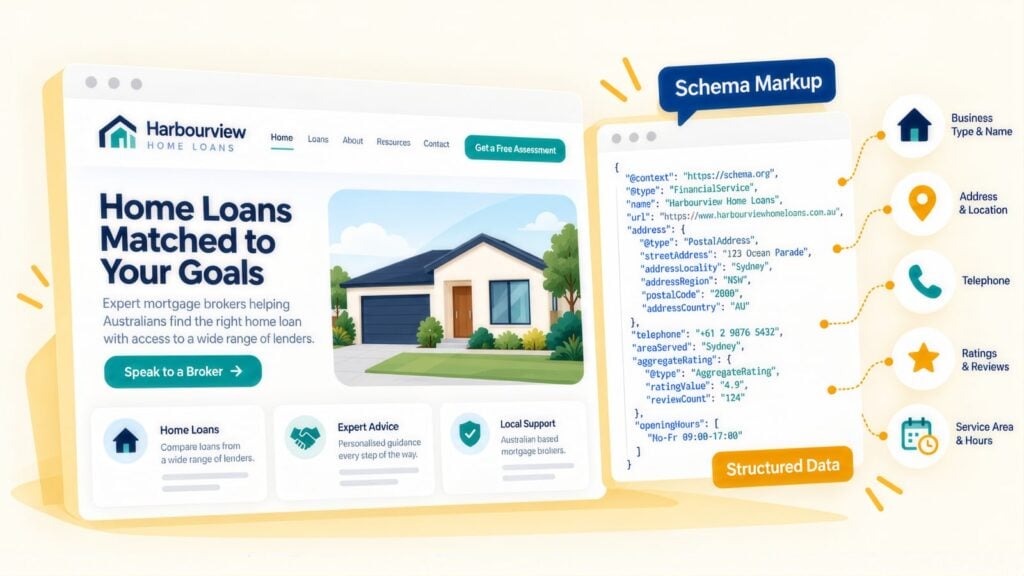
Schema markup is code that tells search engines who the broker is, where the business operates and who wrote each article. It does not directly lift rankings, although it tells Google what each page is for and makes some pages eligible for rich results such as breadcrumbs.
| Schema type | Where to apply | What it does |
|---|---|---|
| LocalBusiness | Homepage and About page | Gives your business name, address, phone, hours, service area and licence details |
| BreadcrumbList | All pages below the homepage | Shows where the page sits in your site (Home > Services > First Home Buyers) |
| Article and Person | Blog posts and author pages | Links each article to a named, qualified author |
| FAQPage | Service pages with FAQs | Optional; it labels questions and answers for search engines and AI tools |
FAQ rich results were limited to government and health sites in August 2023 and stopped altogether from 7 May 2026, according to Google’s Search Central updates log. FAQ markup will therefore not add a dropdown, though the questions are still worth answering on the page. Do not mark up reviews of your own business. Google’s review snippet guidelines call that self-serving, including embedded Google review widgets, and it can lead to a manual penalty. Keep your reviews on your Business Profile instead.
YMYL and E-E-A-T: The Rules for Financial Content
Google checks mortgage content more closely than most. It falls under YMYL, short for Your Money or Your Life: topics that can affect a person’s finances or wellbeing. Google judges the quality of these pages through E-E-A-T, which stands for Experience, Expertise, Authoritativeness and Trustworthiness. This explainer on E-E-A-T for Australian businesses covers each part in more depth.
| E-E-A-T signal | What it means for a broker | How to show it |
|---|---|---|
| Experience | Real, hands-on knowledge of the lending process | Case studies (with client permission) and scenario articles drawn from real outcomes |
| Expertise | Professional knowledge of lending and regulation | Your ASIC credit licence on show, MFAA or FBAA membership, and named author bylines |
| Authoritativeness | Respect from credible sources | Media mentions, industry awards, links from industry bodies and finance publications, and Google reviews |
| Trustworthiness | Honest, open content and practice | Clear disclosure of how you are paid, no misleading rate claims, and correct licence details on every page |
Put a named author with credentials others can check on every article. A refinancing article, for example, should carry a byline that links to the author’s profile page and shows their credit licence number or representative arrangement, so a borrower can check who wrote the advice.
Brokers often underrate the About page, which should tell Google and the borrower who you are and what licences and qualifications you hold. Add how long you have operated and how many lenders you can access, so the credentials claimed on your articles can be checked in one place.
Content that works against you
- Articles with no named author, or an author nobody can verify
- Rate or approval claims without evidence and conditions
- Thin pages that repeat generic facts found on dozens of other sites
- AI-written text that no qualified professional has checked
- Outdated statistics and broken links to sources
Your website must show your Australian Credit Licence (ACL) number, or your credit representative arrangement. Put it in the footer and on every page that discusses loan products. ASIC’s credit licensee guidance sets out the rules. Check your disclosures with your licensee or legal adviser before you publish.
Service and Suburb Pages Every Broker Needs

A broker site works best with one main service page that links to each specific service page and location page. Each of those pages links back to the main one.
| Page | Focus keyword | What to include |
|---|---|---|
| Mortgage Broker [City] | mortgage broker [city] | What you do, how many lenders you use, your process, team credentials, reviews and an FAQ |
| First Home Buyers | first home buyer mortgage broker | Who qualifies for which scheme, deposit needs, your process, common mistakes and an FAQ |
| Refinancing | refinance home loan broker | When refinancing makes sense, break costs, comparison rate disclosure and your process |
| Investment Property Finance | investment property loan broker | Loan-to-value (LVR) limits, interest-only options, which lenders want investors, and tax context |
| Self-Employed Borrowers | self employed home loan broker | Paperwork needed, low doc options, common hurdles and your process |
| About / Team | [broker name] | Credentials, ASIC licence number, years in business, your lender panel and your story |
Most people who refinanced in 2025 moved to a different lender, as the refinancing row in Keyword Clusters That Drive Enquiries shows. Borrowers in that position are comparing options and are often open to talking to a broker. For most broker sites, refinancing is the service page with the most upside this year.
Location pages
Give each suburb or region you serve its own page, and make it truly local. Swapping the suburb name into a template creates doorway pages, which Google treats as spam. A “mortgage broker Penrith” page should answer what a Penrith borrower asks. That includes the first home buyer support available in Western Sydney and what typical local prices mean for the loan sizes you write. The same applies at city level, where a broker covering several capitals needs separate pages for Sydney, Melbourne, Brisbane, Perth and Adelaide. Each page should cover its own state’s stamp duty concessions and first home buyer schemes, which one “Australia-wide” page cannot do.
What every page needs
- One clear H1 heading that matches or closely reflects the focus keyword
- An opening paragraph of 60 to 120 words: who the page is for, what you do and what happens next
- At least one credibility signal: ASIC licence, MFAA or FBAA membership, years of experience, or a measured result
- A short FAQ drawn from questions real borrowers ask (this guide has its own in Mortgage Broker SEO and Google Ads: Your Questions Answered below)
- A link to a trusted source wherever you mention a statistic or rule
- A clear next step: a contact form, a phone number people can tap, or a booking link
Start location pages with the three suburbs where you already settle the most loans or get the most enquiries. You already have proof in those areas, and your reviews are the most likely to mention them.
Title Tags and Meta Descriptions for Broker Pages
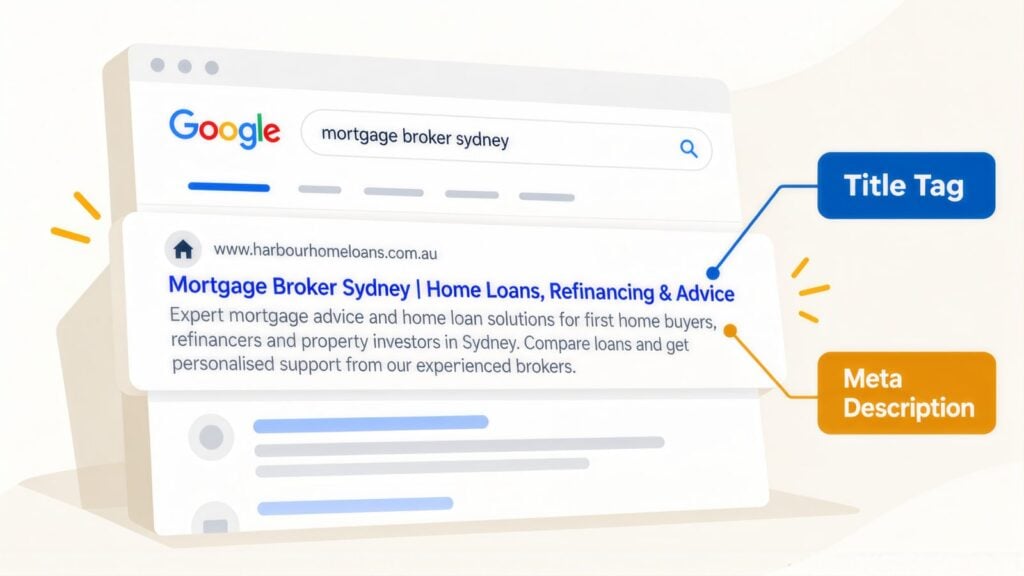
Your title tag is the clickable headline in search results, and the meta description is the short summary under it. They are the first thing a borrower sees in the results. Fixing them is one of the quickest improvements you can make on a broker site. A free meta planner helps you draft them page by page.
Keep each title to 55 characters or fewer, including spaces, and put the focus keyword in the first three words where you can. If there is room, add one point of difference, such as your lender panel size or a free consultation, and skip openers like “Welcome to”, “About” or “Home”.
| Page | Example title tag | Characters |
|---|---|---|
| Main service / home | Mortgage Broker Sydney | Compare 40+ Lenders | 44 |
| First home buyers | First Home Buyer Mortgage Broker in Sydney | 42 |
| Refinancing | Refinance Home Loan Broker | Compare Lenders | 44 |
| Location page | Mortgage Broker Parramatta | Western Sydney | 43 |
| Self-employed | Self-Employed Home Loans | Mortgage Broker | 42 |
| Investment property | Investment Property Loan Broker in Sydney | 41 |
Brokerage names vary a lot in length, so the examples leave the brand off. Add yours at the end only when the full title still fits in 55 characters. Google normally prints your site name alongside the result, so the brand is the part to drop first.
Meta descriptions should run 135 to 150 characters. Give them four parts: the focus keyword near the start, one clear benefit, an accurate summary of the page and a call to action.
| Page | Example meta description | Characters |
|---|---|---|
| Mortgage Broker Sydney | Mortgage broker in Sydney comparing home loans from 40+ lenders for first home buyers, refinancers and investors. Book a free consultation today. | 145 |
| First Home Buyers | First home buyer broker in Sydney. We explain your options, check your eligibility for government schemes and manage the paperwork. Book a free call. | 149 |
| Refinancing | Refinance your home loan with a Sydney broker who compares 40+ lenders and checks break costs before you switch. Book your free home loan review. | 145 |
| Location page | Mortgage broker in Parramatta helping first home buyers, refinancers and investors across Western Sydney find the right loan. Book a free call today. | 149 |
Any interest rate in a meta description needs a comparison rate and the standard disclosure next to it, and that will not fit. Leave rate figures out of titles and meta descriptions. Handle rate claims on ad landing pages, where there is room for proper disclosure.
Google Business Profile, Reviews and Links for Brokers

Most brokers settle the bulk of their loans with borrowers from one area. Local SEO puts you in front of them in the map results, suburb searches and local listings.
Fill in each Google Business Profile field with care:
- Business name: use your exact trading name, because adding suburbs or keywords breaks Google’s guidelines and risks suspension.
- Categories: choose Mortgage broker as the main category, and add others, such as finance broker, only where accurate.
- Address or service area: show a physical address if you meet clients at an office. If you are mobile or work from home, hide the address and list a service area instead.
- Phone: use the number you actually answer. Add a call tracking number here if you want to count profile enquiries separately.
- Services: list every loan type you write, such as first home buyer loans, refinancing, investment property, SMSF and commercial finance.
- Hours: show when you are really available, including whether you take evening or weekend enquiries.
- Photos: add a professional headshot and your logo at least, plus your office or awards where relevant.
Reviews
Google says local results are based on relevance, distance and prominence, and reviews feed prominence. Send a review link to every client after settlement, with a neutral message. Do not ask for positive reviews, offer rewards or pick who gets the link. Each of those breaches Google’s review policy and ASIC’s guidance on testimonials. A steady flow of genuine reviews, including a few under five stars, looks more credible than a sudden burst.
Citations and links
Citations are mentions of your business name, address and phone number on other websites. When they match, they back up your location. Keep your details identical across Yellow Pages, True Local, Hotfrog, the MFAA or FBAA member directory and your aggregator’s broker finder.
The links that help a broker most come from the same kinds of sources:
- your aggregator’s broker profile and news pages
- MFAA or FBAA award listings
- local media stories about first home buyers or refinancing in your area
- local business groups and sponsorships
- guest articles for property or accounting firms you already refer clients to.
Good link building works through sources like these rather than buying links.
Claim and verify your Google Business Profile if you have not already. Complete every field and add at least five photos. Copy the review link from the profile and send it to your last five settled clients with a short, neutral message. Then check your MFAA or FBAA listing, and confirm the contact details match your profile exactly.
Internal Links and Borrower Content
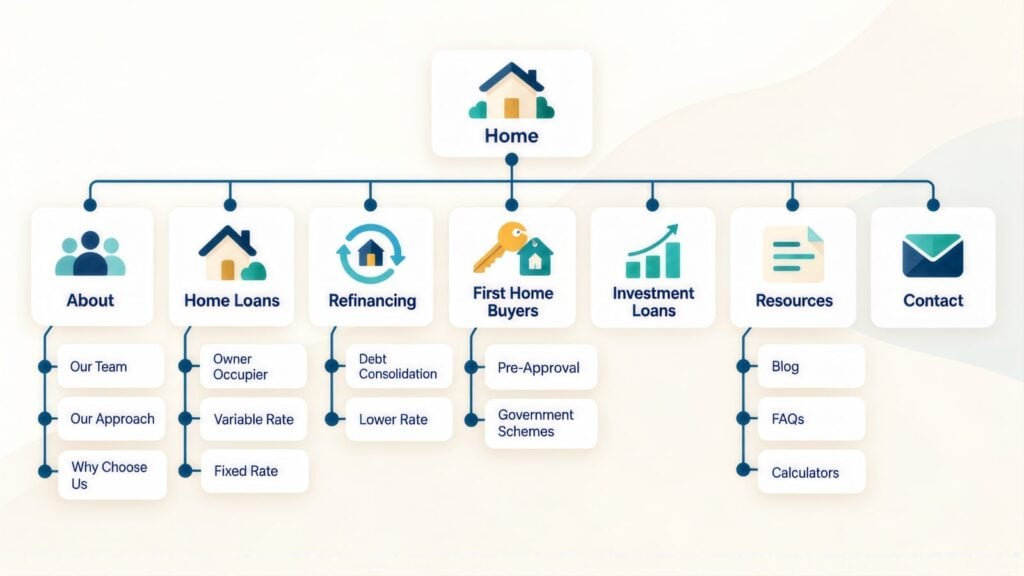
The way your pages link to each other affects how ranking strength passes through the site and how clearly Google understands your services. Many broker sites give it little thought.
Your main service page, such as “Mortgage Broker Sydney”, links to the first home buyer, refinancing, investment and main location pages. Each of those pages links back to it. Related pages link to each other where a borrower has a real reason to move between them, such as refinancing and investment property. Every blog article should link to at least one service page inside the text rather than only as a footer button. An article on borrowing capacity might link to your main broker page or your self-employed page, depending on who it is for.
Vary the words you link with, and make each link describe the page it leads to; this guide to anchor text shows what works and what to avoid. Two to five internal links on a page is a fair target, as long as each one goes somewhere the reader would want to go next.
Some examples of link wording for each page:
- Refinancing page: instead of “refinancing”, use “review your current home loan”, “compare lenders before refixing” or “switching lenders”.
- First home buyers page: instead of “first home buyers”, use “plan your first purchase”, “check your grant eligibility” or “first home loans Sydney”.
- Location page: instead of “Penrith”, use “home loans in Western Sydney”, “our Penrith clients” or “mortgage broker Penrith”.
- About page: instead of “About us”, use “our ASIC-licensed team”, “our broker credentials” or “how we work with lenders”.
What to write about
The questions borrowers type into Google before calling a broker are an underused source of content. Write answers to the questions your clients ask you most often. If several clients ask whether FHSS funds can be used for a property held in trust, publish a clear answer with the conditions and limits. That answer is worth more to a borrower than a summary of the latest RBA decision. Topics that work well include:
- Borrowing capacity: how lenders work it out, what reduces it and how to improve it before applying.
- First home buyers: the First Home Guarantee explained, FHSS eligibility, stamp duty concessions by state, and approval to settlement.
- Refinancing: when refinancing costs more than it saves, and how break costs work.
- Borrower scenarios: casual workers, a new job, loans after bankruptcy, and low doc options for the self-employed.
- Market and process: how cash rate changes reach variable rates, fixed versus variable now, pre-approval versus formal approval, and lender valuations.
Every article needs the author’s name and credentials and a publication date. Check it against current ASIC guidance, and link to at least one service page within the text. Cover the edge cases and the answers that depend on each borrower’s situation, because that detail is what a good broker brings. One well-researched article every two weeks will do more than four rushed ones in a week. A blog whose last post is 18 months old suggests to borrowers that the site is not maintained. Check the “People Also Ask” box for your main terms to see which client questions people already search.
Mortgage Broker Marketing in AI Search
Borrowers now ask AI Overviews, ChatGPT and other assistants questions such as “do I need a broker to refinance?”. Google says pages need no special work to appear in AI Overviews. They only need to be indexed and able to show with a snippet, according to its AI features guidance. On a finance topic, an AI tool can safely quote pages with a named, licensed author, current figures with sources, and direct answers near the top.
In CCM’s captures, AI Overviews cited broker pages on how brokers are paid but no broker on refinance home loan (see the research section above). Generic topics, such as how offset accounts work, are easy for an AI answer to summarise. Local answers for specific situations are much harder to replace. Examples include which lenders accept casual income after three months and what first home buyer support applies in your state this year. Another is how long a refinance takes with the lenders you use. A broker is best placed to write that content, and it is the content that brings enquiries.
In practice, answer one borrower question per article, and put the answer in the first two sentences. Keep your licence details, lender panel size and service areas the same across your site, Business Profile and directory listings. After that, check which of your pages AI answers already cite, which is the first step in AI search optimisation.
Google Ads: Setup, Compliance and What to Get Right First
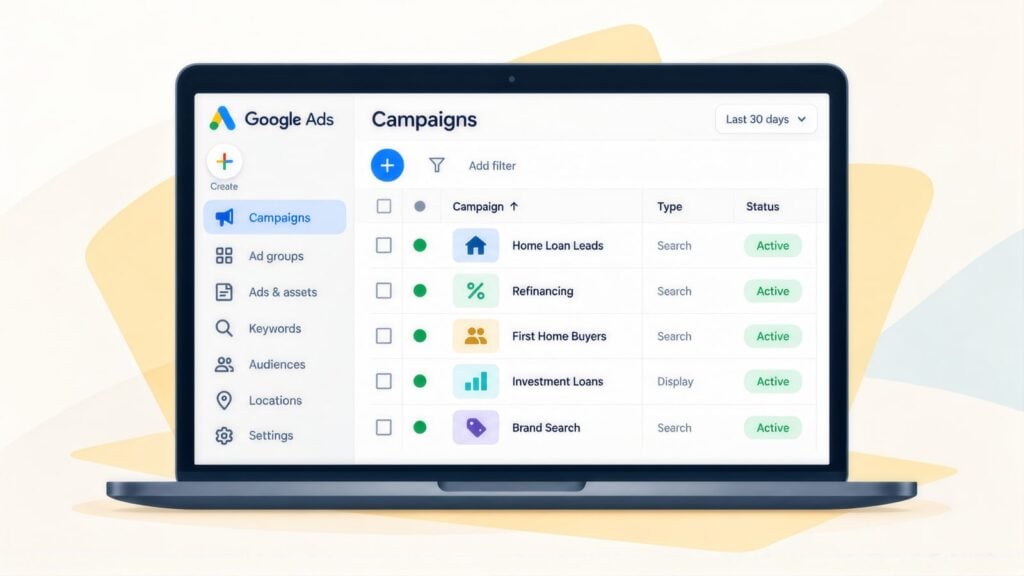
Google Ads can bring in qualified mortgage enquiries from day one, although advertising financial services in Australia involves verification and compliance steps that are best finished before you spend anything.
Financial services verification
Google’s Australian financial services verification applies to anyone promoting financial products and services, brokers included. It requires proof of ASIC licensing, and without it loan ads can be restricted or disapproved. Start before you build campaigns, because it can take several weeks. You do it in the advertiser verification section of your Google Ads account. You will need your credit licence number or representative arrangement, and documents confirming you are authorised to engage in credit activities.
Google updates its financial services policies from time to time. Some restrictions differ between Search, Performance Max and display ads. Check the current policy before you launch any loan or mortgage campaign. At the time of writing, Australian advertisers need financial services verification.
Campaign settings
| Setting | What a broker should choose |
|---|---|
| First campaign | A Search campaign, because its reports show exactly which searches triggered your ads, which Performance Max does not. |
| Location targeting | Presence, meaning people who are in your area rather than people who are only interested in it. You cannot settle a loan for someone in Melbourne who is researching a move to Sydney. |
| Ad schedule | The hours when someone can actually call the borrower back. |
| Budget | An amount you can keep up for at least 60 days, so the campaign has data to learn from. |
| Bidding | Start with manual bids, where you set the most you will pay per click, or Maximise clicks. Once you have at least 30 genuine enquiries recorded, move to target cost per acquisition, where Google bids to hit a cost per enquiry you choose. |
Start with one campaign, one area and one goal. Running every service and suburb on day one spreads the budget too thin to learn anything. The first campaign should show which searches bring real enquiries, what a qualified lead costs and whether your landing page works.
Check your advertiser verification status in Google Ads, and start financial services verification if it is not complete. Confirm you hold administrator access on your own account, rather than only standard access through your agency’s manager account. Make sure conversion tracking is live and tested.
Own your Google Ads account. Link your agency as a manager, keep billing and campaign data in your name, and confirm your own admin access before anything goes live. If you change agencies, you need your account history, conversion data and campaign structure intact. If an agency already runs it, a Google Ads account audit is a sensible first check.
Keywords, Negatives and Ad Copy
Start with a tight set of keywords from people ready to talk to a broker. Widen the list only once those terms bring qualified enquiries at a cost a settled loan can carry.
| Intent level | Example keywords | Decision |
|---|---|---|
| High (ready for a broker) | “mortgage broker “, “home loan broker near me”, “find a mortgage broker” | Make these your core ad groups. |
| Medium (research) | “how much can I borrow”, “should I use a mortgage broker” | Better suited to articles; only bid if your budget already covers the core terms. |
| Unsuitable | “mortgage broker jobs”, “broker salary”, “mortgage broker course” | Add as negative keywords before launch, so your ads never show for them. |
| Lender-specific | “ANZ mortgage”, “CBA home loan rates” | Exclude them, because these people want the lender directly. |
Before launch, add these as negatives: jobs, salary, career, training, course, licence application, login, internet banking, rate tables, today’s rates, compare rates, and any lender brands you do not want to appear beside. Review the search terms report weekly for the first 60 days.
What broker ads can and cannot say
Broker ad copy must meet the ACCC’s rules on misleading claims, ASIC’s RG 234 on advertising credit and Google’s financial services policies. Together they set five limits on what a broker ad can say:
- Do not promise loan approval. Guaranteed home loan approval is not compliant and will be disapproved.
- Do not state interest rates in headlines without a comparison rate and the required conditions.
- Do not claim access to the whole market unless your lender panel covers it.
- Do not suggest your service is always free if a fee applies in some cases.
- Do not use a competitor’s brand name in ad copy without legal sign-off.
That still leaves plenty to work with: lender panel size, your process, response time, fee structure and the borrower situation the ad speaks to.
| Ad component | Example |
|---|---|
| Headline 1 | Mortgage Broker [Suburb] |
| Headline 2 | Compare 40+ Lenders for Free |
| Headline 3 | Book a Free 30-Min Call |
| Description 1 | We compare home loans from 40+ lenders for your situation. Evenings and weekends. |
| Description 2 | First home buyers, refinancers and investors. Tell us your goal. Book a free call. |
Landing Pages That Convert

A landing page is where someone arrives after clicking your ad. A custom landing page built for the ad converts more clicks into enquiries. A generic homepage, or a page that does not match the ad, loses most visitors before they make contact. Build one page per campaign theme, such as first home buyers or refinancing, rather than sending every ad to the same place. Each one should include:
- A headline that matches the ad. If the ad says “First Home Buyer Broker Sydney”, the page confirms it is for a Sydney first home buyer.
- A plain explanation of how the first conversation works and what happens after an enquiry.
- How you are paid. For example: “We are paid by lenders when your loan settles. In most cases there is no fee to you. Where a fee applies, we will tell you before you engage.”
- ASIC licence details on the page as well as in the footer, for compliance and trust.
- Your lender panel size, or at least a plain statement of the range of lenders you can access.
- Social proof: Google reviews, a star rating or testimonials used with permission. Both the count and the rating matter.
- A short form (name, phone, what they need), a phone number people can tap and, ideally, a callback option.
A plain statement of how you are paid answers that question before the first call, and keeps the page compliant.
Before launch, test the page on a phone. Check that the form sends on iOS and Android, that the phone number can be tapped and that the page loads quickly on a mobile connection.
Conversion Tracking: From Click to Settled Loan
Form sends and call clicks are the easy part to track. A conversion is simply an action you count as a result, such as an enquiry. The later stages show whether the spend works: which enquiries became qualified discussions, which became applications and which settled. Record each stage in your CRM against the original source, so you can trace a settled loan back to the search that started it.
| Stage | What to record | Why it matters |
|---|---|---|
| Enquiry received | Form, call or chat, plus the date, source, ad and keyword | Shows volume only, since many enquiries go no further. |
| Qualified discussion | A borrower in scope and engaged, plus the date and service type | Once you have enough of these, use them to guide Google’s automated bidding. |
| Application lodged | Lodged with a lender, plus the date and product type | Shows the borrower is serious. |
| Settled loan | Settlement date, loan value, commission and source channel | Shows whether the budget is profitable. |
| Later adjustments | Clawbacks, trail changes and repeat business | Worth checking in a yearly review. |
Track forms with Google Ads conversion tracking, or import Google Analytics 4 (GA4) key events into Google Ads. A key event is GA4’s name for an action you mark as important. Careful GA4 and GTM setup makes matching to your CRM easier later. A call click is not a completed call. Use call tracking software (CallRail, WhatConverts or similar) to record which calls connected and how long they lasted. Set a minimum call length to stand in for a genuine enquiry, and check the results against your CRM each month.
Count each enquiry once, so a borrower who fills in a form and then calls counts as one enquiry. In Google Ads, set your enquiry conversions to count “one” per ad click rather than “every”, so two actions after the same click count as a single lead. Remove duplicate contacts in your CRM by phone and email too. Before any campaign goes live, send a test form and call your own number. Confirm both show up in Google Ads. If they do not, fix the tracking before launch, because a campaign you cannot track cannot be judged or improved.
Cost per settled loan is the figure to watch. These illustrative figures, not campaign results, show how it works out:
| Step | Number |
|---|---|
| You spend | $4,000 |
| You receive | 50 enquiries |
| You qualify | 20 of them |
| You settle | 8 loans |
| Each settled loan costs | $500 |
Whether $500 is profitable depends on your average commission and clawback rate for that loan type. Label estimates as estimates until real results replace them.
A Quarterly Plan for a Broker’s First Year
Google Ads can bring enquiries in the first week, while SEO is slower. A new suburb page usually shows early traction in three to four months and bigger gains by six to nine months, longer in busy markets, as the FAQ timeline below explains. Plan the year in quarters, and end each quarter with one number that decides what happens next.
| Quarter | Focus | Tasks | Measure at quarter end |
|---|---|---|---|
| Q1 | Foundations and verification | Set up Google Search Console and your Business Profile. Put licence details on every page. Test conversion and call tracking. Start financial services verification. Rewrite the main service and refinancing pages. Ask recent settled clients for reviews. | Pages indexed, tracking working, verification complete |
| Q2 | Launch and local pages | Launch the first Search campaign for one area and one service. Publish three location pages and two borrower articles a month. Review search terms weekly. | Cost per qualified enquiry |
| Q3 | Prove settlement value | Match enquiries to settlements in the CRM. Improve the landing page. Add location pages where views in Google are growing. Start asking local media and your aggregator for links. | Cost per settled loan |
| Q4 | Expand what works | Add a second area or loan type in Ads. Build city pages if you serve more than one capital. Refresh articles with new ABS and MFAA figures. | Organic enquiries, and settled loans by channel |
If the Q2 cost per qualified enquiry is far above what a settled loan can carry, fix the landing page and keywords in Q3 before adding a second area. If it is well below, bring the Q4 expansion forward. Review the result with your loan writers at the end of each quarter, because they know which enquiries actually settled.
Mortgage Broker SEO and Google Ads: Your Questions Answered
How long does SEO take for a mortgage broker?
It depends on where you compete, because suburb pages in areas with few broker sites rank fastest. A term like mortgage broker Sydney puts you up against aggregators and national groups for much longer. Pages waiting on your licensee’s compliance sign-off also add time before anything is live. Across businesses in general, expect early traction in months three to four and significant gains in months six to nine. Results then keep building from about the twelfth month.
What does SEO cost for a mortgage broker?
Cost depends on how many areas you cover and how much compliance work each page needs. Each suburb and loan type needs its own page, and each page needs licence details and a check by your credit licensee. Capital-city suburbs are also contested by aggregators and franchise groups. Agency retainers range from $1,500 to $10,000+ a month. A full-time in-house specialist costs $80,000 to $170,000+ a year with tools and training, according to this comparison of agency and in-house SEO. Put your average commission into the SEO ROI calculator to see how many settled loans would cover the spend.
What are effective marketing ideas for mortgage brokers?
The best ones reach borrowers at the point of choosing a broker. That means a suburb page for each area you serve, a refinancing page, a complete Google Business Profile with steady reviews and a tightly targeted Search campaign. Referral partners such as real estate agents and accountants add to that base, as do articles that answer your clients’ real questions.
What do Google Ads clicks cost for mortgage broker searches?
Top-of-page bids for mortgage broker run from about $7.11 to $23.68 in Australia, and for mortgage broker near me from $6.66 to $26.29. Refinance home loan costs more, at $7.40 to $33.64. These bid ranges come from CCM’s Keyword Planner pull of 1 October 2026, which is separate from the search volumes in Keyword Clusters That Drive Enquiries. The actual cost of each click changes with your bid, how relevant your ad is and how many lenders and brokers are in the auction at that moment.
Is $20 a day enough for Google Ads as a broker?
It is enough to test one suburb but not to cover a city. As an illustration, at top-of-page bids of $6.66 to $33.64, $20 a day buys at most three clicks, and on some days less than one. Google can spend up to twice your daily budget on a busy day, but no more than 30.4 times it in a month, under its daily budget rules. Whatever the amount, keep the budget running for at least 60 days before you judge it.
Do mortgage brokers need Google’s financial services verification?
Yes. Google requires Australian advertisers promoting financial products and services, brokers included, to be verified. That means proving you are licensed by ASIC and that your business details match ASIC’s records. Start it before you build campaigns, because it can take several weeks.
Will mortgage brokers be replaced by AI?
There is no sign of it yet, since brokers wrote a record 81% of new home loans in the March 2026 quarter. Brokers also carry a best interests duty under the National Consumer Credit Protection Act, which ASIC explains in RG 273. AI is changing where borrowers research, which puts more weight on pages where a named, licensed broker gives clear and accurate answers.
Do AI Overviews change SEO for mortgage brokers?
The method stays the same, because Google’s position (see Mortgage Broker Marketing in AI Search) is that no special work is needed beyond being indexed and able to show a snippet. For a broker, that means current figures with sources, licence details on the page and an author borrowers can check.
Andrei Jach is Senior Manager, SEO and Analytics Specialist at Click Click Media in Sydney and brings over 15 years of experience in digital marketing and strategy. He has led SEO across professional services, health, retail and manufacturing, and oversees strategic SEO planning, analytics implementation and technical audits. His earlier roles were at Agent 6 Marketing and Red Propaganda.
Implement this playbook with AI
Opens your assistant with this playbook and seven questions about your business: services, area, website and ads. It then writes your keyword map, page plan and Google Ads starter build with your details filled in.
Copy the prompt for Gemini, Grok or any assistant that cannot open a prefilled link. The prompt points at this page, which is also served as Markdown to assistants that ask for it.
Work with Click Click Media
Brokers now write four in every five new home loans, so most borrowers are choosing which broker to use. That choice often begins with a suburb search and a look at the reviews.
Our free broker audit looks at your website, your Business Profile and, if you run one, your Google Ads account. It checks your credit licence disclosure and where your financial services verification stands. It ends with a short list of fixes in priority order.
Click Click Media has been helping Australian businesses since 2008 with SEO services and Google Ads management, and holds Google Premier Partner status. The more than $115 million in Google Ads spend we have managed includes lenders and other financial services clients. They work under the same verification and disclosure rules as brokers. There is no lock-in contract, and a senior strategist handles your account directly.
Verified Sources and References
- MFAA / Cotality Quarterly Market Share Report (March 2026)
- ABS Lending Indicators, March quarter 2026
- ABS Lending Indicators, December quarter 2025
- Australian Banking Association: Record number of Australians refinancing (ABS data)
- ASIC: Regulatory Guide 234, advertising financial products and services
- ASIC: Regulatory Guide 273, mortgage brokers' best interests duty
- ASIC credit licensing
- Google Ads: Australian financial services verification
- Google Ads financial services policies
- Google Business Profile Help: How Google determines local ranking
- Google Search Central: Documentation updates (FAQ rich results deprecated 7 May 2026)
- Google Search Central: Review snippet guidelines (self-serving reviews)
- Google Search Central: AI features and your website
- Google Ads Help: About average daily budgets
- ACCC: False or misleading claims
- Click Click Media: Custom landing page design (LendInsure result)
- Click Click Media: SME Money launch case study
Last checked October 2026 · next review January 2027
