

Written by Andrei Jach, Senior Manager, SEO and Analytics Specialist at Click Click Media · Updated 1 October 2026
In 2025-26, 205,249 dwellings were approved for construction in Australia, 9.2% more than the year before and the highest total since 2020-21. That means plenty of homeowners need a qualified builder.
SEO for builders is harder than for most local services, because choosing a builder is a slow decision. The choice will shape a homeowner’s home, finances and daily life for the whole build, so most research for a long time and need to trust a builder before they pick up the phone.
Homeowners shortlist the sites that let them check a licence number, see finished homes like theirs and get a straight answer on budget. This guide follows the homeowner through the three stages of that long sales cycle: awareness, consideration and contract. It shows what SEO for builders, construction SEO and Google Ads each need to do at every stage.
Implement this playbook with AI
Opens your assistant with this playbook and seven questions about your business: services, area, website and ads. It then writes your keyword map, page plan and Google Ads starter build with your details filled in.
Copy the prompt for Gemini, Grok or any assistant that cannot open a prefilled link. The prompt points at this page, which is also served as Markdown to assistants that ask for it.
What the Search and Ad Data Shows for Builders
In CCM’s analysis of Semrush ad history for four builder searches, from monthly snapshots between September 2025 and August 2026, none of the 20 builder and renovator advertisers showed a licence number or mentioned home warranty insurance, and only one said it was licensed and insured. Only one of the 20 offered a free consultation or free quote in its ad text. Homeowners check licences before they shortlist a builder, so an ad that names your licence and your home warranty cover answers that question before they click. The records hold no conversion data, so test the message rather than assuming it will work.
Source: CCM analysis of Semrush ad history, September 2025 to August 2026
In CCM’s four captures of three searches for home builders in Sydney on 3 September 2026, 31 of the 34 top-10 organic results held by building businesses were the business’s home page rather than a service or location page. Because most ranking builders rely on the home page, make sure yours names the project types you build and the areas you build in, then add project-type pages for the work you most want.
Source: CCM search captures, Sydney and Australia, 3 September 2026
Across eight captures of seven builder searches CCM made the same day, Google showed an AI Overview on 5 and a map pack on 3, and never both on the same page. The three map packs were all on home builder searches, while builders sydney and the cost, how-to and marketing searches showed an AI Overview instead. A homeowner searching for a home builder sees the map results first, so a complete Google Business Profile matters for those searches, while cost and process questions call for guides that answer them clearly.
Source: CCM search captures, Sydney and Australia, 3 September 2026
CCM made eight Google captures of seven searches on 3 September 2026 (Sydney time): home builders sydney Australia-wide on desktop and in Sydney on mobile, and custom home builders sydney, builders sydney, how much does it cost to build a house, how to choose a builder, marketing for builders and construction marketing Australia-wide on desktop. The home page count uses the four captures of home builders sydney, custom home builders sydney and builders sydney, and a home page was a result that pointed to the main address of the site with no further path. The ad finding comes from CCM’s analysis of Semrush ad history for the Australian database, using monthly snapshots taken on the 15th from September 2025 to August 2026, on builders near me, home builders, home builders sydney and builders sydney: 39 ad records (one advertiser’s ad in one monthly snapshot) holding 26 distinct ads from 21 advertisers. The lead marketplace Oneflare was left out of the 20 builder and renovator advertisers, and because the Semrush database is national, the 20 include builders outside Sydney.
Awareness: How Homeowners Search for a Builder
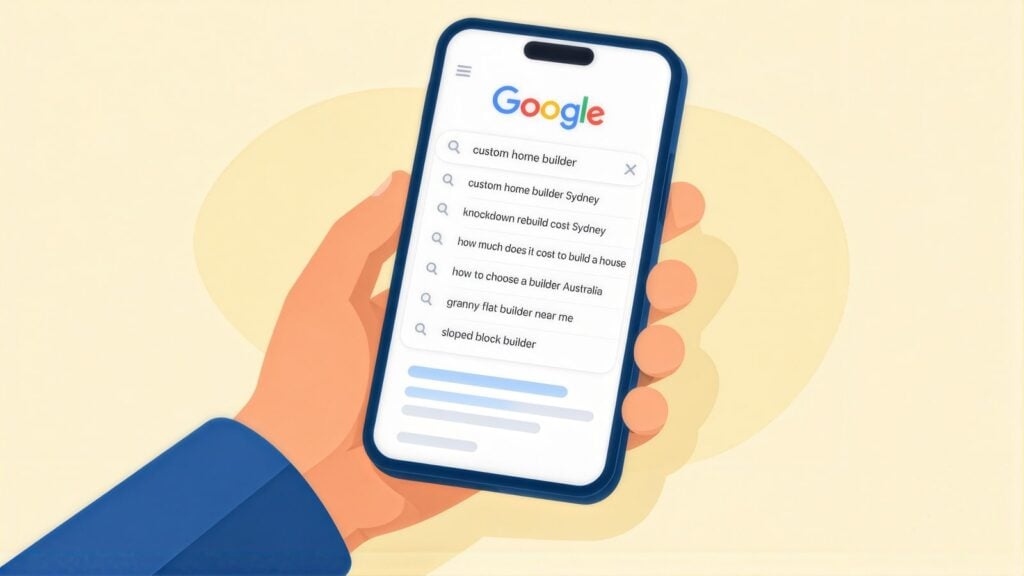
Approvals are at their highest since 2020-21 (see the figures above), so the pool of potential clients is large. Renovation work runs alongside new builds. For builders, the main difficulty in search is the length of the decision.
A homeowner who types custom home builder Sydney is usually starting weeks or months of research rather than calling within the hour. Over that time they read articles, study portfolio photos, check licences, collect quotes and draw up a shortlist. The builders who appear throughout that process, look credible at each step and make the first conversation feel safe are the ones who end up on it.
Someone weighing a custom build or knockdown rebuild may research for months before asking for a meeting. Your website has to serve them the whole way. Early articles reach them during research by explaining what the build process involves, how budgets work and what licences a builder should hold. Portfolio and project pages build a preference for you, and service and contact pages turn that preference into an enquiry. This guide covers awareness in the three sections starting with Awareness: How Homeowners Search for a Builder, consideration in the seven sections starting with Consideration: Licences, Insurance and E-E-A-T for Builders, and the contract stage in the five sections starting with Contract: Google Ads Setup for Builders.
Builder and Construction SEO Keywords by Project Type and Stage
Sort your keywords by project type, by area and by how far along the homeowner is. This works whether you call yourself a builder, a construction company or a contractor, because only the search words change. A search for how much does it cost to build a house sits at a very different point from custom home builder . Both people could become clients, but they need different content.
Builder Discovery
custom home builder [city]
builder [suburb]
residential builder near me
home builder [area]
Project Type
knockdown rebuild [city]
renovation builder [suburb]
granny flat builder [area]
second storey addition [city]
Budget Research
how much does it cost to build a house
custom home build cost per m2
knockdown rebuild cost Sydney
renovation cost calculator Australia
Process Research
how to choose a builder Australia
what to look for in a builder
how long does a house build take
builder licence check NSW
Specialist Build
acreage home builder [state]
sloped block builder [city]
dual occupancy builder [suburb]
owner builder assistance [area]
Region-specific
builder [specific suburb]
home builder [council area]
new home builder [postcode area]
local builder [region]
Why the research-phase clusters matter most for builders
Budget and process searches behave differently from searches for a builder. Someone asking what a house costs to build in Sydney is usually months from signing. A builder who gives them a clear, honest answer now has a better chance of being on their list when they ask for quotes.
Approval patterns vary a lot by state. NSW and Victoria lead on volume, while Queensland, South Australia and Western Australia each behave differently. Licensing is state-based too: QBCC licensing in Queensland, domestic builder registration in Victoria and a NSW Fair Trading contractor licence in NSW. If you build in more than one state, write separate content for each state on licensing, contracts and process rather than one general page.
- Pick the three to five project types that bring in most of your profitable work.
- For each one, check the words people use when they research it in your area. Use Google Search Console if your site already gets traffic, or Google Keyword Planner if you are starting fresh.
- Match each search term to a page with a keyword and meta planner.
- Make those project types your first content and landing page priorities.
Research-Phase Content That Wins the Shortlist
A homeowner six months away from asking for quotes is already searching. They compare approaches, try to understand costs, read about planning rules and decide which builders seem trustworthy. Content for this phase reaches them before the formal quote process starts.
Hi-Craft Home Improvements builds patios, pergolas, decks and carports around Penrith and the Blue Mountains. Its organic sessions grew from 4,330 to 8,175 between 1 July and 25 November, +88.8% year on year (2025 vs 2024). The Hi-Craft SEO case study has the detail. CCM’s client results page adds that sustained digital marketing grew it from under 1,000 to over 2,500 leads a year. Project pages and research articles for bigger builds can bring in enquiries in the same way over many months.
| Topic | Example articles |
|---|---|
| Cost transparency | What drives custom home build costs in NSW. Why two similar-looking houses can cost very different amounts. What prime cost items and provisional sums mean in a building contract. |
| Process explainers | The stages of a custom build, from design brief to handing over the keys. What council approval involves and how long it takes. The building inspection stages. |
| Project type guidance | Knockdown rebuild or renovation: which suits your block? What makes a site suitable for a second storey. The council zone rules for a granny flat in . |
| Credential guidance | What to check before you sign with a builder in NSW. How to read a builder’s licence on the Fair Trading register. What home building compensation covers and when it applies. |
| Material and design | The difference between project homes and custom builds. How to write a brief clear enough for accurate quotes. Energy efficiency rules for new homes. |
Content standards for building articles
Costs change, and so do state planning rules, building code requirements and council overlays. Any article with costs, council rules or regulations needs a publication date and a review at least once a year. A 2022 article on NSW building rules that nobody has updated can mislead a homeowner who relies on it and create a liability for you.
Put a named author on every article, with their licence number or project role, so readers can see the content comes from someone who builds.
Progress content and local partners
Homeowners who research for months like to see work in progress as well as finished homes. With the client’s permission, post short updates and videos at each build stage (slab, frame, lock-up, handover). Put them on the project page and your social channels.
Answers that AI Overviews can cite
Cost and process questions are where AI Overviews appear for builders. In CCM’s captures, Google showed an AI Overview on 5 of 8 captures across seven builder searches, including how much does it cost to build a house and how to choose a builder, while the home builder searches showed a map pack instead. Google’s guidance on AI features asks for nothing extra: a page must be indexed and eligible to show a snippet. A dated cost guide or process article that answers the question in its first paragraph, signed by a named builder, gives the AI Overview something accurate to quote.
The architects, building designers and suppliers you work with are also good link partners. Write up a project they can link to from their own site, which earns you a relevant link and can bring referrals.
Consideration: Licences, Insurance and E-E-A-T for Builders
Once a homeowner has a shortlist, the second stage begins and they start checking each builder. They look up your licence, read your reviews, study your portfolio and compare how each builder explains cost. This section and the six that follow it, ending with Local SEO for Builders and Google Business Profile, are about passing that check.
After the land itself, a custom home or knockdown rebuild is usually the biggest financial commitment a homeowner makes. Google gives extra weight to trust on topics that could affect someone’s finances. It calls these Your Money or Your Life topics. Your site therefore needs to show real expertise through completed projects and named, licensed team members. It should also give realistic cost guidance with clear limits on scope, and show credentials people can check, such as your licence number, insurance and association membership. Google sums this up as E-E-A-T, and this explainer on how Google weighs E-E-A-T breaks it down.
Building is a licensed trade in every Australian state and territory, and home building contracts carry strong consumer protections. Before it does anything else, your website should prove that you are licensed, insured and accountable.
The credentials homeowners look for
- Builder licence. Home building work above certain values needs a licensed contractor in every state. Show your licence number, class and licensing body on your About, service and contact pages. In NSW it is the Fair Trading contractor licence, in Queensland the QBCC licence and in Victoria domestic builder registration. Name the right one for your state.
- Home Building Compensation (HBC) or its equivalent. In NSW and some other states, builders must take out home building compensation cover for home building work above a set value. It is also called home warranty insurance. It protects the homeowner if the builder goes broke or cannot finish the job. Explain on your service pages how your cover works, because some homeowners have never heard of it.
- Public liability and workers compensation. The rules vary by state and contract value, but both are standard for registered home builders. Say you hold current cover, but keep policy numbers off the site.
- Master Builders or HIA membership. Membership of Master Builders Australia or the Housing Industry Association is voluntary and signals a commitment to industry standards. Show the badges on your About page and in the footer, because homeowners recognise them.
- A portfolio of finished projects. Completed work is the proof homeowners can see for themselves. Use your own photos, accurate descriptions and client references (with permission). Add before-and-after shots where you have them, and describe each project: type, area, rough size and any tricky parts. Credit your role accurately, and do not imply you did work that subcontractors mostly did.
NSW homeowners can check a builder on the NSW licence register, and Queenslanders can search the QBCC. Every state has its own version. If your site shows no licence number, or one that is wrong or expired, you lose a careful homeowner at the exact moment they check. Show it accurately, with the right licensing body for your state.
Content credibility for building
You can also show expertise in writing. Explain why a sloped block changes the cost, when a knockdown rebuild suits a block better than a renovation, or how soil affects slab design. This kind of knowledge sets a credible builder apart from one competing on price, and it is what homeowners search for while they research.
The Pages Every Builder Site Needs
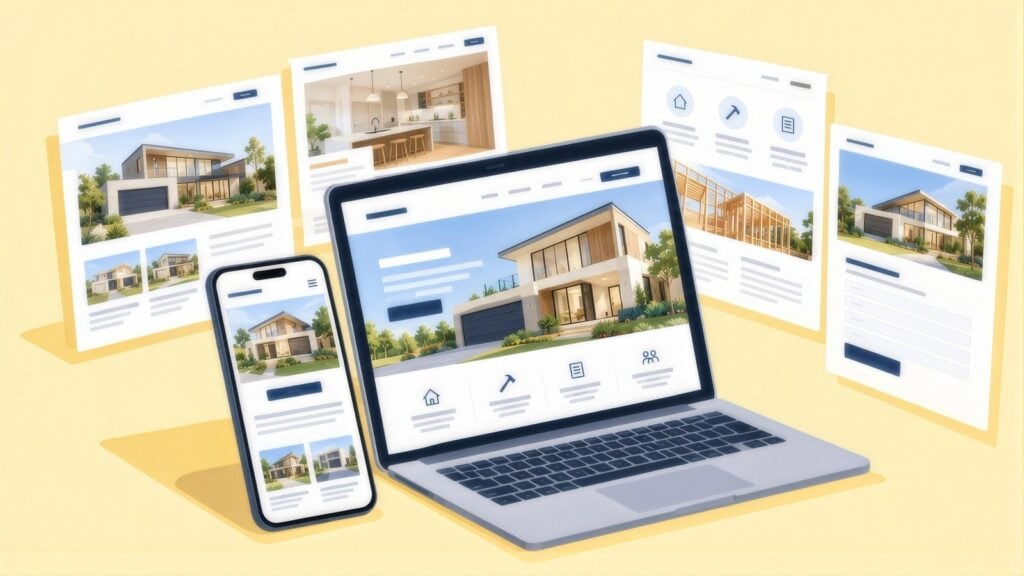
A builder site has to serve homeowners through early research, comparing projects, checking credentials and making an enquiry. Many sites only cover the last two. Covering research as well reaches people before they contact a builder.
Here is what each core page should cover:
- Custom homes or new builds (for “custom home builder [city]”): the project types you take on, how the build works and what drives the budget. Add your licence number, links to your portfolio, how the first consultation works, and FAQs.
- Knockdown rebuild (for “knockdown rebuild [city]”): which blocks suit it, the steps, what council approval involves, cost drivers, portfolio examples and FAQs.
- Renovations (for “renovation builder [city]”): the size of jobs you handle, planning permits, whether owners can live in the home during works, a cost range, the process and FAQs.
- Granny flats or dual occupancy (for “granny flat builder [area]”): which council zones allow them, design options, a cost range, the approval process, your portfolio and FAQs.
- Portfolio or gallery (for “[builder name] projects”): real photos, project descriptions (type, area, scope, tricky parts) and client quotes with permission.
- Cost guide (for “how much does it cost to build a house in “): cost per square metre ranges with their conditions and what makes costs vary. Say what is usually included or left out, and when to get a detailed quote.
- About or credentials (for “[builder name]” or “[business name] builder”): licence number and type, years in business, team size, projects completed, insurance and association memberships.
Searches like “how much does it cost to build a house in NSW” come from homeowners early in planning. Publish an honest, detailed cost guide that covers what makes costs vary, per-square-metre ranges for different build types and what headline prices usually leave out.
Location-specific pages
If you build across several council areas or regions, give each main one its own page rather than a template with the suburb name swapped in. Mention what you have built there, the local planning rules (such as council overlays or heritage controls) and your experience in the area. This detail helps the page rank and shows local homeowners you understand their situation.
Website Foundations for a Builder Site
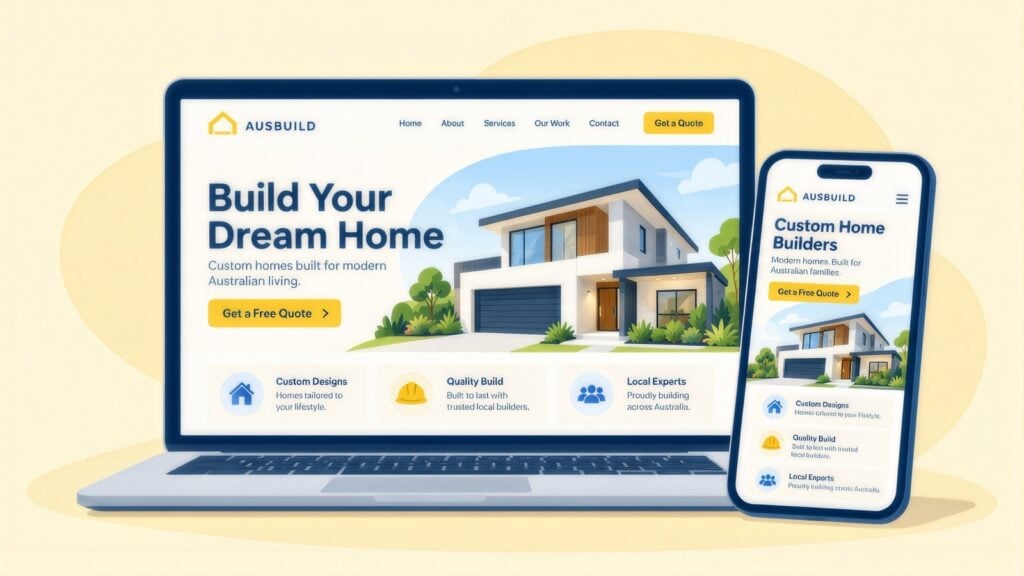
Builder websites often have two problems. First, they are heavy on images and light on words, and a portfolio cannot replace explanation. Second, they are rarely organised around how a homeowner actually makes a building decision. Fix both before you add more content.
Google Search Console and indexing
Google Search Console is a free tool that shows how Google sees your site. Connect your domain and submit your sitemap, the list of pages you want Google to find. A step-by-step guide to setting up Google Search Console covers each click. Then check your main service and project type pages, not just the portfolio, and confirm Google has indexed them.
Portfolio images and page speed
Large portfolio images are a common reason builder sites load slowly. Compress every image and use modern formats such as WebP. Set images further down the page to load only when the visitor scrolls to them, known as lazy loading. Test the site in Google PageSpeed Insights and fix anything rated “Poor“.
Mobile experience
Homeowners often research builders on their phone, sometimes standing on the block they want to build on. Your portfolio must display properly on a phone, your contact form must send, and your phone number must be tappable. Test the whole journey yourself.
Contact form and response process
Reply within a day or two, while the homeowner is still deciding who to call. Whatever form you use, check that enquiries reach the right inbox. Make one person responsible for replying, and make sure the reply sets out the next step.
Title Tags and Meta Descriptions for Project Pages
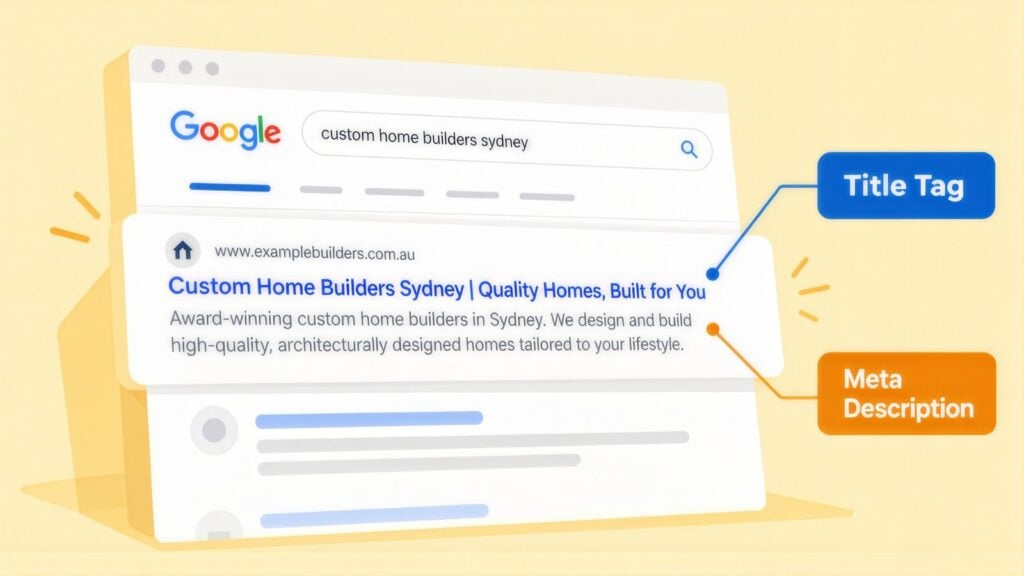
Your title tag is the blue headline in Google’s results, and the meta description is the short summary under it. Lead each title with the project type and the area you build in. Use the description to give homeowners a reason to click: your licence, completed projects or an honest cost guide. Only include a price the landing page can back up.
Title tag examples
A name like “[Surname] Constructions and Renovations” uses up much of a title, so these examples lead with the project type and area. Add the business name at the end only when the full title stays within 55 characters. Google usually shows your site name with the result, which is why the name goes first when space runs out.
| Page | Example title tag | Characters |
|---|---|---|
| Custom homes main | Custom Home Builder Sydney | Licensed and Insured | 49 |
| Knockdown rebuild | Knockdown Rebuild Sydney | [N] Projects Done | 44 |
| Renovations | Renovation Builder Sydney | Extensions and More | 47 |
| Granny flats | Granny Flat Builder [Area] | DA Assistance | 42 |
| Cost guide | Cost to Build a House in NSW | 2026 Guide | 41 |
| Location page | Builder [Suburb/Area] | Custom & Renovation | 43 |
Meta description examples
| Page | Example meta description | Characters |
|---|---|---|
| Custom homes | Custom home builder in Sydney, licensed and insured, with [N]+ homes built to your design and budget. View the portfolio and book a consultation. | 145 |
| Knockdown rebuild | Knockdown rebuild in Sydney managed from demolition to key handover by a licensed builder. See completed projects and request a feasibility chat. | 145 |
| Cost guide | Cost to build a house in NSW in 2026: honest per-m2 ranges, what drives the variation and what to check in builder quotes. Read the full cost guide. | 148 |
| Renovation | Renovation builder in Sydney for extensions, second storeys and whole-home renovations. Licensed, insured, [N]+ projects done. Book a free site visit. | 150 |
A “builds from $X” claim in a title or description sets an expectation the landing page must meet. If the price is buried in conditions, or only covers a narrow scope, trust drops and visitors leave. The ACCC’s rules on misleading claims apply to prices in search results as much as anywhere else. Only use a price if it is a genuine starting point for that project type. Be ready for the enquiries it will bring from budget-focused homeowners.
Schema Markup for Building Companies
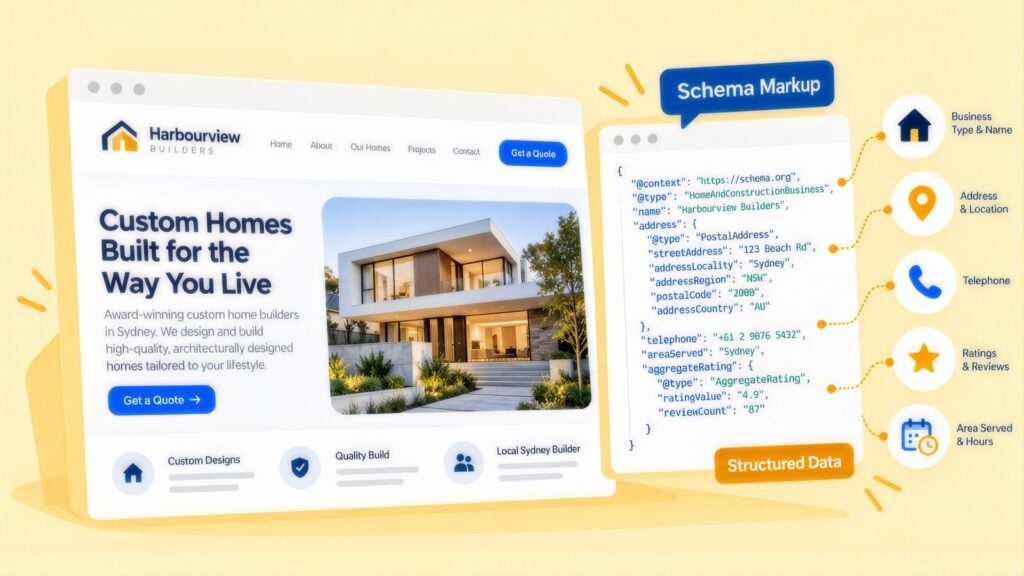
For a building company, the main schema type is GeneralContractor, code on the page that tells Google you are a building contractor, where you work and how to reach you. Mark up your guides as Articles. Add FAQ markup to pages with visible questions and answers.
| Schema type | Where to add it | What it does |
|---|---|---|
| GeneralContractor (a LocalBusiness type) | Homepage and service pages | Says you are a building contractor and gives your service area, hours and contact details in a form Google can read. |
| FAQPage | Service pages, cost guide and project type pages | Labels your questions and answers for search engines and AI tools (see the note on FAQ results below). |
| Article | Cost guides, process explainers and blog posts | States the author, date and type of content, which supports trust in your research articles. |
| BreadcrumbList | All pages below the homepage | Shows where the page sits in your site, such as Home > Services > Knockdown Rebuild. |
| ImageObject | Portfolio project pages | Describes your project photos, which helps them show in Google Images. |
FAQs worth answering on builder pages
Answer the questions homeowners ask most:
- how long the build takes
- how the price is set out and what it includes
- which licences and insurance you hold
- how progress payments work
- what happens with defects after handover
- what to bring to the first consultation
Questions like these often show up in Google’s “People Also Ask” box for builder searches. Answer them in the visible page text and mark them up, although no dropdown will appear under your listing. Google confined FAQ results to well-known government and health sites in August 2023 and ended them on 7 May 2026. The markup still flags each homeowner question and its answer for search engines and AI tools.
Linking Cost Guides, Projects and Portfolio Pages
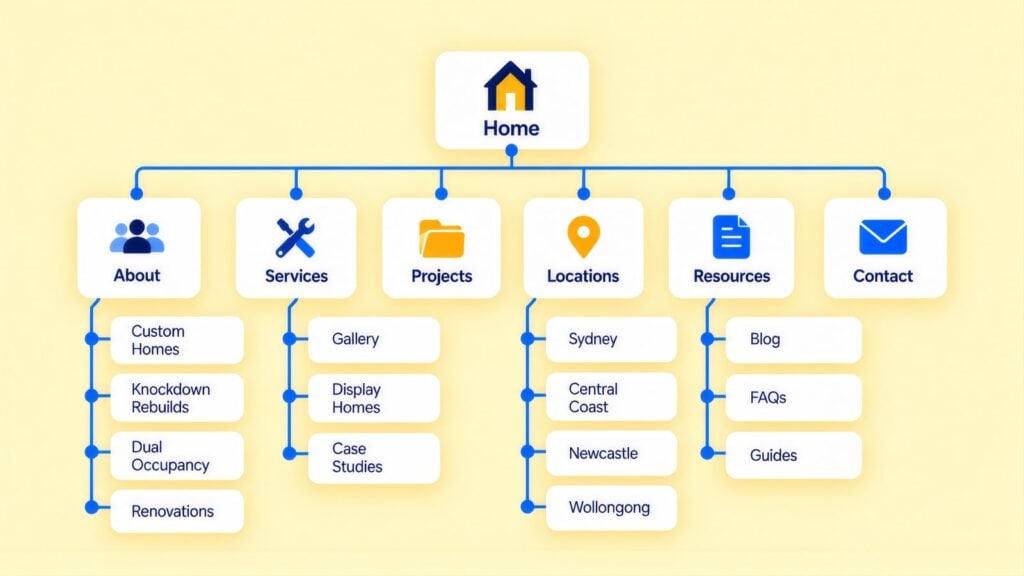
Links between your own pages carry a homeowner from early research to enquiry. Many builder sites link project types to each other but leave out the cost guides and process articles an early researcher needs.
Hub-and-spoke for builders
Your services overview is the hub of the site. Project type pages (custom homes, knockdown rebuilds, renovations, granny flats) are the main spokes. The cost guide, process article and About page are smaller spokes that support the decision. Portfolio pages sit under the project type they belong to. Every spoke links back to the hub, and the hub links to every spoke. Word each link so it names the page it leads to, which is called descriptive anchor text, as the examples below show.
| Destination page | Avoid | Use instead |
|---|---|---|
| Knockdown rebuild page | “knockdown rebuild” | “demolish and rebuild”, “our knockdown rebuild process”, “knockdown rebuild or renovation” |
| Cost guide | “our pricing” | “custom home costs in NSW”, “build costs before quotes”, “budgeting a knockdown rebuild” |
| Portfolio page | “our work” | “completed projects in “, “recent custom homes”, “ renovation examples” |
| About page | “About us” | “our building licence and credentials”, “the team behind your build”, “our licence and insurance” |
Local SEO for Builders and Google Business Profile
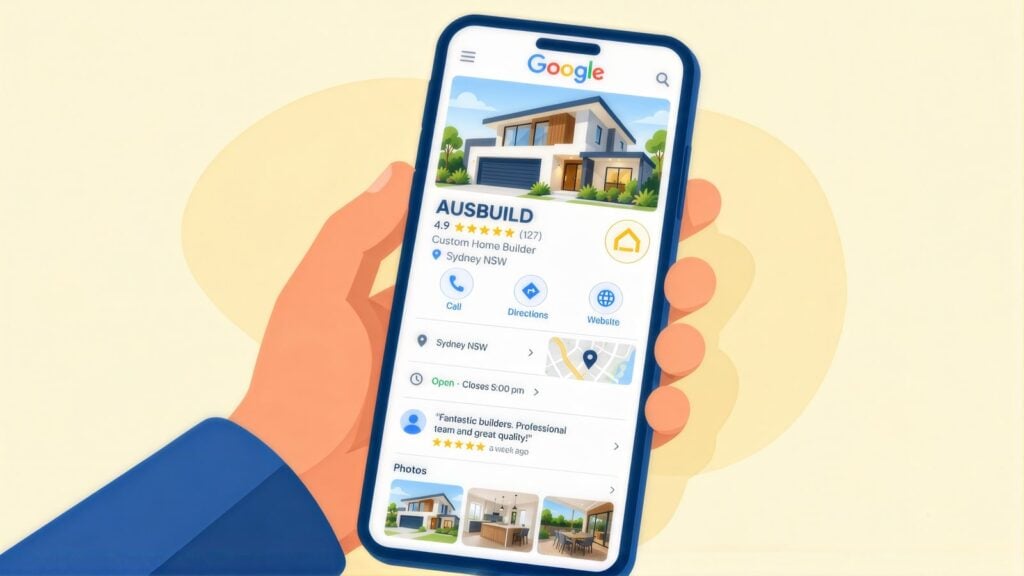
Google Business Profile does a different job for builders than for a workshop or a GP. Map results appear on home builder searches, and many homeowners also look a builder up by name before they call. Once they have your name, from search or a referral, the profile is one of the first things they check. They read the reviews, photos and details closely. A neglected profile with old photos and no reviews makes you look less credible than a builder who keeps theirs current. That is why local search work is still worth doing for builders.
Google Business Profile setup for builders
Use your exact trading name. Choose Home builder or General contractor as the main category, whichever matches most of your work. Add Renovation contractor or Addition contractor where they fit.
Most builders do not see clients at an office, so set the profile up as a service-area business. List the council areas you actually build in. Point the website link at your main project type page, such as the knockdown rebuild page if that is most of your work. Load 20 or more completed project photos, with before-and-after pairs where you have them. Add team photos that show safe site practice.
Reviews for builders
A review of a building project is long, detailed and believable in a way a one-line “great service” review is not. Handle them with care:
- Ask at handover, when the project is done and the client is happiest.
- Never reveal a client’s address, finances or project details when you reply to a public review.
- Take a complaint about a defect offline first. Reply in public with an acknowledgement and a direct contact rather than a detailed defence.
- Do not ask for reviews during a dispute, or before the defect liability period is resolved.
Contract: Google Ads Setup for Builders
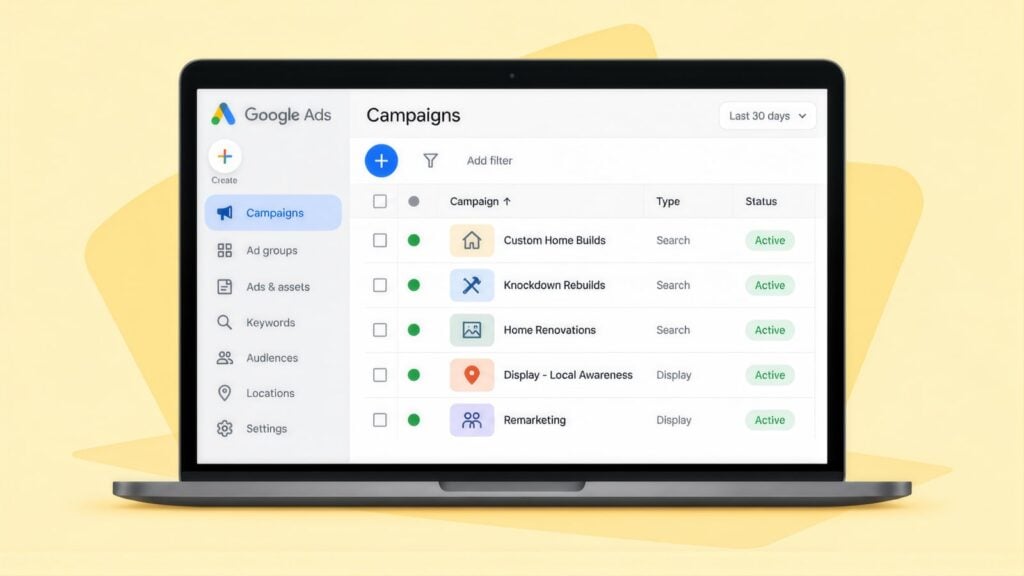
The third stage starts when a homeowner is ready to talk to builders, and this is where paid search is most useful. Google Ads can bring in good building enquiries at a manageable cost. The long decision cycle and high project value make setup, tracking and judging results harder than for a quick local service.
Campaign structure
| Setting | What we advise builders |
|---|---|
| Campaign type | Use Search ads split by project type, so a knockdown rebuild enquiry and a renovation enquiry each show their own cost. Hold back Performance Max (Google’s mostly automatic campaign type) until consultations are tracked. |
| Location targeting | Show ads only to people in the council areas, suburbs or regions you build in. Leave out places where you will not quote or build. At building industry click prices, spend on areas you do not serve adds up quickly. |
| Budget and evaluation period | Set a budget you can hold for at least 90 days. When the decision takes several months, judging the return after 30 days gives a misleading result. |
| Ad schedule | Homeowners often research in the evening. If you have an online enquiry form, run ads outside business hours too. If you rely only on phone calls, run ads only when someone can answer. |
| Bidding | Start by setting your own maximum cost per click (manual CPC), or by letting Google get the most clicks for your budget, with a careful cap on each click. Click costs vary by project type, and renovation searches reach the highest top-of-page bids (the ranges are in the FAQ on Google Ads costs). Raise bids on the searches that lead to consultations. |
The long decision cycle and its impact on reporting
A signed contract can land months after the first enquiry. Google Ads often counts results only within 30 days of the click, so its default reports can miss many contracts. You can set a conversion window of up to 90 days. Use the maximum for building enquiries. Where you can, import offline conversions, which means uploading signed contracts to Google Ads so it links them to the first click. Review campaigns each quarter.
Search Terms, Negatives and Ad Copy for Builders
Pay for searches that name a project type and a place, and leave cost and process research to your articles. Block job, training and game searches before launch. In your ads, state your licence and insurance and say what the first consultation involves.
Keyword selection
| Intent level | Example keywords | What to do |
|---|---|---|
| High (ready for a builder) | “custom home builder [city]”, “knockdown rebuild “, “renovation builder [area]” | Include these as your main terms. |
| Medium (still researching) | “how much to build a house”, “knockdown rebuild vs renovation” | Better served by articles than paid ads. If your cost guide is strong, these people will find it in organic search. |
| Low / unsuitable | “builder jobs”, “building apprenticeship”, “construction course”, “Minecraft house build” | Block these before launch, because they bring clicks from people who will never hire a builder. |
| Related services | “architect “, “building designer [area]” | Some homeowners at the design stage will also need a builder and can turn into good enquiries, so check each one. |
Negative keywords to add before launch
Negative keywords are searches you tell Google never to show your ads for. Start with: jobs, employment, vacancy, apprentice, course, degree, training, Minecraft, LEGO, game, software and project management software. Add commercial building terms if you only build homes. Check the search terms report weekly for the first 60 days and add what you find. A Google Ads audit checklist helps you catch the settings that waste budget.
Ad copy for builders
| Ad part | Example |
|---|---|
| Headline 1 | Custom Home Builder [City] |
| Headline 2 | Licensed and HBC Insured |
| Headline 3 | [N]+ Homes Completed |
| Headline 4 | Book a Free Site Consultation |
| Description 1 | Custom homes, knockdown rebuilds and extensions in [Region]. See our completed projects. |
| Description 2 | Clear scope and a quote process explained up front. Free first meeting, no obligation. |
Landing Pages and Portfolio Pages That Convert
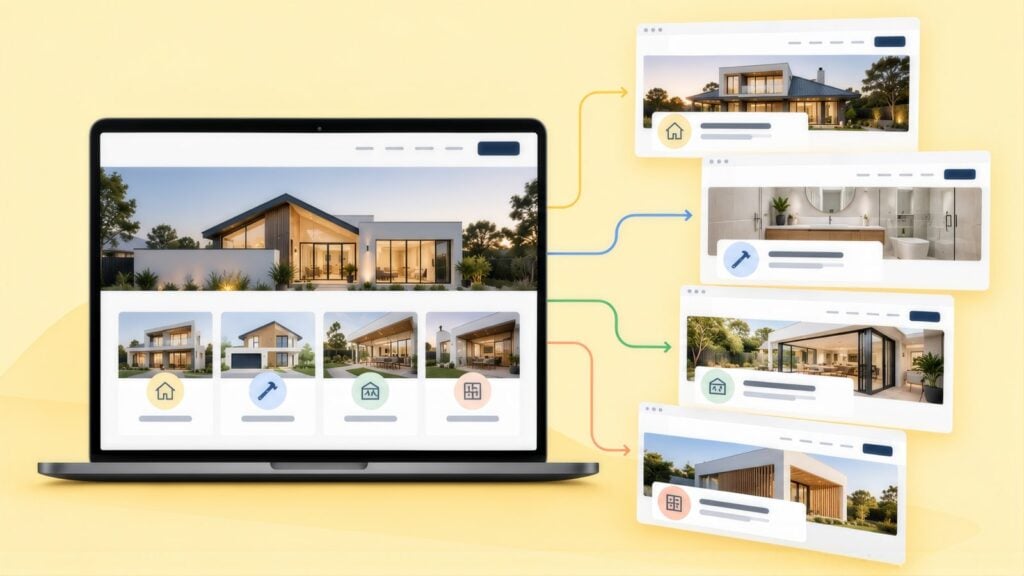
A builder’s landing page has to show quickly that you build this kind of project, that you are licensed and that the first conversation carries no risk. Portfolio pages back that up with well-described projects.
Service landing pages
Answer those three points near the top of the page. Purpose-built landing pages for each project type make that far easier than sending ad clicks to the homepage.
- Confirm the project type straight away. If the ad said “knockdown rebuild Sydney”, the headline should say the same.
- Show your licence number early, with the right licensing body for your state, rather than only in the footer.
- Show finished projects of the same type. Someone who clicked a knockdown rebuild ad wants to see knockdown rebuilds rather than your custom home gallery.
- Explain the first conversation: a site meeting or a phone call, what to bring or prepare, and that there is no cost or obligation at that stage.
- Keep the enquiry form short: name, phone, project type, suburb and a description box. Plans and detailed briefs come after the first conversation.
Portfolio pages
Each project page needs at least eight real photos: outside, inside, key features and any tricky design or building detail. Describe the project type and the area (suburb or council area, never the full address). Give the rough size (house size, storeys, main inclusions) and any notable challenge. Client quotes can go in with permission, as long as they talk about the process and result rather than money.
For knockdown rebuilds and renovations, a before-and-after pair shows the change in a way a single finished shot cannot. Placing a 1970s fibro house next to the modern home that replaced it on the same block helps a homeowner picture their own project. Use both images wherever you have permission, and label them clearly.
Brisbane Structural Repairs is a licensed builder in South East Queensland. It runs Google Ads to a single purpose-built landing page. Between September 2025 and March 2026, the campaign produced 393 leads at an average conversion rate of 16.01%. The page has an 18% all-time conversion rate. The Brisbane Structural Repairs case study shows how the page is built: the job named in the headline, licence and proof up front, and a short form.
Conversion Tracking: Enquiry to Signed Contract
A custom home contract usually runs to six or seven figures, so you need to know what each client cost to win. Without tracking, you cannot tell whether Google Ads, SEO, referrals or the cost guide sends the best leads. The first step is setting up Google Analytics 4 (GA4) and Google Tag Manager, the tool that installs tracking on your site. Getting the GA4 and Tag Manager setup right makes everything after it reliable.
| Stage | What to record | How to use it |
|---|---|---|
| Enquiry received | The form, call or email, with the project type, suburb, source and date. | Shows how many enquiries you get and where they come from. |
| Consultation held | The date of the site or phone meeting, and whether the project is viable and in scope. | Once you have enough of these, tell Google Ads to bid for more of them. |
| Quote submitted | The date the detailed quote or tender went out, with the project value and type. | Shows the value of work in your pipeline. |
| Contract signed | The signed contract’s value, type and location, linked to the source. | The result you use to work out your return. |
| Project completed | The handover date, the final value including variations, and how happy the client is. | Shows which clients bring referrals and good reviews over time. |
The share of quotes that become contracts varies widely across the industry. A lead who has been briefed on scope and budget before the quote is better placed to sign. Track the rate from consultation to quote, and from quote to contract, separately. If plenty of consultations become quotes but few quotes become contracts, look at your pricing or proposal. If few enquiries become consultations, look at your website or how fast you reply.
Months 1 to 6 for a Residential Builder: What to Do and What to Expect
A builder’s plan has to run longer than the usual 90 days. In this plan, contracts from your first enquiries are expected in months four to six. Here is how the first half-year tends to unfold.
Month 1: get found and pass the check
Connect Google Search Console and submit the sitemap. Complete the Google Business Profile with current project photos and an accurate service area. Put your licence number on the About and service pages, with the right state body named. Compress the portfolio images and test the enquiry form from start to finish. Make one person responsible for replying within 24 hours. Set up conversion tracking, so nothing after this point goes unmeasured.
Month 2: build the page that sells your main project type
Rewrite the page for the project type that earns you the most. Publish a cost guide for “cost to build a house in “, with visible FAQs on both pages. Write up three finished projects you have permission to show, with before-and-after photos where you have them.
Month 3: switch on paid search
Launch one Google Ads campaign for that project type in your main build region, with the conversion window set to 90 days. Review search terms weekly. Enquiries should start within weeks and consultations will follow, but do not expect a signed contract yet.
Month 4: feed the research phase
Publish two research articles on cost or process. Ask your last three handover clients for reviews. In Google Search Console, look for pages that people see in results but rarely click, and improve their titles and opening paragraphs.
Month 5: read the funnel
Work out the three conversion rates from Conversion Tracking: Enquiry to Signed Contract above for your first enquiries, and start fixing the weakest stage.
Month 6: judge the return and pick the next project type
The first contracts from month-three enquiries may be signing now, which makes this the first fair point to compare what each contract cost with what it is worth. Use the data to choose a second project type page and campaign. Set the same six-month expectation with your team before launch, so nobody switches the campaign off in month two.
SEO and Google Ads for Builders: Questions We Get Asked
How long does SEO take for a builder?
Builders need to allow for two timelines: how long SEO takes and how long homeowners take to decide. Project pages and a cost guide usually start ranking 3 to 4 months after they go live. In regions where established builders hold the top spots, it is closer to 6 to 9 months. Research articles added steadily keep building on each other past the first year. The homeowner’s own decision cycle (see Contract: Google Ads Setup for Builders above) adds to that, so judge SEO on good enquiries and consultations first, and on contracts as they land.
How much does SEO cost for a building company in Australia?
What a builder pays depends on scope, mainly how many project types and build regions need their own pages and how much portfolio and cost guide writing is involved. Working across states with different licensing rules adds work, as does a site in poor condition. Agency fees for that work run from $1,500 to over $10,000 a month in Australia. A dedicated in-house SEO costs $80,000 to $170,000-plus a year once salary, tools and training are counted, as this agency and in-house cost comparison sets out. A single signed contract is often worth six figures, so run your numbers through an SEO ROI calculator first.
What is SEO in construction?
It is the work of getting a builder or construction company found by people researching and commissioning building work. For home builders, that means project-type pages, an About page that leads with your licence, a cost guide, portfolio pages and a Google Business Profile. All of it is written for homeowners who research for months before they call.
What do Google Ads clicks cost for builders?
Expect anything from a few dollars to the high teens per click. In CCM’s Google Keyword Planner pull of 1 October 2026 (Australia), top-of-page bids for builders near me ran at about $3.70 to $13.40 a click. “Renovation builders” ran at about $3.80 to $17.25, “knockdown rebuild” at about $2.80 to $13.75 and “custom home builders” at about $2.80 to $11.90. CCM’s analysis of Keyword Planner data for the 12 months to July 2026 shows about 6,600 searches a month for builders near me. Set a budget you can hold for at least 90 days, for the reasons given in Contract: Google Ads Setup for Builders above.
Do Google Ads work for builders?
Yes, when you judge the campaign over a full decision cycle. Set the conversion window to the 90-day maximum, upload signed contracts as offline conversions where you can, and measure cost per consultation and cost per contract. Contract: Google Ads Setup for Builders covers the reporting setup.
Should builders use Facebook ads or Google Ads?
Start with Google Ads, then add Meta. Google Ads reaches homeowners already searching for a builder or a project type. Meta ads suit showing finished homes and build progress to local people who are not searching yet. They also reach past site visitors during their long research phase.
How should a builder talk about price without a fixed quote?
Publish ranges with the conditions that move them. A good cost guide gives per-square-metre ranges by build type, explains what makes costs vary and lists what headline prices usually leave out. That answers the question honestly without tying you to a figure. Any “from” price in an ad or title must be a genuine starting point the landing page can back up.
Should my builder licence number be on my website?
Yes, on your About, service and contact pages, with the licensing body for your state named. Homeowners check builders on registers such as the NSW licence check and the QBCC search, as the callout in Consideration: Licences, Insurance and E-E-A-T for Builders above describes.
Andrei Jach is Senior Manager, SEO and Analytics Specialist at Click Click Media in Sydney, and has spent over 15 years in digital marketing and strategy. He has led SEO across manufacturing, professional services, retail and health, and oversees strategic SEO planning, analytics implementation and technical audits for CCM clients. He previously worked at Agent 6 Marketing and Red Propaganda.
Implement this playbook with AI
Opens your assistant with this playbook and seven questions about your business: services, area, website and ads. It then writes your keyword map, page plan and Google Ads starter build with your details filled in.
Copy the prompt for Gemini, Grok or any assistant that cannot open a prefilled link. The prompt points at this page, which is also served as Markdown to assistants that ask for it.
Work with Click Click Media
Homeowners planning to build next autumn are reading cost guides and checking licence registers now. Builders whose sites answer their questions well are shortlisted before anyone asks for a quote.
Click Click Media is a Google Premier Partner and has managed over $115 million in Google Ads spend since 2008. For builders, we handle SEO for building companies through the research phase and run Google Ads campaigns measured on consultations and signed contracts. A free audit of your website, Google Business Profile and any Google Ads account ends with a priority list written for a building business.
With no lock-in contract, you can stop whenever you choose. One senior strategist stays your contact from start to finish.
Verified Sources and References
- ABS Building Approvals, Australia, June 2026
- ABS: Dwelling approvals rise in June 2026
- ABS: Dwelling approvals rise in February 2026
- Australian Government: Building approvals hit four-year high (January 2026)
- NSW Fair Trading: Contractor licences
- NSW Fair Trading: Home Building Compensation Fund
- NSW Government: Licence check
- QBCC: Queensland building licences
- Google Search Central: Creating helpful, reliable, people-first content
- Google Search Central: Documentation updates (FAQ rich result removal)
- Google Search Central: Changes to HowTo and FAQ rich results (August 2023)
- Google Search Central: AI features and your website
- Google Ads Help: About conversion windows
- ACCC: False or misleading claims
- Master Builders Australia
Last checked October 2026 · next review January 2027
