

Written by Andrei Jach, Senior Manager, SEO and Analytics Specialist at Click Click Media · Updated 1 October 2026
Australia’s veterinary services market is worth $6.0 billion in 2026, and 73% of Australian households now own at least one pet, so SEO for vets and Google Ads reach a large audience. Corporate groups have bought up clinics across the cities, and VetPartners had 267 clinics and hospitals when EQT agreed to buy it. Well-run independent practices still compete on community ties, specialist skills and after-hours access.
Vet searches come in two kinds. The owner whose cat stopped eating at 10pm needs to know within minutes who is open or where to go. The owner of a new puppy is planning vaccinations and a regular clinic, and has time to compare. Each needs different pages, different campaigns and a different response from your front desk.
This playbook splits emergency from routine care first. It then covers local SEO, booking and Google Ads for vets. The final sections cover the rules from state vet boards and consumer law, and tracking new clients through their first year.
Implement this playbook with AI
Opens your assistant with this playbook and seven questions about your business: services, area, website and ads. It then writes your keyword map, page plan and Google Ads starter build with your details filled in.
Copy the prompt for Gemini, Grok or any assistant that cannot open a prefilled link. The prompt points at this page, which is also served as Markdown to assistants that ask for it.
What Our Research Found in Vet Search
On emergency vet sydney, all 10 page-one results in CCM’s Sydney desktop capture of 3 September 2026 were emergency or 24-hour pages, 3 of them from specialist emergency hospital groups and 1 from the University of Sydney’s teaching hospital.
Q. Should every clinic build an after-hours page?
A. Yes, even if you close at 6pm. One clinic’s emergencies page also reached page one on all three Sydney searches CCM captured: vet near me, emergency vet sydney and vet sydney. Explain where owners should go after hours, including any referral to an emergency hospital, without advertising opening hours you cannot staff.
Source: CCM search captures, Sydney, desktop and mobile, 3 September 2026
In CCM’s analysis of Semrush ad history from September 2025 to August 2026, one hospital in Palmerston, Northern Territory, held the top ad position in 9 of the 15 ad records on five national vet searches, and Semrush held no ad records at all for emergency vet sydney, 24 hour vet sydney, vet sydney or 24 hour vet.
Q. Does that make Google Ads an easy win for vets?
A. It points to thin competition on these searches, although a small sample from the past cannot predict today’s costs. None of the 15 records mentioned a payment plan or vet finance, while 13 promised availability, such as 24 hours, open 7 days, after hours or emergency care. If you offer payment plans, test them in your ad copy. Referrals and walk-ins also bring new clients, so measure search alongside them.
Source: CCM analysis of Semrush ad history, September 2025 to August 2026
CCM captured three Sydney searches through the DataForSEO SERP API on 3 September 2026: vet near me and emergency vet sydney on desktop and mobile, and vet sydney on desktop. Three other searches captured Australia-wide that day (how much does a vet visit cost, dog vaccination schedule and vet marketing) are not used here. For the ad findings, CCM analysed Semrush ad history for Australia from monthly snapshots on the 15th, September 2025 to August 2026: vet near me, emergency vet near me, emergency vet, cheap vet near me and mobile vet returned 15 ad records from 5 advertisers, and the four Sydney and 24-hour searches above returned none. An ad record means one advertiser showing one ad in one monthly snapshot.
Emergency vs Routine: Two Kinds of Vet Search
A Sydney pet owner searching for a vet is either dealing with something urgent or planning routine care. Urgent searches, such as emergency vet near me or 24 hour vet, want a phone number, an address and an answer about who is open. Routine searches, such as puppy vaccinations, desexing or a new regular vet after a move, want booking, fees and a sense of the team.
- Give emergencies their own page, and their own campaign too if you staff after hours.
- Win routine care through the map pack, online booking and pages for new pets, services and species.
- Vet clicks are cheap (about $2.65 for vet near me), so track new clients through to 12 months before you judge spend.
- The advertising rules come from your state veterinary board and the Australian Consumer Law, because AHPRA does not cover vets.
Keyword Clusters Split by Urgency
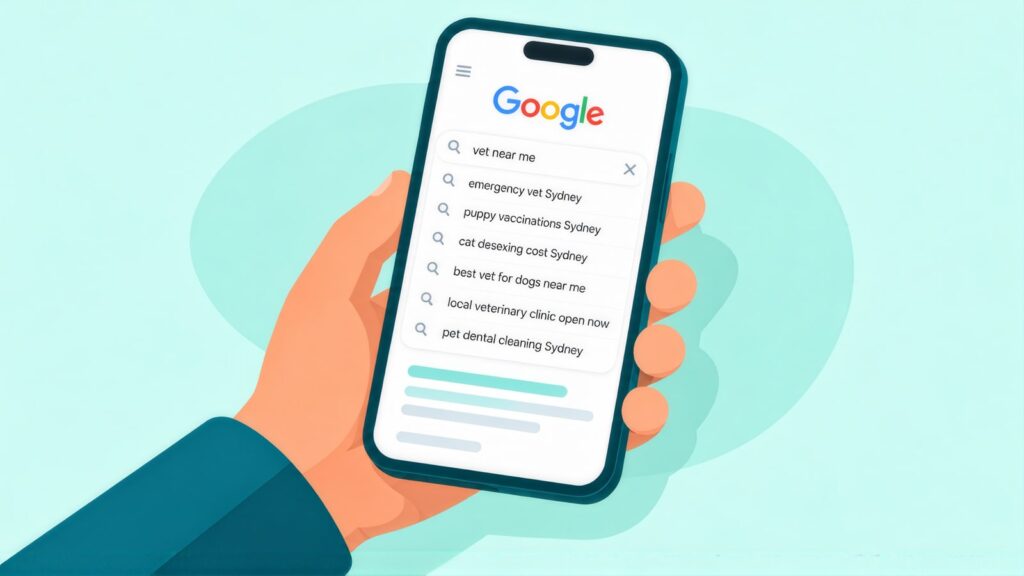
Vet searches fall into six groups, one urgent and five routine. General searches for a vet carry the most volume. Vet near me gets about 110,000 searches a month, against about 9,900 for emergency vet, according to CCM analysis of Google Keyword Planner data for Australia, 12 months to August 2026. Google groups close variants, so the vet near me figure includes vets near me.
Urgent: After Hours
emergency vet [suburb]
after hours vet near me
24 hour vet [city]
urgent vet [area]
Routine: Discovery
vet [suburb]
veterinarian near me
local vet [area]
veterinary clinic [suburb]
Routine: New Pet
puppy vet [suburb]
new puppy checkup [area]
kitten vaccinations [suburb]
first vet visit [area]
Routine: Services
pet desexing [suburb]
dog vaccinations [area]
pet dental [suburb]
microchipping near me
Routine: Species
cat vet [suburb]
rabbit vet [suburb]
bird vet [area]
exotic pet vet Sydney
Routine: Cost
vet costs [suburb]
pet insurance vet
how much does a vet cost
affordable vet [suburb]
Emergency Care Online: The After-Hours Page and Campaign
An owner with a sick animal at 11pm needs to know quickly whether a vet is on call or whether you refer to an emergency hospital. If you refer, they need that hospital’s name, phone number and address. Put those answers on a page of their own and in the homepage header. In the research above, emergency pages filled page one for emergency vet sydney, and one clinic’s emergencies page also ranked on general vet searches.
The page should cover four things:
- whether you provide after-hours care or refer
- the referral clinic’s name, address and phone number
- signs that an animal needs emergency care now
- your own number, shown clearly, for clinic hours.
Title it plainly, for example After-Hours Vet [Suburb] | Emergency Info (41 characters).
When to run an emergency campaign
Run an emergency campaign only for hours when someone can answer the phone. If you refer after hours, skip the campaign and rely on the after-hours page instead. If you do staff after hours, run searches such as emergency vet, after hours vet and 24 hour vet as their own Search campaign. Add a call button to the ads, schedule them strictly to your staffed hours and point them at the after-hours page.
Routine Care: New Pet, Service, Species and Specialist Pages
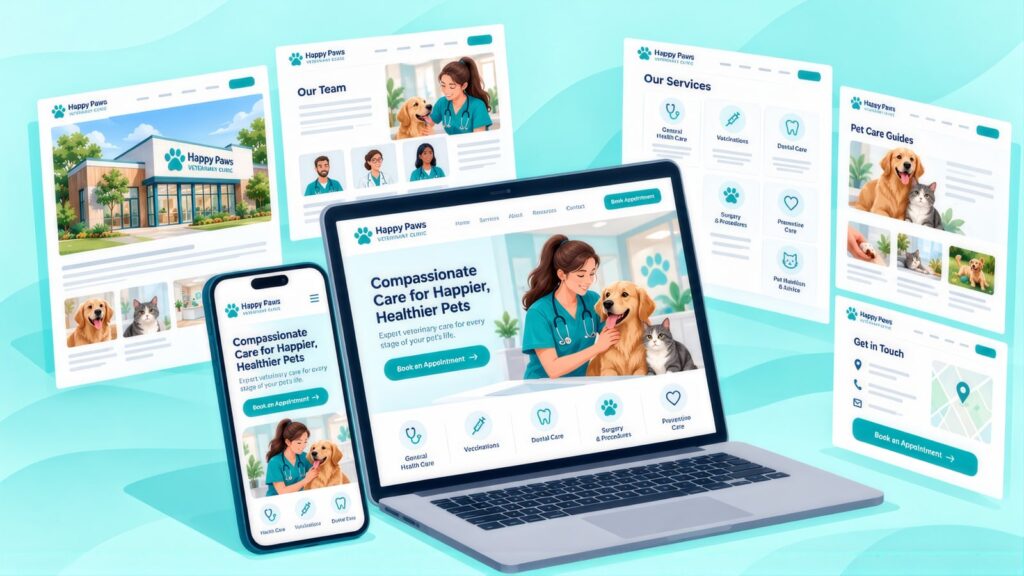
Routine searches carry most of the volume, as the Keyword Planner figures in Keyword Clusters Split by Urgency above show, and each type needs a page that answers it.
| Page | Focus keyword | What the page should include |
|---|---|---|
| Main vet page | vet | Services, team, fees, hours, where to go after hours, booking link |
| New pets | puppy vet | Vaccination schedule, when to desex, microchipping, the first visit, what to bring |
| Services | pet desexing | What the service involves, when you recommend it, cost range, booking |
| Species | rabbit vet | Which species you see, vets with that interest, equipment, booking |
| Specialist or referral services | veterinary dentistry [city] | Who provides it, their recognised qualifications, how referrals work |
| Fees and insurance | vet costs | Consultation fees, price ranges for procedures with caveats, payment options, insurance |
Species and referral pages reach owners a general page can miss. An owner of a rabbit, bird or reptile may travel further to find a clinic that sees their pet. Only use a specialist title where your state board recognises it.
Content owners search for
The articles that bring in clients answer a worry the owner has right now. Good topics include a puppy’s first-year vaccinations, when to desex, and signs your pet needs a vet today rather than next week. Heatstroke in dogs during a Sydney summer and what pet insurance really covers also work well. A named, registered vet at the practice should review clinical content, and each piece needs a date. Clinical posts promote a vet service, so the same conduct rules apply as to your ads.
Veterinary Board Rules and Trust Signals
Vets are not regulated by AHPRA, which covers human health professions only. Each state and territory registers vets through its own board. In NSW that is the Veterinary Practitioners Board of NSW. It works under the Veterinary Practice Act 2003 and its code of professional conduct, which bars conduct that misleads or deceives. The Australian Consumer Law applies on top. The ACCC’s rules on misleading claims cover prices, reviews and service claims.
| Obligation | What it means for vet practices |
|---|---|
| Genuine testimonials | Although AHPRA’s ban on clinical testimonials does not apply to vets, the reviews you feature must not mislead. Quote real clients without editing them to overstate results. Do not present one pet’s recovery (thank you for saving Biscuit’s life) as a promise to others. |
| Evidence-based claims | Claims about treatments, results or expertise need proper evidence. Do not claim specialist status unless your state board recognises the title. |
| Honest fee claims | A “first consultation free” offer must state its conditions. Only call a fee discounted if you really charged more before. |
| Accurate credentials | Show registration numbers and qualifications accurately. Do not imply postgraduate qualifications that are not held. |
Credentials shown this way also give owners proof they can check. Our guide to Google’s E-E-A-T guidance explains how Google describes experience and trust.
Local SEO for Vets: Map Pack, Citations and Links
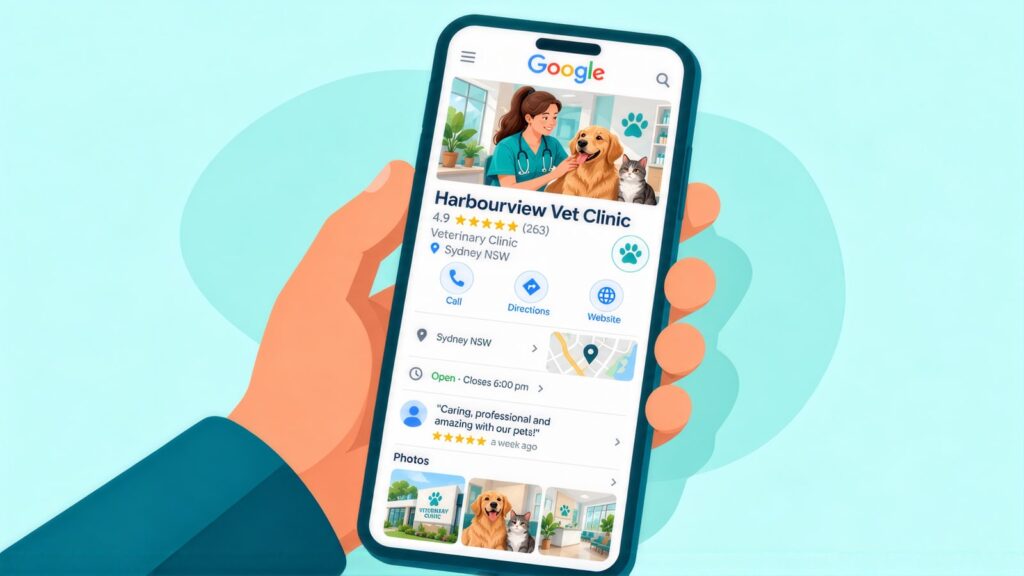
On local vet searches, Google often shows the Maps local pack, the group of three clinics shown with a map. Google says local results depend on relevance, distance and popularity. A complete profile, steady reviews and the same details everywhere your clinic is listed all help with those three factors.
| Field | What to do |
|---|---|
| Primary category | Choose Veterinarian rather than a general healthcare category. |
| Services | List every service: consultations, vaccinations, desexing, dental, surgery, exotic pets, and emergency if you really offer it. |
| Hours | Show accurate clinic hours and special public holiday hours. List after-hours cover only if you staff it. |
| Reviews | Send a neutral request after each visit and reply to every review. Never offer discounts in exchange for reviews. |
Citations and local links
A citation is any listing of your clinic’s name, address and phone number. Keep those details identical across your website, Google Business Profile, Apple Business Connect, Bing Places and pet directories. Pet insurers and vet associations also list clinics. Pet Insurance Australia, for example, runs the PIA vet directory, where owners search for vets and animal hospitals by location. If your clinic appears in a listing like that, check the details match too.
The best link sources are usually local. Good sources include groomers, trainers, boarding kennels, shelters and rescue groups you work with. Breed clubs, local council pet pages and community sponsorships also count. A few relevant links do more than many weak ones, which is the idea behind quality link building.
Competing with corporate groups
Where a group-owned clinic runs on a shared network template, an independent can stand out with detail. Show named vets with photos and interests, and build species and referral pages the group site lacks. Write local content about your suburb, and reply to reviews faster. If you run several clinics, give each one its own Google Business Profile. Each also needs its own location page with that clinic’s team and hours, and its own ad radius.
For vets, local SEO services centre on the map pack, the profile and the suburb pages, because Google weighs distance in local results.
We have no published vet case study yet. The closest is Woofers World, a Melbourne dog daycare, walking and grooming business that serves the same pet owners. SEO brought it “1,900+ monthly organic visitors“, and “Dog Walking Melbourne: jumped from around position 12 to position 7”. The Woofers World case study shows how.
Booking, Fees and Landing Pages
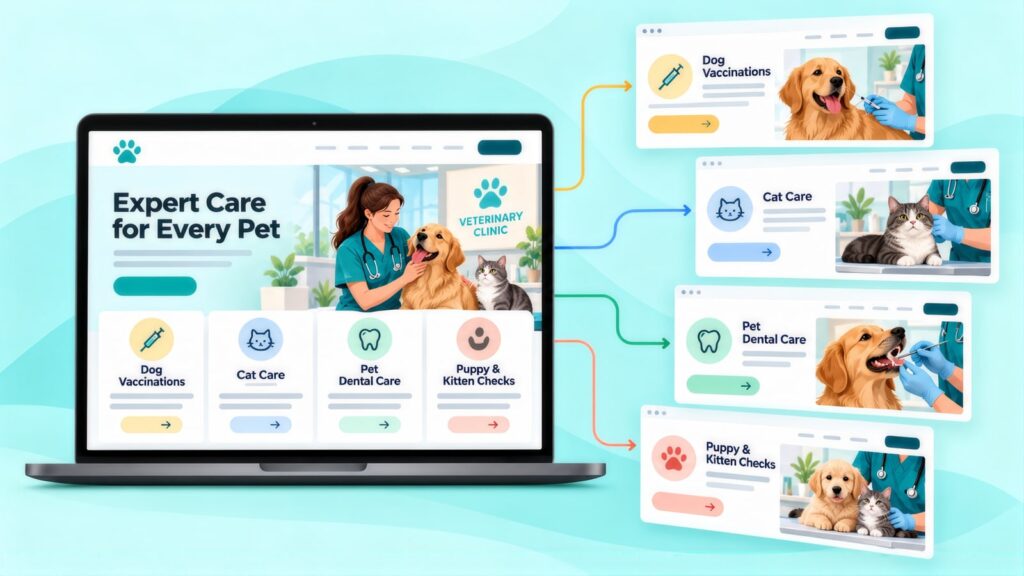
Most practice management systems for vets, such as PetYeti, Vetlink, Provet Cloud and ezyVet, offer online booking. Turn it on for routine appointments and put the button where people see it. Online booking lets an owner book a puppy vaccination at 9pm without waiting to phone the clinic. If your system’s booking is clunky, a custom booking system can sit in front of it.
Describe consultation fees, price ranges for common procedures and payment options accurately. A line such as “We accept most pet insurance” is fine, but only say “All pet insurance accepted” if every insurer is covered.
Each campaign should land on a purpose-built landing page. The page should:
- say you are taking new patients, and what the first visit involves
- put the booking button near the top
- explain where to go after hours, on the page itself
- give a guide to fees, such as the standard consultation fee
- name your vets, with their background and registration number.
Google Ads for Vets: Settings and Click Costs
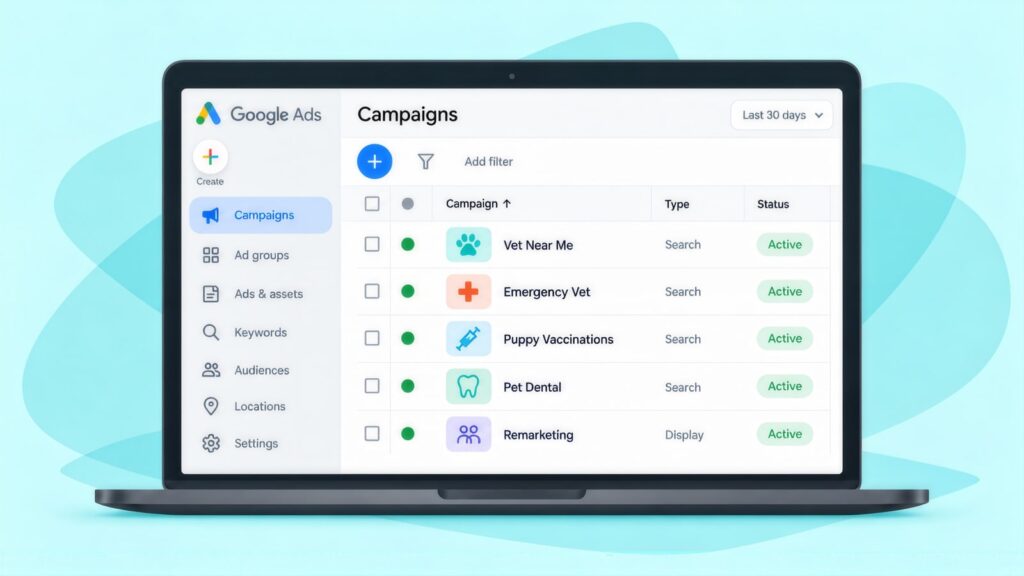
Routine searches from new clients, such as vet near me, vet and puppy vet, belong in their own campaign, separate from any emergency campaign. Show the ads to people within a short drive of the clinic, starting at around 5 kilometres and widening the radius if volume is thin. A suburbs lookup tool lists the suburbs inside that radius. Run routine ads in clinic hours, and set your own maximum cost per click (CPC) at first.
Most vet searches cost under $3.50 a click on average across Australia, so a modest budget buys a useful number of clicks.
| Keyword (Australia) | Monthly searches | Top-of-page bid range | Average CPC |
|---|---|---|---|
| vet near me | 110,000 | $1.36 to $4.90 | $2.65 |
| emergency vet | 9,900 | $1.29 to $4.18 | $3.44 |
| vet clinic | 4,400 | $1.49 to $5.05 | $2.49 |
| 24 hour vet | 3,600 | $1.17 to $3.93 | $3.16 |
| dog desexing | 1,300 | $0.79 to $3.79 | $2.98 |
| cat vaccination | 1,000 | $0.75 to $2.97 | $2.58 |
Source: CCM analysis of Google Keyword Planner data, Australia, 12 months to August 2026; Google’s average CPC is a past average and can sit above the top-of-page bid range. At about $3 a click, $500 a month buys roughly 160 clicks.
The click prices come from Google Keyword Planner. The booking rate is an illustrative assumption rather than a benchmark, with 1 in 10 clicks becoming a booking from a new client. Replace it with your own rate from call and booking tracking.
| Keyword | You pay per click | Clicks per new client | Each new client costs |
|---|---|---|---|
| vet near me | $2.65 | 10 | About $26.50 |
| 24 hour vet | $3.16 | 10 | About $31.60 |
| emergency vet | $3.44 | 10 | About $34.40 |
Compare that cost with what a new client spends in their first 12 months, which your practice management system can tell you. A client with several pets, coming back over several years, justifies more spend than a single visit suggests.
Before you scale, run through a Google Ads audit checklist. If you would rather hand the account over, look for Google Ads management that tracks new clients rather than just clicks.
Sydney Paws Petdoor installs pet doors and reaches the same owners as a vet clinic. It “has seen their organic website traffic grow by nearly 100% and their organic lead volume increase by over 400%“, along with “A 33% increase in traffic from paid search”. The Sydney Paws case study has the detail.
Keywords, Negatives and Ad Copy for Vet Clinics
Bid on searches that pair “vet” with a suburb or a service, and add negative keywords before launch. Negative keywords keep your ads away from the wrong searches, so use them to block job, course and pet supply searches.
- Include: “vet “, “veterinarian near me”, “puppy vet “, “emergency vet [area]” (emergency campaign only).
- Exclude: vet jobs, vet nursing course, vet school, vet supplies wholesale, pet food, pet shop, grooming (if you do not groom).
| Component | Example |
|---|---|
| Headline 1 | Vet [Suburb] |
| Headline 2 | Book Online Today |
| Headline 3 | New Patients Welcome |
| Headline 4 | Dogs, Cats and Small Pets |
| Description 1 | Vet clinic in taking new patients. Vaccinations, desexing and dental care. |
| Description 2 | Book online or call in clinic hours. After-hours referral details on our website. |
Keep after-hours claims to the hours you really cover, and only list species you actually see.
Site Structure: Titles, Schema and Internal Links
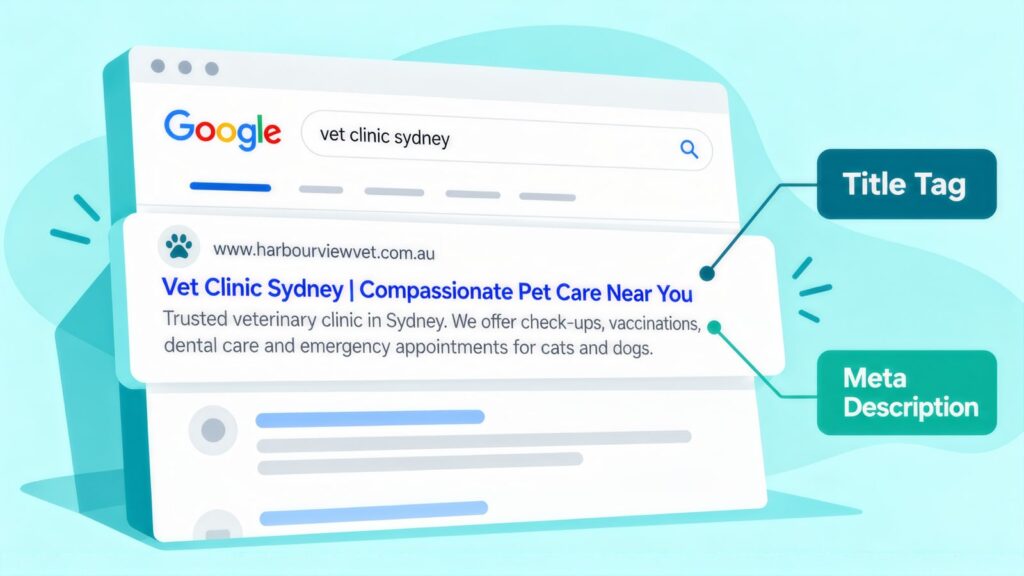
A title tag is the clickable headline Google shows for your page. Lead each one with the service and suburb, then a reason to click:
| Page | Example title tag | Characters |
|---|---|---|
| Main vet page | Local Vet Clinic [Suburb] | Book Online Today | 45 |
| New pets | Puppy and Kitten Vet [Suburb] | First Visit Guide | 49 |
| Vaccinations | Pet Vaccinations [Suburb] | Dogs, Cats and Rabbits | 50 |
| After hours | After-Hours Vet [Suburb] | Emergency Info | 41 |
A service and a suburb leave little room in a vet title, so add the clinic name only if the title still fits in 55 characters. Your clinic name usually shows with the listing already, so it is the first part to trim.
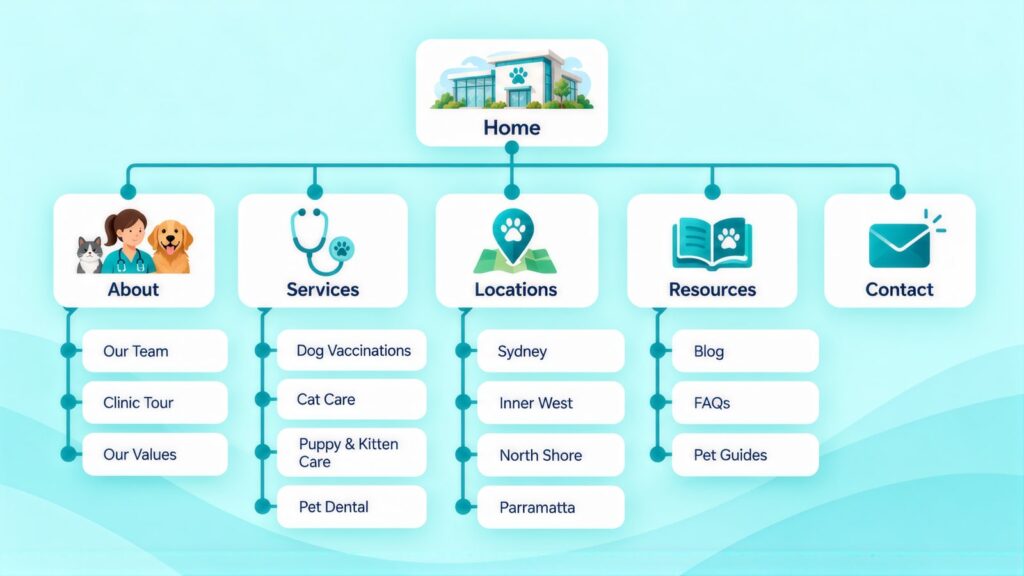
Schema.org has a type made for a vet’s office, VeterinaryCare, so use it in the page code to tell search engines this is a vet clinic. Add LocalBusiness as a second type, so you can mark up opening hours. Mark each vet as a Person, with hasCredential for their registration and worksFor pointing to the clinic. Do not use Physician, which describes a doctor’s practice, and add BreadcrumbList to pages below the homepage.
A pet care FAQ page can still carry FAQPage markup, so search engines and AI tools can match each question to its answer. The markup will not add a dropdown to your listing. Google confined FAQ rich results to government and health sites in August 2023 and stopped showing them from 7 May 2026.
Link your pages to each other with short, plain link text:
| Destination | Natural link text |
|---|---|
| After-hours page | “after-hours pet emergencies”, “our emergency referral arrangements”, “emergency vet contact” |
| Booking | “book a consultation”, “schedule your puppy’s first visit”, “book online” |
| Fees page | “consultation and procedure fees”, “pricing and payment options” |
Call and Booking Tracking: Enquiry to Registered Patient
The value of a vet client builds over years, so track each new client well past the first visit. Bookings come by phone as well as online, so call tracking is the first job:
- To count only real calls, use Google’s call conversion setup. It counts a call as a conversion (a result Google Ads reports) only when it lasts a minimum time you set. That filters out hang-ups and wrong numbers.
- Give Google Ads, your Google Business Profile and the website their own tracked numbers, so you can see which one brings calls.
- Filter out existing clients by asking “have you been to us before?” at the front desk or in the booking form. Only count new clients as conversions.
| Stage | What to record |
|---|---|
| Online booking or call received | Service type, new or existing client, source and date |
| First appointment completed | Pet type, service, fees and source |
| Still active at 90 days | Whether the client has rebooked or come back |
| Still active at 12 months | Whether the client is still with the clinic |
Never upload pet names, diagnoses, treatment histories or owner details to advertising platforms. Track conversions by type and date only. Owner details are personal information under the Australian Privacy Principles. Check your Google Analytics 4 (GA4) and Google Tag Manager setup too. A GA4 and Tag Manager check confirms nothing extra is leaking from your booking forms.
Six Months for a Sydney Vet Clinic
The six months below take emergency care first and routine care second, in line with the split earlier in this playbook.
Month 1: the emergency route
Publish the after-hours page and put the route in the homepage header. Make the phone number and booking button easy to see on every page. Set up call tracking with one number per source.
Month 2: the profile and booking
Complete the Google Business Profile with every service, accurate hours and recent photos. Turn on online booking and start a neutral review request after each visit. Fix directory listings that carry old details.
Month 3: routine care pages and ads
Build the new pet page and your two busiest service pages, with VeterinaryCare schema. Launch the routine campaign for new clients in your main suburbs. Check the search terms each week.
Month 4: species, team and links
Add species pages for the animals you see beyond cats and dogs, and team profiles with registration numbers. Ask local pet businesses and rescue groups you work with for a listing or link.
Month 5: the first numbers
Work out the cost per new registered patient for each source. Check which clients from months 2 and 3 are still active at 90 days. Decide whether an emergency campaign suits the after-hours cover you really have.
Month 6: adjust and plan the year
Shift budget toward the searches that bring clients who return. Publish two pet health articles a month, reviewed by a vet. Set a 12-month retention check, so the first group of new clients can be judged on lifetime value.
Vet Clinic SEO and Google Ads: Common Questions
How long does SEO for vets take?
A clinic’s own suburb usually responds first, especially for after-hours and species searches where few competitors have a proper page. With an established site and a steady flow of reviews, expect early movement in the map pack and on those pages within 3 to 4 months. Broader terms like vet plus a nearby suburb, and areas with several group-owned clinics, take more like 6 to 9 months. A new domain or a slow, outdated site adds time. Past 12 months, each new review, team profile and pet health article adds to the base. CCM’s agency vs in-house cost comparison, linked in the next answer, describes the same stages.
What does SEO cost for a vet clinic?
SEO cost for a vet clinic grows with the number of clinics and the range of care you promote. One clinic with a general page, a new pet page and an after-hours page is modest work. A group with several sites, exotic and referral services and a profile for each location needs much more. Having a vet review every clinical article adds time too. This SEO pricing comparison puts the market range at $1,500 to $10,000+ a month for an agency. Employing your own SEO costs $80,000 to $170,000+ a year once you include salary, tools and training. To see what extra registered patients would be worth, try the SEO ROI calculator.
How much do Google Ads cost for vets, and what budget should a clinic start with?
Most vet clicks cost under $3.50. CCM’s analysis of Google Keyword Planner data for Australia, 12 months to August 2026, shows average clicks of about $2.65 for vet near me and $3.44 for emergency vet. The term 24 hour vet averages about $3.16. A starting budget of around $500 a month buys well over a hundred clicks, enough to see which searches turn into bookings before you raise spend.
Do most new vet clients come from Google or from referrals?
Both matter, and the mix differs by clinic. Word of mouth and walk-ins also bring new clients. Search catches owners with no recommendation, such as people new to the area and first-time pet owners. Record the source of every new client, so you know your own split.
Can an independent vet clinic compete with corporate groups in local search?
Yes, because Google bases local results on relevance, distance and popularity rather than company size. An independent can win with a complete profile, steady reviews, named vets, species pages and local content that a template network site may lack.
Can vets use Google Local Services Ads in Australia?
Vets cannot use Local Services Ads in Australia at the moment. Google’s Local Services Ads help centre lists veterinarians as a category, but Australia was not among the supported countries as at October 2026. Clinics can use Search campaigns with a call button instead, backed by a fully completed Google Business Profile.
Do vets have to follow AHPRA advertising rules?
No, AHPRA covers human health professions only. Vets are registered by their state or territory board, such as the Veterinary Practitioners Board of NSW. The Australian Consumer Law applies to all their advertising.
Is SEO being replaced by AI?
Google says SEO best practices remain relevant for its AI features, so SEO is not being replaced. To appear as a supporting link in AI Overviews or AI Mode, a page must be indexed and eligible to show a snippet in Search, with no additional technical requirements. Clear service, after-hours and team pages with consistent details give a clinic pages that meet that bar.
Andrei Jach is Senior Manager, SEO and Analytics Specialist at Click Click Media in Sydney. He has led SEO across health, retail, professional services and manufacturing across more than 15 years in digital marketing and strategy, and oversees strategic SEO planning, analytics implementation and technical audits. He previously worked at Agent 6 Marketing and Red Propaganda.
Implement this playbook with AI
Opens your assistant with this playbook and seven questions about your business: services, area, website and ads. It then writes your keyword map, page plan and Google Ads starter build with your details filled in.
Copy the prompt for Gemini, Grok or any assistant that cannot open a prefilled link. The prompt points at this page, which is also served as Markdown to assistants that ask for it.
Work with Click Click Media
Our free audit for vet clinics covers your website, Google Ads account and Google Business Profile. We check the after-hours route, new pet pages and online booking first, because those decide whether a new owner registers with you.
Click Click Media has worked in search marketing since 2008 and brings Google Premier Partner status to the work. We have managed more than $115 million in Google Ads spend for Australian businesses. Clinic ads must meet your state veterinary board’s conduct rules and the Australian Consumer Law. For that reason we review your current website and live ads before any new campaign goes live.
There are no lock-in terms, so you can stop at any time. Your clinic gets a senior strategist who runs the account and reports straight to the practice owner or manager.
Verified Sources and References
- IBISWorld: Veterinary Services in Australia market size (2026)
- Animal Medicines Australia: Pets in Australia 2025
- EQT: EQT to acquire VetPartners (October 2023)
- Veterinary Practitioners Board of NSW
- ACCC: False or misleading claims
- OAIC: Australian Privacy Principles
- Pet Insurance Australia: PIA vet directory
- Google Business Profile Help: Improve your local ranking
- Google Ads Help: Tracking calls to a phone number on a website
- Schema.org: VeterinaryCare
- Google: Getting started with Local Services Ads (supported countries and categories)
- Google Search Central: AI features and your website
- Google Search Central: Removal of FAQ rich results (2026)
- CCM analysis of Google Keyword Planner data: Australian search volumes and CPCs, 12 months to August 2026
- CCM search captures (DataForSEO SERP API), Sydney, desktop and mobile, 3 September 2026
- CCM analysis of Semrush ad history, Australia, monthly snapshots September 2025 to August 2026
- Click Click Media: SEO cost comparison, agency vs in-house
- Click Click Media: SEO services
- Click Click Media: Google Ads management
Last checked October 2026 · next review January 2027
